

Clinical Evidence Brief· Evidence · Frontier
When the Algorithm Becomes Part of the Medicine: Moderna V940's Phase 3 Evidence and Its Limits
Merck and Moderna's Phase 3 trial INTerpath-001 met its recurrence-free survival (RFS) and distant metastasis-free survival (DMFS) endpoints, and the effect sizes came out on 22 October 2026. The therapy is still investigational and not approved; overall survival, replication in other cancers and individualized manufacturing remain open.
◐Company-reported detailed Phase 3 results (22 October 2026); the NEJM paper is accepted but not yet published
This work advances: Lets an algorithm help define the individualized medicine a patient receives
- MODELUnderstand / predict
- DECIDEChoose next
- INTERACTTest against reality
- UPDATEChange next round
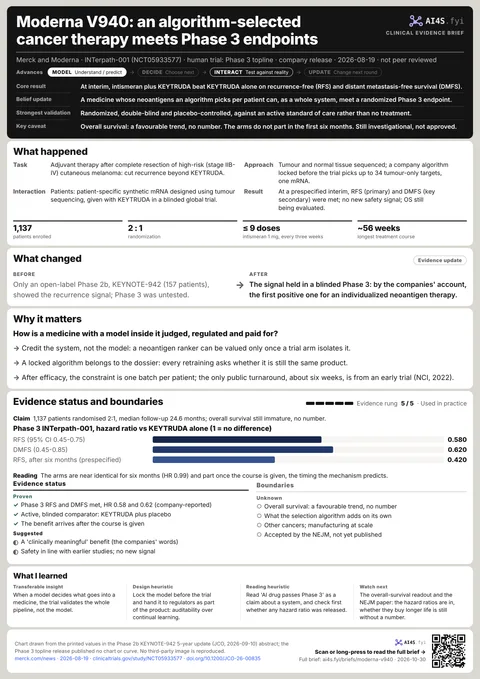
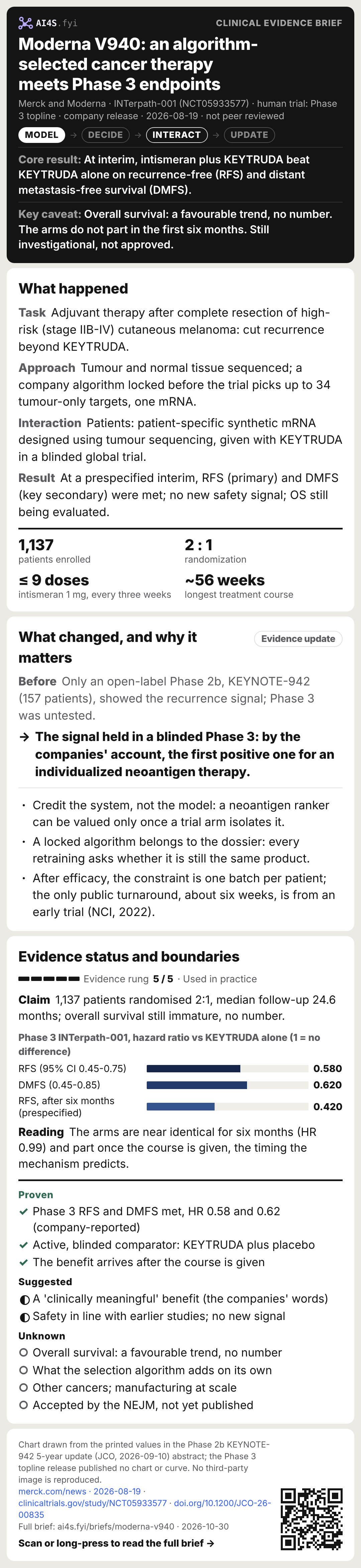
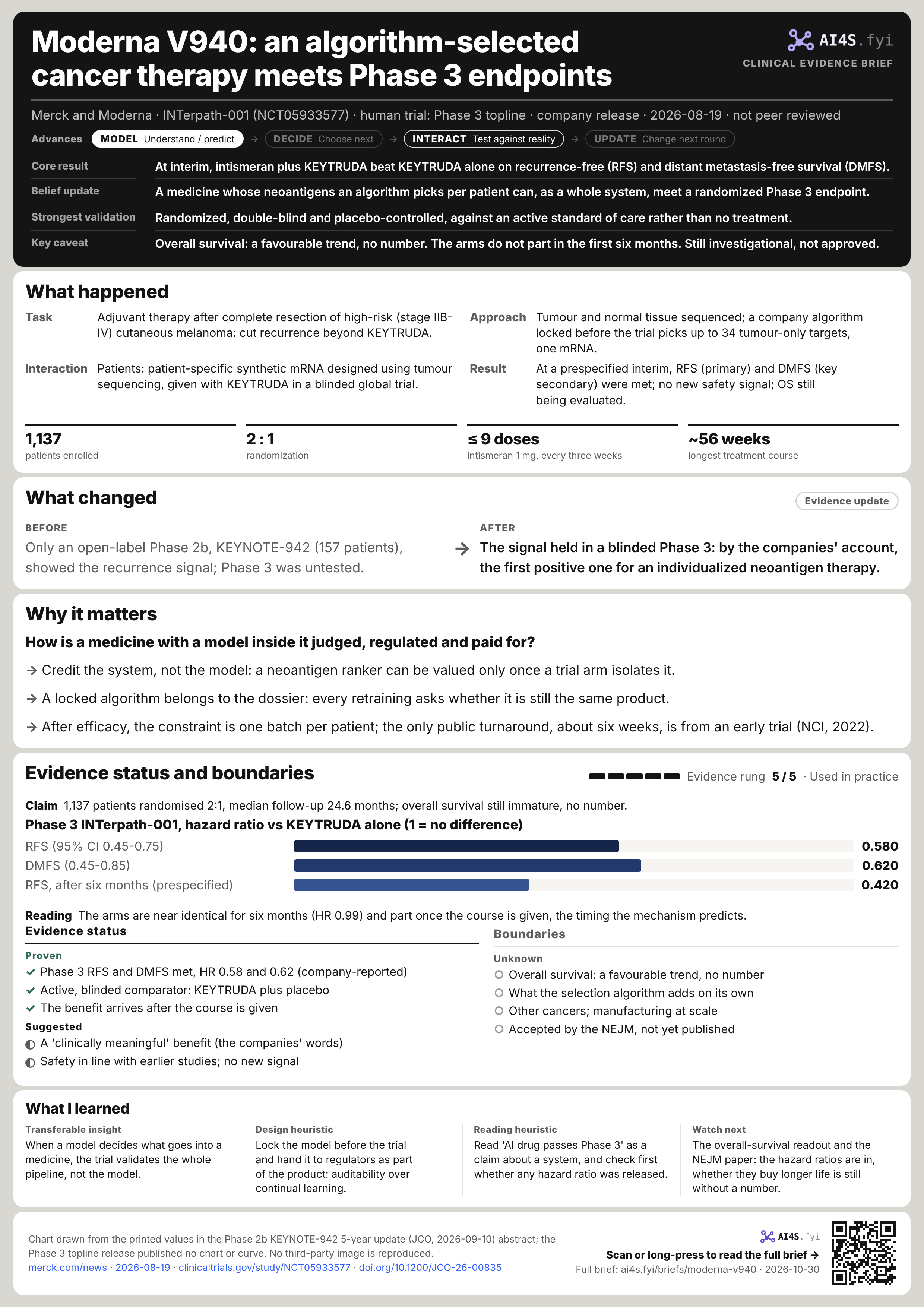
At interim, intismeran plus KEYTRUDA beat KEYTRUDA alone on recurrence-free (RFS) and distant metastasis-free survival (DMFS).
- Belief update
- A medicine whose neoantigens an algorithm picks per patient can, as a whole system, meet a randomized Phase 3 endpoint.
- Strongest validation
- Randomized, double-blind and placebo-controlled, against an active standard of care rather than no treatment.
- Key caveat
- Overall survival: a favourable trend, no number. The arms do not part in the first six months. Still investigational, not approved.
01What happened
- Task
- Adjuvant therapy after complete resection of high-risk (stage IIB-IV) cutaneous melanoma: cut recurrence beyond KEYTRUDA.
- Approach
- Tumour and normal tissue sequenced; a company algorithm locked before the trial picks up to 34 tumour-only targets, one mRNA.
- Interaction
- Patients: patient-specific synthetic mRNA designed using tumour sequencing, given with KEYTRUDA in a blinded global trial.
- Result
- At a prespecified interim, RFS (primary) and DMFS (key secondary) were met; no new safety signal; OS still being evaluated.
1,137patients enrolled
2 : 1randomization
≤ 9 dosesintismeran 1 mg, every three weeks
~56 weekslongest treatment course
A Phase 3 result, with the effect sizes now out
On August 19, 2026, Merck and Moderna reported positive topline results from INTerpath-001. This randomized global Phase 3 trial used double blinding together with placebo and active comparator controls. It enrolled 1,137 patients with cutaneous melanoma at stages IIB to IV whose tumors had been completely resected and who remained at high risk. Participants were randomized 2:1. The combination arm received intismeran 1 mg every three weeks for up to nine doses plus pembrolizumab 400 mg every six weeks for up to nine cycles; the control arm received placebo plus pembrolizumab, for up to approximately 56 weeks.[S1][S3]
At a prespecified interim analysis, the combination met the primary endpoint of recurrence free survival (RFS) and the key secondary endpoint of distant metastasis free survival (DMFS). The companies described both results as statistically significant and clinically meaningful, with no new safety signal.[S1]
[Evidence update, 22 October 2026] The detailed data is out. After a median 24.6 months, the risk of recurrence or death fell 42% (HR 0.58, 95% CI 0.45-0.75, two-sided p<0.001), with two-year recurrence-free survival at 82.2% (79.3-84.8) against 70.0% (65.0-74.5); the risk of distant metastasis or death fell 38% (HR 0.62, 0.45-0.85, p=0.002), with two-year DMFS at 88.5% (86.0-90.6) against 80.2% (75.6-84.0). Median RFS and DMFS were not reached in either arm. The arms do not part in the first six months: the prespecified sensitivity analysis after six months gives HR 0.42 (0.30-0.58), which matches the timing of a course of up to nine doses. Treatment-related adverse events ran 95.8% (723 of 755) against 90.0% (342 of 380), grade 3-5 at 14.2% (107) against 13.4% (51), most commonly pyrexia at 52.2%. Overall survival is still immature, reported as a favourable trend with no number; the paper has been accepted by the New England Journal of Medicine.[S1]
When the algorithm enters the definition of the medicine
Intismeran does not have the same composition for every patient. Tumor and normal samples are sequenced to identify mutations specific to the tumor. A proprietary algorithm ranks those mutations, predicts which may be recognized by the patient's immune system and selects up to 34 neoantigens. Those sequences are encoded into individualized synthetic mRNA, then enter manufacturing, quality release and delivery.[S4]
Moderna management previously said the algorithm was locked before the study to preserve interpretability and could not keep learning during the trial. The company also expected regulators to inspect the algorithm during review. This makes it more than a hidden research tool: it becomes part of the medicine's definition and regulatory evidence package.[S5]
The more precise interpretation is not that AI independently designed the drug. The algorithm helps determine which neoantigens the medicine encodes, as one component of a larger system spanning sequencing, mRNA engineering, manufacturing and clinical treatment.
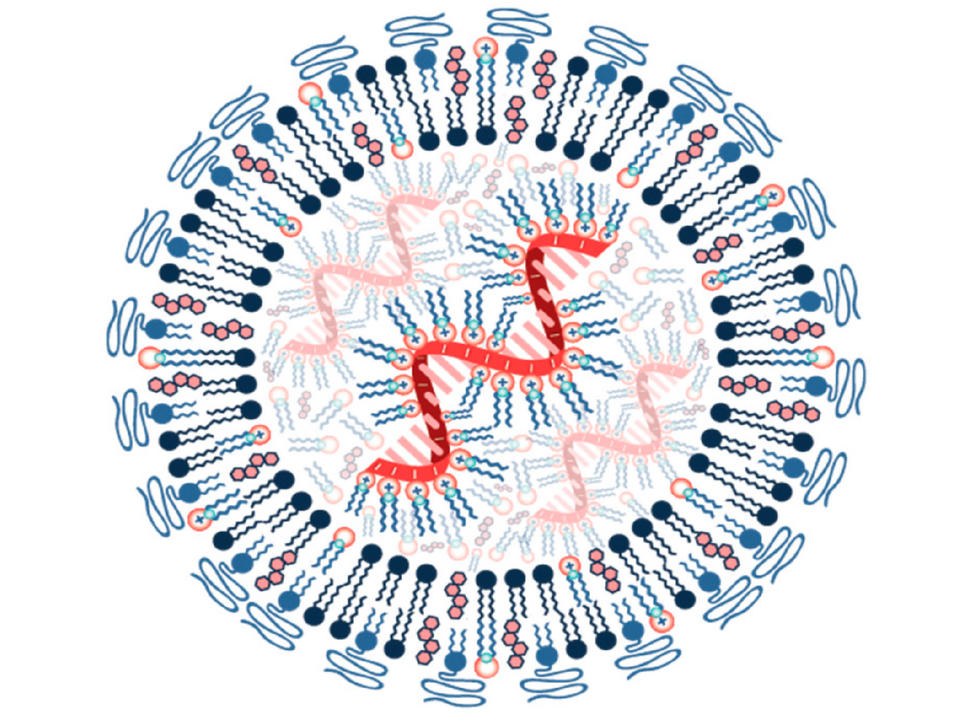
An NCI schematic of the delivery vehicle, not of any one patient's dose. What to read here is which part is constant and which is not: the lipid shell is the same for every patient, and what differs is the mRNA sequence inside: a sequence produced by an algorithm that picks neoantigens out of that patient's tumour sequencing. The physical form of the medicine is standardised; what is individualised is what it encodes. National Cancer Institute (a U.S. federal work, public domain). [S9]
02What changed
Evidence updateOnly an open-label Phase 2b, KEYNOTE-942 (157 patients), showed the recurrence signal; Phase 3 was untested.
The signal held in a blinded Phase 3: by the companies' account, the first positive one for an individualized neoantigen therapy.
Before
Phase 2b showed recurrence and distant-metastasis signals; Phase 3 replication remained unknown[S8]
Bottleneck
Randomized Phase 3 evidence in a larger population
What changed
INTerpath-001 met its topline RFS and DMFS endpoints[S1]
New bottleneck
Full effect size, overall survival and detailed safety data
What remains unsolved
Attribution to the algorithm, replication across cancers, and the scale and economics of individualized manufacturing
03Why it matters
How is a medicine with a model inside it judged, regulated and paid for?
- Credit the system, not the model: a neoantigen ranker can be valued only once a trial arm isolates it.
- A locked algorithm belongs to the dossier: every retraining asks whether it is still the same product.
- After efficacy, the constraint is one batch per patient; the only public turnaround, about six weeks, is from an early trial (NCI, 2022).
From biological constraints to real deployment
Tumor heterogeneity and immune escape remain mechanistic questions. Mutations found in one resected sample may not represent every residual clone, while recurrent tumors may alter antigen presentation or lose antigens. This does not negate the Phase 3 result, but it leaves open whether benefit is concentrated in particular mutational or immune subgroups and whether recurrent tumors develop new escape routes.
Individualized manufacturing creates another layer of constraint. Each patient requires sampling, paired sequencing of tumor and normal tissue, neoantigen selection, individualized mRNA synthesis, formulation, quality release and delivery. The only public turnaround comes from a 2022 National Cancer Institute explainer: in the early clinical study it described, Moderna made each personalized vaccine in about six weeks, and the same piece put production of a personalized mRNA cancer vaccine at one to two months after tissue collection in general. That is an early-trial figure, not a validated commercial supply time for the current product, and actual turnaround depends on sample, sequencing, manufacturing and release workflows.[S9]
The companies have not disclosed enough data to judge unit economics at commercial scale, batch failure rates, timely dosing or capacity. Evidence that one individualized batch can be produced is not yet evidence that the system can serve large populations reliably and economically. Success in melanoma also does not establish a platform that works across cancer types; lung, bladder and kidney cancers still require their own randomized evidence.[S1]
Safety should be read at the same pace. The topline announcement reported no new safety signal, but detailed Phase 3 safety data are not yet public. Results after five years of follow up from Phase 2b reported fatigue, pain at the injection site and chills as common events, while adverse events involving the immune system were similar between groups. The careful conclusion is only that prior data did not show a clear increase in these events. Larger data sets, longer follow up and monitoring after launch still matter.[S1][S6]
04Evidence status and boundaries
Evidence rung 5 / 5 · Used in practice · Field or production useEvidence status
Proven
- Phase 3 RFS and DMFS met, HR 0.58 and 0.62 (company-reported)
- Active, blinded comparator: KEYTRUDA plus placebo
- The benefit arrives after the course is given
Boundaries
Suggested
- A 'clinically meaningful' benefit (the companies' words)
- Safety in line with earlier studies; no new signal
Unknown
- Overall survival: a favourable trend, no number
- What the selection algorithm adds on its own
- Other cancers; manufacturing at scale
- Accepted by the NEJM, not yet published
Claim1,137 patients randomised 2:1, median follow-up 24.6 months; overall survival still immature, no number.
Phase 3 INTerpath-001, hazard ratio vs KEYTRUDA alone (1 = no difference)
ReadingThe arms are near identical for six months (HR 0.99) and part once the course is given, the timing the mechanism predicts.
INTerpath-001 marks an important transition: an algorithm is no longer only supporting research but helping determine the composition of the medicine each patient receives. The reported result supports a complete system of algorithmic selection, individualized manufacturing, mRNA therapy and KEYTRUDA in one clinical setting. It does not independently validate the algorithm, demonstrate a cure, establish an overall survival benefit, prove replication across cancer types or show that individualized manufacturing can scale economically.
The 5/5 rung on this page follows this site's ladder: the result has left the lab and been read out in a regulated randomized trial. It does not mean approval or routine use. Per the companies' release, intismeran is still an investigational therapy, and they plan to engage regulators on filings.[S1]
What a positive Phase 3 result actually demonstrates
The key evidence is not that an AI model was shown to predict accurately. It is that a complete chain spanning algorithmic selection, individualized manufacturing, mRNA delivery and immunotherapy produced measurable clinical benefit in patients with completely resected melanoma who remained at high risk, compared with a control arm receiving standard pembrolizumab treatment.[S1][S3]
That also defines the attribution boundary. The trial does not isolate how much benefit came from neoantigen selection, the mRNA platform, individualized manufacturing or their interaction with pembrolizumab. A positive Phase 3 trial for the system should not be restated as “the AI model passed Phase 3.”
This is not a preventive vaccine for healthy people but adjuvant treatment after cancer diagnosis and complete surgical resection. It evaluates the combination with pembrolizumab, not intismeran monotherapy, and it cannot be extrapolated to unresectable, visible or broadly metastatic disease. RFS and DMFS matter, but OS is not mature: Phase 3 positivity is not the same as curing cancer.[S1][S3]
Results after five years of follow up from the randomized Phase 2b KEYNOTE-942 study reported a 49% reduction in recurrence or death and a 59% reduction in distant metastasis or death versus pembrolizumab alone. Exploratory analysis of overall survival trended favorably, but confidence intervals were wide. Full Phase 3 results will show whether that signal replicates in a larger population and clarify absolute benefit, subgroup consistency and duration of benefit.[S6][S7][S8]
05What I learned
- Transferable insight
- When a model decides what goes into a medicine, the trial validates the whole pipeline, not the model.
- Design heuristic
- Lock the model before the trial and hand it to regulators as part of the product: auditability over continual learning.
- Reading heuristic
- Read 'AI drug passes Phase 3' as a claim about a system, and check first whether any hazard ratio was released.
- Watch next
- The overall-survival readout and the NEJM paper: the hazard ratios are in, whether they buy longer life is still without a number.
The algorithm is not a background tool
In V940, the model helps determine which neoantigens each patient's medicine encodes, placing it inside the product, manufacturing and regulatory chain. The Phase 3 trial evaluates that whole treatment system, not the algorithm in isolation.
The bottleneck keeps moving after clinical success
Meeting RFS and DMFS endpoints moves uncertainty to the next layer: full effect size, OS, replication across cancers, the time and scale of individualized manufacturing (the only public figure is about six weeks in an early trial) and whether patients and payers can support it.[S9]
The next important evidence is not another celebratory headline but full Phase 3 effect sizes, absolute benefit, confidence intervals and safety data, followed by OS, subgroup consistency, the independent contribution of the selection algorithm and replication in other tumors. Manufacturing turnaround, batch success, commercial capacity, pricing and reimbursement will then determine whether clinical success becomes access in practice. The regulatory path for future algorithm updates is another unresolved question.
On September 21, 2026, Moderna announced that the INTerpath-001 Phase 3 data will be presented as LBA1 in the Presidential Symposium at the ESMO Congress 2026 (October 24, Madrid, presented by Georgina V. Long). That is the first chance to see hazard ratios and full safety data.[S10]
The current view would strengthen if full data show clinically meaningful absolute benefit and stable confidence intervals, OS later improves, randomized trials replicate in other tumors and reproducible manufacturing turnaround and batch success become public. It would weaken if RFS benefit is small or confined to a narrow subgroup, OS fails to improve, other tumors do not replicate or manufacturing delay, failure and cost restrict access.
This is a meaningful clinical milestone: an individualized medicine shaped by an algorithm has moved from a computational workflow to positive endpoints in a large randomized Phase 3 trial.
The narrower and more defensible conclusion is that INTerpath-001 provides positive topline evidence for an individualized treatment system guided by an algorithm. It does not yet establish a cancer cure or prove that the system can be replicated across tumors and deployed at commercial scale.
Note: the market reaction
Moderna shares closed approximately 177% higher on August 19 after the announcement. The move reflects rapid repricing of regulatory, platform and commercial expectations, but it cannot answer questions about effect size, overall survival, manufacturing capacity or reimbursement. It belongs in the market timeline, not the clinical evidence ledger.[S11][S12]
As one imageTo save and share→Sources
Factual claims link to original announcements, project lists, trial records or journal papers where possible. Research plans are kept separate from completed results.
- S1INTerpath-001 Phase 3 topline announcementMerck × Moderna · 2026.08.19 · Company release
- S2INTerpath-001 Phase 3 detailed RFS and DMFS resultsMerck × Moderna · 2026.10.22 · Company release
- S3INTerpath-001 / NCT05933577 trial recordClinicalTrials.gov · 2026 · Trial registry
- S4Advancing the fight against cancer with mRNA and AIModerna · 2023.12.21 · Company technical blog
- S5Expected FDA review of the locked neoantigen selection algorithmFierce Biotech · 2024.02.21 · Industry interview
- S6Results after five years of follow up from KEYNOTE-942Merck × Moderna · 2026.06.03 · Company conference data
- S75-year update of the randomized Phase IIb KEYNOTE-942 studyJournal of Clinical Oncology · Khattak et al. · 2026.09.10 · Journal paper
- S8Randomized Phase 2b KEYNOTE-942 study in The LancetThe Lancet · 2024.01.18 · Journal paper
- S9Manufacturing individualized mRNA cancer vaccinesNational Cancer Institute · 2022.12.13 · Government research explainer
- S10Moderna announces late-breaking data to be presented at ESMO Congress 2026Moderna · ACCESS Newswire · 2026.09.21 · Company release
- S11Intraday market reaction after the Phase 3 resultAssociated Press · 2026.08.19 · Market reporting
- S12Moderna historical price on August 19, 2026Yahoo Finance / Refinitiv · 2026.08.19 · Market data