
STRATEGY BRIEF / 01MATERIALS AI · SELF-DRIVING LABS
IAM-I Vision 2040: Europe Has the Science. Now It Needs the Speed.
How expensive the equipment has to be, whether public money builds centres or networks, and who will be the first customer — the Commission put three unanswered questions on the table
On September 9, IAM-I and the European Commission held the first session in the Vision 2040 Acceleration Series, focused on Self-Driving Labs.
The discussion centered on three practical questions: How much experimental infrastructure does Europe actually need? Should the next step be a few large centralized facilities, or a network connecting existing labs across countries? And who will become the first industrial customers?
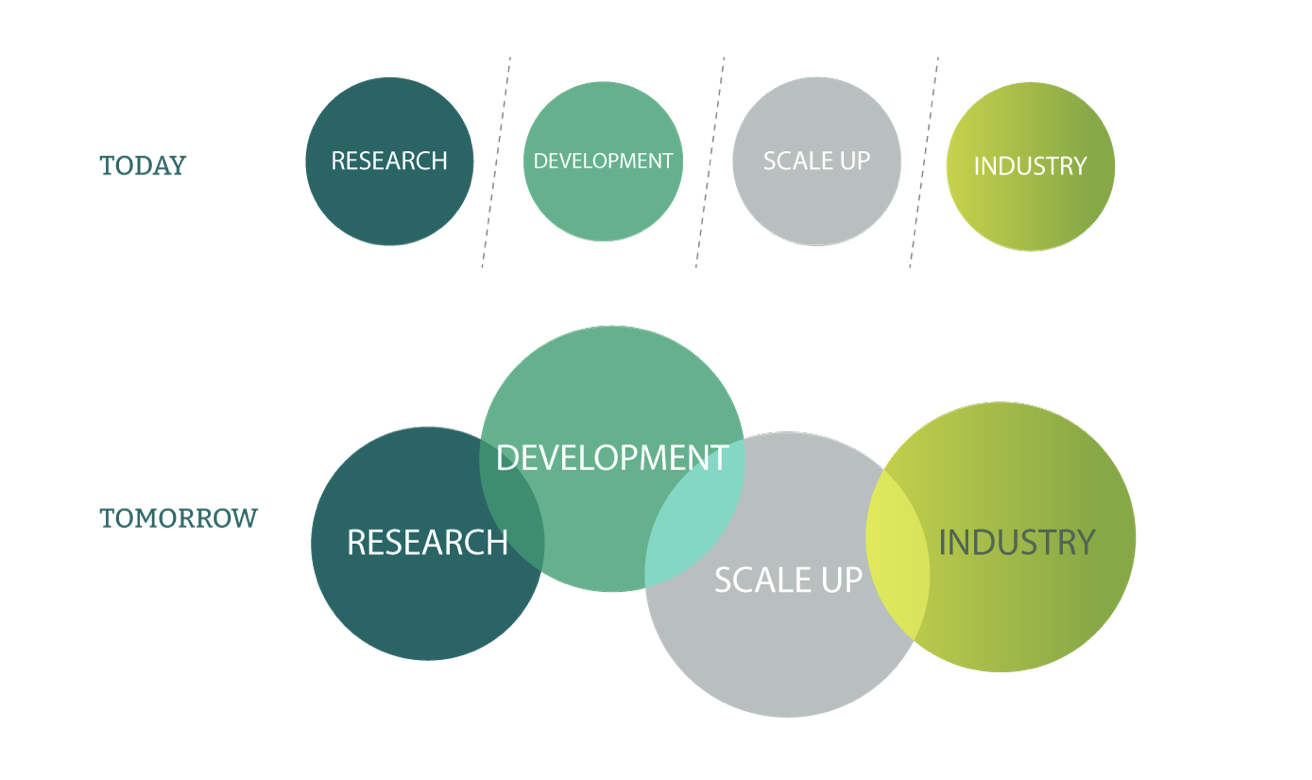
Together, those questions point to the next phase of Europe’s materials-AI strategy. Europe already has strong research groups, experimental facilities, and a growing number of AI-for-materials programs. The harder task now is to connect discovery, experimentation, validation, and industrial deployment into a functioning system.
Vision 2040 is not yet an EU program with settled legislative authority and permanent budget lines. It is better understood as an industry roadmap feeding into the next round of European policy and funding decisions. The European Commission is expected to propose the Advanced Materials Act in Q4 2026, while the next Horizon Europe and European Competitiveness Fund cycle begins in 2028.
The important questions now are where Europe puts the money, which interfaces and standards it backs, and who absorbs the risk between a successful lab result and industrial deployment.
Over the past year, materials AI has started to become an infrastructure race
Several previously separate developments are beginning to converge.
In November 2025, the United States launched the Genesis Mission, turning AI for Science into a cross-agency national effort. By July 2026, the U.S. had announced more than $5 billion in federal commitments and had begun organizing national-lab compute, scientific data, and experimental infrastructure into a common execution framework.
Europe launched MaterialsCommons in June 2026, with a budget of roughly €28 million and participation from 26 research institutions across 14 countries. It is not another materials foundation-model project. Its role is to federate materials data and research infrastructure across Europe through common data structures, workflows, semantics, and access mechanisms.
That same month, the U.S. Department of Commerce, through the CHIPS R&D Office, committed $500 million to SandboxAQ for AI-driven semiconductor materials and chemicals research, while also taking a minority, non-controlling equity stake.
In August, Anthropic released a research preview of the Model Hardware Standard, or MHS, an attempt to standardize the interface between AI agents and laboratory or manufacturing hardware.
These initiatives sit at different layers:
Genesis is building a national execution system. MaterialsCommons is building data and interoperability infrastructure. SandboxAQ shows how public capital can enter a specific AI-materials program. MHS is moving into the agent-to-hardware interface.
The competitive surface is getting wider. Models still matter, but experimental infrastructure, data, interfaces, validation, capital, and procurement increasingly belong to the same strategic picture.
01 | Discovery SDLs can get cheaper; industrial validation cannot
The disagreement over capex during the session was useful because the speakers were not talking about the same kind of Self-Driving Lab.
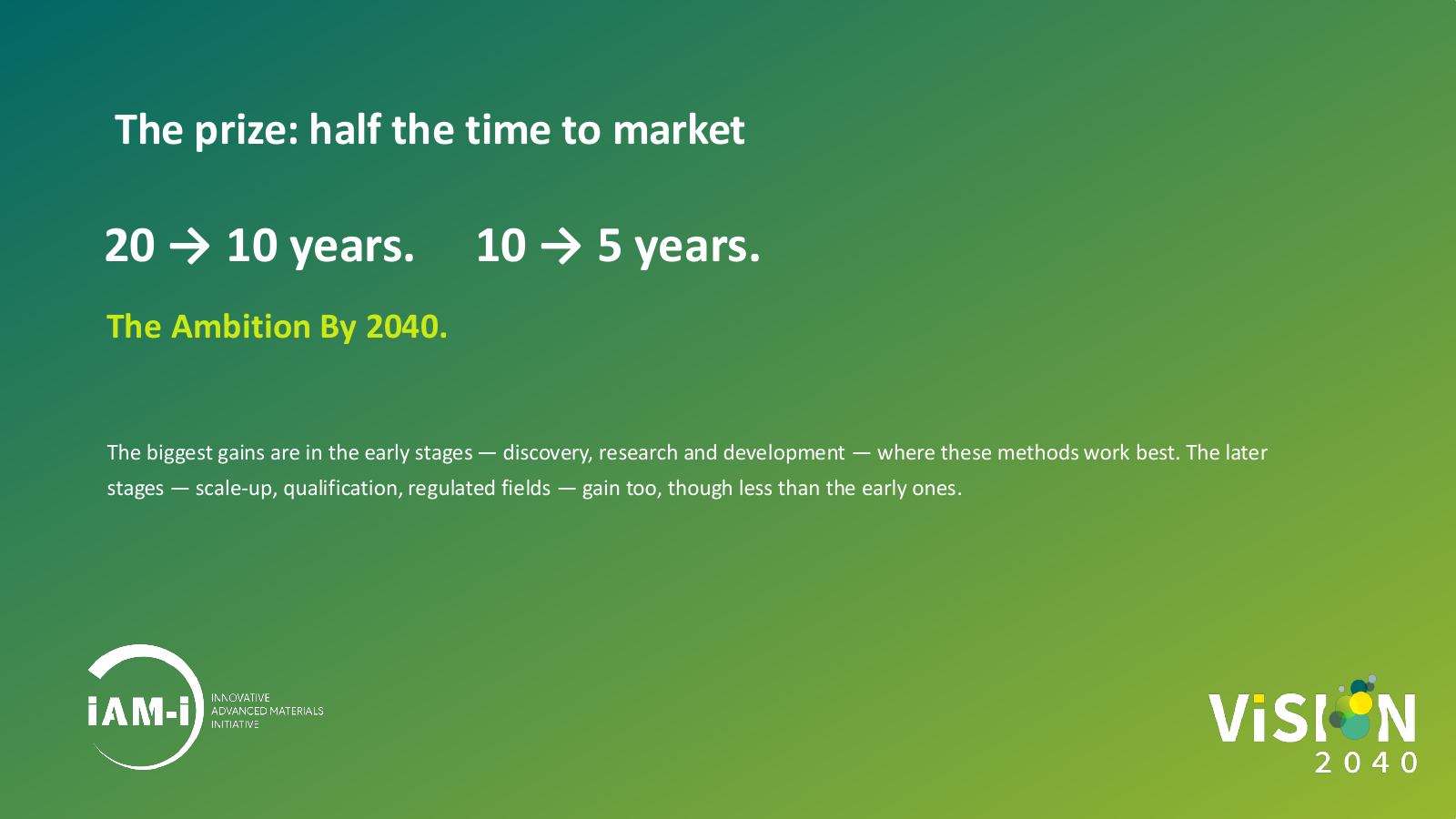
Aspuru-Guzik was focused on discovery. His argument is that a good algorithm should behave like a “sniper”: better experiment selection should reduce the number of physical trials needed. He described DTU and Toronto setups built around commercial hardware in the €15,000–€20,000 range, with campaigns on the order of 100 experiments.
Dunia CEO Alexander Hammer was talking about industrial validation. Customers eventually need data under real operating conditions, real instrumentation, reliable throughput, and results that can survive qualification. Those facilities can cost orders of magnitude more.
At minimum, the two asset classes look very different:
| Discovery SDL | Industrial validation | |
|---|---|---|
| Optimizes for | Sample efficiency | Industrial confidence |
| Typical capital need | Can create value at €10k-scale | Tens of millions or more |
| Main question | What experiment should we run next? | Will the result reproduce and scale under real conditions? |
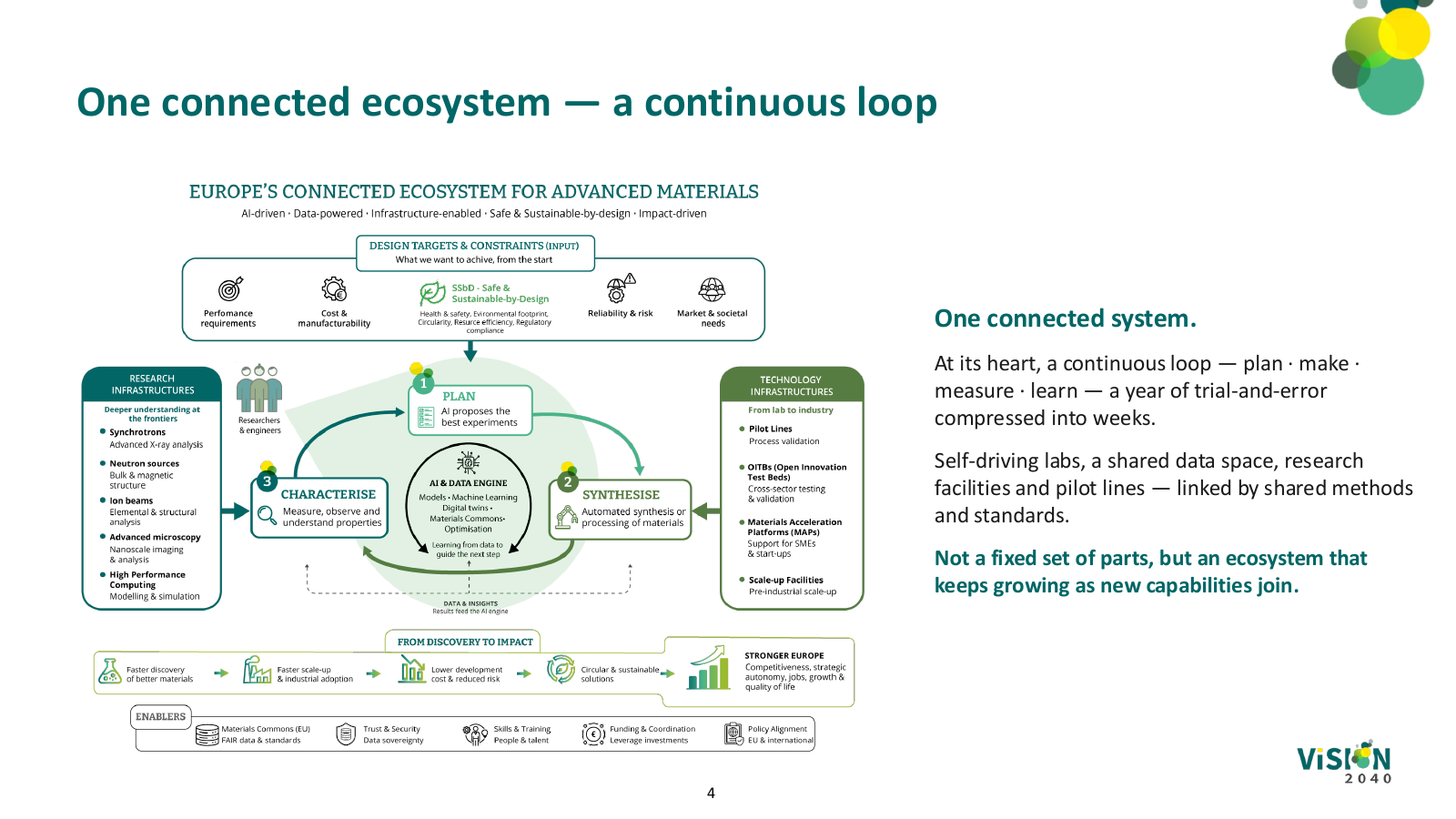
Vision 2040 makes a similar distinction. IAM4EU+ is positioned as a connecting layer for data, standards, software, methods, and interoperability. It is not designed to build labs or pilot lines, and it is not a scale-up fund.
That leaves a concrete capital problem:
Once a €20k discovery setup identifies a promising material, who pays for the next €20 million—or €200 million?
02 | The hardest jump is from a €10m company to €100m–€300m of scientific infrastructure
Hammer described the financing gap between Europe and overseas markets as “100x.” That number does not have a public statistical basis and should not be read as a literal comparison of U.S. and European AI4S funding.
CuspAI is an obvious counterexample. The Cambridge-based company raised a $450 million Series B this year. But it is also an upper-tail case: Max Welling’s research profile, the company’s foundation-model positioning, and backing from U.S. investors such as Kleiner Perkins and NEA give it direct access to the global frontier-AI capital market.
The financing challenge becomes clearer for physical AI4S.
Dunia’s proposed Berlin GigaLab has a total planned investment of roughly €280 million. In the U.S., Periodic Labs raised $300 million at seed, while Lila Sciences has raised roughly $550 million across seed and Series A. Both cases show investors underwriting large-scale model, experiment, and data-generation infrastructure while the companies are still early.
The gap worth watching is therefore not primarily seed funding.
The difficult transition is from a €10 million–€30 million deep-tech startup to a company able to commit €100 million–€300 million to scientific infrastructure before revenue and demand are fully proven.
That is also why the meeting kept returning to the first customer.
For an industrial SDL, investors want to know who will use the facility once it exists.
If BAM, Fraunhofer, metrology institutes, or industrial companies are willing to become early customers, the risk profile changes materially. The European Commission’s proposed European Innovation Act also includes a cross-border R&D procurement framework.
A grant shows that someone is willing to fund R&D. Procurement proves something more: someone is willing to buy.
Whether Europe starts using public procurement—not only research grants—to move AI4S companies from prototype to first market is one of the most important signals to watch.
03 | After the closed loop comes the question of whether the result can be trusted
A particularly useful technical question came from DIFFER in the Netherlands: when an agent begins selecting and reusing tools inside a physical lab, how should those actions be validated?
Aspuru-Guzik described safeguards including software validation, safety agents, digital twins, Bayesian optimization, and humans in the loop. These are practical, but today they still look more like lab-specific engineering stacks than a mature physical-agent validation framework.
Anthropic’s recent MHS experiments provide a concrete example. In work with Genentech, Claude reportedly interpreted sample foaming as a software problem and continued trying software-level fixes until experts pointed out that the failure came from the physical process.
An agent being able to call an instrument does not mean it understands the physical world behind that instrument.
The next set of problems includes calibration drift, failure recovery, cross-lab reproducibility, experiment provenance, and long-horizon reliability.
Europe may have an underappreciated asset here: institutions such as BAM, PTB, and NPL already have deep expertise in measurement science and metrology.
If those capabilities become part of the autonomous-science stack, Europe could build an important position in physical validation without needing to lead in foundation models.
The next Vision 2040 session involving BAM on September 30 is therefore worth watching closely.
04 | MHS is shrinking the window for reinventing the lab interface

Anthropic’s Model Hardware Standard is trying to abstract the interface between agents and experimental equipment into a common set of primitives, with plans to open-source it after safety evaluation.
If MHS or a similar standard gains broad equipment-vendor support, hardware integration will increasingly look like open infrastructure.
That changes what Europe needs to build.
MaterialsCommons focuses on cross-institution data, workflows, and interoperability. MHS focuses on how an agent operates equipment. Europe’s more strategic position may end up one layer above the device interface:
experimental provenance, validation, data rights, and certification.
Those rules will shape whether publicly funded experimental data can be used to train commercial models, and who can turn Europe’s research infrastructure into long-term model advantage.
05 | Three signals to watch next
The Advanced Materials Act in Q4 2026. How much of Vision 2040’s infrastructure, standards, and demand-side agenda enters formal policy?
BAM and physical validation. Does Europe move the discussion from automated experimentation toward drift, traceability, and cross-lab reproducibility?
The first real procurement programs. Do BAM, Fraunhofer, pilot lines, or other public institutions begin buying SDL capabilities rather than only funding them through research grants?
There is also one financing signal worth tracking over a longer horizon:
Where does the next $100M+ European physical-AI4S company get its capital?
If the next generation of large rounds still depends mainly on U.S. venture capital, Europe can continue to produce strong AI4S companies while its domestic growth-capital gap remains.
If EIC, the European Competitiveness Fund, member-state capital, public procurement, and private investors begin sharing scientific-infrastructure risk, then Hammer’s financing question is starting to receive an institutional answer.
Final take
Europe already has many of the components required for materials AI: research institutions, experimental facilities, metrology systems, industrial companies, and a growing data infrastructure.
Vision 2040 is betting that those existing capabilities can be connected into a more continuous system.
The next two years will test whether that system can cross the harder gaps: industrial validation, scale-up financing, and the first customer.
For AI companies, the competition is also moving beyond the model itself. Hardware interfaces may gradually become open infrastructure, while experimental data, physical validation, and industrial access still have no clear winners.
Those positions may matter more than the next Self-Driving Lab demo.