RL with Verifiable Rewards, but the Verifier is a Lab
Human text is nearly exhausted: how can AI learn from new, real-world experiments?
Why I recommend it
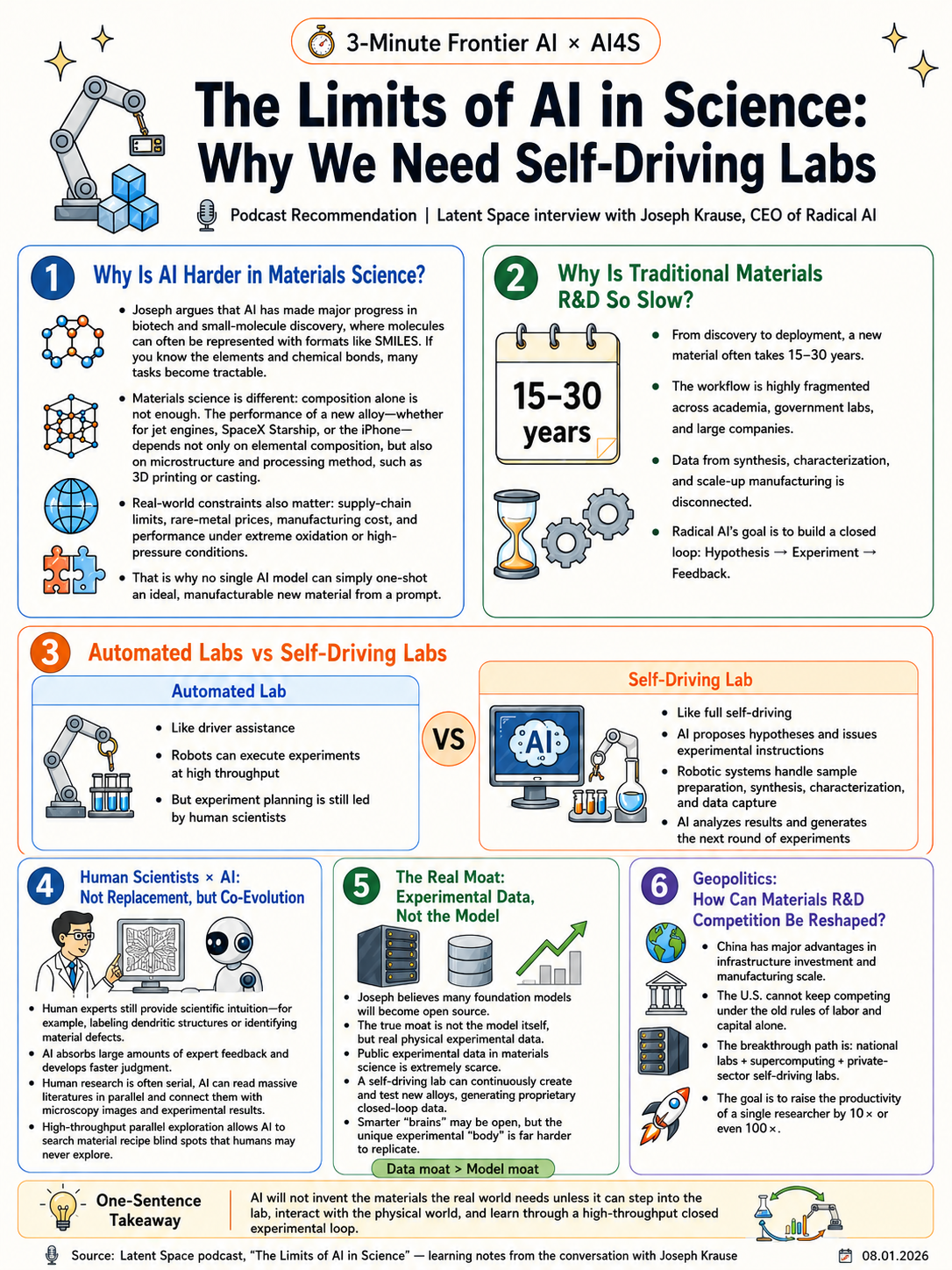
A Latent Space interview with Lila Sciences CTO Andy Beam and co-founder Rafael Gómez-Bombarelli, Chief Scientific Officer for Physical Sciences on using real physical laboratories as reinforcement-learning verifiers to address AI for Science's shortage of high-quality data.
- Scientific data scarcity and a new scaling law:Large language models have consumed much of the internet's human text, what Andy calls AI's fossil fuel. In biomedicine and materials science, high-quality real-world data is far scarcer, so Lila treats experimental data generation as a new scaling dimension.
- An AI science factory:Lila positions itself neither as a traditional biotech nor merely a lab-automation company. Its goal is a model-controlled experimental platform whose instruments share a physical transport layer analogous to a computer's PCI bus, including 96-well plates moving on magnetic tracks.
- Closed-loop RL: nature as the verifier:Code and mathematics offer clear verification rules. For scientific discovery, high-throughput physical experiment results can become the reward signal: AI proposes a hypothesis, writes experimental code, the lab executes it, and both successes and failures feed back into the model.
- General scientific reasoning across domains:Rather than building a separate vertical model for protein folding or battery materials, Lila says it has assembled roughly ten trillion experimentally verified reasoning tokens across biology, chemistry and materials for foundation-model post-training; the scale and transfer gains remain company-reported.
Reinforcement learningScientific dataSelf-driving labs
Read Source Notes →