
Paper & Experimental Validation· Evidence · Frontier
Machine-Learning-Designed HEA05 Reaches 1.75 GPa Yield Strength with 25% Uniform Elongation
The result is more than a stronger alloy. Materials knowledge narrowed the search space, then active learning chose the next experiments so a scarce validation budget could be spent on more informative candidates.
●Peer-reviewed paper + experimental validation
Current boundary:Room-temperature tensile behavior and deformation mechanisms are well characterized; long-term high-temperature stability, fatigue, fracture, scale-up and cost remain unresolved
This work advances:Chooses the next expensive experiment to run
- MODELUnderstand / predict
- DECIDEChoose next
- INTERACTAct / measure
- UPDATEChange next round
HEA05 is a fabricated and validated alloy, not merely a model prediction
In June 2025, a Xi'an Jiaotong University team reported the multi-principal-element alloy Fe₃₅Ni₂₉Co₂₁Al₁₂Ta₃, called HEA05, in Nature. The team fabricated, rolled and heat-treated the alloy, then performed room-temperature tensile testing and multiscale microstructural characterization.[S1]
After a representative one-hour ageing treatment at 750 °C, HEA05 reached a yield strength of 1,750 ± 50 MPa, an ultimate tensile strength of 2,403 ± 46 MPa and a uniform elongation of 25 ± 1.5%. True stress approached 3 GPa before fracture, while the work-hardening rate remained above 2 GPa across a large strain range.[S1]
Bulk metals near 2 GPa rarely retain large uniform plasticity. In some ultra-high-strength steels, nominal elongation includes localized deformation from Lüders or Portevin–Le Châtelier bands, while conventional precipitation-strengthened high- and medium-entropy alloys usually remain below roughly 1.2 GPa in yield strength. HEA05 deforms smoothly, and the same composition can be processed to span combinations from 1.5 GPa with 31% uniform elongation to 1.95 GPa with 15%.[S1]
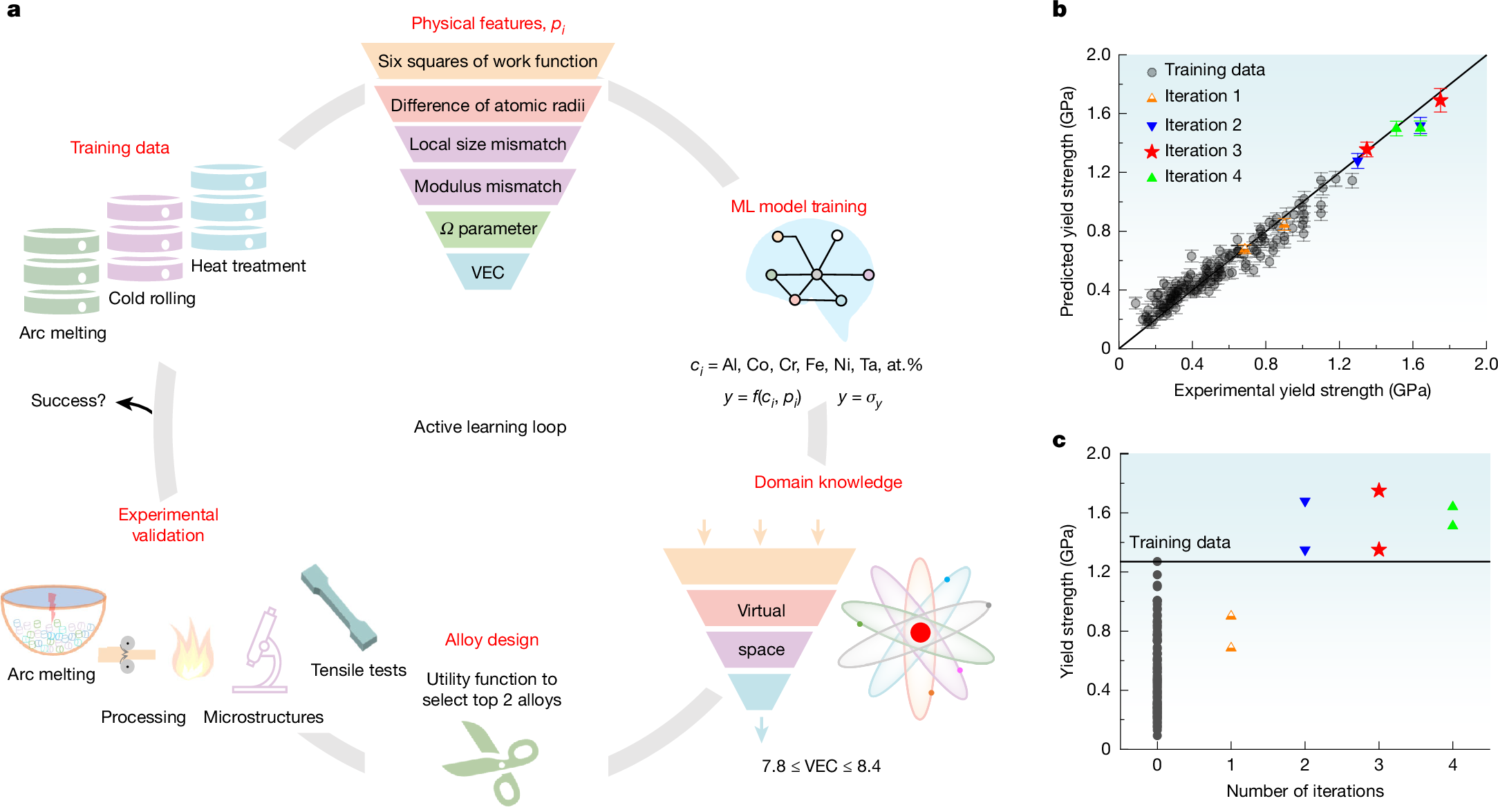
Paper Fig. 1: materials knowledge narrows the candidate space before active learning selects alloys across four rounds and eight new experiments, returning each measurement to the model. Image from the paper. [S1]
Domain knowledge narrows the space before active learning chooses the next experiments
The model did not invent an alloy from the entire periodic table
The paper estimates a potential multi-component alloy space of roughly 10⁴⁹ variants. Instead of handing that space to a black box, the team selected an FeNiCo FCC matrix and added Al and Ta, aiming for solid-solution strengthening, a high volume fraction of coherent L1₂ nanoprecipitates and a controlled amount of deformable B2 phase.[S1]
Active learning began with data from 140 FCC AlCoCrFeNiTa high-entropy alloys. The researchers retained six of twenty candidate physical features and filtered virtual compositions with constraints including 7.8 ≤ VEC ≤ 8.4. Each round proposed two candidates for fabrication, processing and testing before the measurements returned to the training set. Across four rounds, eight new alloys were tested, six improved yield strength, and HEA05 appeared in round three.[S1][S2]
That boundary matters. The model primarily searched chemical composition with an emphasis on yield strength. It did not directly predict “1.75 GPa plus 25%,” nor did it autonomously produce the final three-phase microstructure. Rolling, recrystallization and ageing were still designed by researchers. The more accurate sequence is: domain knowledge narrows the space, the model selects compositions, experiments return data, and microstructure engineering produces the final properties.[S1]
The L1₂ + B2 dual-precipitate structure carries the performance
Representative HEA05 contains an FCC matrix with an average grain size of about 7.6 μm and two precipitate populations: coherent L1₂ nanoprecipitates roughly 15 ± 3 nm in size at 66.6 ± 2.3% volume fraction, and incoherent B2 precipitates roughly 350 ± 70 nm at 15 ± 2%.[S1]
The authors estimate that L1₂ contributes about 859 MPa to yield strength and B2 about 351 MPa, with the remainder coming from lattice friction, pre-existing dislocations and grain boundaries. The high-volume-fraction L1₂ phase is the primary strengthening source, while Ta raises its antiphase-boundary energy and makes ordered precipitates harder for dislocations to shear.[S1]
B2 behaves less conventionally. Traditional NiAl-type B2 is hard and often brittle. The multi-component B2 in HEA05 has lower chemical ordering energy, with Ta and other alloying elements reducing antiphase-boundary energy by about 30% relative to binary NiAl. Dislocations can therefore enter B2, multiply and be stored during tension. B2 raises yield strength and also supports later work hardening.[S1]
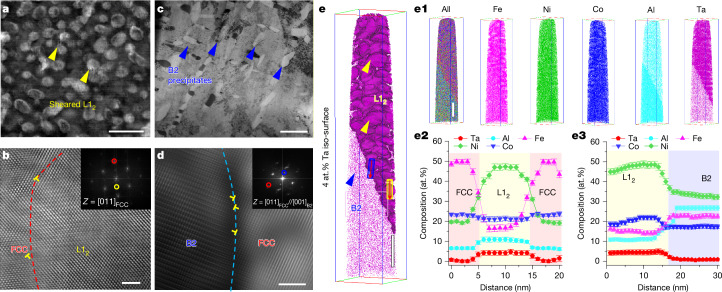
Paper Fig. 2: coherent L1₂ nanoprecipitates, incoherent B2 microprecipitates and their compositional distribution in the FCC matrix. Sohail et al., Nature (2025), CC BY-NC-ND 4.0; image unmodified. [S1]
Why 25% uniform elongation is the result to notice
For uniform tensile deformation to continue, work hardening must offset the instability caused by a shrinking cross-section. HEA05 hardens from 1.75 GPa yield strength to 2.40 GPa ultimate strength, a gap of roughly 650 MPa and a yield ratio of about 0.73. Its work-hardening curve shows no pronounced serrations or collapse.[S1]
Geometrically necessary dislocation density in B2 rises from about 0.8 × 10¹⁴ m⁻² before deformation to 6.8 × 10¹⁴ m⁻² at 20% strain, even above the roughly 5.4 × 10¹⁴ m⁻² measured in FCC/L1₂ regions at the same strain. Strain incompatibility among phases also produces hetero-deformation-induced hardening. The alloy is not merely strong at yield; it continues storing dislocations throughout plastic deformation.[S1]
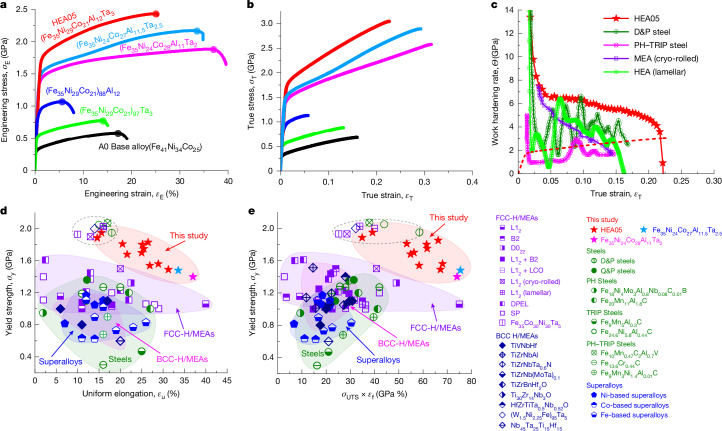
Paper Fig. 3: HEA05 stress-strain and work-hardening behavior, plus strength-elongation comparisons with other high-strength alloys. Sohail et al., Nature (2025), CC BY-NC-ND 4.0; image unmodified. [S1]
Starting with 140 samples, four rounds required only eight new experiments
measured yield strength of HEA05[S1]
uniform elongation[S1]
measured ultimate tensile strength[S1]
started from 140 prior data points, then experimentally tested eight new candidates across four rounds[S1][S2]
volume fractions of L1₂ and B2[S1]
strength (GPa) / uniform-elongation range from one composition under different processing[S1]
When each round allows only two experiments, the model decides what to ask nature next
This is small-data AI4S. A set of 140 samples is tiny by modern machine-learning standards, but complete composition–processing–microstructure–property labels are expensive in materials science. Instead of masking data scarcity with a more elaborate model, the team used knowledge of VEC, atomic-size mismatch, phase stability and precipitation strengthening to prune the search space.[S1]
When a model can generate many candidates but the laboratory can melt and test only two per round, generating more compositions is no longer the tightest constraint. Active learning becomes a way to allocate experimental budget: choose the candidate most likely to improve performance, or the one whose failure would still reduce uncertainty most effectively.
HEA05 is not a self-driving laboratory; melting, processing, characterization and judgment still rely heavily on people. But it closes an important part of the loop: the model proposes compositions, physical experiments return results, and the next round changes accordingly. Metrics such as experiments-to-discovery, time-to-verification and information gained per experiment may matter more here than R² or RMSE alone.
WHAT CHANGED
- AI4S layer
- Materials discovery / Active learning / Experiment selection
- Original bottleneck
- The composition space is vast, while every real candidate requires melting, processing, characterization and mechanical testing
- What changed
- Physical descriptors, phase constraints and active learning were joined in a loop that selects the next experimental compositions
- Key evidence
- 140 prior data points → eight new experiments across four rounds → HEA05; 1.75 GPa yield strength and 25% uniform elongation were measured
- Still unsolved
- Generalization across alloy families, joint composition–processing optimization, long-term service, scale-up and tantalum cost
EVIDENCE IN CONTEXT
- Editorial status
- Frontier
- Evidence setting
- Closed-loop or robotic lab
- How the evidence was produced
- Prospective · Physical · Adaptive
- Provenance and access
- Peer reviewed · Public code
- Evidence ceiling
- It shows that active learning can allocate validation budget across four physical rounds in one alloy family, but does not establish cross-family, cross-lab or scaled operation.
- Who did what
- The model proposed candidates; researchers set the space, made samples and performed mechanical and microscopy validation
Room-temperature strength and ductility are measured; cross-system generalization and engineering remain unvalidated
This is not an AI-designed material supported only by computational metrics.
HEA05 was physically fabricated and repeatedly tested in room-temperature tension. Its microstructure was characterized with XRD, TEM, SEM, EBSD, TKD, APT and synchrotron scattering. The 1.75 GPa and 25% values are measurements, not model outputs, and the training data and code are public.[S1][S2]
Machine-learning design should be interpreted narrowly.
The model did not directly optimize both 1.75 GPa and 25%, nor did it predict the final three-phase microstructure end to end. Experts chose the element system, physical features and VEC constraints, while later processing determined the final structure. This is ML-assisted alloy design, not fully autonomous discovery.[S1]
Validation still stops early in the path to an engineering material.
The paper validates room-temperature strength–ductility and deformation mechanisms, but not long-term high-temperature stability, fatigue life, fracture toughness, corrosion resistance, manufacturing at scale or industrial qualification. HEA05 also contains 3 at.% Ta. Reducing cost and reproducing the same precipitate architecture in large products remain open problems.[S1]
Active learning found the composition; experiments still had to explain why it works
Domain knowledge can become part of the search algorithm
Materials knowledge defines the element system, physical features and phase constraints; machine learning chooses the next expensive experiment within the remaining space. In small-data science, that division is more practical than treating domain knowledge and models as opposites.
Active learning allocates scarce physical labels
Model inference is cheap; melting, heat treatment, characterization and tensile testing are expensive. Active learning asks a concrete question: if only two experiments fit in this round, what is most worth asking nature next?
Finding a composition and explaining its behavior are different tasks
Active learning found the HEA05 composition, but later experiments explained how L1₂ strengthens it, why B2 does not simply embrittle it and how B2 stores dislocations at later strain. Prediction and scientific understanding still require separate evidence in AI4S.
A hard second phase does not have to act only as an obstacle
By lowering B2 ordering energy through multi-component alloying, an intermetallic phase usually considered hard and brittle can deform, store dislocations and sustain work hardening. That materials insight is more memorable than the phrase “AI found a record-setting alloy.”
Sources
Factual claims link to original announcements, project lists, trial records or journal papers where possible. Research plans are kept separate from completed results.