
Model & Data Release· Evidence · Frontier
OpenBind-0 Is Fully Open—and Points to the Data Gaps That Actually Matter
OpenBind-0 matters for more than being fully open. Real drug-discovery projects expose a deeper problem: more data does not automatically produce a stronger model unless it fills the regions the model does not understand.
●Official model and data release + public benchmark evaluation
Current boundary:results come from the official evaluation rather than a peer-reviewed paper, and performance remains low on FatA and both RdRp targets
This work advances:Uses new structures to test data gaps in molecular-interaction models
- MODELUnderstand / predict
- DECIDEChoose next
- INTERACTAct / measure
- UPDATEChange next round
01 | What happened
On August 21, 2026, OpenBind released its first molecular structure prediction model, OpenBind-0 (OB0). Built on OpenFold3 and specialized for protein–small-molecule co-folding, it was trained on public PDB structures through June 2025.[S1]
The release also includes 717 new ligand-bound experimental structures from three real fragment-to-hit projects: FatA, Dengue virus RdRp and Zika virus RdRp. They comprise 547 fragment binding events and 170 hit binding events.[S1][S3]
Why the zero mattersOB0 deliberately excludes OpenBind-generated structures from training. It establishes a public-data-only baseline so that future models can measure how much improvement actually comes from OpenBind's experimental data.[S1]
The release is therefore not just a model. It combines a baseline model, new experimental data and a framework for measuring the value of future data.
02 | What Changed
Open source means more than a runnable model
OpenBind-0 uses the Apache 2.0 license and releases training data, code, model weights and training recipes. Users can do more than run inference: they can retrain the model or experiment with proprietary data mixed into the original training distribution.[S1][S2]
For a scientific foundation model, architecture is only part of the story. Data provenance, cutoff dates, modality mixtures, checkpoint selection and whether fine-tuning preserves the original distribution all affect behavior. Opening these components makes OB0 a baseline that can be studied and modified rather than a black-box service.[S1][S2]
On standard protein–ligand benchmarks, OB0 is competitive with strong systems such as AlphaFold3 and Protenix. But the release is more interesting for the uneven results that follow—results closer to real discovery than another near-SOTA headline.[S1]
A correct position is not enough; the molecule must also be chemically valid
A co-folding model may place a ligand in roughly the correct pose while producing unrealistic bond lengths, angles or local geometry. RMSD alone can count such a structure as correct, but chemically invalid geometry undermines free-energy calculations and medicinal-chemistry decisions.[S1]
OpenBind adds inference-time chemical steering during diffusion sampling and uses PoseBusters to check ligand validity. The joint success rate for both correct pose and chemically valid geometry rises from 48% to 61%.[S1]
It is not the flashiest architecture headline, but it exposes the gap between a pose that is approximately correct on a benchmark and a structure that downstream science can actually use.
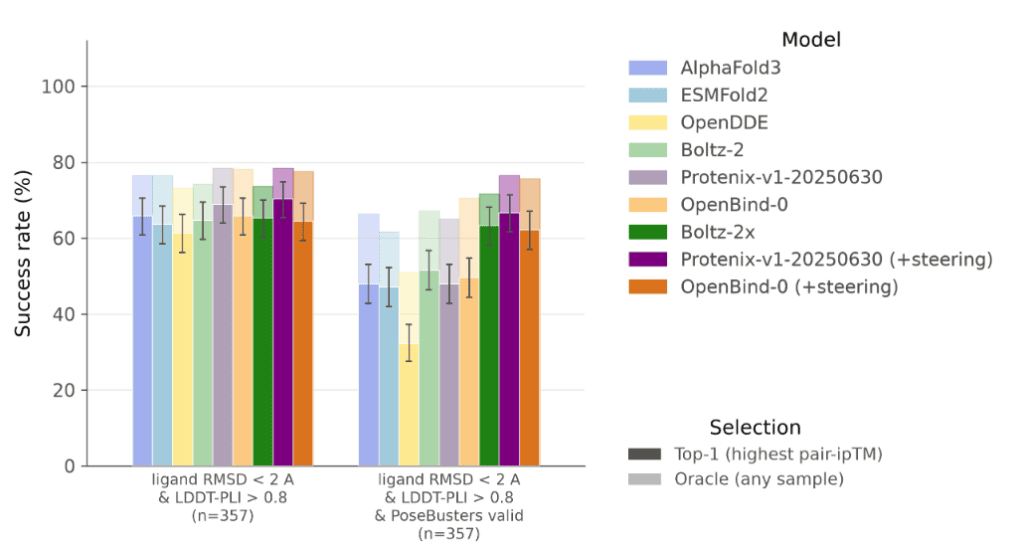
OpenBind blog Fig. 2: chemical steering leaves pose accuracy broadly similar while increasing the share that is both structurally correct and chemically valid. Image from the OpenBind release. [S1]
Why did four more years of PDB data not improve everything?
OB0's training cutoff is June 2025, while OpenFold3-preview2 stops in 2021. Intuitively, nearly four additional years of PDB data should make every test case easier. In practice, the two models perform similarly across many train-set-similarity bins.[S1]
The team then examined each test complex's distance to its nearest training structure. PDB added many protein–ligand structures, yet for many test cases the nearest neighbor did not become meaningfully closer. The dataset grew, but those targets did not become more familiar to the model.[S1]
Clear gains appear mainly when new data actually change a target's position in the training distribution—when a previously unfamiliar structure becomes more in-distribution. Data value therefore cannot be measured only by structure count; the key question is which chemical and structural space it fills.[S1]
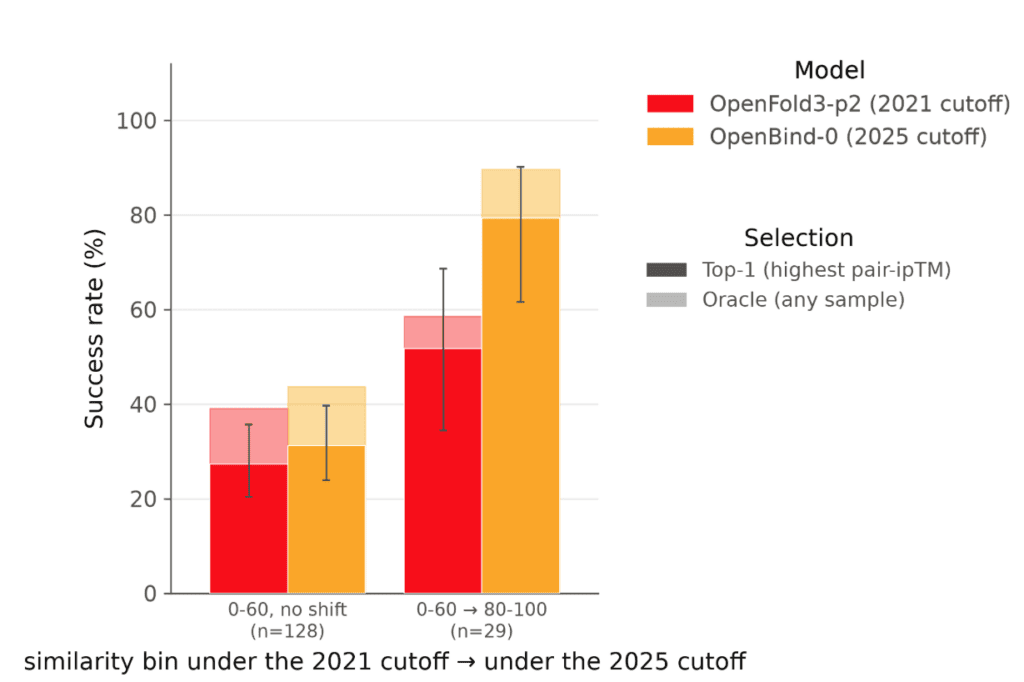
OpenBind blog Fig. 5: the x-axis measures whether 2025 data made a target closer to the training distribution than 2021 data. Gains are clearer when the new structures fill a relevant gap. Image from the OpenBind release. [S1]
Real projects expose three different failure modes
OpenBind evaluates models on real fragment-to-hit campaigns. The results are uneven, and that unevenness is the most useful part. On EV-A71 2A protease, OB0 reaches 92.2% top-25 success and 73.8% top-1. Related fragment structures were already in PDB before OB0's cutoff, giving the model highly relevant structural information.[S1]
On FatA, OB0 falls to 28.2% top-25 success; the best model, Protenix-v1-20250630, reaches only 39.4%. Models usually identify the correct pocket and a reasonable protein conformation but often miss the ligand pose. The failure is not where the ligand should go, but how it should sit there.[S1][S4]
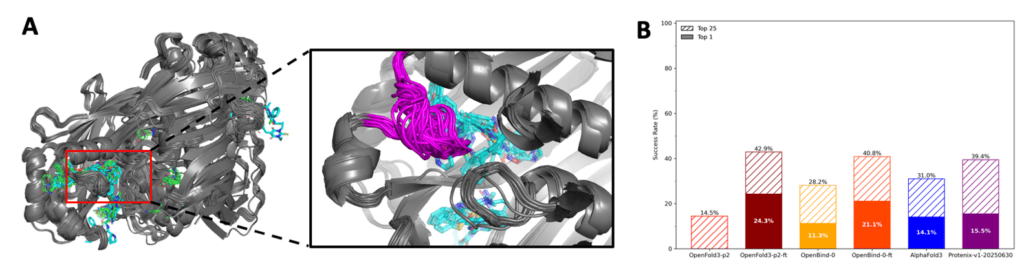
OpenBind blog Fig. 7: models often find the FatA pocket, while ligand pose remains the main problem; OB0 top-25 is 28.2%. Image from the OpenBind release. [S1]
On RdRp, models often miss the pocket itself
On Dengue and Zika RdRp, nearly every model fails. The best top-25 success rates are only 7.7% and 6.7%. RdRp is large, has multiple surface pockets and is highly flexible around the primary site; both systems are also very dissimilar to known structures in the 2021 and 2025 training sets.[S1][S5]
Models frequently choose the wrong pocket; even when they find it, receptor conformation or ligand pose can still be wrong. Protein–ligand prediction is therefore not one uniform task: EV-A71 has relatively good coverage, FatA is dominated by ligand placement, and RdRp exposes pocket selection, conformational modeling and OOD generalization at once.[S1]
The same class of co-folding model falling from above 90% to single digits reveals more about where it fails than an aggregate benchmark score.
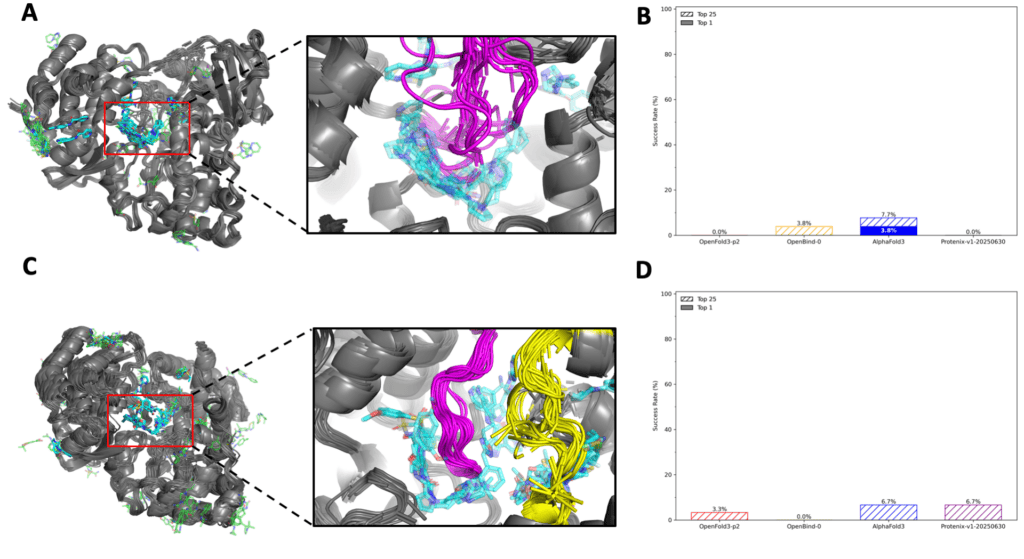
OpenBind blog Fig. 8: every model remains below 10% top-25 success on DENV-2 and ZIKV RdRp, with failures in pocket selection, protein conformation and ligand pose. Image from the OpenBind release. [S1]
Can fine-tuning close the gap? It depends on the target
The team fine-tuned models on target-specific fragment structures. On EV-A71, related data had clearly improved OpenFold3-preview2; OB0 then surpassed the fine-tuned model after absorbing those fragments into pre-training. In this system, incorporating relevant data into pre-training may be more effective.[S1]
The result does not generalize. FatA improves only modestly, and both RdRp systems remain poor after fine-tuning. The careful conclusion is not that pre-training always beats fine-tuning, but that training tricks may not substitute for missing experimental coverage.[S1]
03 | Key figures
04 | Why it matters
OpenBind-0 would already be useful as another fully open co-folding model, but its deeper value is the data loop. OB0 deliberately excludes OpenBind's own data to create a clean baseline; the team can then find failure regions and decide which new structures are most valuable to generate experimentally.[S1]
OpenBind explicitly says model predictions are helping determine which experiments to run next. This complements SAPP/DMX: SAPP/DMX addresses laboratory throughput lagging behind design, while OpenBind shows that even abundant data may add little if it does not reach unfamiliar regions.[S1]
The AI4S data question is shifting from “How do we get more data?” to “What is the next most valuable experiment to run?”
WHAT CHANGED
- AI4S layer
- Molecular structure prediction / Scientific data
- Original bottleneck
- Relevant protein–ligand structural data
- What changed
- A fully open baseline model, 717 new experimental structures and real fragment-to-hit benchmarks
- Key evidence
- Four additional years of PDB data did not improve everything; gains appeared when data filled a relevant structural gap
- Still unsolved
- How to choose the most valuable new experiments and make the data loop reliably improve the next model
EVIDENCE IN CONTEXT
- Editorial status
- Frontier
- Evidence setting
- Wet-lab validation
- How the evidence was produced
- Physical dataset · Retrospective evaluation
- Provenance and access
- Open model and data · Consortium-reported
- Evidence ceiling
- It shows that data covering relevant structural space is associated with better predictions, but does not establish a reliable loop for selecting data and improving the next model.
05 | Evidence status and boundaries
Evidence formOpenBind-0 is currently a model and data release with official benchmark analysis, not a full peer-reviewed paper. The performance numbers here come from OpenBind's release and accompanying evaluation.[S1][S3]
What 92.2% meansIt is not a general drug-binding prediction accuracy. Each binding event receives 25 structures; top-25 success means at least one satisfies ligand RMSD ≤2 Å, LDDT-PLI ≥0.8 and PoseBusters validity checks.[S1]
Domain of applicabilityEV-A71 reaches 92.2%, FatA 28.2%, and the best models on both RdRp targets remain below 8%. The evidence supports strong dependence on training coverage, target flexibility and failure mode—not that co-folding is generally solved.[S1]
Comparison boundaryThe 2021-versus-2025 comparison is not a perfectly controlled data-cutoff experiment. OpenFold3-preview2 and OB0 are architecturally similar but not identical, a limitation OpenBind also notes.[S1]
06 | What I Learned
1 | The data question is shifting from quantity to coverageFour additional years of PDB data did not make every test case easier. If new structures sit inside regions the model already knows, their marginal value for difficult targets may be low. Beyond size, an AI4S dataset should be judged by the scientific coverage it adds.
2 | Failure modes matter more than an average scoreEV-A71, FatA and RdRp are all protein–ligand prediction problems, yet fail differently: good coverage, incorrect ligand placement, or even wrong-pocket selection. Knowing that a model failed is not enough; the useful question is why and where the next experimental budget should go.
3 | Fine-tuning is not a universal patch for missing dataThe same fine-tuning strategy ranges from useful to nearly ineffective across systems. If an entire structural region is missing, a few dozen target-specific examples may not repair the gap; new experiments may matter more.
4 | Full openness makes the data–model relationship researchableWeights alone let us compare predictions. Opening training data, recipes, code and weights makes deeper questions testable: which data are valuable, where should they enter training, and what does a particular mixture improve or damage?
5 | The hardest part of self-driving science may be choosing the next experimentValuable active learning is not merely choosing 100 candidates from 10,000. It asks whether those 100 experiments maximally reduce important uncertainty or fill the most consequential gap in the training distribution. A system that repeatedly answers which data to generate next may matter more than any single model or dataset.
Sources
Factual claims link to original announcements, project lists, trial records or journal papers where possible. Research plans are kept separate from completed results.
- S1OpenBind-0: Advancing Open Molecular Structure PredictionOpenBind · 2026.08.21 · Official model, data and benchmark release
- S2OpenFold3 v0.5.0 / OpenBind-0 model releaseAQLaboratory / GitHub · 2026.08.21 · Code and model weights
- S3OpenBind-0 model release infoOpenBind Consortium / GitHub · 2026.08.21 · Evaluation scripts and data documentation
- S4FatA fragment-to-hit dataFragalysis / OpenBind · 2026.08.21 · Experimental structure data
- S5DENV-2 and ZIKV RdRp fragment-to-hit dataFragalysis / OpenBind · 2026.08.21 · Experimental structure data