

Paper & Experimental Validation· Evidence · Frontier
CASS and the A-Lab: 78 autonomous syntheses steer NASICON phase purity by XRD, with conductivity in the loop only as a proxy domain
In Gerbrand Ceder's team at UC Berkeley and Lawrence Berkeley National Laboratory, robots dosed, fired and X-rayed each powder, and every measured phase and lattice parameter rewrote the cost function for the next design; no conductivity was measured inside the loop. Of six samples people later pressed and measured by impedance, the best two reached room-temperature bulk conductivities of 3.96 and 3.17 mS/cm, but total conductivity was only 0.7 and 0.3 mS/cm, about 1/6 and 1/11 of bulk.
●Preprint + autonomous synthesis + manual conductivity measurement
Current boundary: That the loop improves phase purity and that two samples conduct well in the bulk are measured; there is no same-budget baseline, the 18 'promising' are a call made inside a surrogate domain, and only six samples were measured for conductivity
This work advances: Has an autonomous lab rewrite its cost function from each measured XRD and design the next NASICON synthesis from it
- MODELUnderstand / predict
- DECIDEChoose next
- INTERACTTest against reality
- UPDATEChange next round
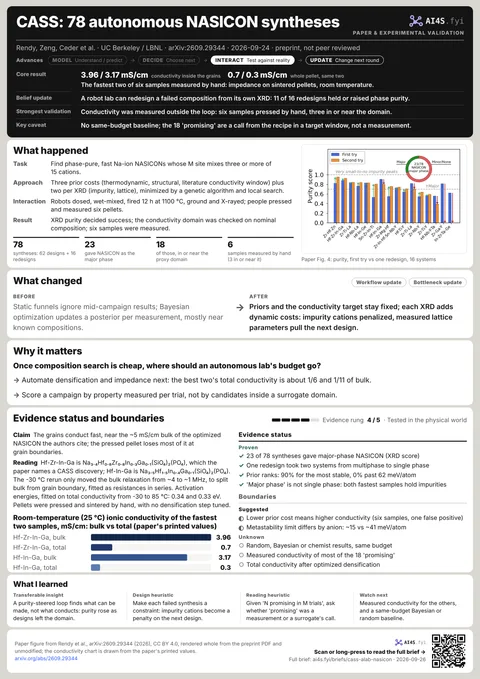
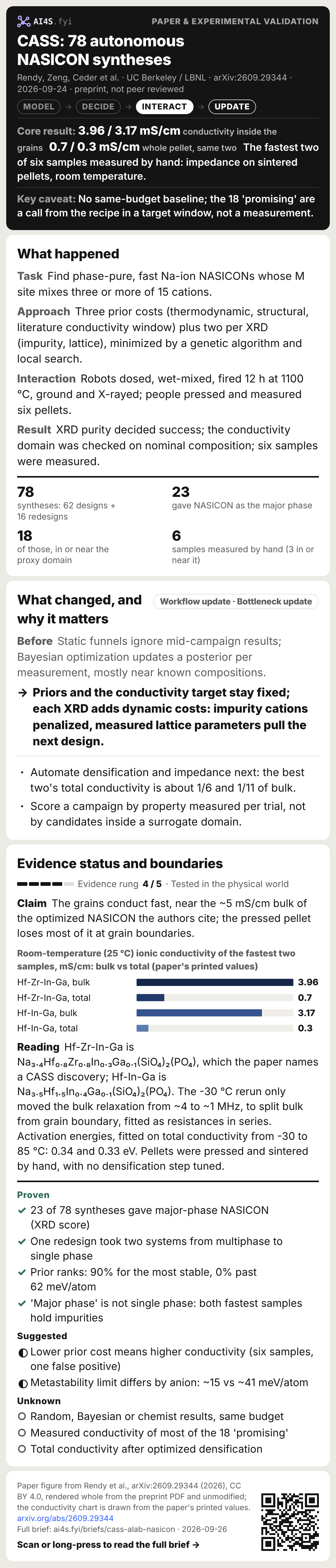
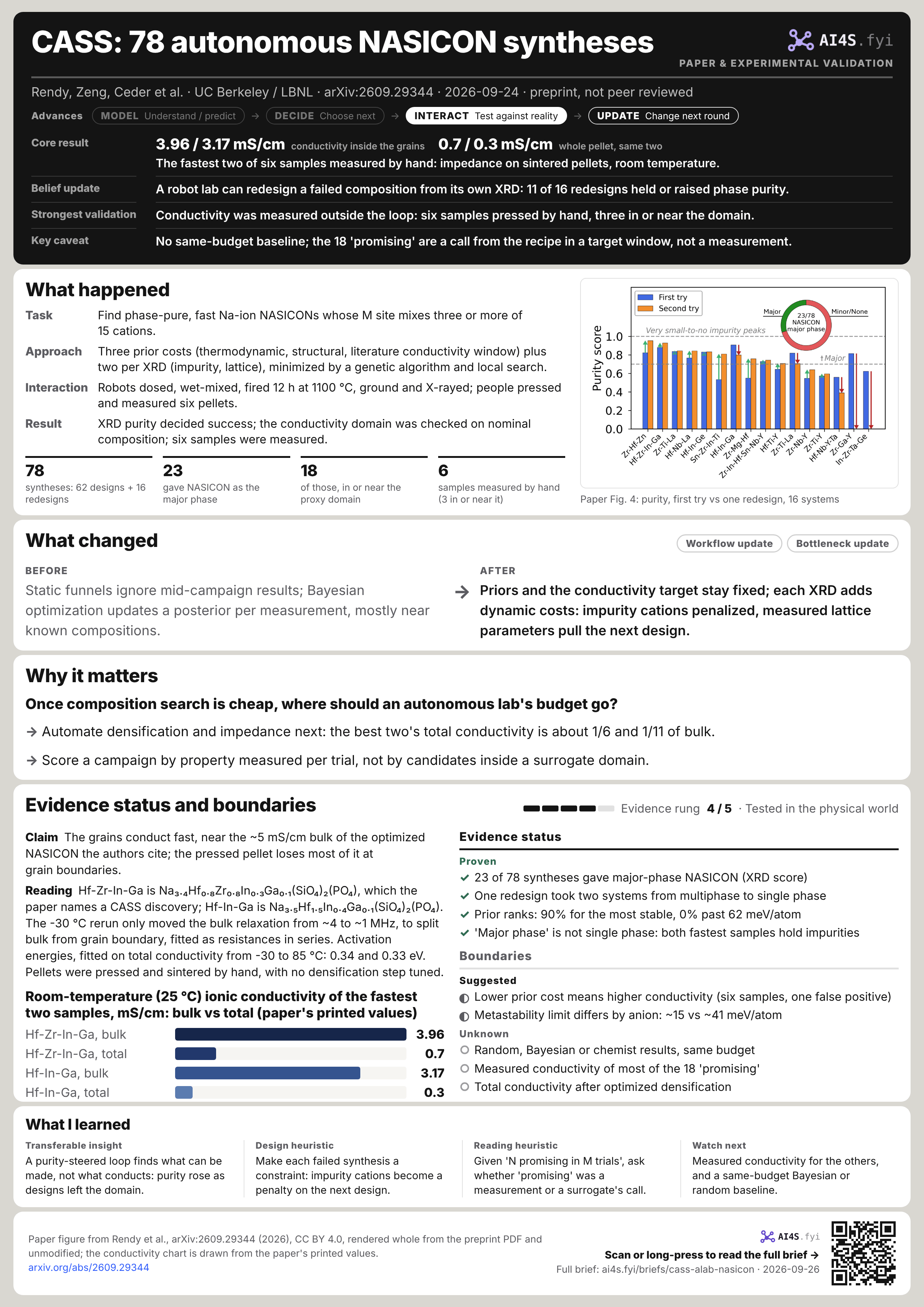
3.96 / 3.17 mS/cmconductivity inside the grains
0.7 / 0.3 mS/cmwhole pellet, same two
The fastest two of six samples measured by hand: impedance on sintered pellets, room temperature.
- Belief update
- A robot lab can redesign a failed composition from its own XRD: 11 of 16 redesigns held or raised phase purity.
- Strongest validation
- Conductivity was measured outside the loop: six samples pressed by hand, three in or near the domain.
- Key caveat
- No same-budget baseline; the 18 'promising' are a call from the recipe in a target window, not a measurement.
01What happened
- Task
- Find phase-pure, fast Na-ion NASICONs whose M site mixes three or more of 15 cations.
- Approach
- Three prior costs (thermodynamic, structural, literature conductivity window) plus two per XRD (impurity, lattice), minimized by a genetic algorithm and local search.
- Interaction
- Robots dosed, wet-mixed, fired 12 h at 1100 °C, ground and X-rayed; people pressed and measured six pellets.
- Result
- XRD purity decided success; the conductivity domain was checked on nominal composition; six samples were measured.
78syntheses: 62 designs + 16 redesigns
23gave NASICON as the major phase
18of those, in or near the proxy domain
6samples measured by hand (3 in or near it)
On 24 September 2026, Rendy, Zeng, Ceder and colleagues at UC Berkeley and Lawrence Berkeley National Laboratory posted a preprint (arXiv:2609.29344, 80 pages including 35 of supplementary information) describing CASS, a cost-guided autonomous solid-state synthesis framework, and its use in the A-Lab to search for NASICON-type sodium solid electrolytes. The paper has not been peer reviewed.[S1]
The cost function: three priors, two terms learned from experiment
Each candidate is written as its cation composition (excluding Na) and its polyanion ratio, with Na set by charge neutrality. Three static costs are fixed before any experiment: thermodynamic stability (a linear SVC on published NASICON stability descriptors, with the Ehull threshold relaxed to 62.22 meV/atom so that all 524 experimentally known literature compositions classify as accessible); structural stability (a ceiling on the standard deviation of cation radii that tightens with the number of cations); and ionic conductivity (a 'likely high ionic conductivity' domain adapted from 484 published composition-conductivity pairs, bounded by mean cation radius, Na content and mean polyanion centre-ion radius).[S1]
Two dynamic costs come from the XRD after each synthesis: an impurity term penalises candidates whose concentration of any ion found in an impurity phase exceeds that of the previous target, and a lattice-parameter term maps the automatically refined NASICON lattice parameters back to composition through a fine-tuned Vegard's approximation, pulling the next design toward the phase that actually formed. The five terms are summed with weights (50 for four of them, 1 for the impurity term), searched globally by a real-coded genetic algorithm and refined locally with BFGS.[S1]
Which steps were autonomous
The A-Lab, orchestrated by AlabOS, did the following on its own: weighing precursors to stoichiometry (with 10 wt% excess Na₂CO₃), wet-mixing in ethanol, transferring to crucibles and drying, robot-loading furnaces for a 12-hour dwell at 1100 °C, recovering and grinding the product, and preparing and scanning the XRD sample. Patterns uploaded automatically; BGMN ran the Rietveld refinement and DARA the phase identification, and the results went straight into the next cost function, from which CASS proposed the next composition.[S1]
Not autonomous: the researchers set the chemical space, the form of the cost terms and their weights; the 62 first-round designs were constrained to the (SiO₄)₂(PO₄) anion composition; the 16 second-round samples were picked from the 24 that showed NASICON for practical reasons (excluding Sc to limit cost, and in multiples of 8 because each box furnace heats 8 samples per batch); and the six conductivity samples were chosen by the researchers, ball-milled, cold-pressed at about 700 MPa, sintered to over 85% of theoretical density, fitted with indium electrodes and measured by impedance, with manual GSAS-II refinement. The paper itself lists manual densification of the loose powder as a current limitation.[S1]
How the 78 are counted
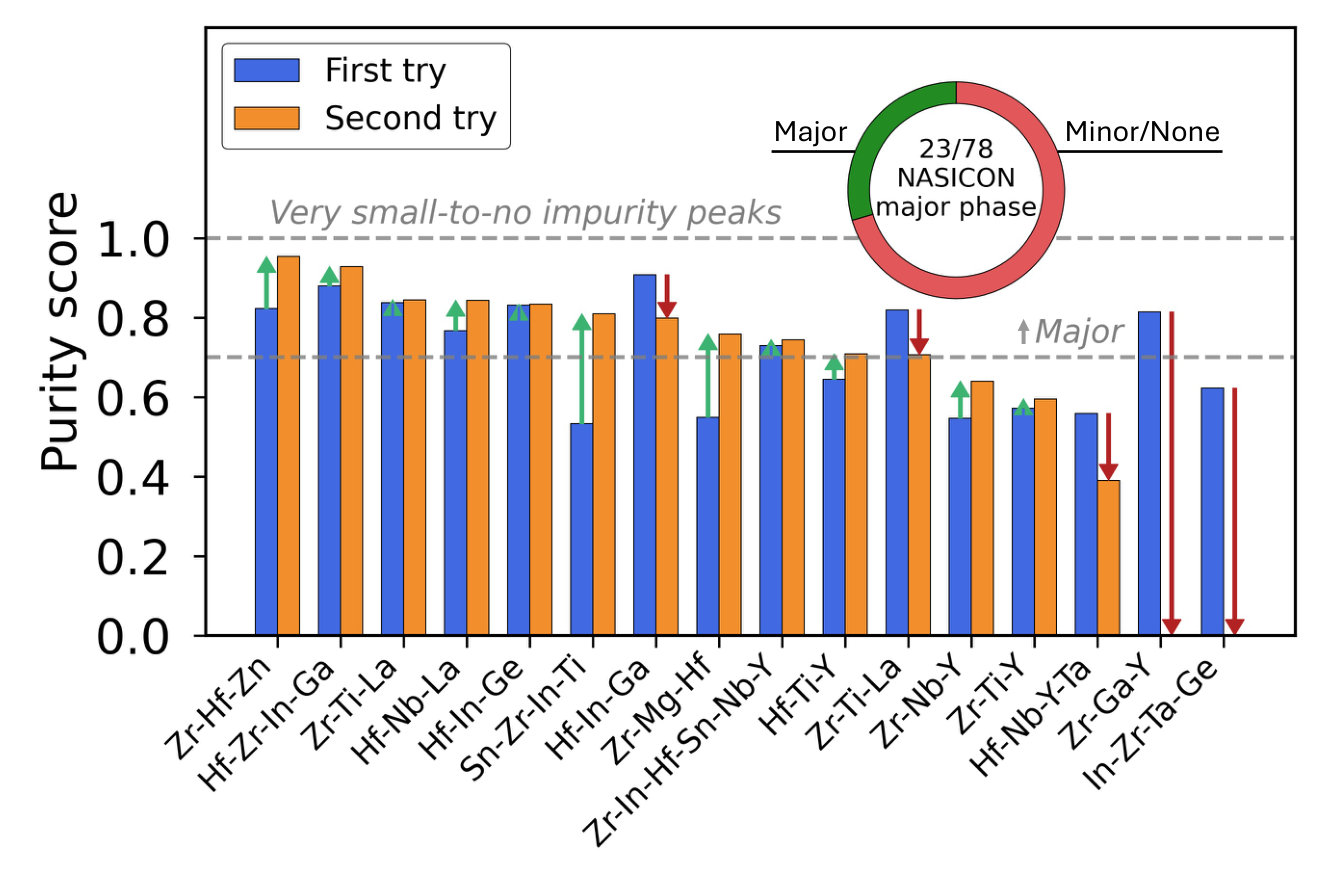
78 is a count of syntheses (the paper's 78 trials, or 78 attempted compositions), not of 78 new materials: 78 = 62 + 16. Across 54 compositional spaces, each got at most two syntheses: an initial design and one optimisation. The 62 first-round designs used static costs only; 24 (39%) showed an observable NASICON phase and 12 formed it as the major phase (Purity Score > 0.7). Of the 16 second-round redesigns, 11 held or raised purity (not 11 improvements), 3 got worse and 2 failed to form NASICON near the target composition. Cumulatively 23 of 78 gave NASICON as the major phase; checked against the conductivity cost πIC ≤ 0.025 on their nominal compositions, 18 of those (78%) sat inside or near the proxy domain. That step is a calculation, not a measurement: the abstract says CASS 'optimizes ionic conductivity and phase purity', but conductivity enters the loop only through this proxy domain, and every cost update in the loop comes from XRD.[S1]
The 78 are not counted against anything: no random search, Bayesian optimisation or chemist-designed set was run on the same space with the same budget. The paper argues that Bayesian optimisation needs substantial initial sampling to build useful priors while CASS typically reaches satisfactory purity in one to three iterations, but that is an argument, not a measurement. The dataset also holds phosphosilicate syntheses from preliminary testing of each cost term, 281 in all; the 78 are the subset designed with conductivity in view.[S1]
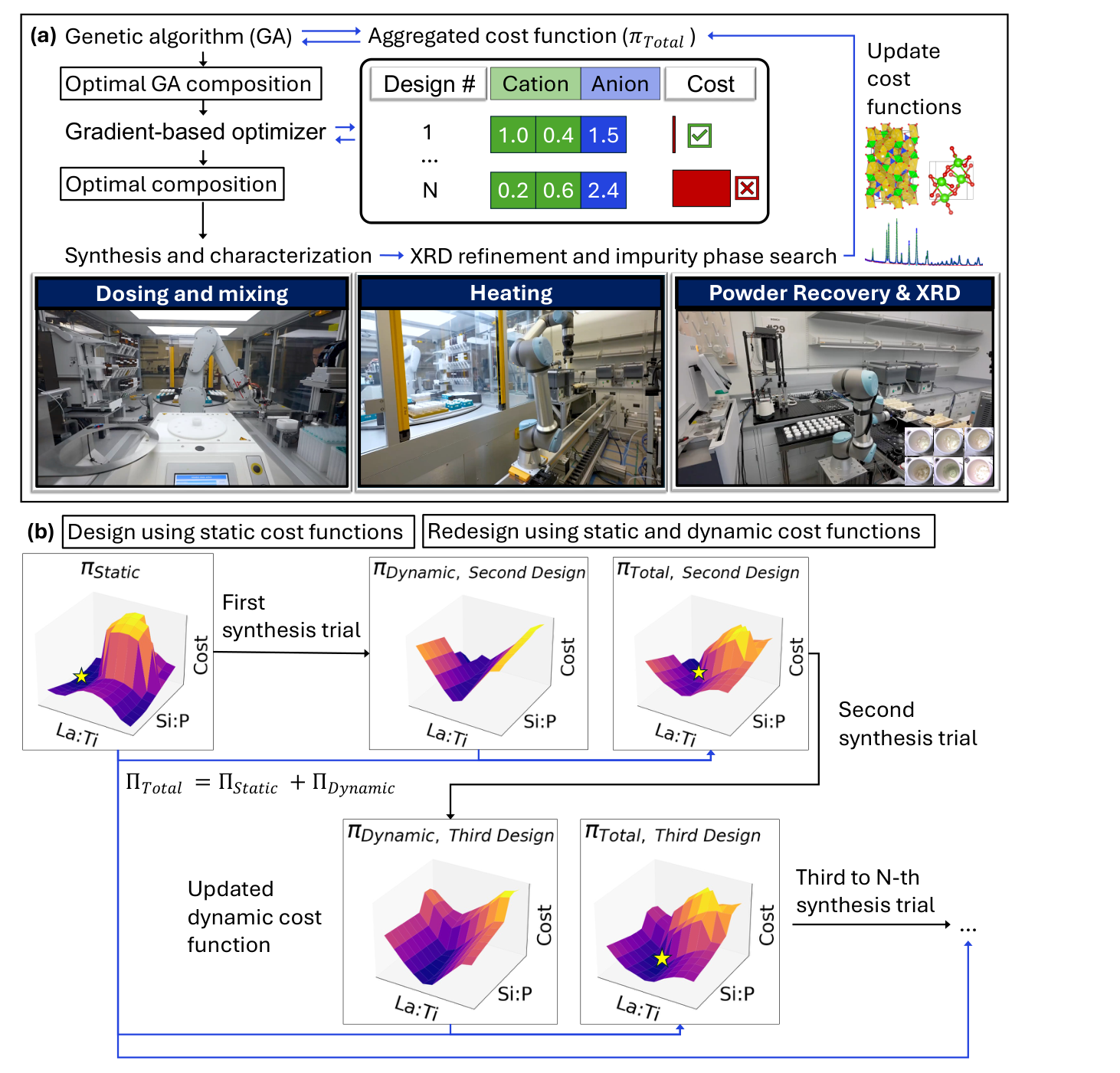
Paper Fig. 1: (a) the closed loop of design, synthesis and XRD characterization, with photos of the A-Lab's dosing and mixing, heating, and powder recovery and XRD stations; (b) the first design uses static costs only, and each later round adds dynamic costs from characterization. Rendy et al., arXiv:2609.29344, CC BY 4.0; image unmodified. [S1]
02What changed
Workflow updateBottleneck updateStatic funnels ignore mid-campaign results; Bayesian optimization updates a posterior per measurement, mostly near known compositions.
Priors and the conductivity target stay fixed; each XRD adds dynamic costs: impurity cations penalized, measured lattice parameters pull the next design.
The paper's starting point is that static funnels cascade candidates through rigid filters without adapting to mid-campaign results, while Bayesian optimization, which does update its posterior with each measurement and has tuned NASICON compositions before, has largely stayed in the close vicinity of known materials. There, elemental substitution gives smooth landscapes that suit standard Gaussian-process kernels; crossing into new phase boundaries gives a rugged, non-stationary one: wide regions of competing phases with the target phase appearing abruptly. CASS does not try to fit that landscape: the three static priors, the conductivity target domain among them, stay fixed throughout, and after each experiment two dynamic costs derived from XRD are added that correct the synthesizability estimate locally.[S1]
In the synthesizability-only demonstration one iteration was enough to see the effect: in the Hf-Zr-Ge system the first attempt, NaHf₀.₆₇Zr₀.₆₇Ge₀.₆₇(PO₄)₃, gave about 53 wt% NASICON with NaGe₂(PO₄)₃ and ZrP₂O₇ impurities; CASS cut Ge and Zr and proposed NaHf₁.₀Zr₀.₈₉Ge₀.₁₁(PO₄)₃, which came out single-phase. In Hf-Zr-Ti-Ge, about 90 wt% went to single phase. Those two starting compositions were chosen deliberately beyond solubility limits by the researchers, not generated by the cost function.[S1]
Purity and the conductivity domain pull against each other
The paper's own example is the Sn-Zr-In-Ti system: the redesign lifted the Purity Score from about 0.53 to about 0.81, but by pushing the composition out of the conductivity target domain, with πIC drifting from 0 to about 0.14. The authors also name why redesigns fail: in a high-dimensional composition space a set of lattice parameters maps to a whole surface of solutions under Vegard's approximation, not a point, so when NASICON first appears in a multiphase sample πLP cannot pin its composition. They propose automated SEM-EDS for phase-specific composition.[S1]
The bottleneck moves one step downstream. Composition search can run as an autonomous loop, but conductivity has to go from loose powder to a dense, measurable pellet: in the two best samples room-temperature total conductivity is about 1/6 and 1/11 of bulk, a gap that sits in grain boundaries and densification: still done by hand pressing and sintering. The paper says plainly that post-synthetic processing (densification, sintering conditions, binder) was not optimised.[S1]
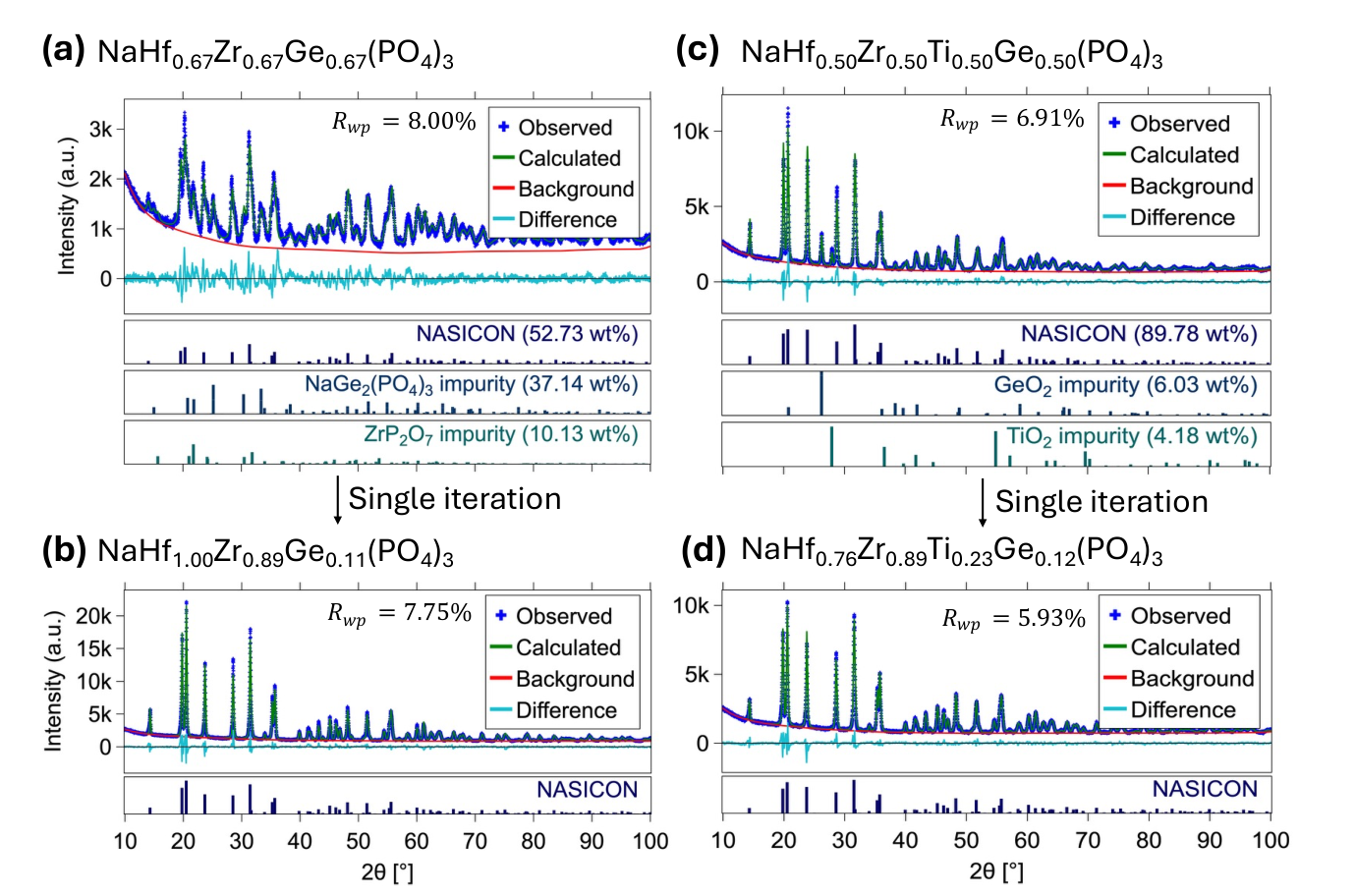
Paper Fig. 3: Rietveld refinements of the first attempt (top) and one CASS redesign (bottom) in the Hf-Zr-Ge and Hf-Zr-Ti-Ge systems; impurity peaks drop sharply. Rendy et al., arXiv:2609.29344, CC BY 4.0; image unmodified. [S1]
03Why it matters
Once composition search is cheap, where should an autonomous lab's budget go?
- Automate densification and impedance next: the best two's total conductivity is about 1/6 and 1/11 of bulk.
- Score a campaign by property measured per trial, not by candidates inside a surrogate domain.
What CASS shows is specific: in a high-dimensional solid-solution space, synthesizability can be treated as a cost that experiments rewrite, rather than a gate set in advance. A failed synthesis stops being only a wasted run and becomes a constraint on the next design: which cations went into impurities, and what lattice parameters the phase that did form has.[S1]
For a solid electrolyte, though, a whole stretch of processing lies between 'can be made' and 'conducts fast'. In this paper the synthesis-and-characterisation loop ran on robots, while the pressing, sintering and impedance that set the final total conductivity were manual. If the goal is a usable electrolyte rather than a synthesizable composition, the next investment belongs there; the authors themselves name automated grinding and pressing units as the next step.[S1]
The same goes for evaluation. The '18 promising compositions' are judged by their nominal composition falling inside the πIC surrogate domain; only six samples were actually measured, and one sitting right by the domain reached only 0.01 mS/cm. A closed-loop campaign's output should be measured in properties that were measured, and hits per trial.[S1]
04Evidence status and boundaries
Evidence rung 4 / 5 · Tested in the physical world · Closed-loop experimentationEvidence status
Proven
- 23 of 78 syntheses gave major-phase NASICON (XRD score)
- One redesign took two systems from multiphase to single phase
- Prior ranks: 90% for the most stable, 0% past 62 meV/atom
- 'Major phase' is not single phase: both fastest samples hold impurities
Boundaries
Suggested
- Lower prior cost means higher conductivity (six samples, one false positive)
- Metastability limit differs by anion: ~15 vs ~41 meV/atom
Unknown
- Random, Bayesian or chemist results, same budget
- Measured conductivity of most of the 18 'promising'
- Total conductivity after optimized densification
ClaimThe grains conduct fast, near the ~5 mS/cm bulk of the optimized NASICON the authors cite; the pressed pellet loses most of it at grain boundaries.
Room-temperature (25 °C) ionic conductivity of the fastest two samples, mS/cm: bulk vs total (paper's printed values)
ReadingHf-Zr-In-Ga is Na₃.₄Hf₀.₈Zr₀.₈In₀.₃Ga₀.₁(SiO₄)₂(PO₄), which the paper names a CASS discovery; Hf-In-Ga is Na₃.₅Hf₁.₅In₀.₄Ga₀.₁(SiO₄)₂(PO₄). The -30 °C rerun only moved the bulk relaxation from ~4 to ~1 MHz, to split bulk from grain boundary, fitted as resistances in series. Activation energies, fitted on total conductivity from -30 to 85 °C: 0.34 and 0.33 eV. Pellets were pressed and sintered by hand, with no densification step tuned.
How purity was measured.
The Purity Score comes from automated XRD. Estimated Purity (EP) is the refined NASICON phase's integrated intensity as a share of the total background-subtracted intensity, so unidentified impurities and poor refinement both lower it; it is divided by a 78.33% baseline set on 20 high-purity calibration samples and capped at 1.0. If the refined a lattice parameter or cell volume deviates from the Vegard prediction by more than the model uncertainty plus 15% of the end-member range, the score is set to 0. A score above 0.7 defines a major phase, a threshold set by sensitivity analysis: the NASICON maximum peak exceeds any unidentified secondary peak. So 'major phase' is not single phase: both of the best-conducting samples contain impurities such as HfZrO₄, Na₂HfSi₂O₇ or HfO₂, and the combined XRD and SEM-EDS analysis finds a second, minor NASICON-type phase in each. The paper also concedes that purity was optimised only indirectly.[S1]
How conductivity was measured.
Six samples with NASICON as the major phase: powder ball-milled 30 minutes, cold-pressed into 6 mm pellets at about 700 MPa, sintered at 1050-1100 °C for 1-2 hours and fast-cooled, to over 85% of theoretical density; indium electrodes applied by cold isostatic pressing, impedance recorded from 7 MHz to 100 mHz and fitted with an equivalent circuit carrying separate bulk and grain-boundary R-CPE elements. At room temperature the bulk relaxation sits near 4 MHz, close to the instrument's limit, so the samples were remeasured at -30 °C, which moves it to about 1 MHz and exposes the bulk semicircle: the low-temperature run is there to separate bulk from grain boundary, and the conductivities reported are room-temperature values. Na₃.₄Hf₀.₈Zr₀.₈In₀.₃Ga₀.₁(SiO₄)₂(PO₄) and Na₃.₅Hf₁.₅In₀.₄Ga₀.₁(SiO₄)₂(PO₄) gave room-temperature total conductivities of 0.7 and 0.3 mS/cm against corresponding bulk conductivities of 3.96 and 3.17 mS/cm, so total is about 1/6 and 1/11 of bulk; their activation energies, 0.34 and 0.33 eV, come from Arrhenius fits of total conductivity at points between -30 and 85 °C (done for four of the six samples). The authors' comparison point is optimised Na₃.₄Zr₂(SiO₄)₂.₄(PO₄)₀.₆ at about 5 mS/cm bulk.[S1]
The target domain's predictive power rests on six points.
Of the six samples, three sat inside or near the target domain (πIC ≤ 0.025) and three outside. Two of them conducted fast, but the third, Na₃.₅Hf₀.₇In₁.₂Ge₀.₁(SiO₄)₁.₃(PO₄)₁.₇, also right by the domain, reached only 0.01 mS/cm total; the three outside gave 0.01 to 0.06 mS/cm. So this is not a 23 → 18 → 6 funnel: the six are major-phase samples the researchers picked to span distances from the domain, only three of them fall within πIC ≤ 0.025, and the paper does not say whether those three are all among the 18. The authors conclude that lower πIC 'generally' gives higher conductivity, with occasional false positives, and suggest the exception may come from excessive cation size mismatch, a factor the model does not describe. The six were chosen by the researchers, not sampled at random; the main text names the 0.7 mS/cm composition as a CASS discovery, but does not say trial by trial which of the 78 each of the other five came from.[S1]
The priors themselves were tested against experiment.
Across 281 phosphosilicate syntheses the thermodynamic prior's binned success rate fell monotonically: compositions on the hull (0 meV/atom) formed major-phase NASICON 90% of the time, intermediate stability 37-40%, above 41 meV/atom 21%, and beyond 62.22 meV/atom 0%; samples over the distortion ceiling succeeded 6% of the time. Successful pure-phosphate and pure-silicate syntheses all sat below about 15 meV/atom, under the roughly 41 meV/atom of mixed-anion phosphosilicates. This supports the priors' ranking power: on the authors' own data, assessed by the authors.[S1]
Data and code could not yet be reached.
The paper says the full record of all 78 syntheses is on figshare (doi:10.6084/m9.figshare.31829305) and the code on GitHub at CederGroupHub/cass. When checked on 2026-09-26 and again on 09-27 the DOI returned 404 and so did the GitHub repository, so the trial-by-trial record could not be read; every number in this brief comes from the paper's main text and supplementary information.[S1]
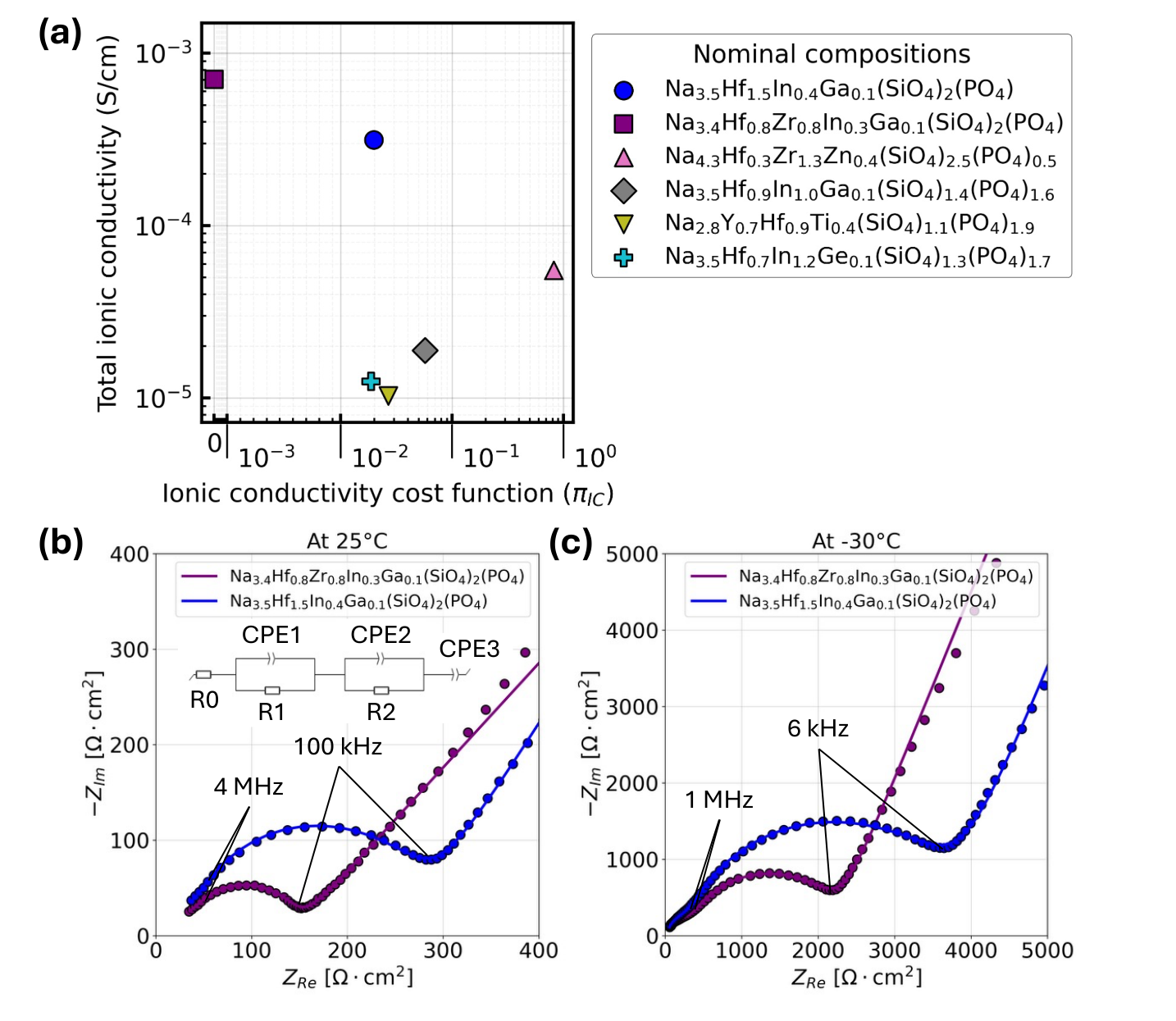
Paper Fig. 5: (a) measured total conductivity of six samples against πIC: two near πIC = 0 lead, but a third just as close to the domain reached only 0.01 mS/cm total; (b-c) Nyquist plots of the two fast conductors at 25 °C and -30 °C, where cooling moves the bulk relaxation from about 4 MHz to about 1 MHz and exposes the bulk semicircle. Rendy et al., arXiv:2609.29344, CC BY 4.0; image unmodified. [S1]
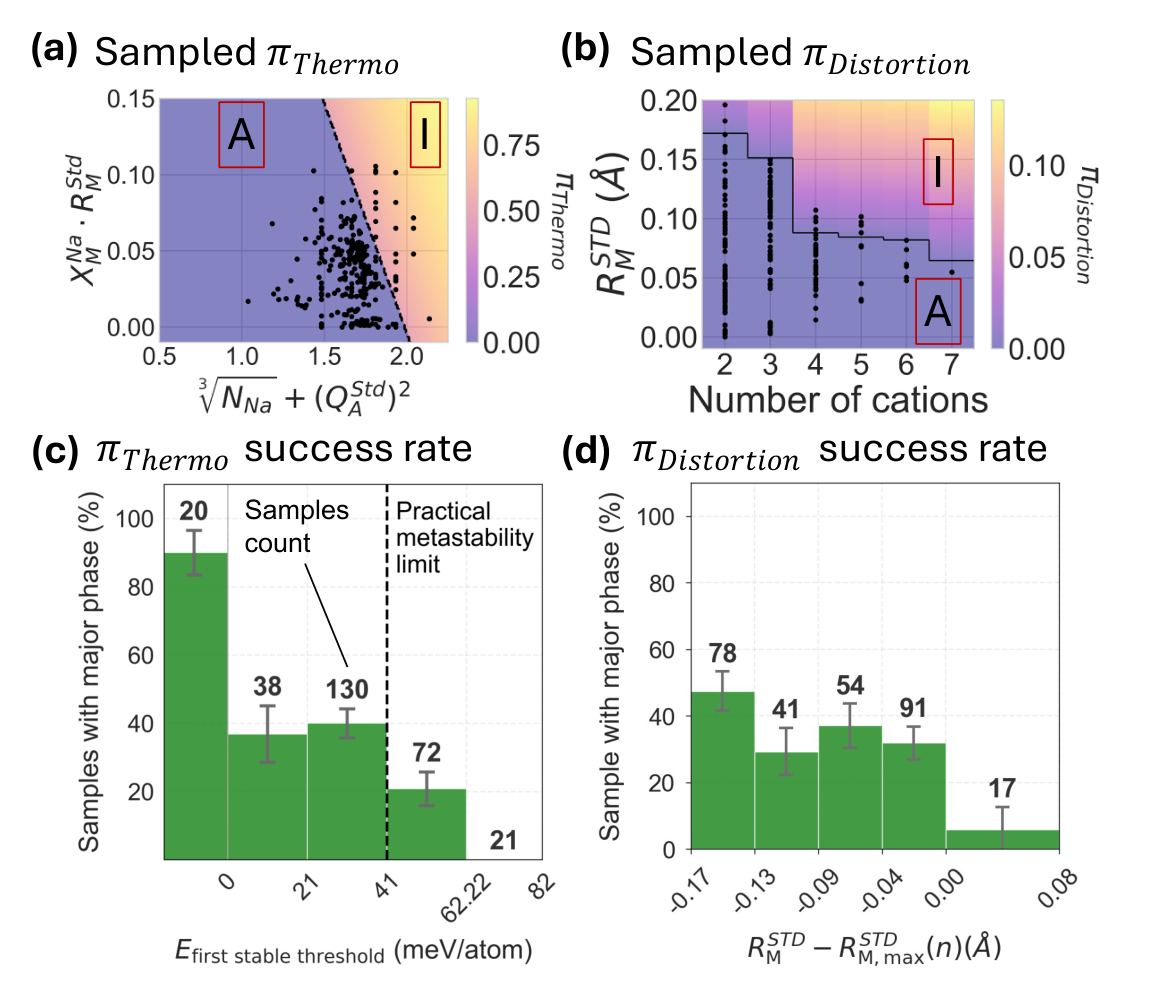
Paper Fig. 6: 281 phosphosilicate syntheses set against the two static synthesizability priors; success falls as the Ehull threshold and cation size mismatch rise. Rendy et al., arXiv:2609.29344, CC BY 4.0; image unmodified. [S1]
05What I learned
- Transferable insight
- A purity-steered loop finds what can be made, not what conducts: purity rose as designs left the domain.
- Design heuristic
- Make each failed synthesis a constraint: impurity cations become a penalty on the next design.
- Reading heuristic
- Given 'N promising in M trials', ask whether 'promising' was a measurement or a surrogate's call.
- Watch next
- Measured conductivity for the others, and a same-budget Bayesian or random baseline.
Synthesizability can be a cost that experiments rewrite
A static funnel treats synthesizability as a gate; CASS treats it as a continuous cost that updates with observation. That lets a failure carry direction: not only 'it did not work' but which ions went into impurities and which way the phase that did form leans.
The loop ends where the automation ends
The loop only carries questions XRD can answer: did the phase form, how pure is it. Conductivity is outside the loop, waiting for people to press a few samples into pellets. So the system optimises what it can measure itself, and the target property enters only indirectly, through a surrogate domain.
Between 'inside the domain' and 'fast' there is a false positive
Of three samples near the domain, one reached 0.01 mS/cm. Six points cannot estimate the surrogate's hit rate, but they are enough to show that counting 'promising' candidates with a surrogate counts the surrogate's opinion.
A step forward for the A-Lab, not a re-proof of it
As this site's A-Lab entry records, its 2023 discovery claims needed an outside correction. The test here is different: conductivity is a directly measured property, not a judgment of novelty. But the paper is still designed, measured and assessed by the same group, with no outside replication.
As one imageTo save and share→Sources
Factual claims link to original announcements, project lists, trial records or journal papers where possible. Research plans are kept separate from completed results.