

Paper & Experimental Validation· Evidence · Frontier
MatSemNet: a literature-trained model ranks seven rare-earth dopants, and the lab measures the same top four
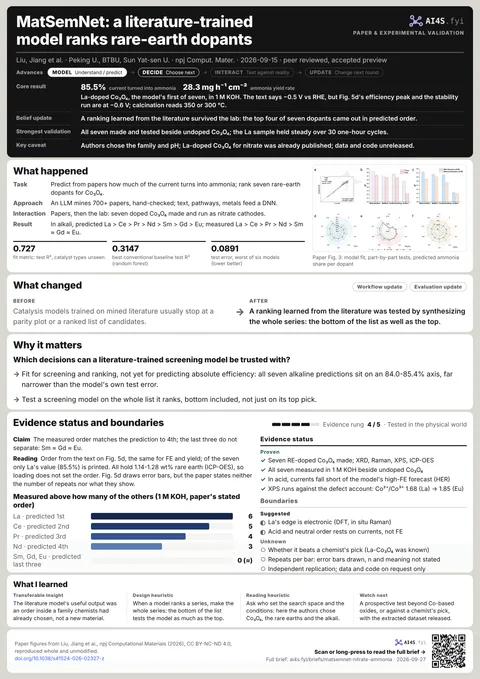
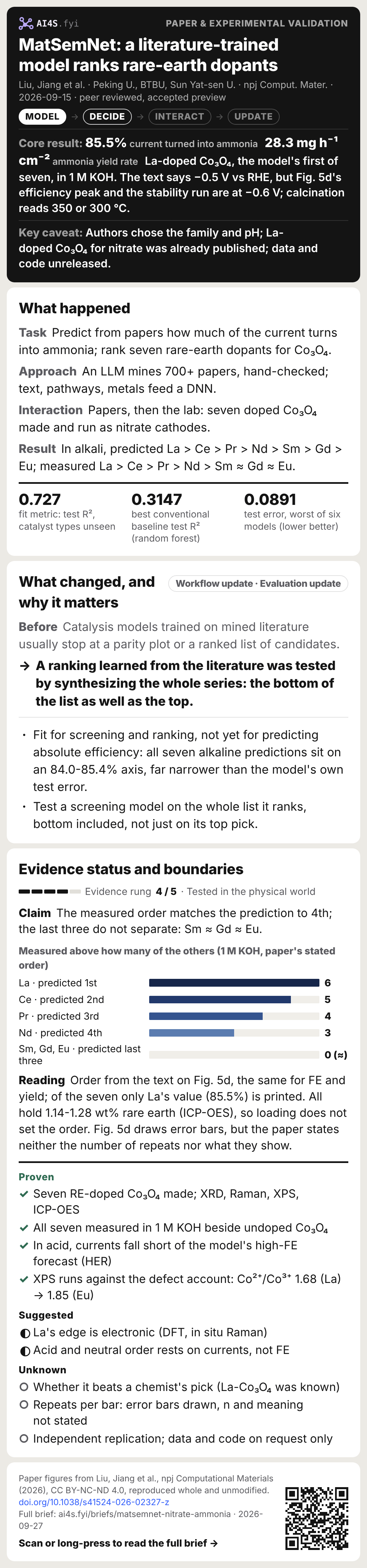
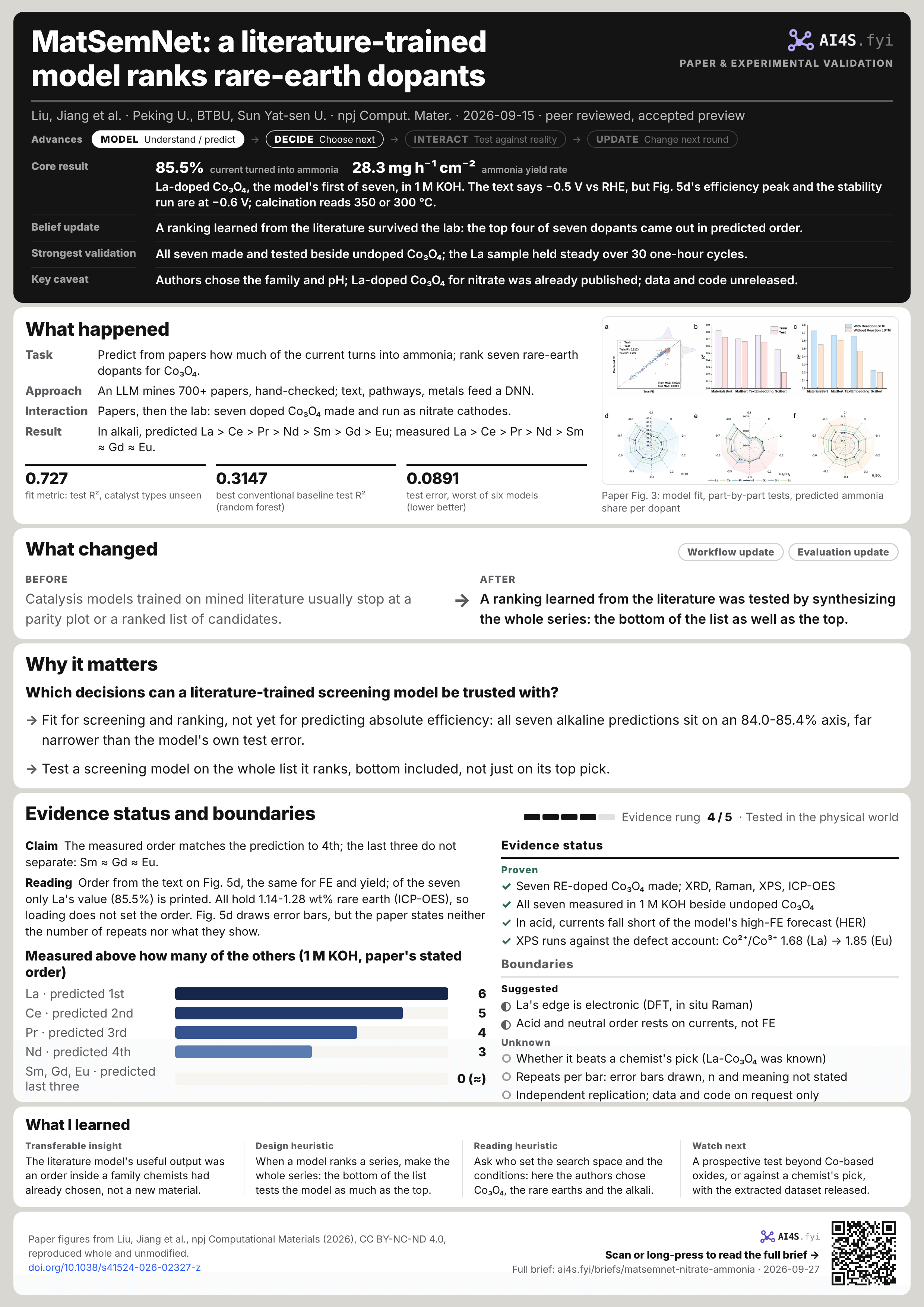
A team from Peking University, Beijing Technology and Business University and Sun Yat-sen University had a model that learned from more than 700 papers put rare-earth-doped Co₃O₄ in order, then made all seven and measured them. The ranking held, but the authors picked the family and the electrolyte, and the top pick, La-doped Co₃O₄, was already in the literature.
●Peer-reviewed paper + experimental validation
Current boundary: The alkaline ranking of seven dopants and the La sample's performance are measured; whether the model beats a chemist's pick, travels beyond Co-based oxides, or can be reproduced by others is unknown
This work advances: Learns a Faradaic-efficiency model from more than 700 papers and ranks candidate dopants within a family the authors chose
- MODELUnderstand / predict
- DECIDEChoose next
- INTERACTTest against reality
- UPDATEChange next round
85.5%current turned into ammonia
28.3 mg h⁻¹ cm⁻²ammonia yield rate
La-doped Co₃O₄, the model's first of seven, in 1 M KOH. The text says −0.5 V vs RHE, but Fig. 5d's efficiency peak and the stability run are at −0.6 V; calcination reads 350 or 300 °C.
- Belief update
- A ranking learned from the literature survived the lab: the top four of seven dopants came out in predicted order.
- Strongest validation
- All seven made and tested beside undoped Co₃O₄; the La sample held steady over 30 one-hour cycles.
- Key caveat
- Authors chose the family and pH; La-doped Co₃O₄ for nitrate was already published; data and code unreleased.
01What happened
- Task
- Predict from papers how much of the current turns into ammonia; rank seven rare-earth dopants for Co₃O₄.
- Approach
- An LLM mines 700+ papers, hand-checked; text, pathways, metals feed a DNN.
- Interaction
- Papers, then the lab: seven doped Co₃O₄ made and run as nitrate cathodes.
- Result
- In alkali, predicted La > Ce > Pr > Nd > Sm > Gd > Eu; measured La > Ce > Pr > Nd > Sm ≈ Gd ≈ Eu.
0.727fit metric: test R², catalyst types unseen
0.3147best conventional baseline test R² (random forest)
0.0891test error, worst of six models (lower better)
On 15 September 2026 a team from Peking University, Beijing Technology and Business University and Sun Yat-sen University published MatSemNet (Material Semantics Network) in npj Computational Materials. The version online is the peer-reviewed, accepted article preview, which the publisher says will be replaced by the final Version of Record. The question is whether electrocatalysis data scattered through papers, under very different experimental conditions, can train a model good enough to screen catalysts.[S1]
The data: extracted by an LLM, checked by people
A few-shot prompt had an LLM extract catalyst type, metals, architecture, defect engineering, cell type, electrolyte, nitrate concentration, pH, optimum voltage, stability, reaction pathway, adsorption and activation energies and Faradaic efficiency from more than 700 electrocatalysis papers, as XML. In a check of 300 papers in three batches of 100, 12, 14 and 20 papers carried extraction errors, which the paper reports as roughly 80-90% document-level accuracy before correction. Every record used for training was verified by hand against the source, and papers with unresolved ambiguities were dropped. The paper does not state how many records the final dataset holds.[S1][S2]
The statistics show Co-based catalysts, CoOx above all, dominating the literature, alkaline media as the most common environment, and metal-composition engineering as the descriptor most correlated with Faradaic efficiency. On that basis the authors chose CoOx as the platform for modelling and validation.[S1]
The model: three kinds of input, one regression target
Text fields are encoded by MaterialsBERT and reduced with PCA; literature-reported reaction pathways such as *NO₃→*NO₂ are split into symbol sequences and encoded by ReactionLSTM; metal information enters as numerical features; a DNN regresses Faradaic efficiency on the concatenation. The authors state plainly that the pathways are statistical proxies for how reactions are reported, not taken as physical mechanisms.[S1]
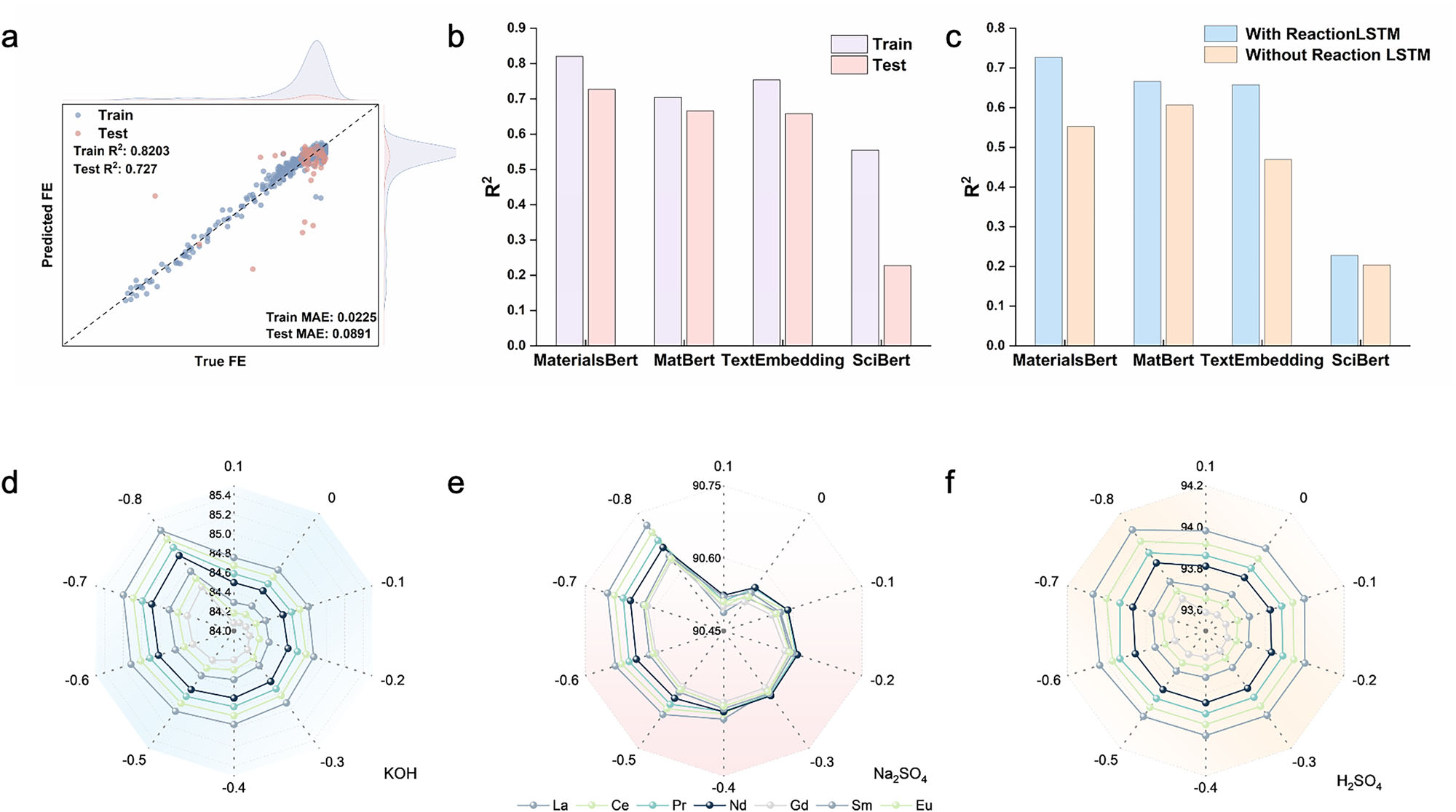
A random train/test split left the two sets more than 58% similar on average, so information leaked. The authors instead split by catalyst type, holding out a random subset of types that never appear in training. Under that split MatSemNet reaches a training R² of 0.8203 and a test R² of 0.727, with training MAE 0.0225 and test MAE 0.0891.[S1][S2]
0.727 vs 0.3147
test R² of MatSemNet and of five conventional models trained on numerical and categorical features only (random forest, SVR, XGBoost, GBDT, LightGBM) under the same grouped split; the best of those is random forest at 0.3147[S2]
+31.56%
relative gain in test R² from adding ReactionLSTM with the MaterialsBERT encoder; 11.61%, 9.72% and 40.22% with SciBERT, MatBERT and Text-embedding-3-large[S1]
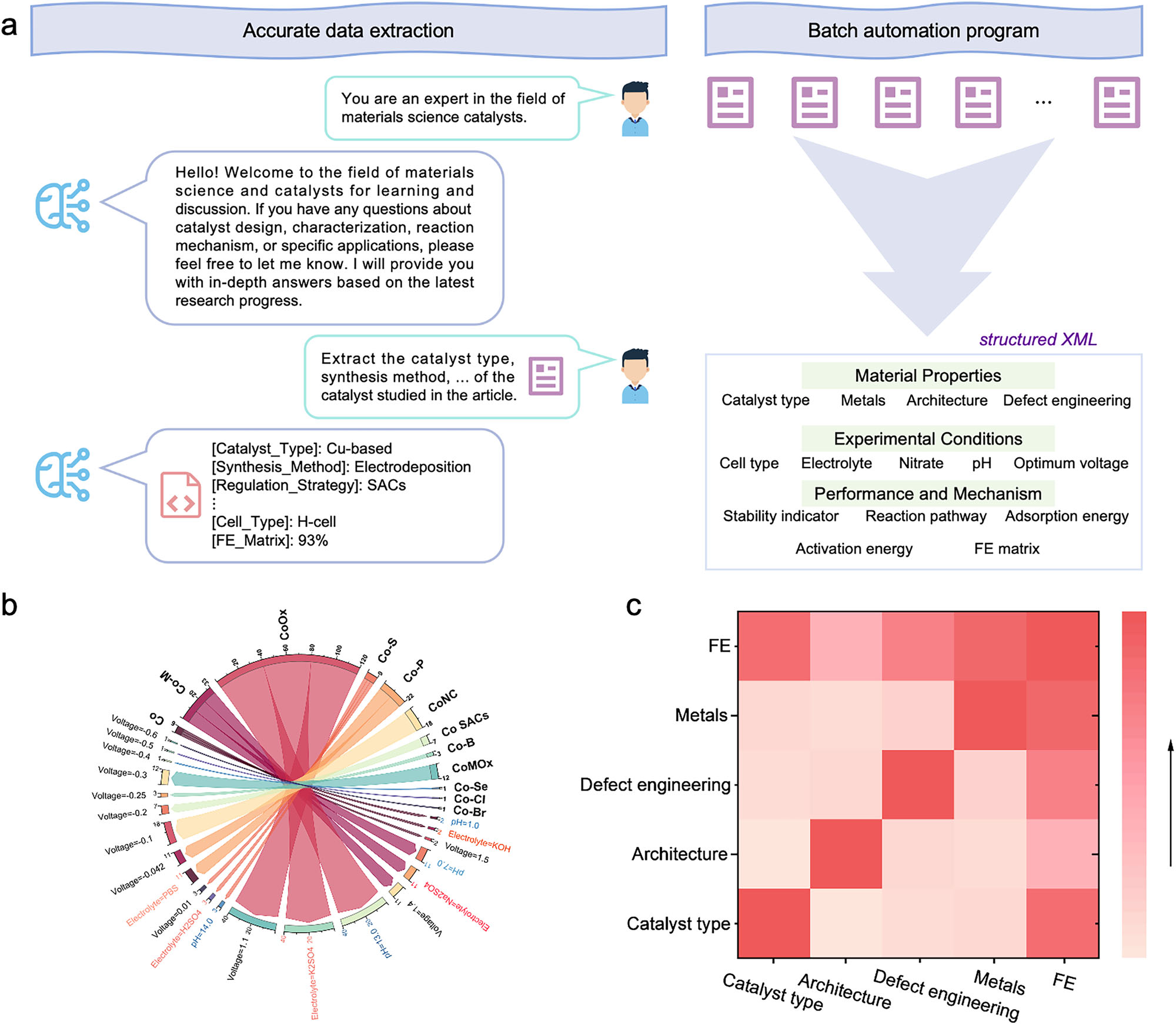
Paper Fig. 1: a, LLM batch extraction structured into XML; b, distribution of Co-based electrocatalysts across electrochemical conditions in the literature; c, Pearson correlations between material features and Faradaic efficiency. Liu, Jiang et al., npj Computational Materials (2026), CC BY-NC-ND 4.0; image unmodified. [S1]
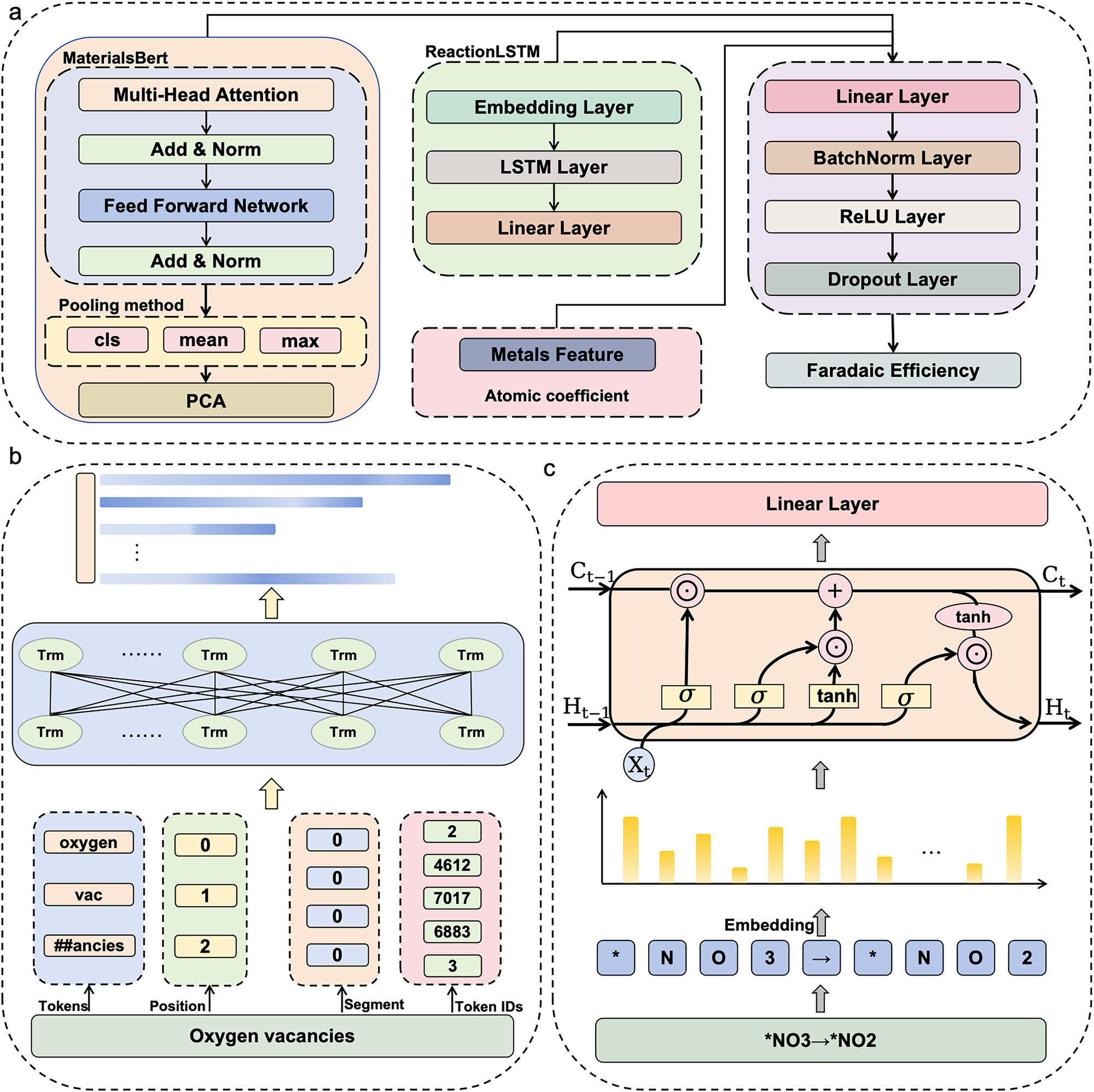
Paper Fig. 2: MaterialsBERT encodes text and ReactionLSTM encodes literature-reported reaction pathways; with metal features they feed a DNN that predicts Faradaic efficiency. Liu, Jiang et al., npj Computational Materials (2026), CC BY-NC-ND 4.0; image unmodified. [S1]
02What changed
Workflow updateEvaluation updateCatalysis models trained on mined literature usually stop at a parity plot or a ranked list of candidates.
A ranking learned from the literature was tested by synthesizing the whole series: the bottom of the list as well as the top.
What the model proposed
The authors fixed the CoOx system, added La, Ce, Pr, Nd, Sm, Eu and Gd in turn, and varied electrolyte and voltage with every other feature held constant, asking the model for each one's Faradaic efficiency. In acidic, neutral and alkaline media alike the model put the La-containing system highest. The predicted alkaline order was La > Ce > Pr > Nd > Sm > Gd > Eu. The model's absolute values were highest in acid; the authors caution that hydrogen evolution competes strongly there, so predictions in that regime are read only as relative trends.[S1]
Rare earths do appear in the training set (La 10 times, Ce 11, Pr 3, Nd 2, Eu 2, Gd 1, Sm none), but by the authors' check none is a simple rare-earth-doped spinel Co₃O₄ matching the experimental series.[S2]
What people decided
The model did not pick this family from open chemical space. CoOx was chosen by the authors from the literature statistics; the rare-earth series was chosen on chemical grounds: most rare earths sit at a stable +3 state while ionic radius and 4f configuration vary systematically, making them a controlled comparison. The paper also says the compositions 'were not predefined based on prior experimental preference but emerged from model-based screening'. Both sentences stand in the paper; the accurate reading is that the authors bounded the family and the model ordered it.[S1]
The electrolyte to test was a human call too. The model predicted the highest efficiencies in acid; the authors, weighing dominant hydrogen evolution in acid and slow kinetics in neutral media, made alkaline the focus. Faradaic efficiency and yield were quantified only in 1 M KOH; neutral and acidic media got LSV currents only.[S1]
03Why it matters
Which decisions can a literature-trained screening model be trusted with?
- Fit for screening and ranking, not yet for predicting absolute efficiency: all seven alkaline predictions sit on an 84.0-85.4% axis, far narrower than the model's own test error.
- Test a screening model on the whole list it ranks, bottom included, not just on its top pick.
The authors themselves position the model as a trend-oriented screening and prioritization tool, not a surrogate for performance: agreement between prediction and experiment is 'mainly reflected at the performance-ranking level'. The numbers say the same. In the paper's Fig. 3d the seven dopants' alkaline predictions are drawn on a radial axis running from 84.0% to 85.4%, while the model's MAE on the held-out test set is 0.0891. Read on a 0-1 scale for Faradaic efficiency (the paper does not state the scale), that is about nine percentage points, far wider than the predicted gaps between dopants. What the seven samples tested is an order, not an absolute efficiency. The reverse holds too: the test R² measures fit to literature data and is not evidence that the ranking is right; only the seven-sample experiment speaks to that.[S1][S2]
Making and testing all seven is the most valuable choice in the paper's experimental design. Making only the top pick shows at most that the model's choice was decent; making the whole series tests the order itself. The cost is that the sample is seven, quantified in one electrolyte, the bottom three are indistinguishable in the measurements, and the paper does not say how many times each point was repeated.
The ranking test still lacks a control: would a chemist's intuition have made the same first pick? La-doped Co₃O₄ for nitrate electroreduction had already been published (for example a Science China Materials paper on La-doped electron-deficient Co₃O₄ and a Journal of Rare Earths paper on La-doped Co₃O₄ nanoneedle arrays, both 2025), and the paper's own comparison table lists a La-Co₃O₄/CC at 96.4% Faradaic efficiency and 9.14 mg h⁻¹ cm⁻² in 0.1 M NaOH. The model's first pick was right, but it was not a material nobody had thought of.[S2][S3][S4]
04Evidence status and boundaries
Evidence rung 4 / 5 · Tested in the physical world · Physical validationEvidence status
Proven
- Seven RE-doped Co₃O₄ made; XRD, Raman, XPS, ICP-OES
- All seven measured in 1 M KOH beside undoped Co₃O₄
- In acid, currents fall short of the model's high-FE forecast (HER)
- XPS runs against the defect account: Co²⁺/Co³⁺ 1.68 (La) → 1.85 (Eu)
Boundaries
Suggested
- La's edge is electronic (DFT, in situ Raman)
- Acid and neutral order rests on currents, not FE
Unknown
- Whether it beats a chemist's pick (La-Co₃O₄ was known)
- Repeats per bar: error bars drawn, n and meaning not stated
- Independent replication; data and code on request only
ClaimThe measured order matches the prediction to 4th; the last three do not separate: Sm ≈ Gd ≈ Eu.
Measured above how many of the others (1 M KOH, paper's stated order)
ReadingOrder from the text on Fig. 5d, the same for FE and yield; of the seven only La's value (85.5%) is printed. All hold 1.14-1.28 wt% rare earth (ICP-OES), so loading does not set the order. Fig. 5d draws error bars, but the paper states neither the number of repeats nor what they show.
What was measured.
All seven samples are nanorods that keep the spinel structure; the main XRD peaks shift to lower angle and the Raman A1g mode moves, pointing to lattice incorporation. ICP-OES puts rare-earth content between 1.14 and 1.28 wt%, nearly equal across samples (nominal loading 5 mol%). In 1 M KOH the measured order of Faradaic efficiency and yield is La > Ce > Pr > Nd > Sm ≈ Gd ≈ Eu (the order as the paper's text states it); of the seven, only La's values are printed, the rest are drawn as bars in Fig. 5d. La-Co₃O₄ reaches 85.5% and 28.3 mg h⁻¹ cm⁻², which the text places at −0.5 V vs. RHE after 1 h of electrolysis (see below on the potential), and ran 30 one-hour chronoamperometry cycles at −0.6 V in 1.0 M KOH with 0.1 M NO₃⁻. Fig. 5d is labelled 1 M KOH and gives no nitrate concentration.[S1][S2]
Against which baseline.
The direct performance control is undoped Co₃O₄ in the same lab under the same conditions; La-Co₃O₄ and Ce-Co₃O₄ are also set against literature Co-based catalysts, but those numbers come from other electrolytes, potentials and electrodes. The control for predictive skill is five conventional ML models: MatSemNet has the highest test R², yet its test MAE (0.0891) is the largest of the six (the worst, since lower is better), with the five baselines at 0.0672-0.0766; the paper concedes some tree models reach 'comparable' MAE. These are fit metrics on literature data and say nothing about whether the ranking is right; the evidence for the ranking is the seven-sample experiment alone. No control for selection (a random pick or a chemist's pick) was run.[S1][S2]
Known limitation: the mechanism fits the order only in part.
DFT nitrate adsorption energies are La −3.41, Ce −2.02, Pr −1.88 and Nd −1.65 eV, with the heavier rare earths and undoped Co₃O₄ between −0.94 and −1.13 eV, matching the measured order, though the bottom three (Sm −0.97, Gd −1.00, Eu −1.13 eV) are bunched too, and in the reverse of the model's predicted order. In situ Raman shows NH₃ signals on La-Co₃O₄ 100 mV earlier than on undoped Co₃O₄. The defect account runs against the measurements: every doped sample has a higher Co²⁺/Co³⁺ ratio than undoped Co₃O₄'s 1.62, which the paper reads as rare earths adding defects, and its Discussion credits light rare earths with inducing surface defects; but the ratio climbs from 1.68 for La to 1.85 for Eu, the reverse of the performance order. On the paper's own reading the best sample, La, has the fewest defects, so 'rare earths add defects' cannot explain the ranking.[S1][S2]
Inconsistencies and gaps in the preview.
The text places the 85.5% and 28.3 mg h⁻¹ cm⁻² at −0.5 V vs. RHE, while in Fig. 5d the tallest La-Co₃O₄ Faradaic-efficiency bar belongs to the −0.6 V series, the −0.5 V efficiency and yield bars are both clearly lower, and the stability run is at −0.6 V; the calcination temperature is 350 °C in the Results and Fig. 4a but 300 °C in the Methods. The Methods have no electrochemistry section: the cell and the reference electrode are not described, and the electrode area S that the yield equation divides by is never defined; nor is what the error bars show or how many repeats stand behind them. As of 27 September 2026 the accepted preview is still the only version online (no Version of Record yet, and no arXiv or other preprint found), so each of these points should be checked against the Version of Record.[S1]
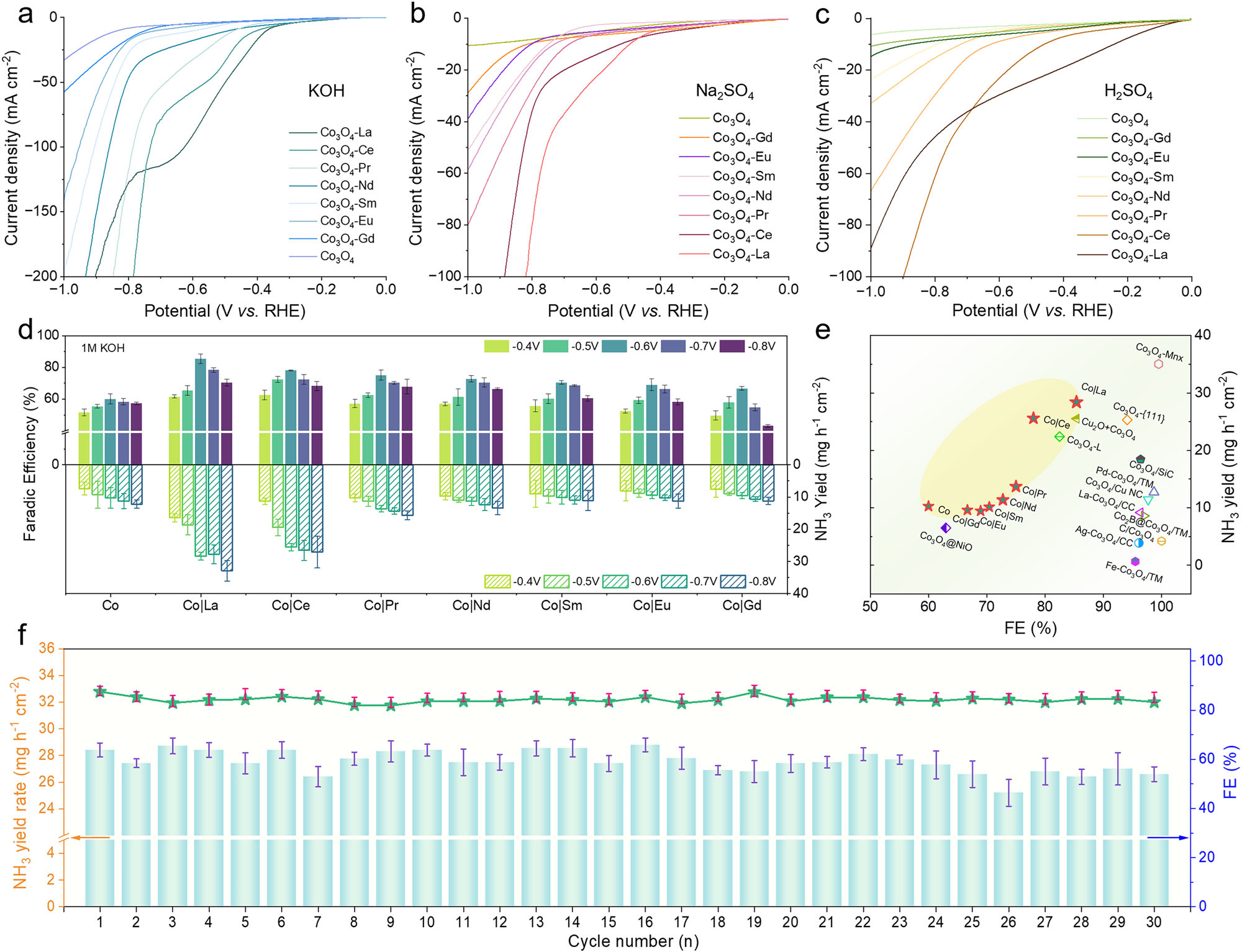
Paper Fig. 5: a-c, LSV in alkaline (KOH), neutral (Na₂SO₄) and acidic (H₂SO₄) electrolytes; d, Faradaic efficiency and yield at −0.4 to −0.8 V in 1 M KOH, with error bars whose meaning and number of repeats the paper does not state; e, comparison with literature catalysts; f, 30 one-hour chronoamperometry cycles of La-Co₃O₄ at −0.6 V in 1.0 M KOH with 0.1 M NO₃⁻. Liu, Jiang et al., npj Computational Materials (2026), CC BY-NC-ND 4.0; image unmodified. [S1]
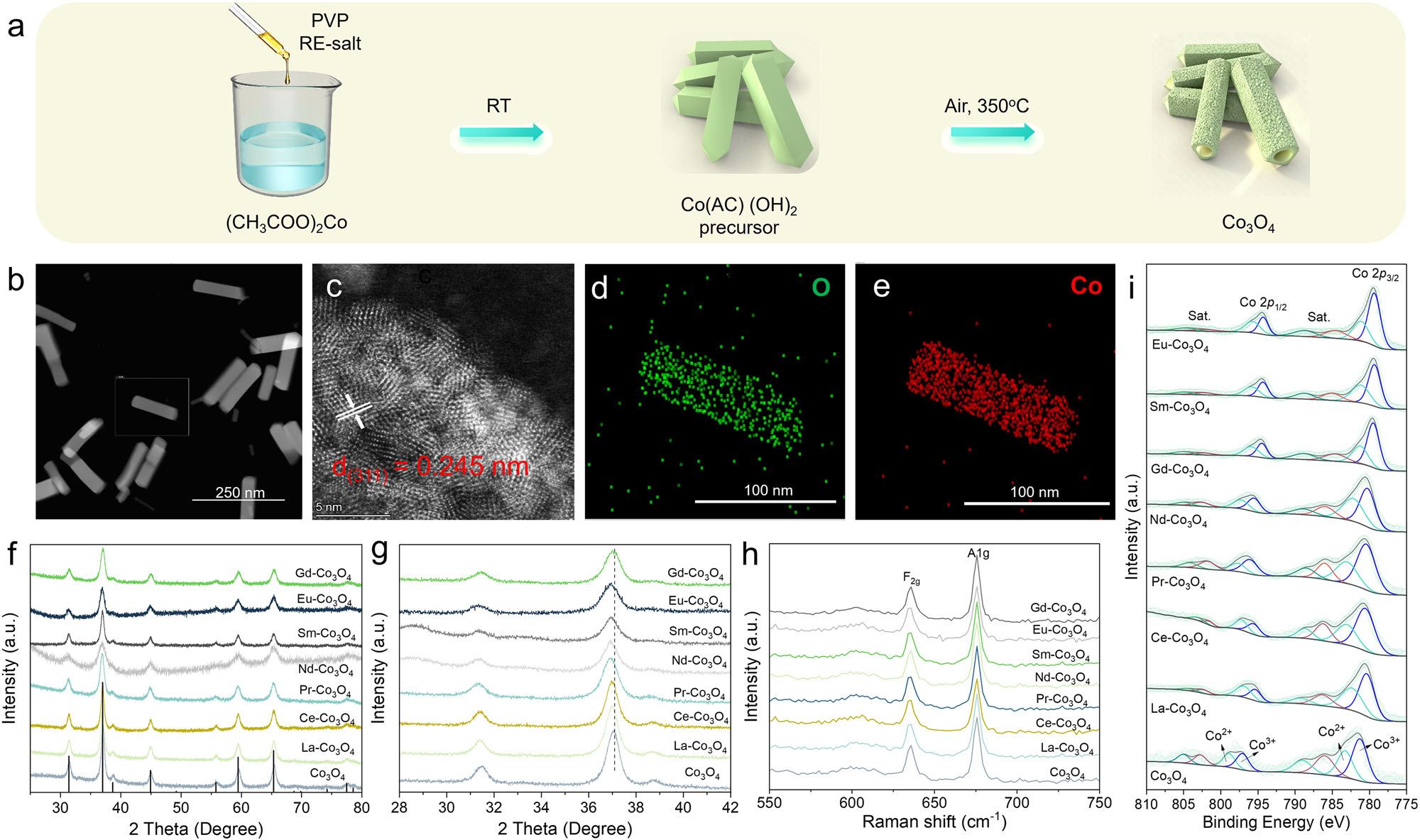
Paper Fig. 4: a, synthesis route; b-e, electron microscopy and elemental maps of the precursor and Co₃O₄; f-i, XRD, Raman and Co 2p XPS of the seven doped samples. Liu, Jiang et al., npj Computational Materials (2026), CC BY-NC-ND 4.0; image unmodified. [S1]
05What I learned
- Transferable insight
- The literature model's useful output was an order inside a family chemists had already chosen, not a new material.
- Design heuristic
- When a model ranks a series, make the whole series: the bottom of the list tests the model as much as the top.
- Reading heuristic
- Ask who set the search space and the conditions: here the authors chose Co₃O₄, the rare earths and the alkali.
- Watch next
- A prospective test beyond Co-based oxides, or against a chemist's pick, with the extracted dataset released.
A literature model fits ranking within a family
Literature data are heterogeneous and noisy, so a model trained on them gets absolute values wrong; within a chemically comparable series, where the errors are roughly shared, the order can still be useful. This paper used the model where it is strongest and described it honestly as such.
'Model-designed catalyst' should be read narrowly
The authors chose the family, the element range and the test electrolyte; the model supplied an order within them; the lab made and tested every candidate. The top pick, La-Co₃O₄, had been reported before. The accurate statement is that a literature-trained model correctly ordered a dopant series the authors chose, not that a model discovered a new catalyst.[S1][S3]
A higher R² is not a smaller error
MatSemNet's test R² is far above the conventional baselines while its test MAE is the largest: the worst point-by-point error of the six. It reproduces the test set's variance better without being more accurate point by point, consistent with using it to screen and rank candidates rather than to predict absolute efficiency, and a reason to read both metrics in papers like this. Keep the two layers of evidence apart as well: the paper cites R² 0.727 as support for reliable ranking, but no fit metric proves a ranking; the ranking conclusion here rests only on the seven-sample experiment.[S2]
What would change the judgment
If the model's order held beyond Co-based oxides on candidates registered in advance, or its first pick beat one a chemist made independently, the work would move from 'ranked a known family correctly' to 'can steer a search'. The dataset and code are available only on request from the corresponding authors; independent reproduction starts when they are released.[S1]
As one imageTo save and share→Sources
Factual claims link to original announcements, project lists, trial records or journal papers where possible. Research plans are kept separate from completed results.
- S1A multimodal semantic learning framework for data-driven discovery of nitrate-to-ammonia electrocatalystsnpj Computational Materials · Liu, Jiang et al. · 2026.09.15 · Peer-reviewed paper · accepted-article preview · Open Access
- S2Supplementary Informationnpj Computational Materials · Liu, Jiang et al. · 2026.09.15 · Supplement: prompts, baseline table, training-set coverage, ICP-OES
- S3Enhancing nitrate electroreduction for ammonia production over electron-deficient Co₃O₄ with La doping regulationScience China Materials · He et al. · 2025 · Prior work · citation checked on Crossref, full text not read
- S4Enhancing electrocatalytic nitrate reduction performance of Co₃O₄ nanoneedle arrays by La-dopingJournal of Rare Earths · Yu et al. · 2025.07 · Prior work · citation checked on Crossref, full text not read