
Paper & System· Evidence · Frontier
How Does a Chemistry PDF Become Data an AI Can Use?
MinerU.Chem turns chemistry papers into traceable, auditable data that software can keep processing—from molecular drawings and SMILES to compound identifiers and reaction relationships.
●Technical report + public system + module evaluations
Current boundary:document-level end-to-end accuracy has not yet been reported
This work advances:Reads chemistry papers into traceable structured data
- MODELUnderstand / predict
- DECIDEChoose next
- INTERACTAct / measure
- UPDATEChange next round
Series Context
MinerU.Chem series | From chemistry PDFs to machine-usable reaction data
01 | What happened
Chemistry parsing begins where PDF extraction ends
OpenDataLab at Shanghai AI Laboratory released the MinerU.Chem technical report with collaborators from East China Normal, Tongji, Fudan, Shanghai Jiao Tong, Peking University and other institutions. It asks a concrete question: how can an organic-chemistry PDF become data that can be searched, computed over, audited and reused by models?[S1]
General PDF parsers can already identify titles, paragraphs, formulas and tables. Chemistry introduces another layer. A reaction scheme contains substrates, products, catalysts, temperatures and sequence for a chemist, yet may remain a single rectangular image block to a document system.[S1]
Finishing PDF parsing does not mean the chemistry inside has been parsed. MinerU.Chem adds the missing layer after document parsing: chemistry parsing.
02 | What Changed
From page regions to source-linked molecular and reaction records
Not one model, but a pipeline
MinerU.Chem does not ask one model to jump from a whole PDF page to a reaction database. MinerU first parses the page; a chemistry-specific filter then decides whether a figure or table contains chemistry, keeping microscopy and ordinary charts away from more expensive specialist models.[S1]
The system then locates molecular drawings and nearby identifiers such as 1a, 2b or compound 7, linking visual structures to references in the paper. Only then does OCSR reconstruct a molecular graph and export machine-readable formats such as MolFile and SMILES.[S1]
Reaction-diagram parsing comes last: which molecules are reactants and products, whether text near an arrow is reagent, solvent or temperature, and how several arrows form successive steps. Together, the five modules turn image recognition into a document-to-data pipeline.[S1][S3]
A SMILES string without knowing whether the paper calls it 2b or 7c is hard to audit. A set of molecules without reaction relationships is still a stack of molecule cards, not a synthesis route.
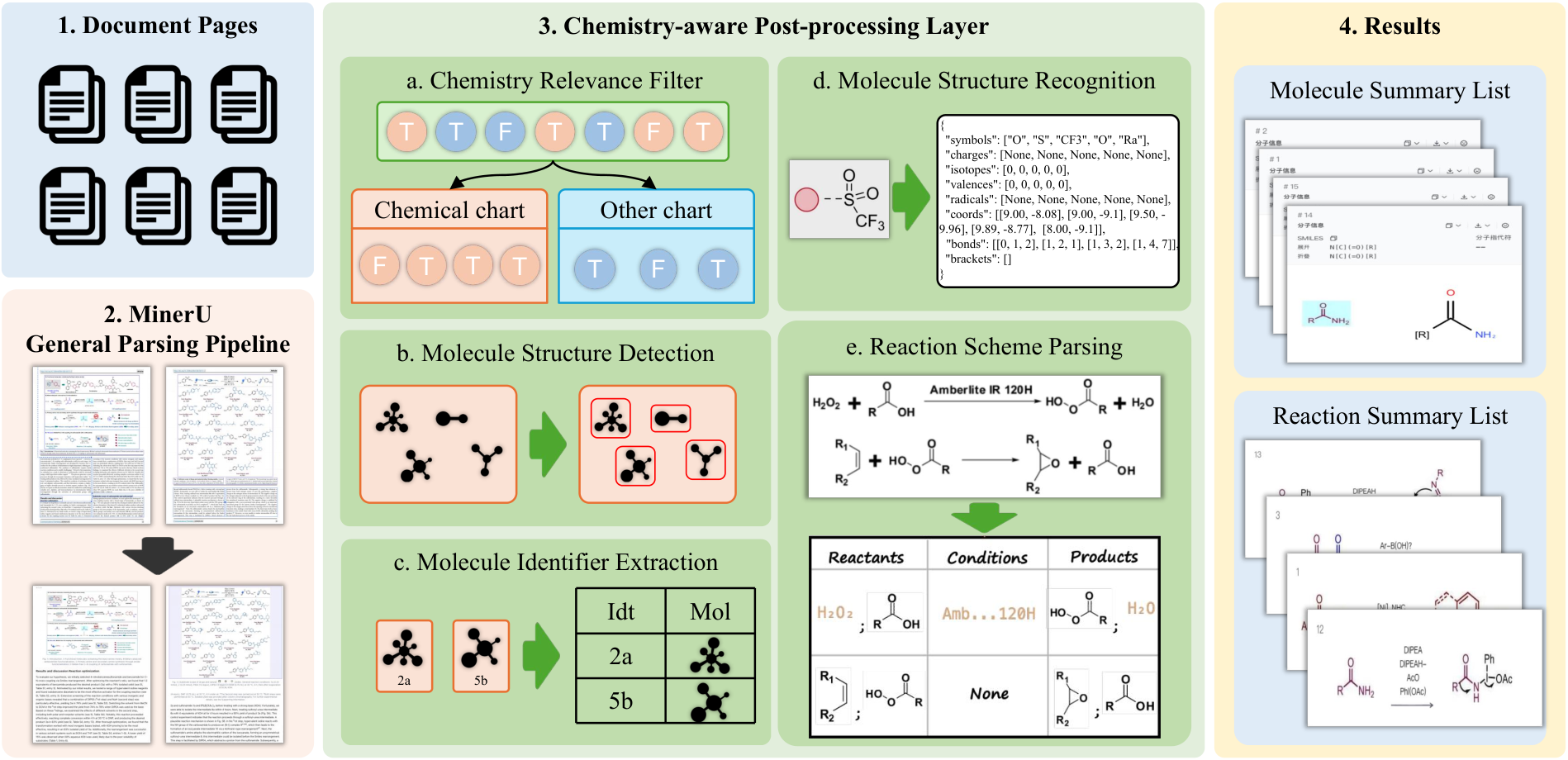
Paper Fig. 1. Read from the MinerU-parsed PDF pages on the left, through chemistry filtering, molecule detection, identifier extraction, structure recognition and reaction parsing, to the two structured summary lists on the right. Yang et al., arXiv (2026), CC BY-NC-SA 4.0. [S1]
The output is an evidence index, not a summary
A Molecule Summary List stores source location, compound identifier, structure representation and MolFile/SMILES for each molecule. A Reaction Summary List then organizes reactants, products and conditions and links them back to molecule records.[S1]
The part worth noticing is not JSON itself, but traceability. If stereochemistry is wrong, a reviewer can return to the page and original bounding box. A fluent summary is hard to debug; a structured record with source location can be sampled, relabeled and corrected.[S1]
A useful way to read MinerU.Chem is as a chemical evidence index layered over a PDF.
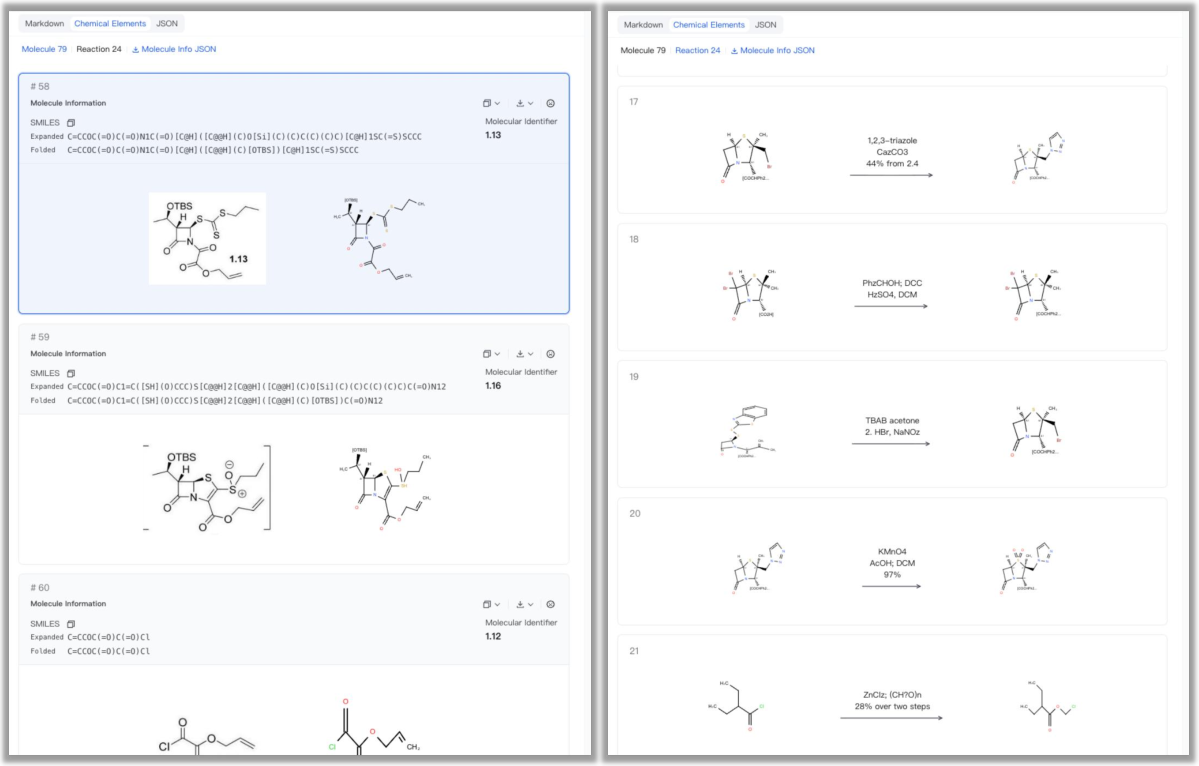
Paper Fig. 2. The molecule view records SMILES, identifiers, source images and recognized structures; the reaction view turns successive steps into auditable reaction records. Yang et al., arXiv (2026), CC BY-NC-SA 4.0. [S1]
Why SMILES alone is not enough
Real papers contain more than textbook SMILES: Ph, Et, Bu, Markush fragments, polymer repeat units, wavy bonds, coordination bonds and unusual valence. If the figure says Ph but extraction expands it into a full phenyl ring to produce a standard SMILES, the output may be chemically valid while no longer faithfully matching the source.[S2][S1]
CARBON preserves not only atoms and bonds but also 2D coordinates, abbreviations and complex properties that ordinary SMILES struggle to carry, then exports common formats from that richer intermediate representation. The principle matters more than the format name: first preserve what the paper actually shows; standardization comes second.[S2][S1]
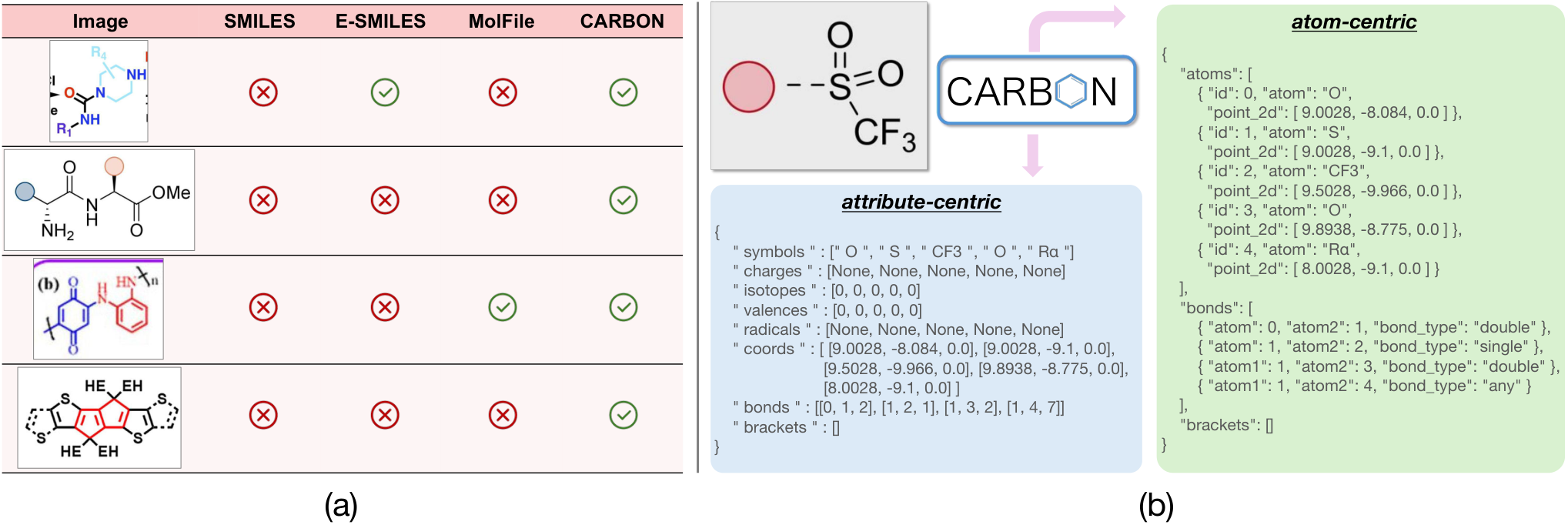
Paper Fig. 4. The left compares how representations handle Markush structures, unusual bonds and repeating units; the right shows how CARBON retains atoms, bonds, properties and 2D coordinates. Yang et al., arXiv (2026), CC BY-NC-SA 4.0. [S1]
03 | Key figures
93.02% is a module result—not document-level accuracy
chemistry-specific processing modules[S1]
fully graph-annotated structures in the revised MolRecBench-Wild[S1]
samples validly convertible to SMILES and included in SMILES evaluation[S1]
GTR-VL-1.4.13 SMILES exact match on that subset[S1]
graph accuracy across 5,024 graph-annotated samples[S1]
04 | Why it matters
Turning the literature into usable training and retrieval data
The easiest number to misread is 93.02%. It is not document-level extraction accuracy, but exact match for one structure-recognition module on a particular benchmark subset. Detection and identifier matching come before it; reaction parsing and document-level linking come after it. End-to-end correctness is a different measure.[S1]
The more interesting question is not how many points AI OCR gained, but where AI-for-chemistry training data will come from. Decades of synthesis knowledge live in papers, supporting information and patents, often in reaction schemes and molecular drawings. As long as those remain pixels, reaction prediction, retrosynthesis, condition modeling and new chemistry foundation models cannot consume them directly.
MinerU.Chem aims to shorten the distance from human-readable literature to machine-usable scientific data. The hard part is not merely running models at scale, but preserving extraction and provenance together.
WHAT CHANGED
- AI4S layer
- Scientific data / Chemistry literature mining
- Original bottleneck
- A large share of chemical knowledge remained trapped in figures and reaction-scheme pixels
- What changed
- Chemistry-region filtering, structure detection, identifier recognition, OCSR and reaction parsing now follow general document parsing
- Key evidence
- Source-linked Molecule Summary Lists and Reaction Summary Lists
- Still unsolved
- Document-level accuracy, complex Markush/R-groups, multi-step routes and the cost of human review
EVIDENCE IN CONTEXT
- Editorial status
- Frontier
- Evidence setting
- Retrospective or simulated
- How the evidence was produced
- Retrospective
- Provenance and access
- Technical report · Public system
- Evidence ceiling
- It shows that modular chemistry-document extraction works on public samples, but does not establish database-ready accuracy for complete papers.
05 | Evidence status and boundaries
The missing metric is end-to-end document correctness
This is a technical report and deployed system, but its strongest quantitative results concern individual modules rather than end-to-end document extraction. A mismatched compound identifier or condition attached to the neighboring arrow can still yield a perfectly valid-looking but incorrect database record.[S1]
Complex Markush structures, R-groups, cross-page references and multi-step routes remain clear boundaries. MinerU.Chem is better understood as high-throughput first-pass processing and a doorway to human review. The critical metrics are how many correct records a paper yields and how much human time is needed to repair the rest.
06 | What I Learned
Provenance is part of the scientific data product
Scientific document parsing begins where OCR endsA chemistry reaction scheme is a graph; a materials paper may contain a phase diagram; a biology paper, a pathway. A general parser finds what is on the page. A domain system must understand what it means scientifically.
Scientific data needs provenance, not only accuracyAn incorrect stereocenter silently entering a training database is different from a chatbot making a verbal mistake. Source page, bounding box and compound ID may not look like AI, but they are core infrastructure.
The most useful automation is often not unattendedLarge-scale machine extraction that focuses human time on difficult Markush structures, low-confidence cases and cross-page linking may be more valuable than insisting on full autonomy.
The literature remains a data mine not yet fully available to AIAs models improve, architecture is not always the bottleneck. A great deal of valuable scientific knowledge may simply remain unstructured.
Sources
Factual claims link to original announcements, project lists, trial records or journal papers where possible. Research plans are kept separate from completed results.
- S1MinerU.Chem: A High-Precision System for Optical Chemical Structure and Reaction RecognitionOpenDataLab / arXiv · 2026.08.04 · Technical report
- S2MolRecBench-Wild: A Real-World Benchmark for Optical Chemical Structure RecognitionOpenDataLab / arXiv · 2026.05.07 · Paper and dataset
- S3RxnCaption: Reformulating Reaction Diagram Parsing as Visual Prompt Guided CaptioningCVPR 2026 · 2026 · Peer-reviewed paper
- S4MinerU online parserOpenDataLab · 2026 · Public system