

Synthesis
Same Model, Different Harness: What Three Studies Show About the System Around a Model
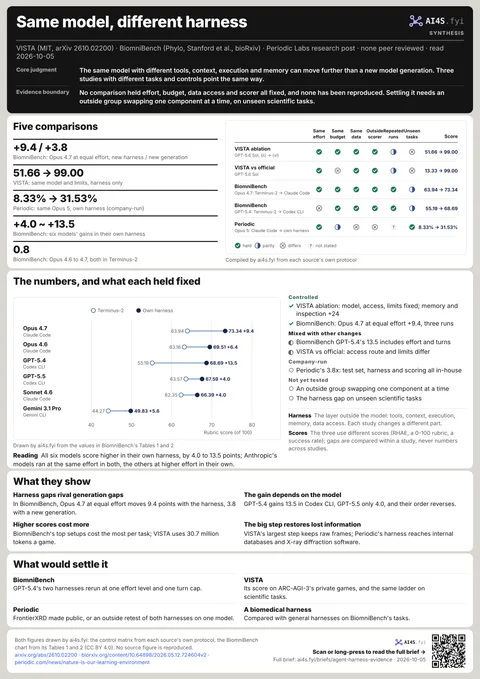
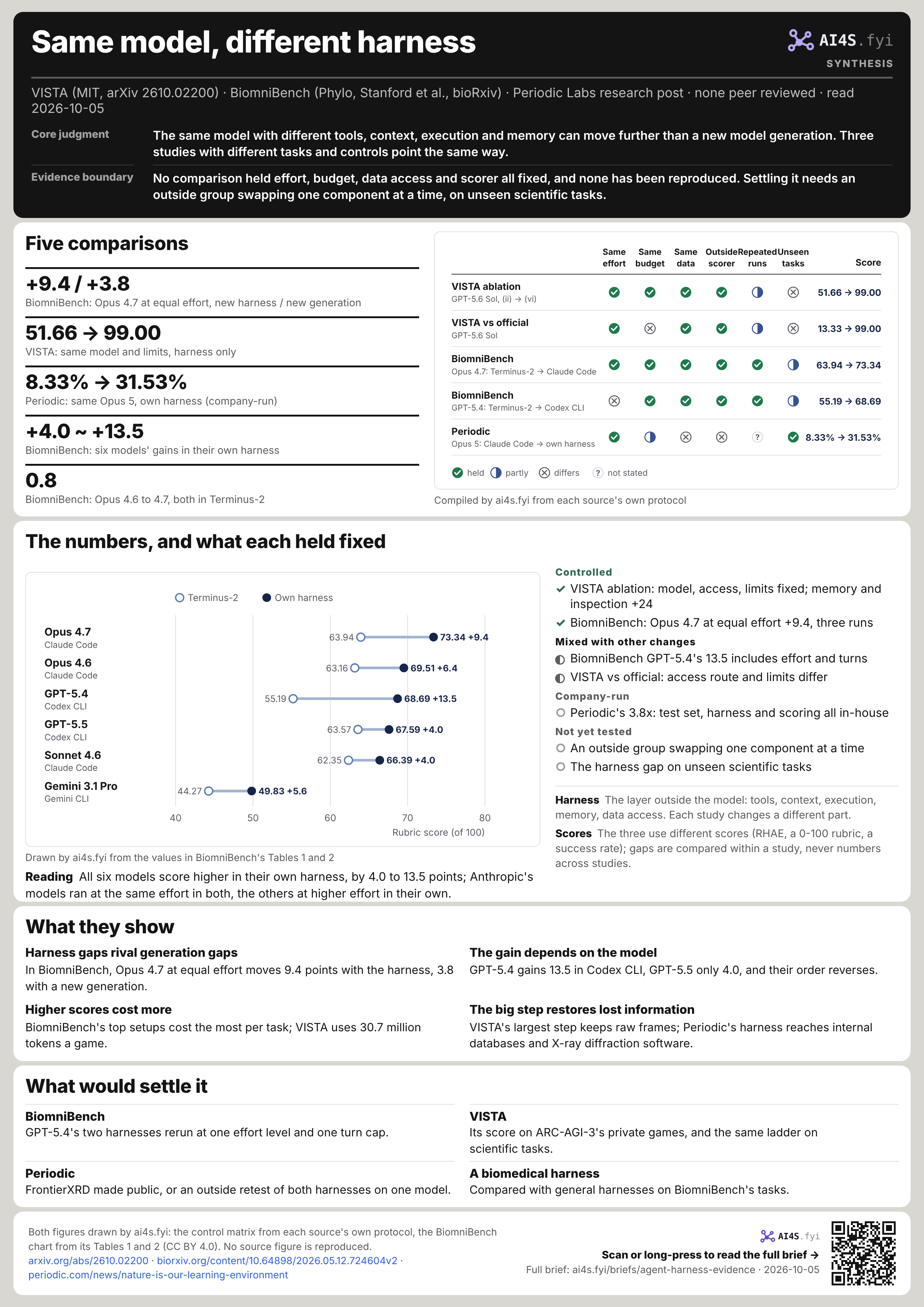
MIT's VISTA, BiomniBench from Phylo, Stanford and others, and Periodic Labs each ran one model in different harnesses on the same tasks. They point the same way, but in every comparison something besides the harness changed too.
◆Three sources + a control matrix

- Core judgment
- The same model with different tools, context, execution and memory can move further than a new model generation. Three studies with different tasks and controls point the same way.
- Evidence boundary
- No comparison held effort, budget, data access and scorer all fixed, and none has been reproduced. Settling it needs an outside group swapping one component at a time, on unseen scientific tasks.
+9.4 / +3.8BiomniBench: Opus 4.7 at equal effort, new harness / new generation
51.66 → 99.00VISTA: same model and limits, harness only
8.33% → 31.53%Periodic: same Opus 5, own harness (company-run)
+4.0 ~ +13.5BiomniBench: six models' gains in their own harness
0.8BiomniBench: Opus 4.6 to 4.7, both in Terminus-2
01Five comparisons
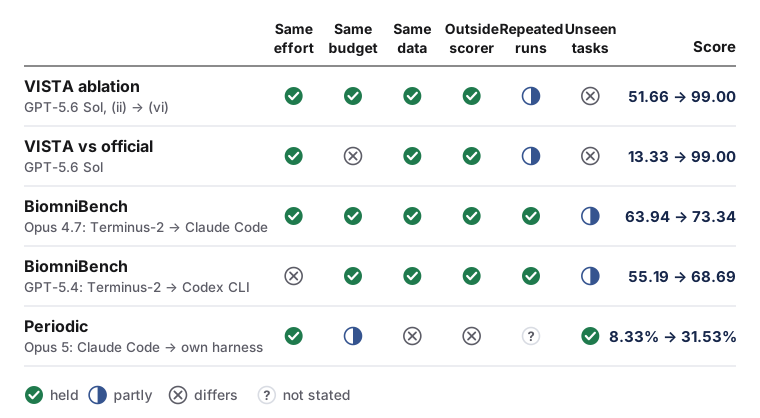
This brief reads three studies together: VISTA from Kaiming He's group at MIT (a tech report of 1 October 2026, in game environments), BiomniBench from Phylo, Stanford and others (a bioRxiv preprint of 12 May 2026, v2 posted 18 May, on biomedical data analysis), and Periodic Labs' research post of 15 September 2026 (XRD phase analysis). Each runs one model in different surrounding systems on the same tasks, and each reports a large gap. This site has a brief on VISTA and one on Periodic; this one asks only what the three show together, and what they do not.[S2][S1][S3]
What 'harness' means here
All three say harness, meaning the layer outside the model: what tools it gets, how context is managed, where it executes, what it remembers, what data it can reach. But each changes a different part. VISTA changes how the model sees and remembers: image input, every frame kept as it was, zoom and replay on demand, pixel reads, plus two notes. BiomniBench compares four off-the-shelf general coding agents (Terminus-2, Claude Code, Codex CLI, Gemini CLI) on the same tasks, data and container. Periodic's own harness adds the company's internal structure and simulation databases and lab context on top of tools, while the comparison gets only open databases and software.[S2][S1][S3]
02The numbers, and what each held fixed
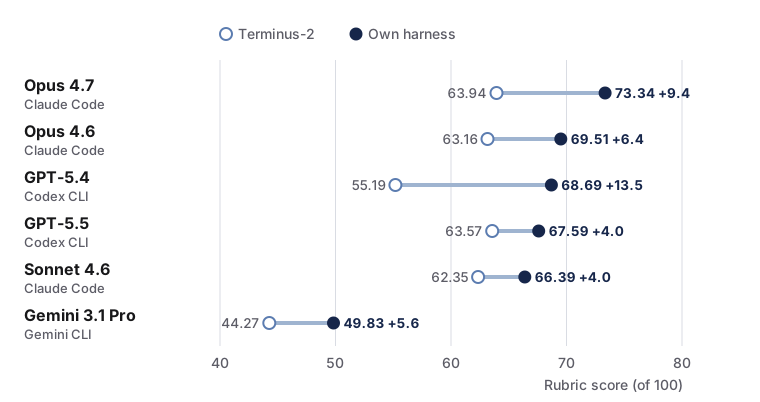
ReadingAll six models score higher in their own harness, by 4.0 to 13.5 points; Anthropic's models ran at the same effort in both, the others at higher effort in their own.
Controlled
- VISTA ablation: model, access, limits fixed; memory and inspection +24
- BiomniBench: Opus 4.7 at equal effort +9.4, three runs
Mixed with other changes
- BiomniBench GPT-5.4's 13.5 includes effort and turns
- VISTA vs official: access route and limits differ
Company-run
- Periodic's 3.8x: test set, harness and scoring all in-house
Not yet tested
- An outside group swapping one component at a time
- The harness gap on unseen scientific tasks
HarnessThe layer outside the model: tools, context, execution, memory, data access. Each study changes a different part.
ScoresThe three use different scores (RHAE, a 0-100 rubric, a success rate); gaps are compared within a study, never numbers across studies.
In BiomniBench, every model does better in its own harness
Table 1 puts nine models in the same Terminus-2 harness: the top four, Opus 4.7 (63.94), GPT-5.5 (63.57), Opus 4.6 (63.16) and Sonnet 4.6 (62.35), sit within 1.6 points, and open-weight GLM-5.1, Qwen 3.6 and Kimi K2.6 trail by 3 to 5. Table 2 puts six models in their own vendor's harness: Opus 4.7 scores 73.34 in Claude Code (+9.4), Opus 4.6 69.51 (+6.4), GPT-5.4 68.69 in Codex CLI (+13.5), GPT-5.5 67.59 (+4.0), Sonnet 4.6 66.39 (+4.0) and Gemini 3.1 Pro 49.83 in Gemini CLI (+5.6). Each setup ran three times, and the standard deviation across the three means, 0.3 to 1.8 points, is smaller than these gaps.[S1]
Reasoning effort was not matched everywhere
BiomniBench's Appendix A.1 states that Anthropic's models ran in Terminus-2's adaptive variant at effort=max, and in Claude Code also at effort=max, so the Opus and Sonnet gaps are at equal effort. The other models ran in Terminus-2 at reasoning_effort=high (the most that harness supports) and in Codex CLI at xhigh, with Gemini CLI on a dynamic thinking budget (thinkingBudget=-1). The paper calls GPT-5.4's 13.5 points 'attributable entirely to agent architecture', but the effort differs too. The harness also changes how the run goes: GPT-5.4's median turns go from 13 to 82, GPT-5.5's cost per task from $1.98 to $4.58 and Opus 4.7's from $0.87 to $2.52; the highest-scoring setups are also the most expensive.[S1]
Who scores
VISTA uses ARC-AGI-3's official RHAE formula. BiomniBench has an LLM judge score each task against its expert rubric, criterion by criterion; the authors compared five candidate judges on 597 criteria from 35 tasks and chose Gemini 3.1 Pro, which agreed best with experts (82% per-criterion accuracy, linear-weighted κ 0.70), and recommend human review for high-stakes use. Periodic uses an LLM-judge ensemble of Opus 5 and GPT-5.6 Sol calibrated against expert ratings, on FrontierXRD, 134 unpublished samples from its own labs. The three scores use different units, so this brief compares gaps within each study and never numbers across studies.[S2][S1][S3]
03What they show
- Harness gaps rival generation gaps
- In BiomniBench, Opus 4.7 at equal effort moves 9.4 points with the harness, 3.8 with a new generation.
- The gain depends on the model
- GPT-5.4 gains 13.5 in Codex CLI, GPT-5.5 only 4.0, and their order reverses.
- Higher scores cost more
- BiomniBench's top setups cost the most per task; VISTA uses 30.7 million tokens a game.
- The big step restores lost information
- VISTA's largest step keeps raw frames; Periodic's harness reaches internal databases and X-ray diffraction software.
What the three support together
The firmest conclusion is the direction: across games, biomedical data analysis and XRD, the same model moved a long way when its surrounding system changed, and in BiomniBench, the only study with a generation comparison, the harness gap at equal effort (Opus 4.7's 9.4 points) exceeds the gap between adjacent model generations (3.8). So 'model X scores Z on task Y' is unclear without the harness, the effort and the budget. That stands firmer than any one study, because the three differ in how they compare and what tasks they use, yet point the same way.[S2][S1][S3]
What they do not yet support
They cannot yet say how much the harness design itself contributes. VISTA's comparison with the official baseline mixes in access route and limits; BiomniBench's largest gap mixes in reasoning effort; Periodic's mixes in private databases and is company-run. None has been reproduced by an independent group; VISTA tested only public games, BiomniBench's tasks are adapted from published papers (agents were barred from reading them, and spot checks found no shortcuts, but memory cannot be ruled out), and only Periodic used samples never published. Nor is there one shape of a good harness: VISTA's gain comes from keeping raw observations, Periodic's from data access and domain software, and BiomniBench's authors argue that no off-the-shelf harness was built for biomedicine, leaving room for one that is.[S2][S1][S3]
What it means for AI for Science
For anyone evaluating science agents, it means reporting the harness as part of what is tested: model, harness, effort, budget, data access, and without any one of them the number cannot be compared with anyone else's. For teams building science agents, it means investing in the harness may pay off sooner than waiting for the next model, but at a cost: BiomniBench's top setups cost the most per task, and VISTA uses 30.7 million tokens a game. Periodic builds its harness as a core system and runs all its model comparisons on it, which shows at least one frontier AI4S company already works this way; but its 3.8x is the least controlled of the three.[S1][S2][S3]
04What would settle it
- BiomniBenchGPT-5.4's two harnesses rerun at one effort level and one turn cap.
- VISTAIts score on ARC-AGI-3's private games, and the same ladder on scientific tasks.
- PeriodicFrontierXRD made public, or an outside retest of both harnesses on one model.
- A biomedical harnessCompared with general harnesses on BiomniBench's tasks.
Three kinds of evidence would turn the direction into a conclusion. First, controlled substitution: an outside group fixing model, effort and budget and swapping one harness component at a time (memory, tools, context management, data access) on scientific tasks, as VISTA did on games. Second, unseen tasks: ARC-AGI-3's private games, unpublished experimental data, or analyses that appear after a model's release. Third, independent reproduction: BiomniBench's dataset is public on Hugging Face, so other groups can retest with their own harnesses; Periodic's result waits on FrontierXRD going public or an outside retest.[S1][S2][S3]
As one imageTo save and share→Sources
Factual claims link to original announcements, project lists, trial records or journal papers where possible. Research plans are kept separate from completed results.
- S1BiomniBench: Process-level Evaluation of LLM Agents for Real-world Biomedical ResearchbioRxiv · Qu, Lu et al. (Phylo, Stanford et al.) · 2026.05.12 · Preprint v2, not peer reviewed · CC BY 4.0
- S2VISTA: A Visual Harness for Reasoning in an Interactive WorldarXiv:2610.02200 · Han, Hu, Qiu, Wu, He (MIT) · 2026.10.01 · Tech report, not peer reviewed · CC BY 4.0