

Papers & Evidence· Evidence · Frontier
AI Agents Are Beginning to Audit Scientific Knowledge
From a Nature report, an audit by SAI and three preprints: AI for Science needs faster verification as well as faster hypothesis generation. New verifier systems can audit papers, code and databases at scale, but they provide leads for investigation, not final verdicts.
◐Reported cases + agent audit + preprint evaluations
Current boundary: Systems can surface objective errors and reproducibility barriers at scale, but misses, false positives and execution failures prevent them from judging papers independently
This work advances: Audits database claims and attempts paper replication
- MODELUnderstand / predict
- DECIDEChoose next
- INTERACTTest against reality
- UPDATEChange next round
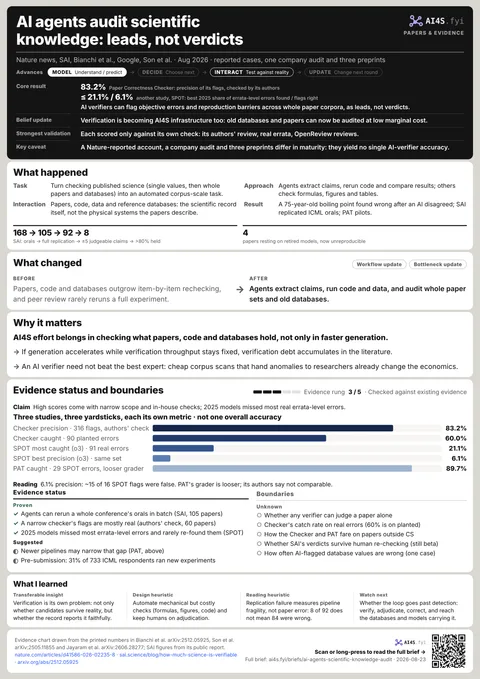
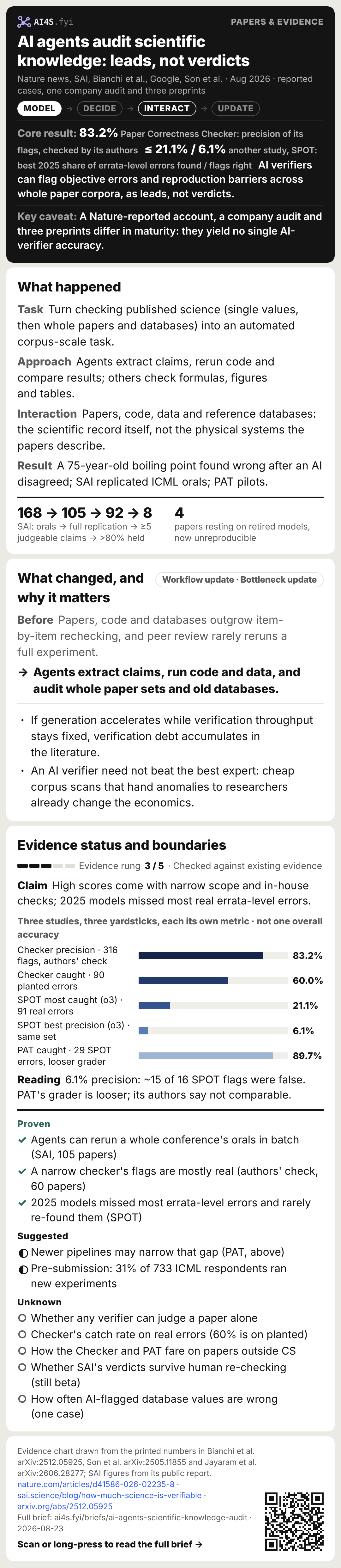
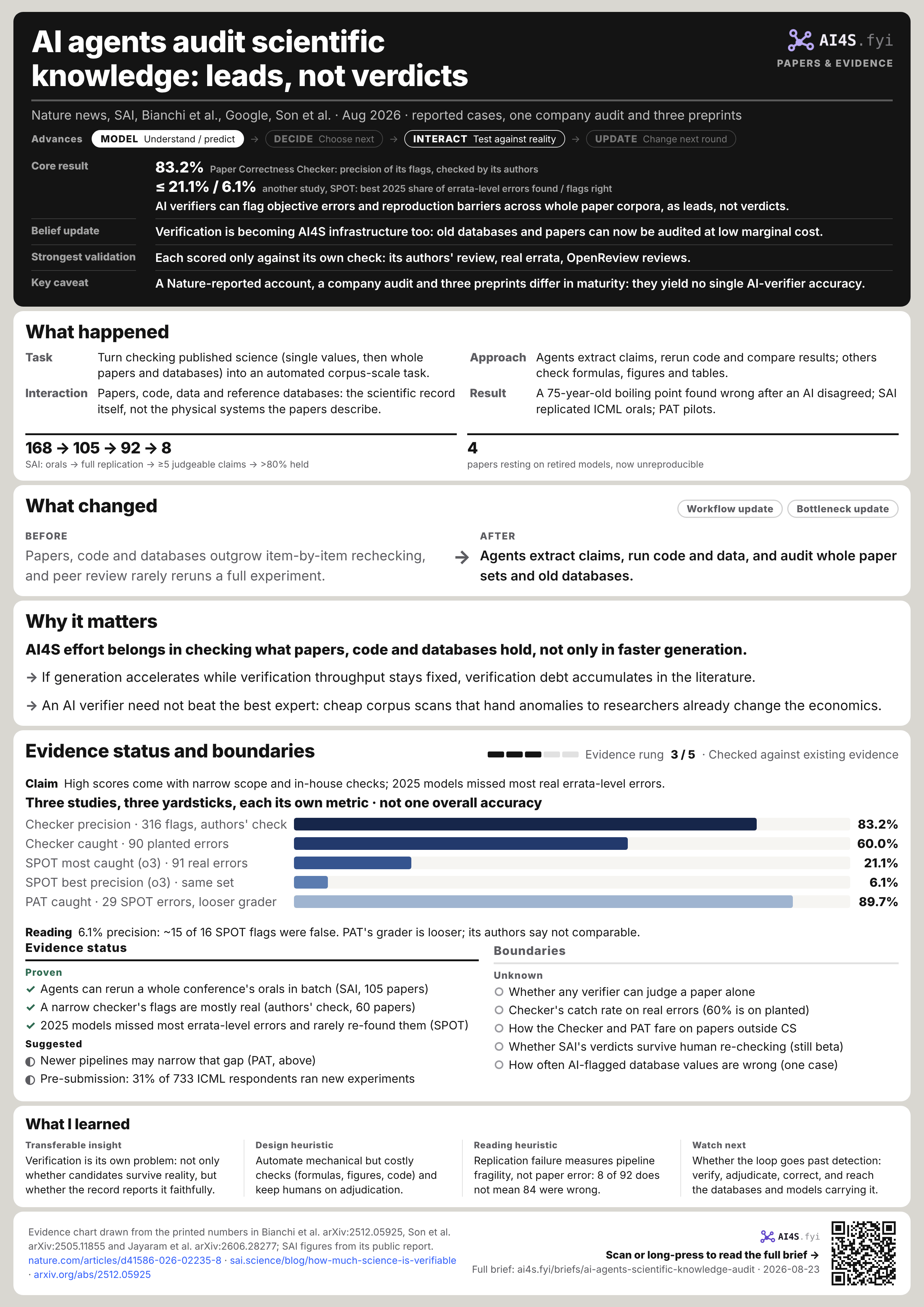
83.2%Paper Correctness Checker: precision of its flags, checked by its authors
≤ 21.1% / 6.1%another study, SPOT: best 2025 share of errata-level errors found / flags right
AI verifiers can flag objective errors and reproduction barriers across whole paper corpora, as leads, not verdicts.
- Belief update
- Verification is becoming AI4S infrastructure too: old databases and papers can now be audited at low marginal cost.
- Strongest validation
- Each scored only against its own check: its authors' review, real errata, OpenReview reviews.
- Key caveat
- A Nature-reported account, a company audit and three preprints differ in maturity: they yield no single AI-verifier accuracy.
01What happened
- Task
- Turn checking published science (single values, then whole papers and databases) into an automated corpus-scale task.
- Approach
- Agents extract claims, rerun code and compare results; others check formulas, figures and tables.
- Interaction
- Papers, code, data and reference databases: the scientific record itself, not the physical systems the papers describe.
- Result
- A 75-year-old boiling point found wrong after an AI disagreed; SAI replicated ICML orals; PAT pilots.
168 → 105 → 92 → 8SAI: orals → full replication → ≥5 judgeable claims → >80% held
4papers resting on retired models, now unreproducible
While using AI to predict molecular boiling points, Zhejiang Lab theoretical chemist Sebastian Pios found results that conflicted with a 75-year-old reference database. He initially suspected the model, but checking the primary literature showed that the database was wrong in this case. Nature reported two similar findings: a typo in an older paper and incorrect century-old measurements that later entered reference works.[S1]
The reliable step was not to trust the AI automatically. The disagreement became an anomaly signal, a researcher returned to the primary source, and only then was the error identified. AI did not overturn established science; it made a contradiction visible enough to investigate.[S1]
At the same time, verification is expanding from individual values to full papers. SAI agents extract central claims, retrieve code and data, rerun experiments where possible and compare outputs with reported results. Google's Paper Assistant Tool and Stanford's Paper Correctness Checker place verifiers at different points: before submission and after publication.[S2][S4][S3]
From one anomalous value to batch replication
SAI analyzed 168 ICML 2026 oral papers and completed full replication attempts for 105. Its current public report states that 92 of those papers contained at least five judgeable claims; 34 reproduced more than 40% of attempted claims, while eight exceeded 80%.[S2][S1]
The 8-of-92 figure is the easiest number to misuse. It does not mean only eight papers were correct. Automated replication depends on claim extraction, artifact retrieval, environment reconstruction, code execution and result matching. Missing files, broken dependencies, unavailable data or checkpoints, and agent execution errors can all lower the score.[S2][S1]
Pipeline failure is still informative. SAI reports common problems including code that does not run as released, underspecified experiments and outputs that differ from the paper; four papers depended on models that had already been retired. The audit primarily measures how fragile the path from manuscript narrative to verifiable result remains.[S2]
02What changed
Workflow updateBottleneck updatePapers, code and databases outgrow item-by-item rechecking, and peer review rarely reruns a full experiment.
Agents extract claims, run code and data, and audit whole paper sets and old databases.
Start with errors that have relatively clear answers
Federico Bianchi, James Zou and colleagues deliberately narrowed the Paper Correctness Checker to objective errors in formulas, derivations, calculations, figures and tables. It does not judge novelty, importance or writing quality. From a random sample of 60 papers with at least one flagged substantive mistake, the paper's own authors reviewed all 316 flagged issues by hand and confirmed 263, for 83.2% precision. Recall, measured separately on 90 planted mistakes, was 60.0%; recall on real mistakes was not measured.[S3]
In that analysis, the mean detected errors per NeurIPS paper rose from 3.8 in 2021 to 5.9 in 2025, a 55.3% increase. This does not prove that AI made papers worse; paper volume, complexity, research practices and reviewer workload also changed. It shows that consistent automated checking makes longitudinal audits possible. The paper itself treats the counts as a conservative lower estimate: with recall around 60%, missed mistakes are not counted.[S3]
Verifiers are moving upstream, before publication
Google offered the Paper Assistant Tool to STOC and ICML authors as private pre-submission feedback, not as a replacement for formal review. Among 733 ICML survey respondents, 35.4% said it identified substantive theoretical gaps requiring meaningful work, while 31% ran new experiments because of the feedback.[S4]
Verifier systems therefore occupy two positions. Before publication, they help prevent new errors from entering the literature; after publication, they audit papers and databases already inside the scientific corpus. One resembles quality control, while the other pays down accumulated verification debt.
03Why it matters
AI4S effort belongs in checking what papers, code and databases hold, not only in faster generation.
- If generation accelerates while verification throughput stays fixed, verification debt accumulates in the literature.
- An AI verifier need not beat the best expert: cheap corpus scans that hand anomalies to researchers already change the economics.
AI4S has focused heavily on generation: new molecules, proteins, materials and hypotheses. Scientific knowledge, however, is not the sum of generated candidates; it is a set of claims that can be checked, reproduced and corrected. If generation accelerates while verification throughput remains fixed, verification debt will accumulate.[S4]
Pios's case also shows that literature and databases are scientific infrastructure. A value moves from an experiment into a paper, handbook and database, then into later experiments and models. The longer it propagates, the further it drifts from its original provenance. Making old knowledge auditable supports not only reviewers but the foundations of training data and scientific decisions.[S1]
An AI verifier does not need to replace the best expert to be useful. If it can scan a large corpus at low marginal cost, reliably surface a subset of anomalies and hand supporting evidence to researchers, it already changes the economics of scientific verification.[S1]
04Evidence status and boundaries
Evidence rung 3 / 5 · Checked against existing evidence · Retrospective or simulatedEvidence status
Proven
- Agents can rerun a whole conference's orals in batch (SAI, 105 papers)
- A narrow checker's flags are mostly real (authors' check, 60 papers)
- 2025 models missed most errata-level errors and rarely re-found them (SPOT)
Boundaries
Suggested
- Newer pipelines may narrow that gap (PAT, above)
- Pre-submission: 31% of 733 ICML respondents ran new experiments
Unknown
- Whether any verifier can judge a paper alone
- Checker's catch rate on real errors (60% is on planted)
- How the Checker and PAT fare on papers outside CS
- Whether SAI's verdicts survive human re-checking (still beta)
- How often AI-flagged database values are wrong (one case)
ClaimHigh scores come with narrow scope and in-house checks; 2025 models missed most real errata-level errors.
Three studies, three yardsticks, each its own metric · not one overall accuracy
Reading6.1% precision: ~15 of 16 SPOT flags were false. PAT's grader is looser; its authors say not comparable.
Nature combines cases at different maturity levels.
The boiling-point case is a researcher account reported by Nature without a corresponding primary publication. SAI is a company-published online audit, while the Paper Correctness Checker, PAT and SPOT are preprints. They do not form one comparable measure of AI-verifier accuracy.[S1][S2][S3][S4][S5]
The five sources side by side: study, object, sample, metric, check
Nature's boiling-point case.
Object: one value in a reference database. Sample: one case. Metric: none. Check: a researcher returning to the primary literature. It is an illustrative case (an AI disagreement led a person to an error) and measures no system's accuracy.[S1]
SAI's audit.
Object: all 168 ICML 2026 orals; 105 full replication attempts, 92 with at least five judgeable claims. Metric: share of attempted claims reproduced per paper, reduced-scope runs included. Check: comparison with the paper's reported results, and its review comments against OpenReview reviews (it covered 78% of points that two or more human reviewers agreed on). The replication results were not checked by people, and SAI says the system is in beta and can make mistakes.[S2]
Paper Correctness Checker.
Object: objective mistakes in 2,100 ICLR and NeurIPS papers plus 400 TMLR papers. Metrics: 83.2% precision (60 papers, 316 flags, checked by the authors) and 60.0% recall (90 planted mistakes).[S3]
Google's PAT.
Object: pre-submission papers at STOC (124 respondents) and ICML (733). Metrics: author self-reports (35.4% of ICML respondents said it found theory errors taking over an hour to fix, 31% ran new experiments), plus recall on 29 SPOT errors, each grade audited by one of the authors.[S4]
The SPOT benchmark.
Object: 83 published papers from ten fields with 91 errors that prompted errata or retractions, cross-checked with the original authors and annotators. Metrics: recall, precision and consistency over eight runs. It tests general-purpose models, not one of the dedicated systems above.[S5]
Replication failure is not a paper-error rate.
Of the 92 papers with at least five judgeable claims, 34 reproduced more than 40% of attempted claims and eight more than 80%. The 8-of-92 result depends on paper artifacts, environment dependencies, resource availability, evaluation definitions and agent capability. It shows that end-to-end automated verification is difficult; it does not mean 84 papers were wrong.[S2]
The verifier must itself be verified.
SPOT contains 83 papers from ten fields and 91 errors serious enough to trigger errata or retractions. Its May 2025 evaluation found no model above 21.1% recall or 6.1% precision (both o3), and across eight independent runs models rarely re-found the same error. A year later, Google's PAT paper took a subset of 26 math and CS papers with 29 equation or proof errors: PAT recalled 89.7% and a single Gemini 3.1 Pro call 55.2%, but with a looser grader that accepts logically equivalent descriptions, and its authors say the numbers are not directly comparable to SPOT's. The appropriate role today is triage, not verdict.[S5][S4]
Checking objective errors and judging scientific value are different tasks.
Formula signs, table inconsistencies, executable code and data provenance often have relatively clear checks. Novelty, significance and interpretation require domain context and judgment. Current systems deliberately preserve that human boundary.[S3][S4]
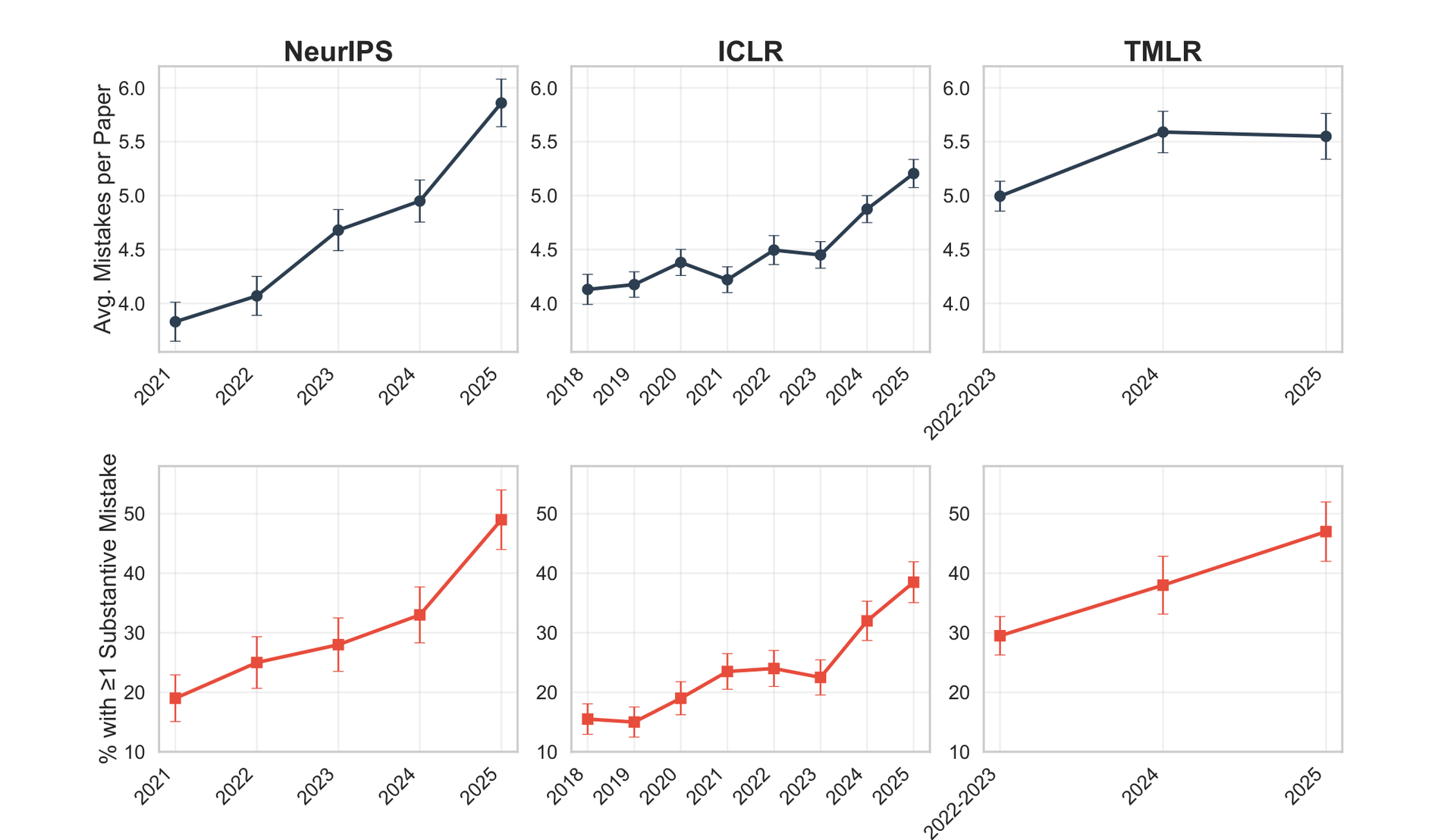
Paper Fig. 1: top, mean detected mistakes per paper; bottom, share of papers with at least one potentially substantive mistake. NeurIPS rose from 3.8 in 2021 to 5.9 in 2025; that does not show research quality fell, since volume, complexity and review load also changed, and the counts are a conservative floor. Bianchi et al., arXiv:2512.05925, CC BY 4.0. [S3]
05What I learned
- Transferable insight
- Verification is its own problem: not only whether candidates survive reality, but whether the record reports it faithfully.
- Design heuristic
- Automate mechanical but costly checks (formulas, figures, code) and keep humans on adjudication.
- Reading heuristic
- Replication failure measures pipeline fragility, not paper error: 8 of 92 does not mean 84 were wrong.
- Watch next
- Whether the loop goes past detection: verify, adjudicate, correct, and reach the databases and models carrying it.
Verification does not happen only in laboratories
Experimental verification asks whether a candidate survives contact with reality. Knowledge verification asks whether papers, databases and handbooks record reality faithfully. Both prevent unchecked outputs from flowing into the next round of learning and decisions.
Publication should not permanently freeze knowledge
A healthier knowledge lifecycle may be Published → Reused → Periodically audited → Corrected. AI makes the last two stages technically imaginable across a large corpus.
Automate checks that are mechanical but expensive
Formulas, calculations, figure consistency, code execution and reference provenance consume time but often have clear evidence standards. Letting AI expand coverage while humans retain judgment and adjudication is more realistic than automating accept-or-reject decisions.
Generation scaling creates demand for verification scaling
As AI lowers the cost of coding, analysis and manuscript production, scientific output will keep growing. If verification capacity does not grow with it, later research will rest on foundations that are increasingly hard to inspect.
After detection, correction propagation becomes the bottleneck
Confirming that a 75-year-old database value is wrong completes only the first step. The correction must reach copied databases, citing papers, dependent experiments and models trained on the value. The full loop is Detection → Verification → Adjudication → Correction → Propagation.
As one imageTo save and share→Sources
Factual claims link to original announcements, project lists, trial records or journal papers where possible. Research plans are kept separate from completed results.
- S1AI agents are checking the scientific literature — and spotting decades-old errorsNature · Chris Stokel-Walker · 2026.08.06 · News in Focus · reported overview
- S2How much science is verifiable? Results from replicating ICML 2026 oral papersSAI · 2026.07.22 · Company-published agent audit
- S3To Err Is Human: Systematic Quantification of Errors in Published AI Papers via LLM AnalysisBianchi et al. · arXiv · 2025.12.05 · Preprint
- S4Towards Automating Scientific Review with Google's Paper Assistant ToolGoogle Research · arXiv · 2026.06.26 · Preprint + conference pilots
- S5When AI Co-Scientists Fail: SPOT—a Benchmark for Automated Verification of Scientific ResearchSon et al. · arXiv · 2025.05.17 · Preprint and benchmark