

Paper Brief
AlphaProtein Novo: de novo enzymes beat natural-sequence mining on practical chemistry for the first time, on selectivity and conditions, not on rate
Google DeepMind and Caltech generate an enzyme's backbone and sequence from a catalytic motif with a diffusion model, then filter on mechanism-specific readings of AlphaFold 3 predictions, testing 3,537 novel-scaffold designs across five reactions. On two practical problems: for piperidine synthesis, the best of 188 natural and engineered heme proteins they screened reached 30:70, while a design reached 99:1 at 94% enantiomeric excess; for degrading the plasticiser DEHP, the designs are worse than natural enzymes at room temperature but still work at 90 °C and in 75% acetonitrile, where two natural esterases are dead. The paper says itself that de novo rates remain orders of magnitude below natural or evolved enzymes.
◆Preprint + wet-lab assays + active-site knockout controls
Current boundary: The designs were synthesised, expressed, purified and measured, and knocking out the catalytic residues removed the activity: that much is tested. But the rates stay orders of magnitude below natural enzymes, the piperidine comparison is the authors' own screen, and the sequences are not released, so nobody outside can replicate
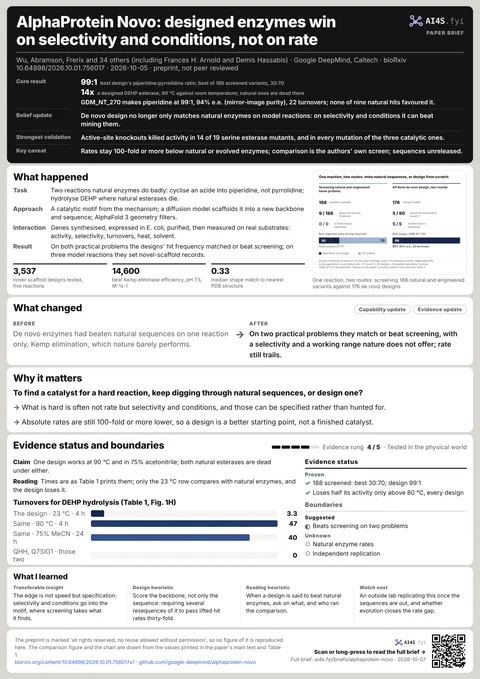
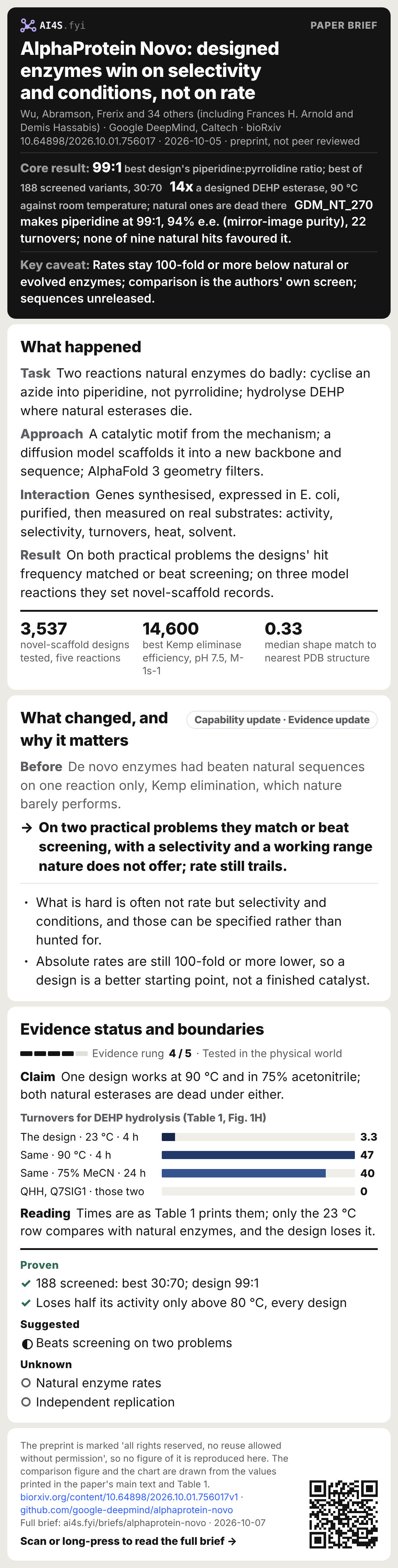
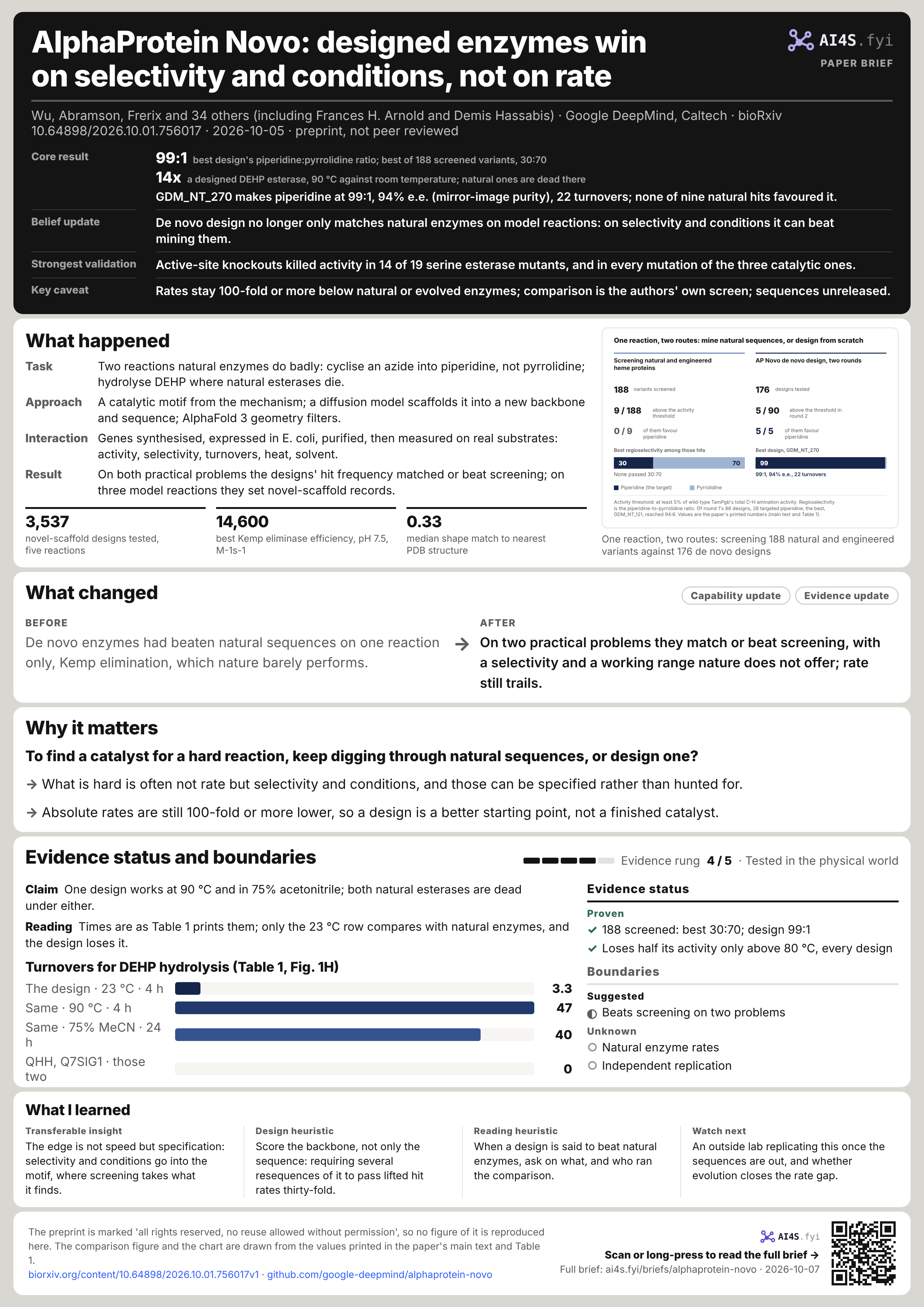
99:1best design's piperidine:pyrrolidine ratio; best of 188 screened variants, 30:70
14xa designed DEHP esterase, 90 °C against room temperature; natural ones are dead there
GDM_NT_270 makes piperidine at 99:1, 94% e.e. (mirror-image purity), 22 turnovers; none of nine natural hits favoured it.
- Belief update
- De novo design no longer only matches natural enzymes on model reactions: on selectivity and conditions it can beat mining them.
- Strongest validation
- Active-site knockouts killed activity in 14 of 19 serine esterase mutants, and in every mutation of the three catalytic ones.
- Key caveat
- Rates stay 100-fold or more below natural or evolved enzymes; comparison is the authors' own screen; sequences unreleased.
01What happened
- Task
- Two reactions natural enzymes do badly: cyclise an azide into piperidine, not pyrrolidine; hydrolyse DEHP where natural esterases die.
- Approach
- A catalytic motif from the mechanism; a diffusion model scaffolds it into a new backbone and sequence; AlphaFold 3 geometry filters.
- Interaction
- Genes synthesised, expressed in E. coli, purified, then measured on real substrates: activity, selectivity, turnovers, heat, solvent.
- Result
- On both practical problems the designs' hit frequency matched or beat screening; on three model reactions they set novel-scaffold records.
3,537novel-scaffold designs tested, five reactions
14,600best Kemp eliminase efficiency, pH 7.5, M-1s-1
0.33median shape match to nearest PDB structure
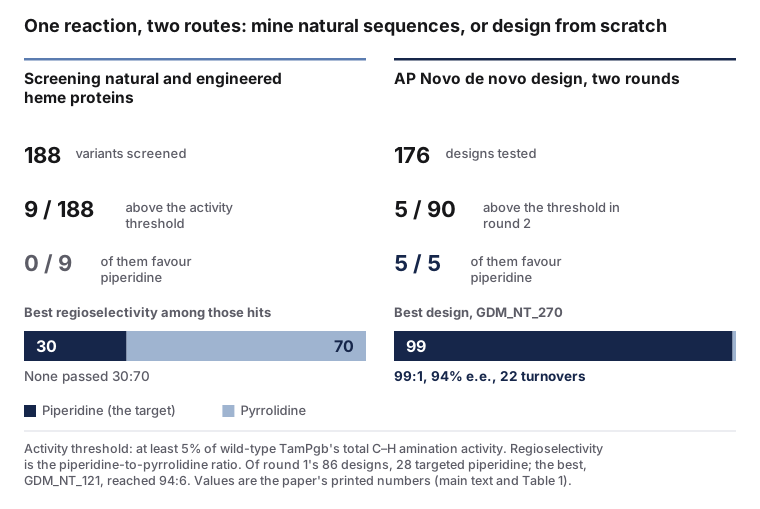
On 5 October 2026, Google DeepMind and Caltech posted the preprint 'Designing enzymes for new-to-nature chemistry and non-natural substrates with AlphaProtein Novo' (10.64898/2026.10.01.756017v1) on bioRxiv. There are 37 authors, with Zachary Wu, Josh Abramson, Thomas Frerix and eight others as equal first authors and Pushmeet Kohli and Jue Wang as corresponding authors; Frances H. Arnold, who won the 2018 Nobel Prize in Chemistry for the directed evolution of enzymes, is on the byline and her Caltech group did part of the wet work, while Demis Hassabis and Rob Fergus are listed as advising the project. It has not been peer reviewed. The authors declare a US provisional patent application on de novo protein and enzyme design using generative diffusion models and structure-prediction networks, and state that all but seven of them have commercial interests in the work.[S1]
The pipeline: generate a backbone, then filter on mechanism
AP Novo's method is motif scaffolding plus filtering. For each reaction the authors write a catalytic motif from a hypothesised mechanism: a set of sidechain functional groups plus small-molecule ligands modelled as the relevant intermediate. The motif goes to a diffusion model, which generates a protein structure holding it in the specified conformation; the process runs Gaussian diffusion over structure coordinates and masked discrete diffusion over the sequence at the same time, so it emits a sequence directly and does not strictly need a separate sequence-design model. In practice most designs still had their generated structure resequenced by LigandMPNN. Candidates are then filtered on structures predicted by AlphaFold 3, or by AF3-LA, a variant fine-tuned for leaving-atom handling. The code and weights are on GitHub: the code under Apache 2.0, the model parameters under separate terms that allow non-commercial use by non-commercial organisations only.[S1][S2]
Piperidine: a selectivity the natural repertoire does not hold
Under nitrene transfer, (5-azidopentyl)benzene can cyclise into the five-membered pyrrolidine or the six-membered piperidine. The pyrrolidine follows the geometrically favoured 1,5-hydrogen atom transfer; the piperidine is driven by the lower bond dissociation energy of the benzylic C-H bond. Piperidine is among the most common nitrogen scaffolds in FDA-approved drugs, so favouring the six-membered ring is worth something. The authors first did the standard thing and screened natural and previously engineered heme proteins: of 188 variants, nine reached at least 5% of wild-type TamPgb's total C-H amination activity, and none of those exceeded a 30:70 piperidine-to-pyrrolidine ratio. They then used AP Novo to design novel scaffolds holding a histidine-coordinated heme, modelled with either the nitrene intermediate or one of the two products, and picked 86 for a first round of testing; every subset yielded at least one enzyme above the threshold, with GDM_NT_141, designed as a pyrrolidine synthase, at 4:96 and GDM_NT_121, designed for piperidine, at 94:6. In a second round of 90 scaffolds aimed specifically at piperidine, five passed the threshold and all were highly selective; the best, GDM_NT_270, gave 22 turnovers at a 99:1 regioisomeric ratio and 94% enantiomeric excess, two orders of magnitude more piperidine turnover than wild-type TamPgb.[S1]
DEHP: the win is in the conditions, not in room-temperature activity
DEHP is a ubiquitous plasticiser and environmental contaminant whose two 2-ethylhexyl chains make it sterically hard for natural hydrolases; it is also nearly insoluble in water (about 0.3 mg/L), and the organic cosolvents that dissolve it inactivate most natural esterases. The authors took Ser-His-Asp triads and oxyanion-hole residues from natural hydrolase crystal structures as motifs and modelled RDKit-generated DEHP conformers into them as tetrahedral intermediates covalently linked to the catalytic serine. In a first round of 81 designs, four were three standard deviations above background; over two more rounds the novel-scaffold hit rate (at least 2% of the natural control QHH's activity) reached 11% and the recycled-scaffold rate 39%. For comparison, an earlier screen of 65 natural esterases found one active DEHPase. The seven structural families among the hits are below 0.5 TM-score from each other and from known natural esterases. On purified enzyme at room temperature in water the designs lose: the most active, GDM_DEHP_378, reaches 6% of QHH's MEHP production after four hours and 26% of Q7SIG1's (13% and 34% after 24 hours). But the most robust, GDM_DEHP_376, is 14-fold more active at 90 °C than at room temperature and 2-fold more active in 75% acetonitrile than in none, while both natural esterases, including the thermophile-derived Q7SIG1, are completely inactive under either condition. At 191 amino acids it is 60% smaller than QHH and 40% smaller than Q7SIG1, and expresses better in E. coli. The authors state that real bioremediation would still need more activity and full degradation of DEHP to phthalic acid.[S1]
02What changed
Capability updateEvidence updateDe novo enzymes had beaten natural sequences on one reaction only, Kemp elimination, which nature barely performs.
On two practical problems they match or beat screening, with a selectivity and a working range nature does not offer; rate still trails.
What changed is where de novo design sits in the workflow, not its ceiling on speed. The earlier consensus went roughly: on reactions natural enzymes have optimised, de novo trails by orders of magnitude; on reactions nature does not perform, de novo can produce something, but whether that beats finding a rough natural starting point and engineering it had never been tested on one problem. This paper runs that test, and the answer splits by case: for rate, mining natural sequences is still the safer bet; for a selectivity natural sequences cannot give, or for work at 90 °C or in 75% acetonitrile, design can write the requirement into the target. The authors also supply a scale reference: earlier methodological conclusions about de novo design rested on few designs and fewer scaffolds, where this tests 3,537 novel-scaffold designs across five reactions.[S1]
03Why it matters
To find a catalyst for a hard reaction, keep digging through natural sequences, or design one?
- What is hard is often not rate but selectivity and conditions, and those can be specified rather than hunted for.
- Absolute rates are still 100-fold or more lower, so a design is a better starting point, not a finished catalyst.
The paper's novelty is not a catalytic parameter but that it puts the two routes on the same problem for the first time: one reaction, one assay, one lab, 188 natural and engineered variants screened against 176 de novo designs. Until now de novo enzymes had been compared with natural sequences almost only on Kemp elimination, a reaction nature barely performs; on reactions natural enzymes have optimised, de novo rates still trail by orders of magnitude. Both problems the authors chose sidestep the race on rate: piperidine needs regioselectivity, DEHP needs an enzyme that still works under denaturing conditions. That is a judgement about where design belongs, not a claim that design has overtaken nature.[S1]
For anyone buying or building, there is a usable line here. If the target reaction is one nature already does well, design cannot buy speed today; if what is wanted is a selectivity nature does not offer, or work at a temperature, solvent or pH where natural enzymes die, design can write those conditions into the target, where screening can only get lucky. The DEHP campaign is the cleanest case: the same design loses to natural enzymes at room temperature and beats them at 90 °C and in 75% acetonitrile by the margin between working and not working at all. For where AI4S money goes, that suggests the near-term value of de novo design sits in industrial enzymes, bioremediation and non-natural substrates rather than in replacing metabolic enzymes evolution has already polished. That is this site's inference; the paper does not make the argument.[S1]
04Evidence status and boundaries
Evidence rung 4 / 5 · Tested in the physical worldEvidence status
Proven
- 188 screened: best 30:70; design 99:1
- Loses half its activity only above 80 °C, every design
Boundaries
Suggested
- Beats screening on two problems
Unknown
- Natural enzyme rates
- Independent replication
ClaimOne design works at 90 °C and in 75% acetonitrile; both natural esterases are dead under either.
Turnovers for DEHP hydrolysis (Table 1, Fig. 1H)
ReadingTimes are as Table 1 prints them; only the 23 °C row compares with natural enzymes, and the design loses it.
Catalytic parameters on three model reactions.
To work out how to filter, the authors ran multiple design-test-learn cycles on three model reactions. Kemp elimination: 1,536 novel-scaffold designs over seven rounds, a best-facet hit rate of 34%, and a best design, GDM_KE_1483, at kcat 18 s-1 and kcat/KM 14,600 M-1s-1 at pH 7.5, which is 70-fold above the best published novel-scaffold values but still one to two orders of magnitude below designs optimised with experimental feedback; at pH 10, kcat rises to 29.9 s-1 and kcat/KM to 44,940. Serine esterases on 4MU-Ac: 1,569 designs over eight rounds, a best-facet hit rate of 44%, and GDM_SE_2937 at kcat/KM 360,000 M-1s-1, which exceeds even the most active previous de novo designs that had been iteratively optimised against experiment. Carbene transfer (styrene cyclopropanation): 91 designs, 77 of which bound heme, 48 taken to chiral analysis; for each enantiomer the four most selective designs all gave the configuration they were designed for, with a diastereomeric ratio above 99:1 and 96% e.e. for the S,S product and 79% for R,R, all in a single round with no experimental feedback.[S1]
The fastest esterase looks like a natural one.
The 360,000 M-1s-1 figure needs one line of qualification. The authors checked and found that GDM_SE_2937's scaffold and active-site placement resemble natural serine esterases in the Protein Data Bank. They therefore defined natural serine esterase (NSE) topology as a TM-score above 0.45 to any PDB-annotated serine hydrolase with a scaffold-aligned triad RMSD under 5 Å: such designs are 16.4% of all novel-scaffold serine esterases but six of the top seven by kcat/KM. Excluding them, the best design, GDM_SE_2754, has a kcat/KM of 4,900 M-1s-1, about four times the best previous novel-scaffold value. Notably, even the natural-looking designs are usually under 20% identical in sequence to natural proteins. The top DEHPase designs all fall outside NSE topology.[S1]
What lifted the hit rates was scoring backbones, not sequences.
The authors call multi-resequence (MR) scoring their most important methodological finding: for one generated backbone, produce several LigandMPNN sequences and require every one of them to pass the same filters. In effect it asks whether the backbone itself robustly holds the catalytic groups where they belong, rather than whether this one sequence happens to. Thresholded retrospectively at 50% recall, hit rates rose 2.5-fold for Kemp elimination and 5.4-fold for serine esterases; applied prospectively, Kemp eliminases hit 23% (twice the unfiltered rate) and serine esterases up to 44% (thirty times). Adding multi-partial-diffusion scoring, which adds a little noise to an existing design and re-denoises it to get another sequence on a nearly identical backbone, and requiring 10 out of 10 to pass both, takes retrospective hit rates to 60% and 80%. From this the authors offer an explanation for why earlier iterative pipelines of repeated redesign and filtering worked: they may implicitly have been doing the same thing, selecting backbones with a larger accessible volume of functional sequence space.[S1]
The limits the paper states itself.
The conclusions are blunt about this. Building motifs takes real expertise, and a motif's influence on the outcome is not captured by the current filters; finding a design that passes filters often requires generating many samples, which can be prohibitive; and choosing an optimal backbone, or an optimal sequence for a given backbone, is far from solved. The one that matters most is the authors' own: de novo catalytic activities remain orders of magnitude below natural enzymes and those optimised by directed evolution, and this indicates that 'our models do not meaningfully model the physics of catalysis'. On data, all designed sequences, predicted structures and metadata are held until publication, so until then nobody outside can replicate these results.[S1]
05What I learned
- Transferable insight
- The edge is not speed but specification: selectivity and conditions go into the motif, where screening takes what it finds.
- Design heuristic
- Score the backbone, not only the sequence: requiring several resequences of it to pass lifted hit rates thirty-fold.
- Reading heuristic
- When a design is said to beat natural enzymes, ask on what, and who ran the comparison.
- Watch next
- An outside lab replicating this once the sequences are out, and whether evolution closes the rate gap.
'Understanding by creating', made operational
A method the authors use repeatedly is to turn a mechanistic hypothesis into a filterable geometry and then see whether it predicts real activity. In Kemp elimination, the predicted distance from the catalytic base to the N3 atom of the transition-state analogue 6-nitrobenzotriazole raised the hit rate 2.7-fold when applied retrospectively at 50% recall, and 3-fold when applied prospectively in the next round, with the best kobs rising from 0.49 s-1 to 1.38 s-1. That is not only yield: it makes a biochemical hypothesis falsifiable. For anyone running an AI-plus-experiment loop this is more transferable than any number: the filter is the hypothesis, and how much it lifts the hit rate is the test of it.
Two Nobel routes on one byline
The byline itself is worth recording: directed evolution (Arnold, Nobel 2018) and structure prediction (Hassabis, 2024) on one paper. It is not decoration, because the paper's argument is exactly that division of labour: de novo design supplies starting points the natural repertoire does not hold, and directed evolution takes the rate from there. The text calls the designed piperidine synthases better engineering starting points than natural sequences, not finished catalysts. If that division holds, the lesson for AI4S is that the round generative models win may not be replacing human experts but replacing the entry point of the experimental loop.
What is open is the code, not the designs
AP Novo's code is Apache 2.0 and the generator weights can be downloaded, but under separate terms that permit only non-commercial use by non-commercial organisations, which follows AlphaFold 3's pattern and is not the same thing as open source. More to the point, the sequences and structures of the 3,537 novel-scaffold designs are held until publication. So an outside lab can run the pipeline on its own targets today but cannot take this paper's specific enzymes and check its conclusions. That is why this site grades it at rung 4 with independence recorded as internal: the experiments were really done, by the same people who wrote the paper.
As one imageTo save and share→Sources
Factual claims link to original announcements, project lists, trial records or journal papers where possible. Research plans are kept separate from completed results.
- S1Designing enzymes for new-to-nature chemistry and non-natural substrates with AlphaProtein NovobioRxiv 10.64898/2026.10.01.756017 · Wu, Abramson, Frerix et al. · Google DeepMind, Caltech · 2026.10.05 · Preprint, not peer reviewed · all rights reserved
- S2google-deepmind/alphaprotein-novoGitHub · Google DeepMind · 2026.10.07 · Code under Apache 2.0; weights under separate non-commercial terms, read 2026-10-07