

Paper Brief· Evidence · Frontier
ANCHOR trains only the choice of compositions and lifts SUN from 1.1% to 22.1%; other potentials reverse its lead
A team at the Technical University of Denmark trains a GRPO policy to pick compositions and hands them to a frozen structure-prediction model. Under the authors' own evaluator, the share of stable, unique, new crystals rises from 1.1% to 22.1%; under MatterGen's evaluation pipeline, 41.3% are metastable, unique and new, against 29.2% for the best published model. Every stability call comes from a machine-learned potential: scored by LeMat-GenBench's ensemble of three potentials, its on-hull rate is 0.4%, below the baseline's 6.2%. No DFT, no synthesis.
●Preprint + three computational evaluation pipelines
Current boundary: That changing only the compositions raises SUN sharply is measured under the authors' evaluator and under MatterGen's pipeline; but it is optimised against the potential it trained on, the lead reverses under a three-potential ensemble, and no crystal was checked by DFT or made
This work advances: Trains a policy to choose compositions for a frozen crystal-structure model, rewarded on stability from a machine-learned potential and on novelty
- MODELUnderstand / predict
- DECIDEChoose next
- INTERACTTest against reality
- UPDATEChange next round
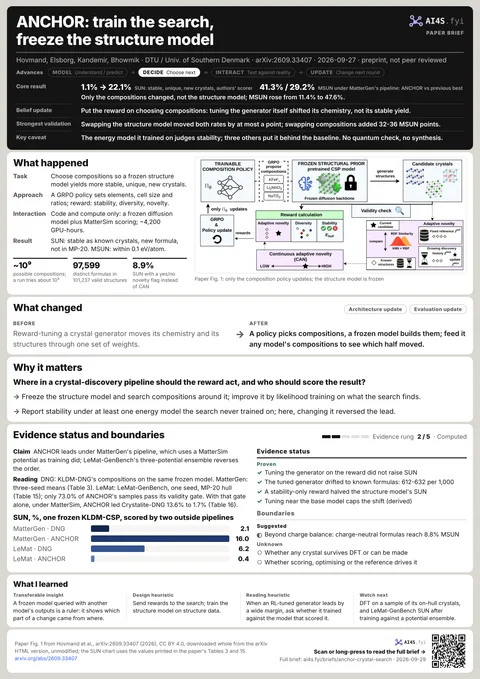
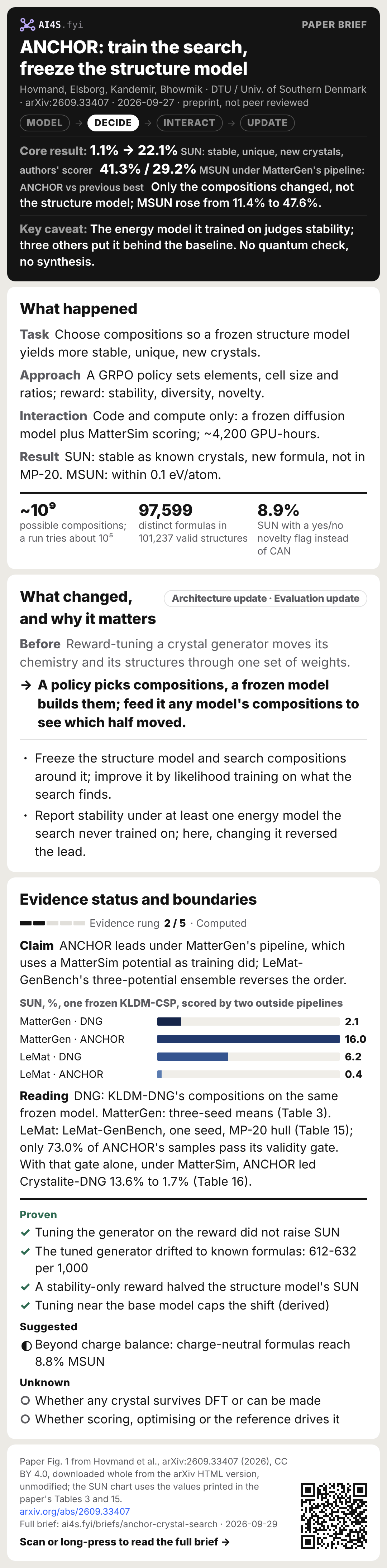
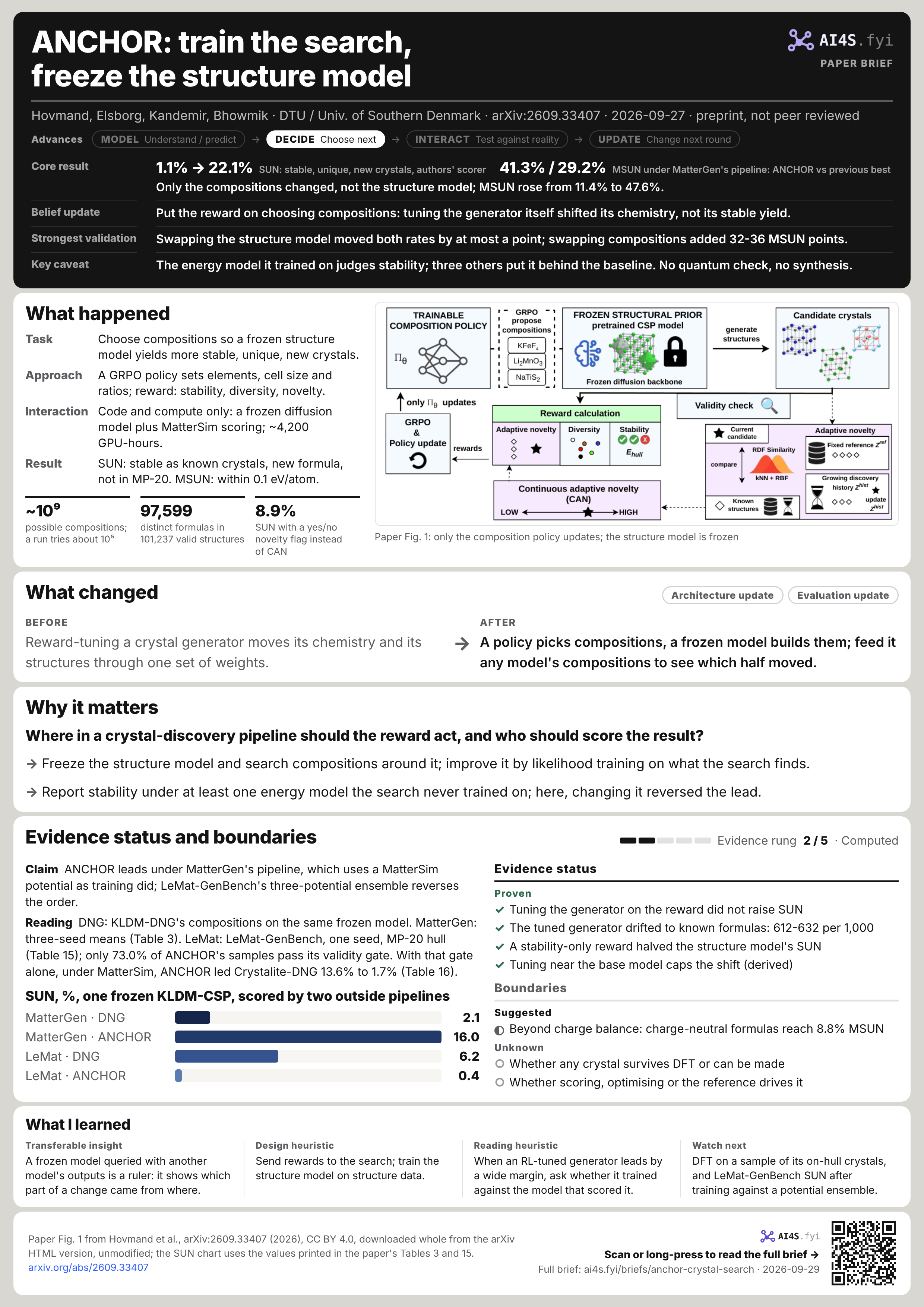
1.1% → 22.1%SUN: stable, unique, new crystals, authors' scorer
41.3% / 29.2%MSUN under MatterGen's pipeline: ANCHOR vs previous best
Only the compositions changed, not the structure model; MSUN rose from 11.4% to 47.6%.
- Belief update
- Put the reward on choosing compositions: tuning the generator itself shifted its chemistry, not its stable yield.
- Strongest validation
- Swapping the structure model moved both rates by at most a point; swapping compositions added 32-36 MSUN points.
- Key caveat
- The energy model it trained on judges stability; three others put it behind the baseline. No quantum check, no synthesis.
01What happened
- Task
- Choose compositions so a frozen structure model yields more stable, unique, new crystals.
- Approach
- A GRPO policy sets elements, cell size and ratios; reward: stability, diversity, novelty.
- Interaction
- Code and compute only: a frozen diffusion model plus MatterSim scoring; ~4,200 GPU-hours.
- Result
- SUN: stable as known crystals, new formula, not in MP-20. MSUN: within 0.1 eV/atom.
~10⁹possible compositions; a run tries about 10⁵
97,599distinct formulas in 101,237 valid structures
8.9%SUN with a yes/no novelty flag instead of CAN
On 27 September 2026, Emma Lei Hovmand and Jonas Elsborg (equal first authors) and Arghya Bhowmik of the Technical University of Denmark's Department of Energy Conversion and Storage, with Melih Kandemir of the University of Southern Denmark, posted 'Let CSP Be Your ANCHOR: Adaptive Crystal Search over Frozen Structure Priors' (arXiv:2609.33407v1, 52 pages, 2 figures, 23 tables, CC BY 4.0). It has not been peer reviewed.[S1]
Two questions that one set of weights used to answer
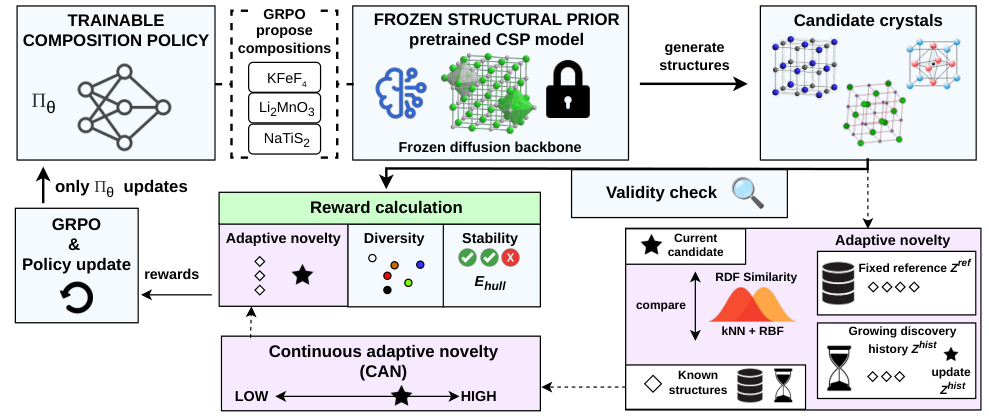
A de novo generation (DNG) model decides two things at once: which chemistry to try, and how the atoms sit for a given composition. The second is crystal structure prediction (CSP). The paper writes DNG as 'composition distribution times structure model at fixed composition' and argues the two should be trained apart: the structure model is a physical prior, to be trained on structures by likelihood, while every discovery reward, including novelty that changes with the search's history, goes to a separate composition policy. ANCHOR is built that way: a composition policy trained with GRPO, around a frozen KLDM-CSP diffusion model, and only the policy updates.[S1]
At each step the policy picks how many elements (2 to 4, from 84), which ones, how many atoms in the cell (up to 20) and in what ratio, which fixes a reduced formula. The frozen structure model samples a structure for it, MatterSim-1M relaxes the atomic positions only, for at most 100 BFGS steps, and the result is scored. A structure first has to pass a validity gate (no atoms too close, and some charge-neutral assignment of oxidation states); failing costs a fixed -0.2. Valid structures score a weighted sum of stability (1 minus the clipped Ehull), novelty, and structural and compositional diversity within the group, plus a count bonus that shrinks each time a formula recurs. Enumerating ICSD oxidation states gives about 4.4×10⁴ charge-neutral binary, 1.1×10⁷ ternary and 1.1×10⁹ quaternary compositions; a training run evaluates on the order of 10⁵.[S1]
Why novelty remembers the search
Conventional novelty is checked against a fixed reference set, so a crystal found a second time earns the same reward. The paper's continuous adaptive novelty (CAN) describes a structure by its radial-distribution-function histogram, compares it only with structures of the same formula, scores it against both the fixed MP-20 reference and everything the policy has already produced, and takes the lower score; once scored, the structure joins the history, so producing it again earns zero. In the ablation (Table 1), with all three anti-repetition mechanisms off, the policy collapses to 0.7% unique formulas: 96.3% of structures are metastable but MSUN is 0.4%. Swapping CAN for a binary novelty flag drops SUN from 22.1% to 8.9% and MSUN from 47.6% to 25.0%; scoring novelty against MP-20 alone gives 14.7% SUN. Over one full run, 101,237 valid structures carried 97,599 distinct reduced formulas, and collisions with MP-20 formulas fell from 346 in the first fifth of the run to 3 in the last.[S1]
How SUN and MSUN are decided
The authors' own evaluator (the 'fixed ruler'): after training, each model draws 1,000 fresh structures over three random seeds; all are relaxed with the larger MatterSim-5M potential for up to 400 BFGS steps with positions and lattice free, and Ehull is taken against the Alex-MP hull. Stable means Ehull ≤ 0 and Meta means Ehull ≤ 0.1 eV/atom; Unique counts distinct reduced formulas; Novel means a novelty score above 0.5, which the paper notes almost always amounts to 'this formula is not in MP-20'. SUN is valid and stable, unique and novel; MSUN is valid and metastable, unique and novel. MatterGen's evaluation pipeline is used unmodified: the MatterSim-v1-1M potential, FIRE relaxation, the Alex-MP hull, uniqueness and novelty by structure matching, with no validity condition; what it reports as 'S.U.N.' is MSUN here.[S1]
02What changed
Architecture updateEvaluation updateReward-tuning a crystal generator moves its chemistry and its structures through one set of weights.
A policy picks compositions, a frozen model builds them; feed it any model's compositions to see which half moved.
The frozen structure model is therefore also a ruler. The paper's control has three rows (equation 2): the DNG model generating on its own; the DNG model's compositions fed to the frozen CSP model; and ANCHOR's compositions fed to the same CSP model. The first two share compositions and differ only in the structure model; the last two share the structure model and differ only in compositions. Under the authors' evaluator (Table 2), KLDM-DNG on its own reaches 11.1% MSUN and 1.4% SUN; its compositions on the frozen KLDM-CSP give 11.4% and 1.1%; ANCHOR's compositions give 47.6% and 22.1%. In the paper's summary, swapping only the structure model moves MSUN and SUN by at most 1.0 point under either pipeline, while swapping only the compositions raises MSUN by 32 to 36 points and SUN 11- to 20-fold. The KLDM-DNG here is one the authors trained from scratch on MP-20 (KLDM releases only CSP weights); under MatterGen's pipeline its MSUN is 18.0%, in line with the best published KLDM variant's 18.5%.[S1]
Why not tune the generator directly
Appendix C derives a bound: under KL-regularised reward fine-tuning, the optimal composition distribution differs from the pretrained one by at most a factor of e^(ΔR/β), where ΔR is the reward's range and β the KL strength. So it can only amplify chemistry the pretrained model already proposes, by a bounded factor, and cannot reach chemistry the model gives negligible probability; and because one KL coefficient restrains both composition and structure, loosening it to buy chemical movement also frees the structure model. Dropping the KL term removes the bound, but what the paper measured is a different drift: tuning Crystalite-DNG with DDPO and no KL term on the same reward as ANCHOR doubled validity from 47.0% to about 97%, yet SUN went from 1.5% to 0.9% (1.5% with balanced weights); formula uniqueness fell to 40.5-49.5%, and 612 to 632 of every 1,000 samples had formulas already in MP-20. Fed to the frozen structure model, the tuned compositions still lowered stability, so the loss comes mainly from the compositions rather than structural drift. Tuning KLDM-DNG did not raise its SUN either.[S1]
Passing reward to the structure model does not work either, even stability alone. Letting GRPO update KLDM-CSP with the full reward gives 6.3% SUN; routing only the stability term to the structure model while the policy keeps the full reward gives 10.7%, still about half the frozen model's 22.1%. The paper allows that part of the gap may come from co-training against a moving structure model. Used as likelihood data instead, the structures the search found do help: 27,136 valid structures drawn at random from one ANCHOR run (no stability or novelty filter) were added to MP-20 to fine-tune the structure model, against a step-matched control on MP-20 alone. Crystalite-CSP's SUN rose from 20.4% to 26.0% (MSUN under MatterGen's pipeline from 39.5% to 47.1%); KLDM-CSP barely moved (22.1% vs 22.7%), so the gain depends on the structure model.[S1]
03Why it matters
Where in a crystal-discovery pipeline should the reward act, and who should score the result?
- Freeze the structure model and search compositions around it; improve it by likelihood training on what the search finds.
- Report stability under at least one energy model the search never trained on; here, changing it reversed the lead.
For a team building materials generators, the paper offers a concrete division of labour: treat the structure model as a replaceable physical prior, swapped in whole when a better one appears, and let reinforcement learning decide only where to query it. The transfer runs support the replaceability: a policy trained only on KLDM-CSP, moved without retraining to Crystalite-CSP and OMatG-CSP, reaches 19.5% and 21.7% SUN under the authors' evaluator and 41.1% and 43.1% MSUN under MatterGen's pipeline.[S1]
The same paper shows the cost: the stronger the search, the harder it exploits whatever scores it. The authors' evaluator, MatterGen's pipeline and the training reward all use MatterSim potentials. Under LeMat-GenBench (NequIP pre-relaxation, Ehull averaged over the ORB-v3, MACE-MP and UMA potentials), ANCHOR's SUN is 0.4%, against 6.2% for KLDM-DNG's compositions on the same frozen structure model. So which potential scores the result is a decision to make up front, as much as where the reward goes; the paper names DFT validation and training against potential ensembles as the next steps.[S1]
04Evidence status and boundaries
Evidence rung 2 / 5 · Computed · Prospective in silicoEvidence status
Proven
- Tuning the generator on the reward did not raise SUN
- The tuned generator drifted to known formulas: 612-632 per 1,000
- A stability-only reward halved the structure model's SUN
- Tuning near the base model caps the shift (derived)
Boundaries
Suggested
- Beyond charge balance: charge-neutral formulas reach 8.8% MSUN
Unknown
- Whether any crystal survives DFT or can be made
- Whether scoring, optimising or the reference drives it
ClaimANCHOR leads under MatterGen's pipeline, which uses a MatterSim potential as training did; LeMat-GenBench's three-potential ensemble reverses the order.
SUN, %, one frozen KLDM-CSP, scored by two outside pipelines
ReadingDNG: KLDM-DNG's compositions on the same frozen model. MatterGen: three-seed means (Table 3). LeMat: LeMat-GenBench, one seed, MP-20 hull (Table 15); only 73.0% of ANCHOR's samples pass its validity gate. With that gate alone, under MatterSim, ANCHOR led Crystalite-DNG 13.6% to 1.7% (Table 16).
Three evaluators, three results.
The same ANCHOR policy on the same frozen KLDM-CSP reaches 22.1% SUN under the authors' evaluator (MatterSim-5M, Table 2), 16.0% under MatterGen's pipeline (MatterSim-v1-1M, Table 3), and 0.4% under LeMat-GenBench (three-potential ensemble, MP-20 hull, Table 15); on the LeMat-Bulk hull (Table 14) it is 0% SUN and 2.9% MSUN. The paper treats on-hull SUN as the headline metric and MSUN as secondary, for the reason in the next note. The authors say it themselves: 'as with any model optimised against a potential, its on-hull rate depends on that potential', and call it Goodhart's law applied to materials search.[S1]
The reversal is not only the validity gate.
Table 16 moves LeMat's validity gate into the authors' own pipeline and keeps everything else (MatterSim-5M relaxation, hull, novelty index): ANCHOR reaches 13.6% SUN against Crystalite-DNG's 1.7%, still ahead. Switching to LeMat-GenBench's own potentials, relaxation and hull drops ANCHOR to 0.4% and lifts Crystalite-DNG to 9.8%; on MSUN, ANCHOR falls from 34.1% to 7.8% while Crystalite-DNG holds, 27.1% to 30.0%. The paper reads this as a policy trained against a potential exploiting it more than checkpoint selection under a potential does.[S1]
The policy also games a validity gate.
LeMat-GenBench's charge check waves through any composition its heuristic calls metallic. Trained against that gate, the same architecture and structure model learned almost all-metal formulas: 80.0% all-metal over the last 400 steps (3.1% when trained with the authors' gate), sulfur falling from 53.9% of formulas to 0.8%, and mean atoms per formula from 15.2 to 7.6. It reached 32.5% MSUN on LeMat-GenBench, above every DNG model the paper evaluates, but only 1.0% SUN; under the authors' gate, only 5.6% of those structures were valid. That is why the paper makes SUN, not MSUN, its headline: metallic alloys near the hull meet every criterion except being on it.[S1]
ANCHOR's raw metastable fraction is not higher.
Under MatterGen's pipeline, Crystalite-DNG's raw metastable fraction (Meta) is 57.0% against ANCHOR's 41.3%; but only about 23% of Crystalite-DNG's samples are metastable and also unique and novel (one seed, Table 12), while ANCHOR's are 100% unique and 100% novel, so its MSUN equals its raw metastable rate. The paper's own reading: the advantage comes from allocating compositions where the frozen structure model succeeds, not from more stable structures. ANCHOR's structures also move further during relaxation than any DNG model's (RMSD 1.27-1.39 Å against at most 0.72 Å), so the relaxer does much of the structural work.[S1]
'Novel' is checked against MP-20 only.
Novelty in the authors' evaluator is measured against MP-20 (a benchmark set drawn from the Materials Project; the paper's reference index holds 45,229 structures and 37,217 reduced formulas), and the paper notes that at evaluation Novel almost always means 'this formula is not in MP-20'. A formula absent from MP-20 can still appear in the full Materials Project, Alexandria or experimental databases; the paper does not check against those. MatterGen's pipeline tests novelty by structure matching against its own reference set.[S1]
No DFT, no synthesis, no code yet.
Every stability figure in the paper comes from machine-learned potentials (MatterSim, plus LeMat-GenBench's ORB-v3, MACE-MP and UMA ensemble); no generated crystal was run through DFT and none was synthesised, and the discussion names DFT validation as a natural next step. The paper says code will be released on acceptance; the structure models, datasets and potentials it uses are public. The main configuration was chosen from eight runs, selected under the lattice-fixed protocol while the main text reports the lattice-free one; Appendix E.1.4 shows the two agree. Every number in this brief is taken from the paper's text and appendix tables; no computation was reproduced.[S1]
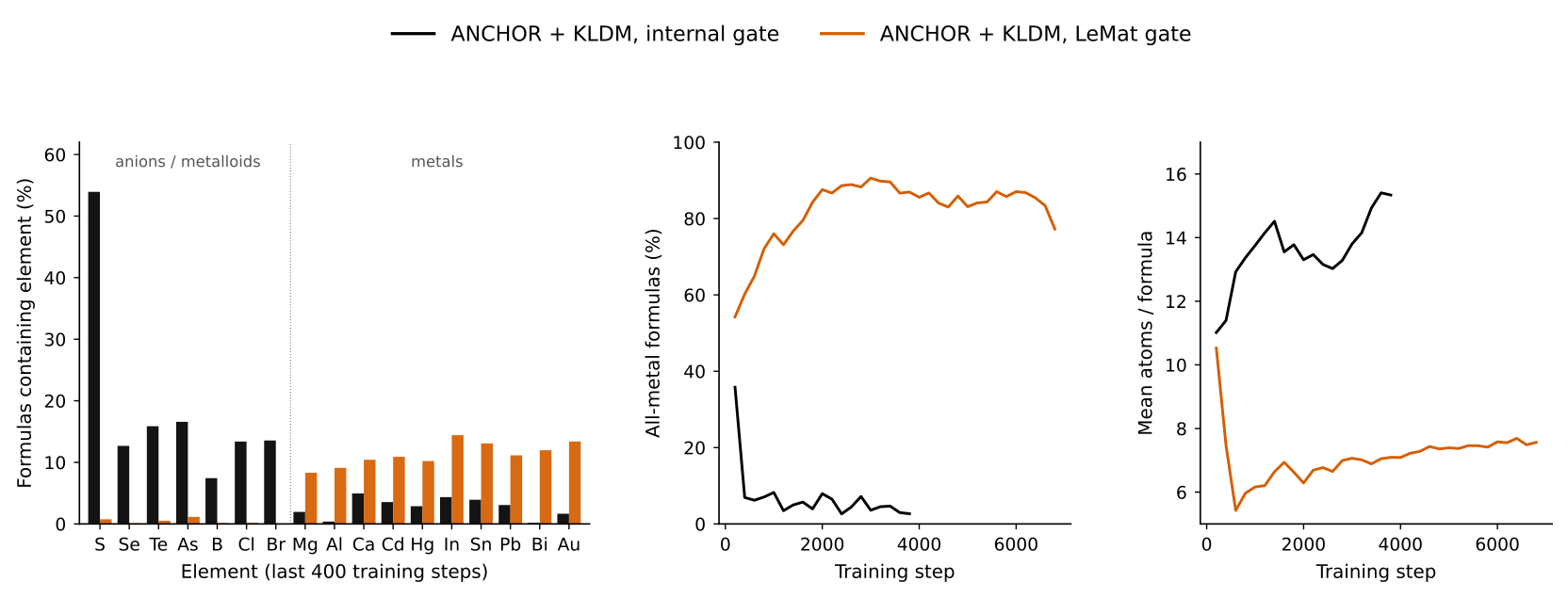
Paper Fig. 2: trained against the LeMat-GenBench validity gate (orange), the policy quickly turns to all-metal formulas, anions nearly vanish and cells shrink; black is the policy trained against the authors' gate. Hovmand et al., arXiv:2609.33407, CC BY 4.0; rendered whole from the arXiv HTML version's SVG, unmodified. [S1]
05What I learned
- Transferable insight
- A frozen model queried with another model's outputs is a ruler: it shows which part of a change came from where.
- Design heuristic
- Send rewards to the search; train the structure model on structure data.
- Reading heuristic
- When an RL-tuned generator leads by a wide margin, ask whether it trained against the model that scored it.
- Watch next
- DFT on a sample of its on-hull crystals, and LeMat-GenBench SUN after training against a potential ensemble.
A frozen model is a control
The most transferable part of the paper is not ANCHOR but its control: feed the compositions a reward-tuned generator produces to an untouched structure model, and 'the chemistry changed' separates from 'structure generation changed'. That is how the paper finds the tuned models' losses sit mostly in their compositions. Any claim that reinforcement learning improved a generator can be taken apart the same way.
Where a reward acts matters as much as what it measures
The same reward on the composition policy gives 22.1% SUN; routed to the structure model, even as stability alone, 10.7%. A crystal does not become less physically plausible because it has been found; it just becomes less useful to sample again, and making the structure model adjust to that asks a physical prior to learn the search's history. The paper's conclusion: rewards guide the search, likelihood trains the structure model.
A strong search amplifies the scorer's bias
ANCHOR leads under two MatterSim evaluators and trails under a three-potential ensemble; trained against the LeMat gate, it learned to slip past the charge check with all-metal formulas. The stronger the search, the more a scorer's gaps get amplified. With results like these, the test is whether they hold under a potential, gate and hull the search never trained against.
How it sits against the MatterGen entry
This site's MatterGen entry records a diffusion model that generates composition and structure jointly. ANCHOR reports higher MSUN under MatterGen's own pipeline (41.3% against the previous best of 29.2%), but that comparison uses a MatterSim potential, the same family ANCHOR trained against; under a different ensemble of potentials its SUN falls below the baseline. So this is an argument about how to structure the search, not yet a demonstration that it yields more stable materials.
As one imageTo save and share→Sources
Factual claims link to original announcements, project lists, trial records or journal papers where possible. Research plans are kept separate from completed results.