

Tech Report Brief· Evidence · Frontier
Anthropic's Wet Lab Reports Its First Result: An Agent Reading Raw DNA Found a Repeat Array, and the Bench Has Shown Only That It Is Transcribed
At Anthropic, 949 Claude sessions surveyed reverse transcriptases without human intervention, and one of them read an unannotated tandem repeat; ten more runs of the same harness all missed it. The noticing was the agent's; the follow-up analysis was directed by the researchers, the bench work was done by people, and what it measured is short RNAs, not what the enzyme does.
●Company preprint + one wet-lab experiment
Current boundary: Shown: the agent recognised the array by reading DNA, the array is transcribed into discrete short RNAs, and ten reruns of the same harness all missed it. Unknown: whether the RT is active, what the system does, and whether the find can be made repeatable
This work advances: Has agents read raw DNA and make the call on what is anomalous and worth pursuing, rather than only finding preset features
- MODELUnderstand / predict
- DECIDEChoose next
- INTERACTTest against reality
- UPDATEChange next round
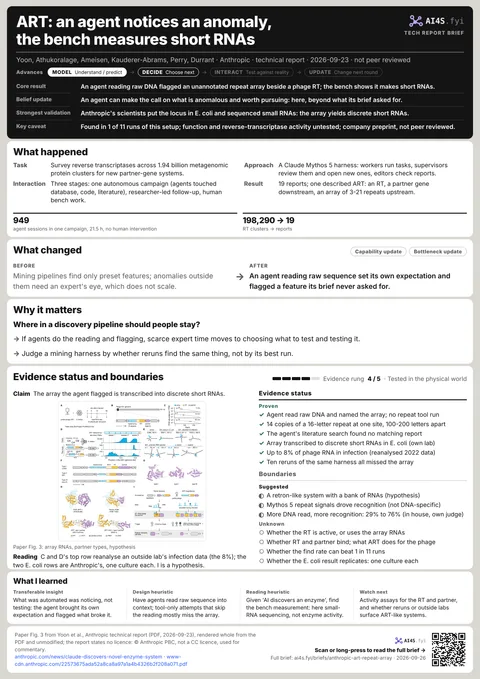

An agent reading raw DNA flagged an unannotated repeat array beside a phage RT; the bench shows it makes short RNAs.
- Belief update
- An agent can make the call on what is anomalous and worth pursuing: here, beyond what its brief asked for.
- Strongest validation
- Anthropic's scientists put the locus in E. coli and sequenced small RNAs: the array yields discrete short RNAs.
- Key caveat
- Found in 1 of 11 runs of this setup; function and reverse-transcriptase activity untested; company preprint, not peer reviewed.
01What happened
- Task
- Survey reverse transcriptases across 1.94 billion metagenomic protein clusters for new partner-gene systems.
- Approach
- A Claude Mythos 5 harness: workers run tasks, supervisors review them and open new ones, editors check reports.
- Interaction
- Three stages: one autonomous campaign (agents touched database, code, literature), researcher-led follow-up, human bench work.
- Result
- 19 reports; one described ART: an RT, a partner gene downstream, an array of 3-21 repeats upstream.
949agent sessions in one campaign, 21.5 h, no human intervention
198,290 → 19RT clusters → reports
On 23 September 2026 Anthropic announced a life sciences research group and laboratory, and its first result: Claude agents found a new family of reverse transcriptases (RTs) in metagenomic data, named array-associated reverse transcriptases (ART). The detail is in a 40-page technical report hosted by Anthropic itself, by Peter H. Yoon, Januka S. Athukoralage, Emmanuel Ameisen, Eric Kauderer-Abrams, Nicholas T. Perry and Matthew G. Durrant. It is not peer reviewed.[S1][S2]
What the people did
The researchers wrote a research brief asking the agents to find new RT systems on the basis of new partner-gene associations, and built the harness and the database. In the post's words: 'Our involvement was limited to the initial prompt and the lab work.' After the campaign, the 19 reports were ranked in a pairwise tournament by a language-model judge (Mythos 5); the ART report ranked third, with 32 wins in 36 games. The researchers then turned to the top-ranked reports and read the session transcripts to establish how the agents had reached ART.[S1][S2]
Every analysis after the campaign (establishing that the RT and array form a coherent family, the phylogeny, the structure predictions, the partner typing) was done in interactive Claude Science sessions, in which, per the report's methods, 'the authors directed the analysis and Claude wrote and ran the code'. The lab work was all human: the post says 'All of the lab work is performed by human scientists', and that the Model Hardware Standard style of lab automation it has tried is less suited to the ad hoc workflows of this molecular biology.[S1][S2]
What the agents did
Every agent in the harness was a Claude Code instance running Claude Mythos 5. They assembled 52 RT profile HMMs, searched 1,939,242,578 protein clusters, kept 198,290 RT clusters and sorted them into nine classes, then sampled 10,983 RT loci and scored the 3,564 protein families recurring beside them. Sixteen families passed criteria the agents set themselves and a seventeenth was nominated by a follow-up task; only three were confirmed as unreported RT associations, and fourteen were set aside as annotation artefacts, parts of known systems or general neighbours. Three RTs were separately identified as new lineages, ART among them.[S2]
The campaign ran 119 tasks, 98 of them opened by the agents during the work; 949 agent sessions, 77 agent-hours and 215.6 million tokens over 21.5 hours of wall-clock time, which the report says ran without human intervention. The post gives rounded figures: 'roughly 950 agents' (these 949 sessions of one campaign, not 949 independent researchers), 210 million tokens, 21 hours, 20 candidates; the report's own counts are 17 candidate families plus 3 new lineages, in 19 reports.[S1][S2]
The moment of noticing
The route to ART was indirect. The agents first picked this candidate because it sat beside a jumbo-phage RNA polymerase subunit; a worker rejected that association but queued a follow-up on the RT itself. Because retron RTs work with an RNA encoded upstream, the supervisor asked the next worker to check the 5′ flanks. The worker read the upstream DNA of close relatives straight into its context and wrote: 'The L0050 ... flank is spectacular: I can see by eye a tandem repeat array ... that's a CRISPR-like or msDNA-like repeat array?!'[S2]
The report's methods check this: neither the task brief nor the research brief mentioned repeats or arrays; the two retrievals before recognition returned unannotated sequence with no tool call in between, and no established repeat finder was run in the session. The worker then wrote its own counting script, found 14 copies of a 16-nt repeat separated by unique 100-200 nt spacers at one locus, and ran a literature search that found no matching report before filing a report for human review. The report says the search 'confirmed' the array fit no reported feature; a search can show only that nothing was found, not that the array is new in any absolute sense.[S2]
The wet lab: the researchers built two plasmids from the phage SA1 ART locus: one carrying the native locus (non-coding region, RT and partner), one with the 1,187-nt non-coding region behind the J23119 promoter and the RT behind an arabinose-inducible promoter. They put them in E. coli DH10B, grew one culture per construct and ran small-RNA sequencing. Both gave discrete short RNAs from the array, similar to those seen during infection. With one culture per construct, the E. coli result has no biological replicate; the RNA boundaries the report calls reproducible across replicates come from the three infection cultures of the public data.[S2]
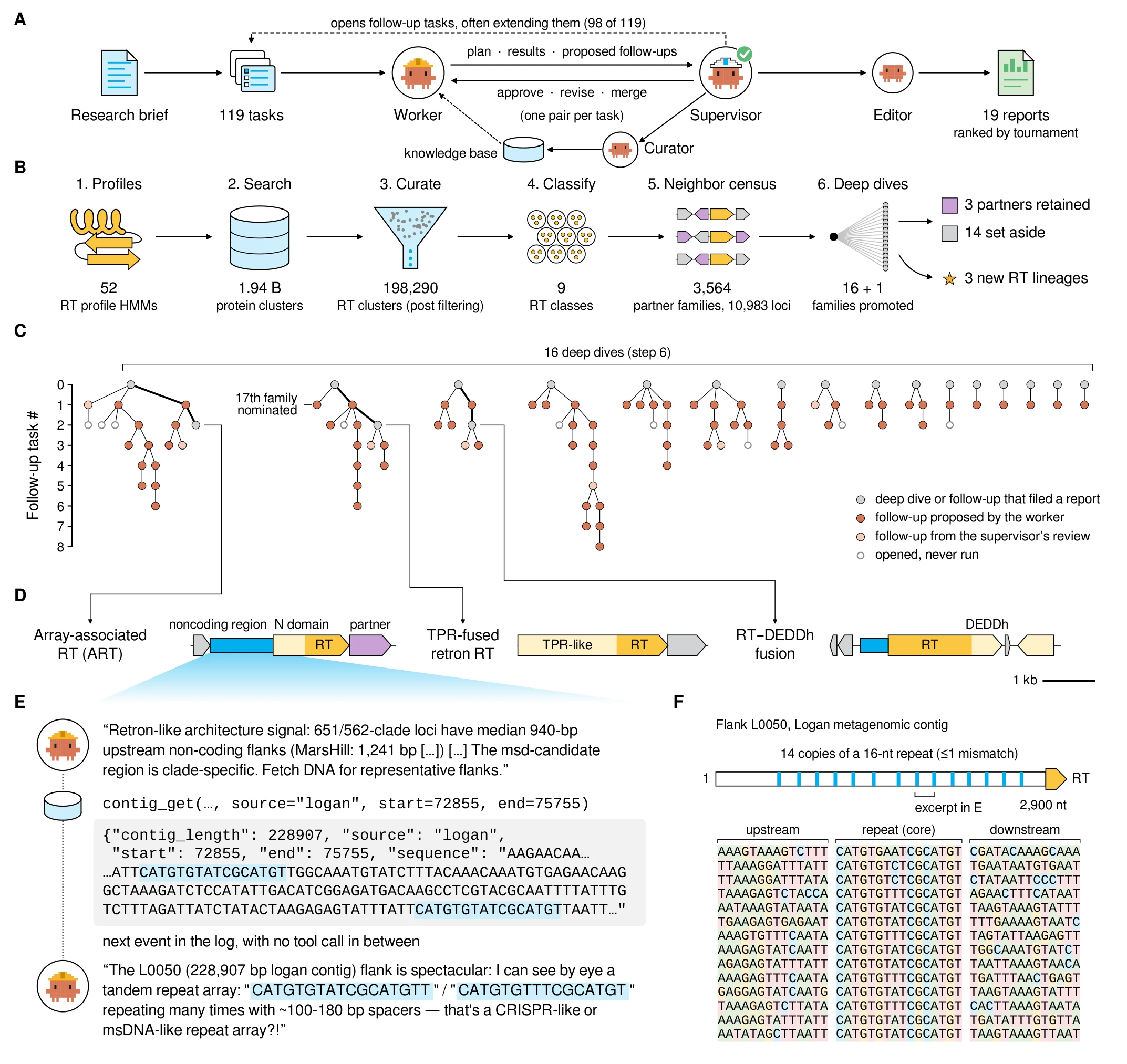
Report Fig. 1: A, the harness; B, the census from 1.94 billion protein clusters to 19 reports; C, the follow-up task trees of each deep dive; E, the worker reading DNA and writing 'I can see by eye a tandem repeat array'; F, the 14 repeat copies at that locus. Yoon et al., Anthropic technical report (2026), no licence stated, © Anthropic PBC, used for commentary; image unmodified. [S2]
02What changed
Capability updateBottleneck updateMining pipelines find only preset features; anomalies outside them need an expert's eye, which does not scale.
An agent reading raw sequence set its own expectation and flagged a feature its brief never asked for.
The report's argument: sequence databases double every four years, systematic mining is only possible with computational pipelines, and novelty in those pipelines is prescribed in advance, so anomalies outside the predefined features go undetected; expert curation catches them but does not scale with the data. In its discussion, the report says earlier attempts at automated discovery had human experts supply both the expectation and the judgment of novelty; here the agents supplied both: an expectation drawn from their own knowledge rather than their task, and the judgment that the atypical observation merited pursuit.[S2]
The report gives a concrete case: phage MarsHill's ART locus was in a 2021 genome report that identified the RT and proposed a 5′ non-coding RNA, yet described neither the repeats nor the partner gene. The post likewise says the RT had been identified before, and that Claude appears to be the first to notice the system's defining features.[S2][S1][S4]
What ART is, and is not
The researcher-directed follow-up found 95 distinct ART RT clusters, 28 with a detectable repeat array upstream. Arrays span 0.3-4.1 kb with 3 to 21 short repeats; repeats are 15-49 nt with a palindromic core of about 15 nt, and spacers run 120-220 nt. All 93 members whose sequences span it keep the catalytic YxDD motif, and about 180 residues precede the polymerase domain, where other RTs typically carry about 50 or fewer. The partner genes fall into three types with no detectable similarity to one another in sequence or predicted structure.[S2]
'CRISPR-like' describes the array's layout only. The report lists the differences itself: CRISPR repeats are near-identical with sharp boundaries and spacers of about 30 nt that are gained and lost between strains; ART spacers are far longer and retained in order between related phages. No cas genes occur near any ART locus. The report's working hypothesis is closer to a retron: one RT and partner protein paired with a bank of distinct RNAs rather than a retron's single one.[S2]
03Why it matters
Where in a discovery pipeline should people stay?
- If agents do the reading and flagging, scarce expert time moves to choosing what to test and testing it.
- Judge a mining harness by whether reruns find the same thing, not by its best run.
In this campaign Claude's output was reports and candidates, not conclusions: 14 of the 17 candidate families were rejected or set aside within the campaign, which ran without human intervention. The post says that because Claude produces hypotheses so prolifically, the hypotheses have become an object of study (hundreds to thousands of candidate reports from one campaign) and the team is asking what separates the proposals judged worth testing from those set aside, feeding what it learns back into Claude's instructions. The human's place moves from reading every locus to setting the bar and deciding what to test.[S1][S2]
But the discovery happened in one run of eleven. The researchers ran the same harness and brief ten more times: nearly every run that completed the census sampled ART loci, and in two the workers investigated the lineage as follow-up, yet none read the DNA upstream of the RT, and all ten missed the array. That is an observed negative result: the researchers searched every task record and session transcript of the reruns for the original campaign's RT and contig identifiers, and the report notes that an ART locus on a contig outside that set would not be found this way. The report attributes the misses to the broad RT search space and the harness's non-deterministic behaviour. What is shown is that it can happen, not that it happens reliably; whether the rate can be raised is untested.[S2]
04Evidence status and boundaries
Evidence rung 4 / 5 · Tested in the physical world · Physical validationEvidence status
Proven
- Agent read raw DNA and named the array; no repeat tool run
- 14 copies of a 16-letter repeat at one site, 100-200 letters apart
- The agent's literature search found no matching report
- Array transcribed to discrete short RNAs in E. coli (own lab)
- Up to 8% of phage RNA in infection (reanalysed 2022 data)
- Ten reruns of the same harness all missed the array
Boundaries
Suggested
- A retron-like system with a bank of RNAs (hypothesis)
- Mythos 5 repeat signals drove recognition (not DNA-specific)
- More DNA read, more recognition: 29% to 76% (in house, own judge)
Unknown
- Whether the RT is active, or uses the array RNAs
- Whether RT and partner bind; what ART does for the phage
- Whether the find rate can beat 1 in 11 runs
- Whether the E. coli result replicates: one culture each
ClaimThe array the agent flagged is transcribed into discrete short RNAs.
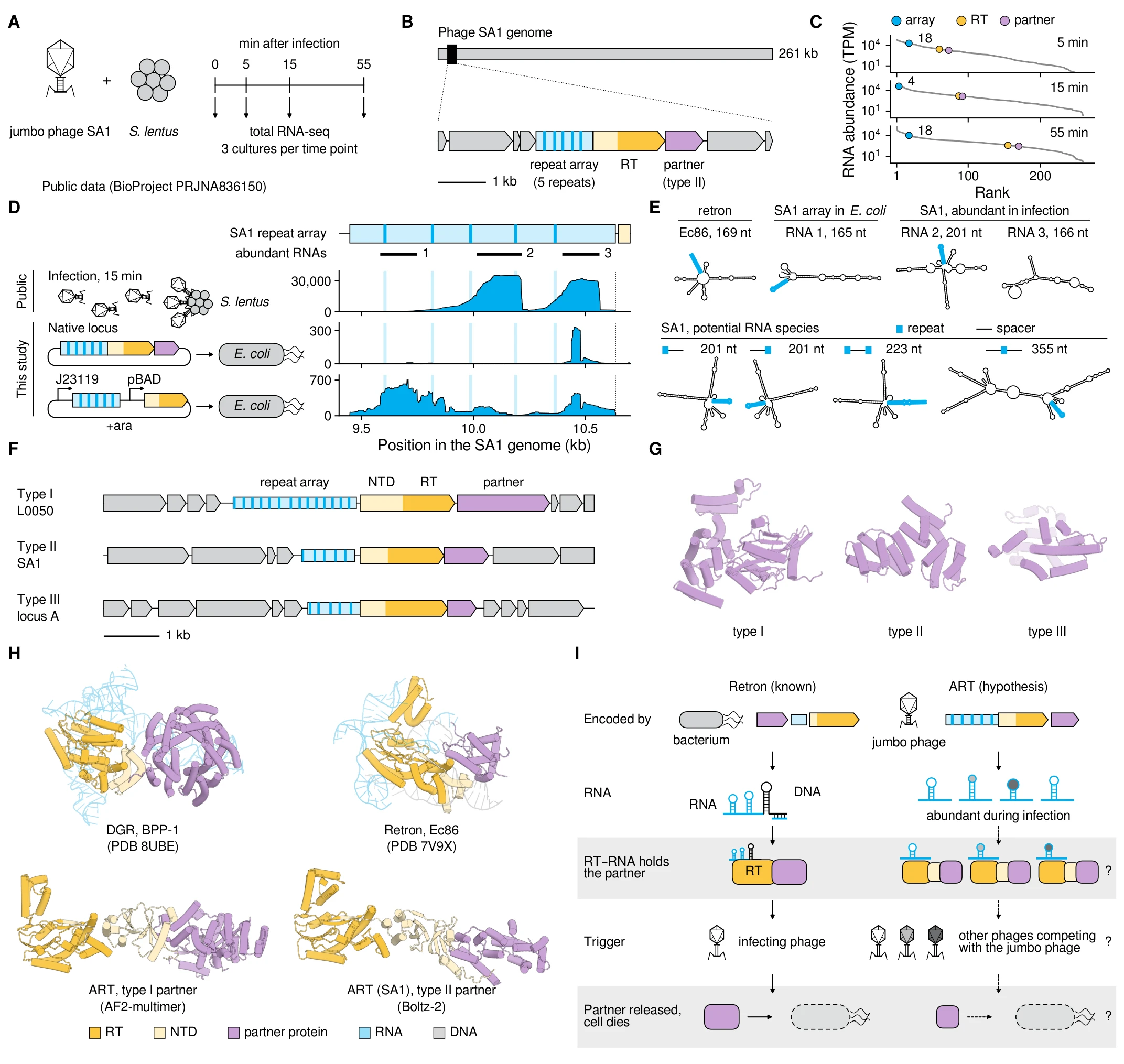
ReadingC and D's top row reanalyse an outside lab's infection data (the 8%); the two E. coli rows are Anthropic's, one culture each. I is a hypothesis.
What the bench measured is transcription.
Anthropic's lab made one measurement of its own: small-RNA sequencing of two SA1 ART plasmid constructs in E. coli, one culture per construct. The array gave discrete short RNAs similar to those seen in infection. One culture per construct is not enough biological replication. The report's discussion is explicit: 'we have not shown that the RT is active or that the unit RNAs are its substrates. Whether the RT and its partner interact, and what the system does for the phage, are currently unknown.' The post says 'we don't yet know its function', with further experiments underway.[S2][S1]
The 8% comes from someone else's data.
That array RNAs reach up to 8% of phage RNA at 15 minutes after infection, among the most abundant phage transcripts, is not a new experiment: a Claude Science session found and retrieved a published 2022 RNA-seq time course of SA1 infecting Staphylococcus lentus (BioProject PRJNA836150, three cultures per time point), which the researchers reanalysed. The data are independent of Anthropic, but were not collected to test ART; the 8% is a reanalysis of public data, not a result of the new experiment.[S2][S3]
Has anyone outside Anthropic checked it?
No one has reproduced it. The report is a PDF on Anthropic's own server, not peer reviewed and not found in Crossref. Outside involvement is two things: the post quotes Feng Zhang (MIT and the Broad Institute), who read the preprint, calling the RNA-repeat arrays beside reverse transcriptases 'genuinely intriguing' and meriting further investigation; and the acknowledgments thank F. Zhang, B. Hie, D. Li and G. Brixi for reviewing an early copy. That is comment on a draft, not a check. What people confirmed is that the array exists and is transcribed, not a working enzyme system.[S1][S2]
Recognition depends on reading the DNA into context.
The researchers also built a fixed-input benchmark: seven Claude models, five information levels, 100 attempts per model per level, scored by a Mythos 5 judge on ten features. The four strongest models recognised the array in at least 90% of attempts with the loci in context, falling as low as 32% with files and tools; 39% of file attempts never read a contiguous 200 nt of DNA. As more DNA was read, recognition for the four pooled rose from 29% to 76%, and to 96% for Mythos 5. Interpretability found two Mythos 5 signals that strengthen along the repeat copies; shuffling each copy silenced one on all 14, but both also respond to non-DNA repeats and are not DNA-specific. All of this is computed, by the same company, with its own model as judge.[S2]
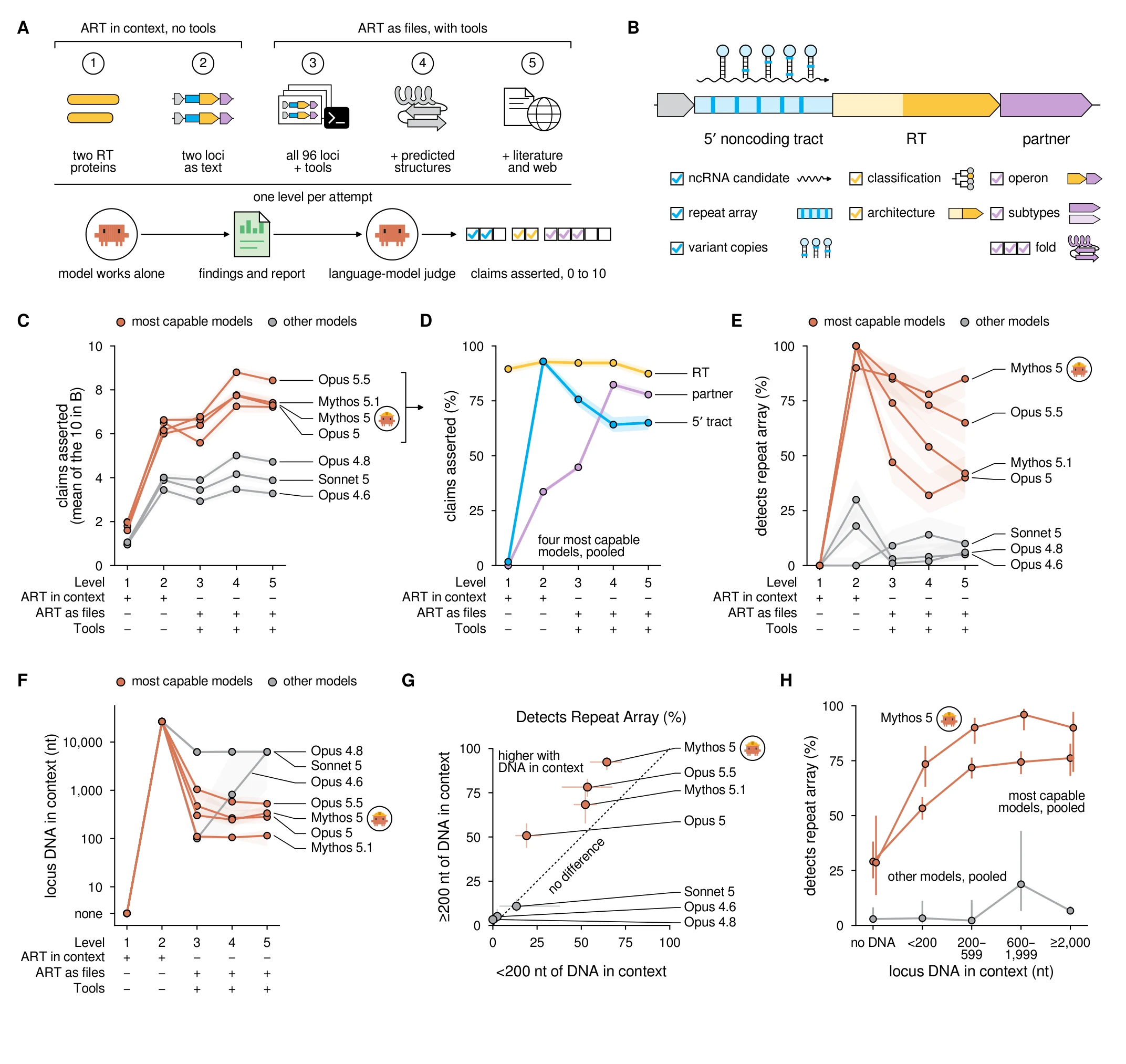
Report Fig. 4: the most capable models recognise the ART array, and recognition depends on reading DNA into context. Yoon et al., Anthropic technical report (2026), no licence stated, © Anthropic PBC, used for commentary; image unmodified. [S2]
05What I learned
- Transferable insight
- What was automated was noticing, not testing: the agent brought its own expectation and flagged what broke it.
- Design heuristic
- Have agents read raw sequence into context; tool-only attempts that skip the reading mostly miss the array.
- Reading heuristic
- Given 'AI discovers an enzyme', find the bench measurement: here small-RNA sequencing, not enzyme activity.
- Watch next
- Activity assays for the RT and partner, and whether reruns or outside labs surface ART-like systems.
Read the division of labour step by step, not from the headline
'Claude autonomously discovered' means precisely this here, in three stages: in one autonomous campaign, the census, the rejections, the follow-up, recognising the array, counting it and searching for prior reports were done by agents without intervention; the family analysis after it was directed by the researchers, with Claude writing the code; all the experiments were done by people. The brief, the choice among ranked reports and the interpretation were people's too. Each part is real, but they are different claims with different evidence.[S2][S1]
A single success needs its rerun rate
The report ran the reruns itself and reported that all ten missed (one success in eleven runs), which is more candid than most 'AI discovery' releases and names the metric to track: how often repeated runs of one harness surface a class of anomaly. That harness design and model capability can dramatically change research outcomes is the report's own conclusion.[S2]
Set against last week's wet-lab entry
The 18 September timeline entry relays Reuters reporting that the lab has Claude orchestrate robotic experiments. In this first result, Anthropic itself says all lab work is performed by human scientists and that automation suits these workflows poorly. In this work at least, Claude's role at the bench was helping people interpret the data.[S1]
As one imageTo save and share→Sources
Factual claims link to original announcements, project lists, trial records or journal papers where possible. Research plans are kept separate from completed results.
- S1Claude discovers a novel enzyme system with CRISPR-like repeatsAnthropic · 2026.09.23 · Company announcement
- S2Autonomous AI agents discover reverse transcriptases with tandem repeat arraysAnthropic · Yoon et al. · 2026.09.23 · Company technical report (preprint), not peer reviewed
- S3Interactions between Jumbo Phage SA1 and Staphylococcus: A Global Transcriptomic AnalysisMicroorganisms · Zhang et al. · 2022.08.07 · Source of the public RNA-seq the report reanalysed (citation checked via Crossref)
- S4Comparative Genomics of Three Novel Jumbo Bacteriophages Infecting Staphylococcus aureusJournal of Virology · Korn et al. · 2021.09.09 · The original MarsHill genome report (citation checked via Crossref)