

Evidence Map· Evidence · Frontier
Putting the wet lab in the loop: three rounds of agent-designed aptamers, 0 to 42%
Cutts, Coller and colleagues at Google Research, Stanford and Google DeepMind let agents design aptamers: about 1,000 designs a round were synthesized, measured and returned to the agents, which changed strategy on what came back. Hit rates went 0 to 42.1% on thrombin and 10.2% to 3.7% to 33.5% on myoglobin, with the dip in the middle diagnosed by the agents themselves.
●Preprint, not peer reviewed; every design was synthesized and measured, in the authors' own assay
This work advances: Lets agents change their own design strategy between three rounds of real experiments
- MODELUnderstand / predict
- DECIDEChoose next
- INTERACTTest against reality
- UPDATEChange next round
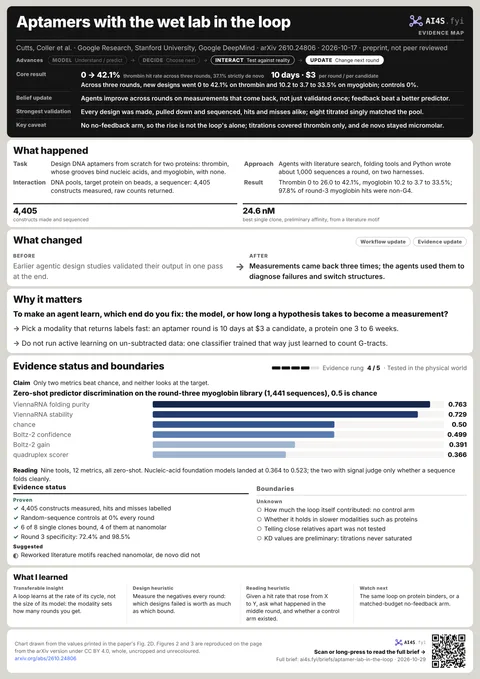
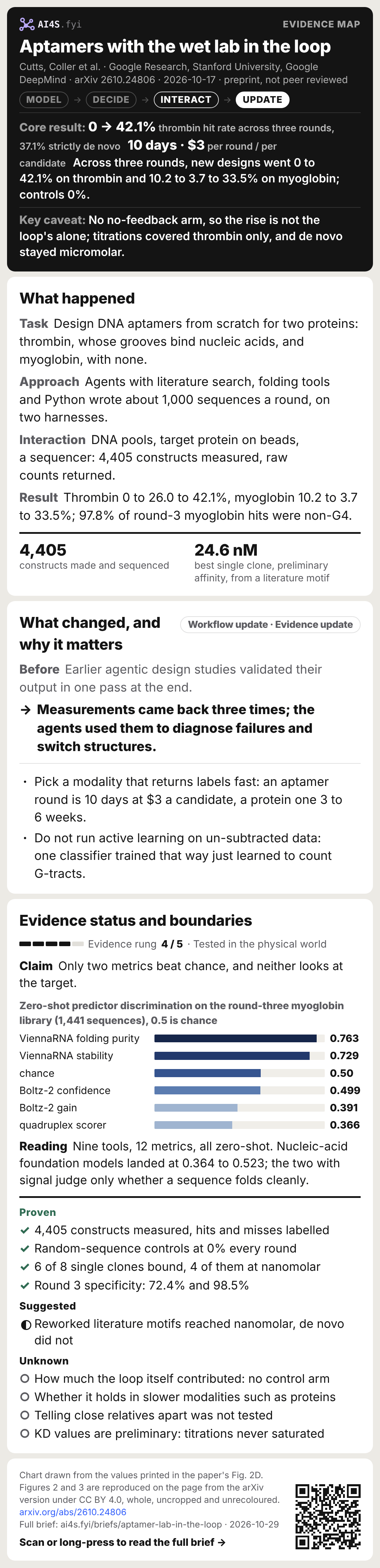
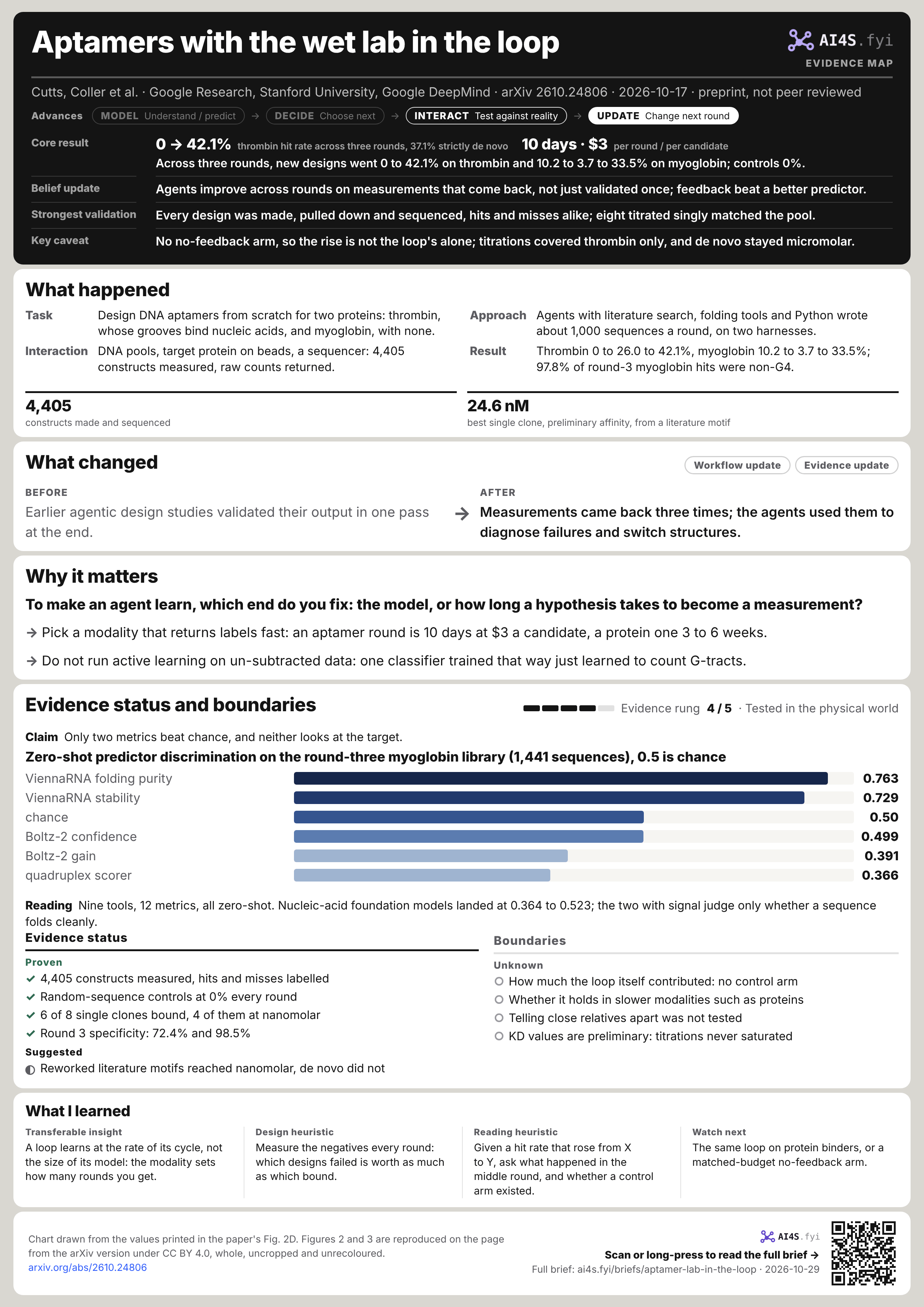
0 → 42.1%thrombin hit rate across three rounds, 37.1% strictly de novo
10 days · $3per round / per candidate
Across three rounds, new designs went 0 to 42.1% on thrombin and 10.2 to 3.7 to 33.5% on myoglobin; controls 0%.
- Belief update
- Agents improve across rounds on measurements that come back, not just validated once; experimental feedback exposed failures the computational predictors missed, though the run has no no-feedback arm to size its own contribution.
- Strongest validation
- Every design was made, pulled down and sequenced, hits and misses alike; eight titrated singly matched the pool.
- Key caveat
- No no-feedback arm, so the rise is not the loop's alone; titrations covered thrombin only, and de novo stayed micromolar.
01What happened
- Task
- Design DNA aptamers from scratch for two proteins: thrombin, whose grooves bind nucleic acids, and myoglobin, with none.
- Approach
- Agents with literature search, folding tools and Python wrote about 1,000 sequences a round, on two harnesses.
- Interaction
- DNA pools, target protein on beads, a sequencer: 4,405 constructs measured, raw counts returned.
- Result
- Thrombin 0 to 26.0 to 42.1%, myoglobin 10.2 to 3.7 to 33.5%; 97.8% of round-3 myoglobin hits were non-G4.
4,405constructs made and sequenced
24.6 nMbest single clone, preliminary affinity, from a literature motif
Why aptamers
The authors picked this molecule because the sequence is the molecule. Going from a designed protein or antibody to a binding readout takes gene synthesis, cloning, transformation, cell culture and expression, lysis, column purification and then the assay itself: seven steps, 3 to 6 weeks a round, with dropouts at expression, folding, solubility and purification. Conventional SELEX skips cloning but relies on blind enrichment from 10^13 to 10^15 random molecules over 8 to 15 six-step rounds before any sequencing, and says little about why a sequence succeeded or failed. Here it is three bench steps: pooled oligo synthesis, bead pulldown, sequencing, about 10 days a round at about $3 a candidate.[S1]
Each round sequenced the input library alongside triplicate target and bare-bead pulldowns, so a sequence that was synthesized but did not enrich genuinely failed to bind rather than failing to be made. That is what makes the loop learnable: in protein screens 60 to 80% of designs never express or fold, and the reasons for failure are mixed together.[S1]
What happened between the rounds
Round one came from AI co-scientist, zero-shot, 642 constructs. On thrombin nothing worked (0 of 167): the fixed PCR primers hybridized with the binding core, so the designed fold did not survive in the full construct. On myoglobin 10.2% (20 of 196) bound. Round two switched to a four-stage pipeline (analyst, strategist, parallel designers, scoring) and clamped round one's cores between 5' and 3' duplexes, lifting thrombin to 26.0% (54 of 208).[S1]
In the same round myoglobin fell to 3.7% (9 of 244). The counter-screen explains it: round two pushed G-quadruplexes, compact folds of four guanine tracts, to about 60% of the library, and those carry heavy negative charge, so on a protein with no nucleic-acid groove they simply stick to charged surfaces. The analyst agent found in the raw counts that 97% of cross-reactive binders were G-quadruplexes, and myoglobin's on-target specificity had collapsed from 75.0% to 19.1%.[S1]
In round three the agents cut unclamped G-quadruplexes from 20.4% to 1.3% and moved 72.3% of the pool into non-G4 scaffolds. The data backed the call: retained G4s hit 0% to 2.4%, while H-type pseudoknots reached 80.4% (37 of 46), extended palindromic hairpins 61.8% (47 of 76) and bulge hairpins 45.9% (67 of 146). Of 184 myoglobin hits in round three, 180 came from non-G4 families with no off-target cross-reactivity, and specificity returned to 72.4%. On thrombin, round three went 69.1% non-G4 and reached 98.5% specificity.[S1]
The single-clone titrations
Enrichment in a pool can come from PCR bias or competition, so the authors separately synthesized eight fluorescently labelled thrombin candidates (T01 to T08, 75 to 85 bases) and ran five-point equilibrium titrations from 0 to 1,000 nM. Six of the eight showed concentration-dependent binding, and endpoint fluorescence at 1 µM tracked round-three pooled enrichment across nearly four orders of magnitude (Pearson r = 0.90, p = 0.0021). The four highly enriched constructs (T01 to T04) gave nanomolar curves, with preliminary apparent KD of 24.6 to 133 nM, while strictly de novo scaffolds only began to bind at 1 µM. The authors call these KD values preliminary because the fluorescence never reached a plateau within 1 µM.[S1]
Where those nanomolar binders came from is worth reading separately: T01 to T04 are all agent-reworked stems around published thrombin cores (TBA and NU172), not designs from scratch. The strictly de novo designs stopped at micromolar this round. The authors give the comparison themselves: earlier work that trained deep networks on nearly a million physical screening measurements reached 1.5 nM.[S1]
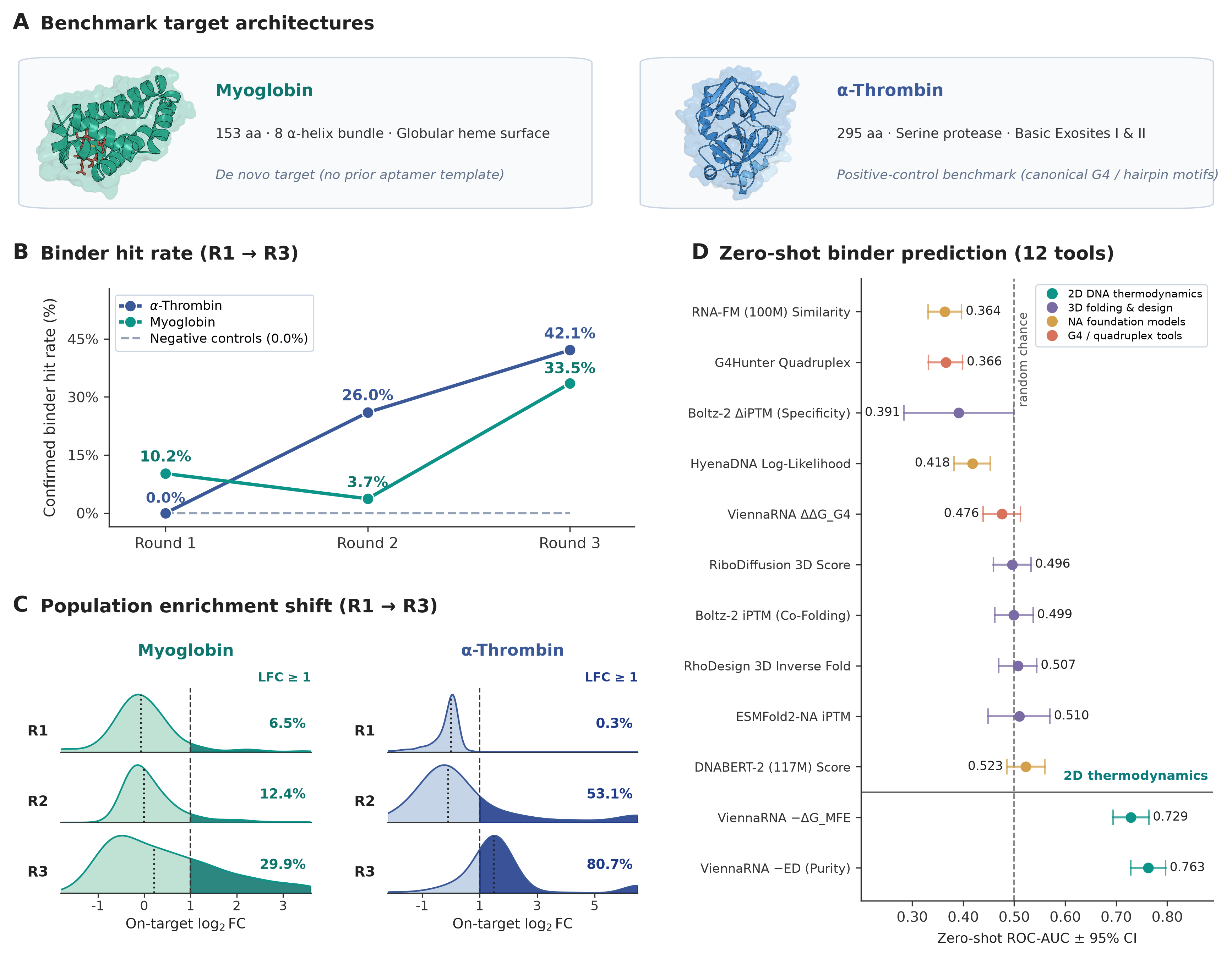
Panel B is the hit rate across rounds, C the raw enrichment distributions before background subtraction (the share of the thrombin pool enriched at least twofold went 0.3%, 53.1%, 80.7%), and D is the source of the chart in this page's evidence section. Source: Cutts et al., arXiv 2610.24806, CC BY 4.0. [S1]
02What changed
Workflow updateEvidence updateEarlier agentic design studies validated their output in one pass at the end.
Measurements came back three times; the agents used them to diagnose failures and switch structures.
Before
Agents designed once and were validated once, at the end[S1]
Bottleneck
Three to six weeks from a design to a binding readout
What changed
An aptamer round takes 10 days, and three closed rounds were run[S1]
New bottleneck
How much the loop itself contributed, with no control arm to compare
What remains unsolved
Affinity for strictly de novo designs, and whether this holds in slower modalities[S1]
03Why it matters
To make an agent learn, which end do you fix: the model, or how long a hypothesis takes to become a measurement?
- Pick a modality that returns labels fast: an aptamer round is 10 days at $3 a candidate, a protein one 3 to 6 weeks.
- Do not run active learning on un-subtracted data: one classifier trained that way just learned to count G-tracts.
The most transferable thing here is not about aptamers but about choice of problem: the authors first picked the modality with the shortest path from hypothesis to measurement, then asked whether agents could learn. The learning rate of a closed loop is the frequency of the experimental cycle, not the size of the model. The same reasoning on protein binders would get a dozen rounds a year.[S1]
The second point is for anyone hoping a model can replace the experiment. On the round-three myoglobin library (1,441 sequences) the authors ran 12 metrics from 9 tools zero-shot: 3D co-folding, inverse folding, nucleic-acid foundation models and G-quadruplex scorers all landed at or below chance. The only two with signal come from ViennaRNA's secondary-structure calculation, and they do not look at the target at all: they judge whether a sequence folds into a clean structure. Boltz-2's interface confidence even anticorrelated with specific binding, because it favours the compact G-quadruplex folds that stick non-specifically.[S1]
One more line sits in the discussion and is easy to skip: the value of a loop is not only iteration but layering. The first round can ask for affinity, the second add a counter-screen for specificity, later ones stability in serum or uptake into cells. A one-shot screen has to satisfy every constraint at once; a loop can add one per cycle.[S1]
04Evidence status and boundaries
Evidence rung 4 / 5 · Tested in the physical world · Closed-loop experimentationEvidence status
Proven
- 4,405 constructs measured, hits and misses labelled
- Random-sequence controls at 0% every round
- 6 of 8 single clones bound, 4 of them at nanomolar
- Round 3 specificity: 72.4% and 98.5%
Boundaries
Suggested
- Reworked literature motifs reached nanomolar, de novo did not
Unknown
- How much the loop itself contributed: no control arm
- Whether it holds in slower modalities such as proteins
- Telling close relatives apart was not tested
- KD values are preliminary: titrations never saturated
ClaimOnly two metrics beat chance, and neither looks at the target.
Zero-shot predictor discrimination on the round-three myoglobin library (1,441 sequences), 0.5 is chance
ReadingNine tools, 12 metrics, all zero-shot. Nucleic-acid foundation models landed at 0.364 to 0.523; the two with signal judge only whether a sequence folds cleanly.
This site puts the result on rung 4 of the evidence ladder: the designed sequences were physically made and measured on beads and a sequencer, not scored back on existing data. Two things add to its weight: negatives were measured every round, so the denominator behind 42.1% is real, and the single-clone titrations calibrate the pooled readout against physical binding.[S1]
Attribution is where to be careful. The campaign ran no no-feedback control arm and no matched-budget comparison against evolutionary, Bayesian or supervised baselines. Round one's 0% was a construct defect and the harness changed after it, so the curve from 0 to 42% mixes bug-fixing, a system swap and genuine learning from data. The authors write this into their discussion themselves and say matched control arms are needed next.[S1]
The second boundary is affinity. The four nanomolar binders are all agent-reworked stems around published thrombin cores; strictly de novo designs stopped at the onset of binding in the micromolar range. The titrations covered thrombin only, were capped at 1 µM and never reached a plateau, so 24.6 to 133 nM are preliminary numbers. Discrimination against close relatives (myoglobin against haemoglobin, thrombin against prothrombin) was not tested, and the authors name it as the next step for counter-selection.[S1]
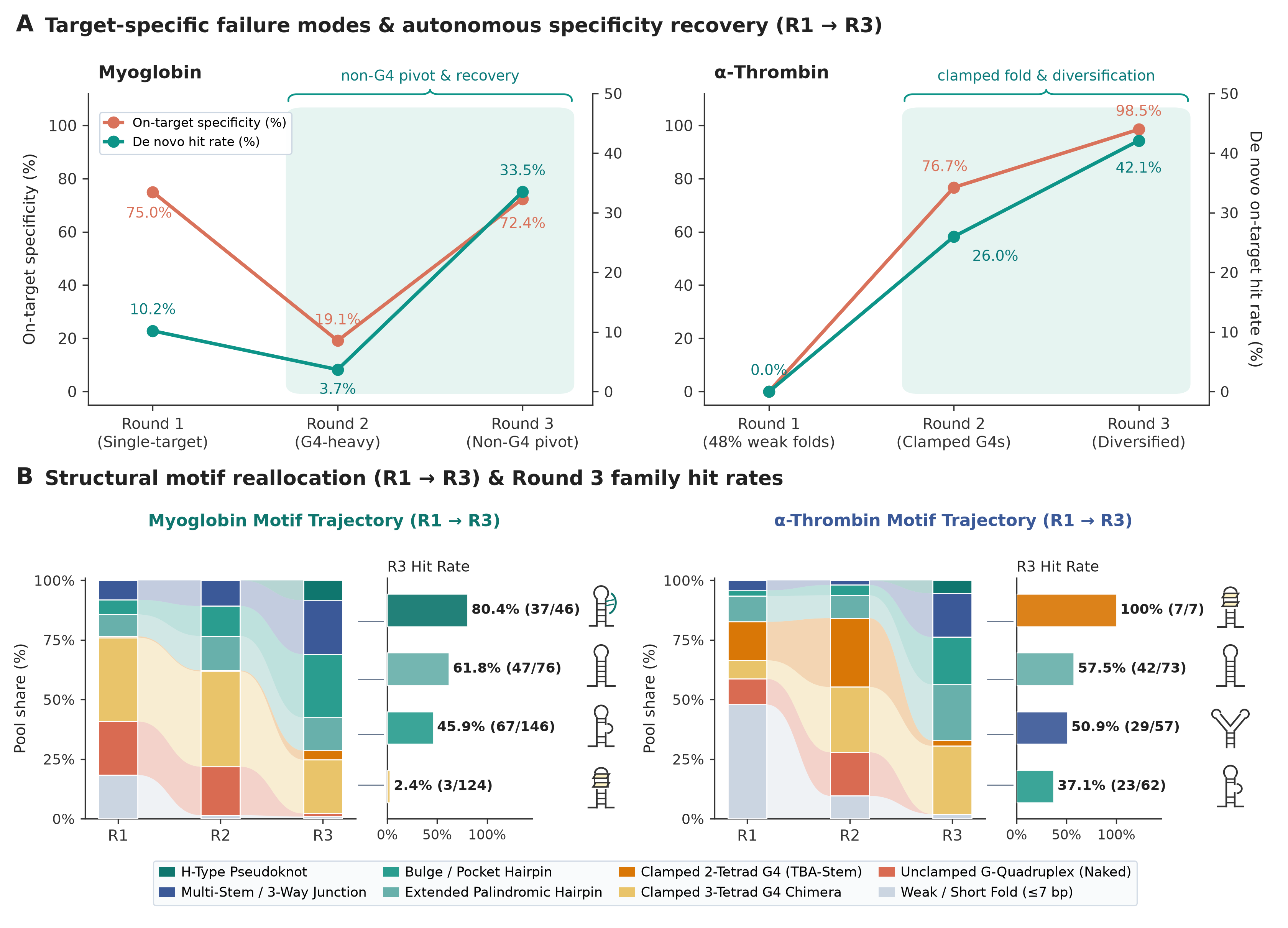
The left of panel A is myoglobin's specificity collapse and recovery (75.0% to 19.1% to 72.4%), the right is thrombin (0% to 76.7% to 98.5%); panel B shows how the structural families were reallocated and how each performed in round three. Source: Cutts et al., arXiv 2610.24806, CC BY 4.0. [S1]
05What I learned
- Transferable insight
- A loop learns at the rate of its cycle, not the size of its model: the modality sets how many rounds you get.
- Design heuristic
- Measure the negatives every round: which designs failed is worth as much as which bound.
- Reading heuristic
- Given a hit rate that rose from X to Y, ask what happened in the middle round, and whether a control arm existed.
- Watch next
- The same loop on protein binders, or a matched-budget no-feedback arm.
The middle round is the interesting one
Myoglobin's drop to 3.7% in round two is not a failure but the strongest evidence in the paper: the dip came from adding a counter-screen that subtracted sequences sticking to the beads, the agents found the reason in the raw counts, and the next round replaced a whole class of structure. A curve that only goes up is a sign that nobody checked in the middle.[S1]
A cheap experiment changes how to evaluate
At $3 a candidate and 10 days a round, you can afford to buy the failures: most of the 4,405 constructs did not bind, and it is those negatives that make the statistical filtering and any later model training sound. When experiments are expensive, people report only the successes, and evaluation follows.[S1]
This reading would strengthen if someone ran a matched-budget arm with no data returned and the loop still won clearly, or if the same method reached nanomolar on strictly de novo designs against a target with no published motif. It would weaken if a no-feedback arm produced a similar curve, or if further single-clone work showed the pooled enrichment was inflated by PCR bias.
It reads best beside two other entries on this record. The AIntibody blinded round showed that a hit rate without a baseline says little; this paper supplies that baseline (random sequences at 0% every round) but lacks the other control, a matched-budget arm with no feedback. Each paper has half of what an evaluation needs.
As one imageTo save and share→Sources
Factual claims link to original announcements, project lists, trial records or journal papers where possible. Research plans are kept separate from completed results.