

Policy explainer
40,363 Submissions in a Month: Why arXiv Now Limits Each Submitter to Two
arXiv limits submissions per submitter from 1 October 2026: submissions that doubled in two years, the change in papers arXiv puts down to AI, its fourth tightening in a year, and what a per-submitter limit leaves open.
○arXiv's announcement, monthly statistics and 2025 annual report were read at source; the rise is put down to AI by arXiv's moderators, and arXiv has published no share of AI-written submissions

- Core judgment
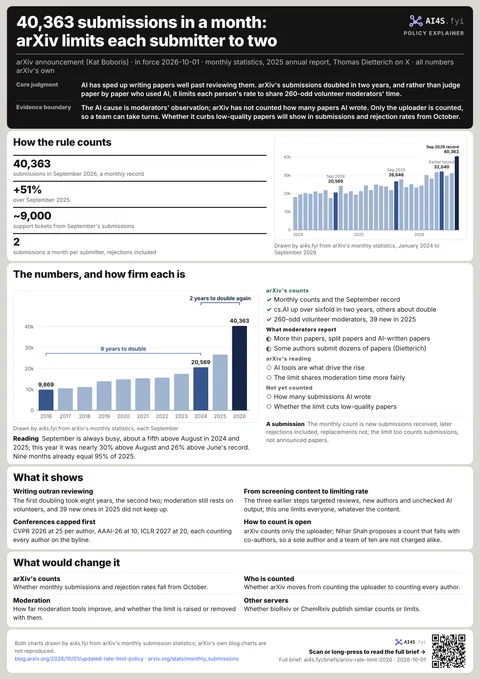
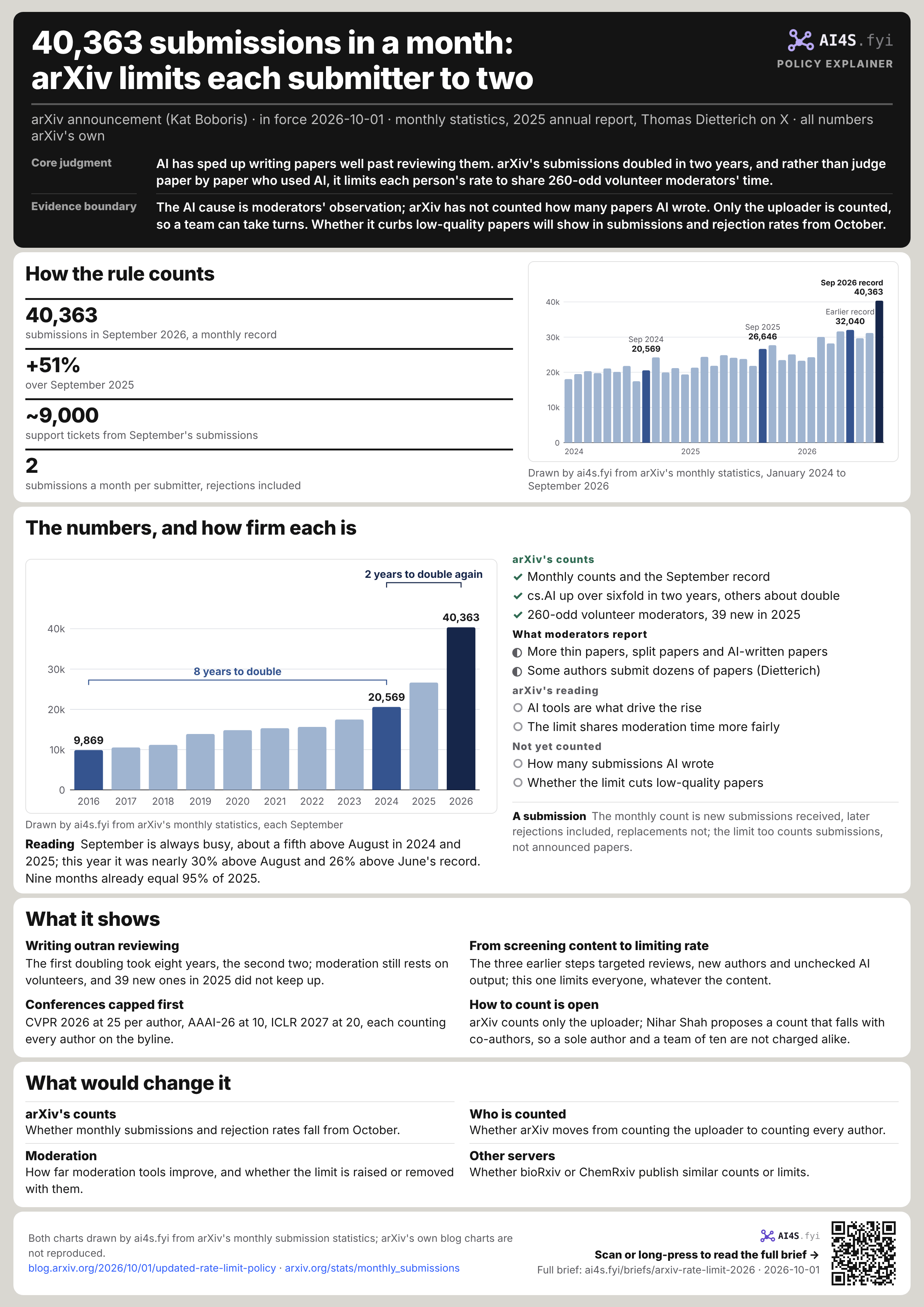
- AI has sped up writing papers well past reviewing them. arXiv's submissions doubled in two years, and rather than judge paper by paper who used AI, it limits each person's rate to share 260-odd volunteer moderators' time.
- Evidence boundary
- The AI cause is moderators' observation; arXiv has not counted how many papers AI wrote. Only the uploader is counted, so a team can take turns. Whether it curbs low-quality papers will show in submissions and rejection rates from October.
40,363submissions in September 2026, a monthly record
+51%over September 2025
~9,000support tickets from September's submissions
2submissions a month per submitter, rejections included
01How the rule counts
How arXiv explains the limit
The announcement, signed by Kat Boboris of arXiv, was published on 1 October 2026 and took effect that day. arXiv says that before AI there was a plain practical limit to how fast one person could produce papers, and volunteer moderators limited only those far above it; with AI tools more capable and easier to use, where that limit sits is now open to debate. So it calls the rule a stopgap: one line for everyone while it works out good practice for authors using AI and improves its moderation tools and procedures.[S1]
Rate limiting is not new: arXiv's moderators have always been able to limit heavy submitters at their discretion. What changes is that it becomes one hard rule for every submitter. arXiv's AI policy is unchanged: authors may use AI in support of their research if they disclose it and the paper meets arXiv's scholarly standards and advances the field.[S1][S5]
Thomas Dietterich, Distinguished Professor Emeritus at Oregon State University and chair of arXiv's Editorial Advisory Council, says in the announcement that a small share of authors submit many low-quality papers and take a disproportionate share of moderators' time, which is unfair to authors of good papers, delayed by days or weeks as a result. On X the same day he added that analysis of submissions shows some authors submitting dozens of papers; that he hopes the limit will also discourage "micro result" papers, which report one more ablation or a slight architectural change, and encourages "best publishable units" rather than "least publishable units"; and that it buys time to make moderation scale: "We hope the limit can be raised or removed at some point in the future."[S1][S4]
02The numbers, and how firm each is
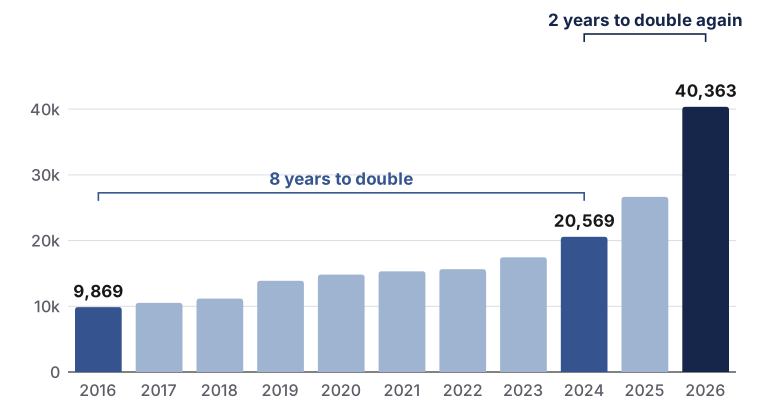
ReadingSeptember is always busy, about a fifth above August in 2024 and 2025; this year it was nearly 30% above August and 26% above June's record. Nine months already equal 95% of 2025.
arXiv's counts
- Monthly counts and the September record
- cs.AI up over sixfold in two years, others about double
- 260-odd volunteer moderators, 39 new in 2025
What moderators report
- More thin papers, split papers and AI-written papers
- Some authors submit dozens of papers (Dietterich)
arXiv's reading
- AI tools are what drive the rise
- The limit shares moderation time more fairly
Not yet counted
- How many submissions AI wrote
- Whether the limit cuts low-quality papers
A submissionThe monthly count is new submissions received, later rejections included, replacements not; the limit too counts submissions, not announced papers.
How unusual September was
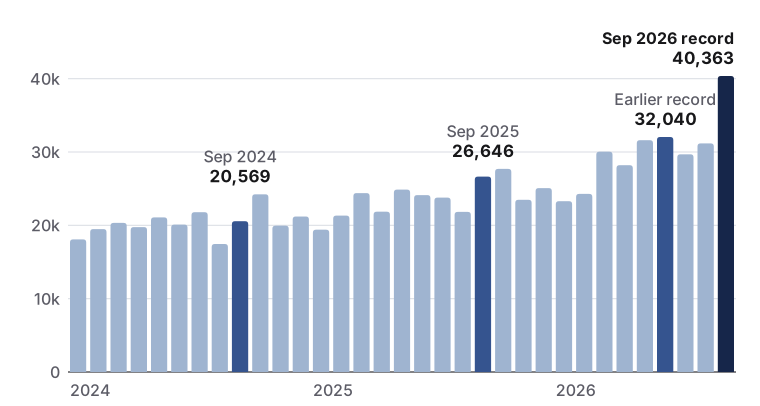
By arXiv's monthly statistics, September 2026 brought 40,363 new submissions: nearly 30% more than August's 31,173, 26% above the record of 32,040 set in June, and 51% more than September 2025's 26,646. September is always busy (in 2024 and 2025 it ran 18% and 22% above August), but this year the jump came on top of an already high base. The first nine months brought 270,685 submissions, already 95% of 2025's record total of 284,486.[S2][S3]
The announcement's long view: 9,869 submissions in September 2016, 20,569 in September 2024, 40,363 in September 2026. The first doubling took eight years, the second two. The 40,363 also brought almost 9,000 support tickets for staff and moderators.[S1]
Who does the reviewing
arXiv does no peer review, but every submission is moderated before it appears: is it scholarly research, complete, in the right category? By the 2025 annual report that work falls mainly on 260-odd volunteer moderators, researchers in their own fields; the editorial and user-support team is the scientific director, seven staff and several part-time students (28 staff in all). Each announcement day brings 700 to 1,400 new submissions and another 500 to 1,000 replacements and cross-lists. arXiv onboarded 39 new moderators in 2025, against 7 in 2024. Computer science made up 46% of 2025's submissions.[S3]
What the submissions look like
The announcement says moderators see more thin papers of narrow scope, 'salami' papers that split one work into several, and dense AI-written papers. The 2025 annual report says rejection rates rose significantly and lists four reasons: more submissions overall (LLMs and AI as research topics that also speed up writing), more marginal and below-the-bar AI-generated content, more submissions from high-school, undergraduate and graduate students under pressure to publish, and more submissions tied to fraud such as citation rings. These are moderators' observations and arXiv's attribution; arXiv has not published how many submissions were written by AI.[S1][S3]
03What it shows
- Writing outran reviewing
- The first doubling took eight years, the second two; moderation still rests on volunteers, and 39 new ones in 2025 did not keep up.
- From screening content to limiting rate
- The three earlier steps targeted reviews, new authors and unchecked AI output; this one limits everyone, whatever the content.
- Conferences capped first
- CVPR 2026 at 25 per author, AAAI-26 at 10, ICLR 2027 at 20, each counting every author on the byline.
- How to count is open
- arXiv counts only the uploader; Nihar Shah proposes a count that falls with co-authors, so a sole author and a team of ten are not charged alike.
The fourth tightening in a year
On 31 October 2025 arXiv's computer science category began requiring review articles and position papers to be accepted after peer review at a journal or conference first (arXiv said this was technically a change of practice, not of policy). On 21 January 2026 an institutional email stopped being enough to endorse a new author: they need both that email and an earlier paper accepted in the same endorsement domain, or a personal endorsement from an established author there (mathematics did it first, in December 2025). On 14 May 2026 Dietterich set out on X the penalty for clear evidence that authors did not check LLM output (hallucinated references, leftover model comments such as "would you like me to make any changes?"): a one-year ban, after which later submissions must first be accepted at a reputable peer-reviewed venue. The first three steps targeted a kind of paper or a kind of author; this one limits everyone's rate, whatever the content.[S6][S7][S8]
Conferences capped first, and count differently
CVPR 2026 caps each author at 25 submissions and desk-rejects any beyond. AAAI-26 allows each author 10 submissions across its technical track, including the AI Alignment and AI for Social Impact tracks. ICLR 2027's rules, published on 2 September 2026, set 20 per author; a one-paper limit for "new authors" who have never published at a major AI, ML, CV, robotics or NLP conference; and at most one paper per author with no qualified reciprocal reviewer. The program chairs write that modern AI systems can generate "paper-shaped objects" even for people unfamiliar with the related work, and that fewer than 0.2% of ICLR 2026 authors submitted more than 20 papers, mostly with acceptance rates well below the conference's, none with more than 20 accepted. These conferences count every author on the byline; arXiv counts only the submitter.[S9][S10][S11]
How to count fairly is still open
Nihar Shah of Carnegie Mellon University argued in a June 2026 arXiv paper that the usual rule (each submission counts once against every co-author) charges a sole-authored paper and a ten-author paper the same per author. He proposes a "Harmonic Quota": a submission's cost to each author falls with the number of co-authors, as the reciprocal of their harmonic number; a generalised version needs three interpretable parameters and is built to resist adding spurious authors.[S12]
What it means for AI for Science
Most AI4S results on this record first appear as preprints on arXiv, bioRxiv or ChemRxiv, and the field itself builds systems that write papers. arXiv's numbers say AI has sped up writing papers and not reviewing them; its answer is not a better way to judge which paper to trust but a speed limit for now. For most labs two a month changes little, but releasing results in batches, or having one student upload the whole group's papers, will have to change. Whether preprints stay a trustworthy first record depends on moderation keeping up, and that is not settled.[S1]
04What would change it
- arXiv's countsWhether monthly submissions and rejection rates fall from October.
- Who is countedWhether arXiv moves from counting the uploader to counting every author.
- ModerationHow far moderation tools improve, and whether the limit is raised or removed with them.
- Other serversWhether bioRxiv or ChemRxiv publish similar counts or limits.
arXiv says it will monitor the rule's effect on authors, readers and the corpus and adjust it as needed; Dietterich says the limit buys time to scale moderation and he hopes it can be raised or removed. So the things to wait for: submission counts and rejection rates from October on; whether arXiv moves to counting every author; how far its moderation tools improve, and whether the limit loosens with them; and whether bioRxiv, ChemRxiv and other servers publish similar numbers or rules: the announcement says open-access repositories across the board are seeing sharp rises in submissions per author.[S1][S4]
As one imageTo save and share→Sources
Factual claims link to original announcements, project lists, trial records or journal papers where possible. Research plans are kept separate from completed results.
- S1Fair Moderation, Equitable Access, and AI: arXiv’s Updated Rate Limit PolicyarXiv · 2026.10.01 · Announcement
- S2arXiv monthly submissionsarXiv · 2026.10.01 · Statistics
- S3arXiv 2025 Annual Report (PDF)arXiv · 2026.06.26 · Annual report
- S4Thomas Dietterich's X thread on the submission limitX · 2026.10.01 · Social media
- S5arXiv moderation policy (including generative AI tools)arXiv · 2026.10.01 · Policy page
- S6Updated practice for review articles and position papers in arXiv CS categoryarXiv · 2025.10.31 · Announcement
- S7Attention authors: updated endorsement policyarXiv · 2026.01.21 · Announcement
- S8Thomas Dietterich's X thread on penalties for unchecked LLM outputX · 2026.05.14 · Social media
- S9CVPR 2026 Author GuidelinesCVF · 2026 · Conference rules
- S10AAAI-26 Submission InstructionsAAAI · 2025 · Conference rules
- S11Submission policies for ICLR 2027ICLR · 2026.09.02 · Conference rules
- S12How Many Submissions May an Author Make? A Harmonic Quota for Submissions under CoauthorshiparXiv (Nihar B. Shah) · 2026.06.09 · Preprint