

Preprint & Benchmark
ChefNMR2 works out a small molecule's structure from simple NMR spectra, ranking the right one first for 82% of 2,031 test molecules
Princeton's Ziyu Xiong, Ellen D. Zhong and Mohammad R. Seyedsayamdost, with collaborators at Edison Scientific, trained a generative model that takes a molecular formula and one-dimensional hydrogen and carbon NMR peak lists and samples candidate structures, using how often each recurs as its confidence. Across five test sets it ranked the right structure first more often than a retrieval method or frontier language models; with an agent that reasons and searches the literature, it solved four natural products whose structures had not been reported. Planar structures only, in a preprint.
●Preprint + benchmark + new structures
Current boundary: Planar structures only, and a formula is required; the new structures have no crystal structure or synthesis behind them; no outside lab's results yet
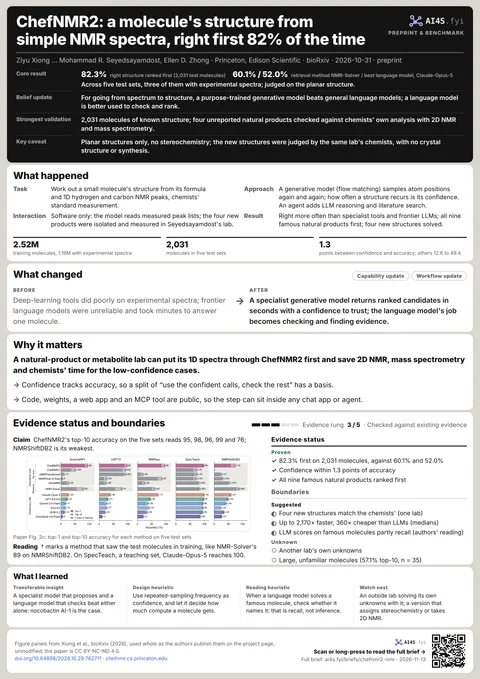
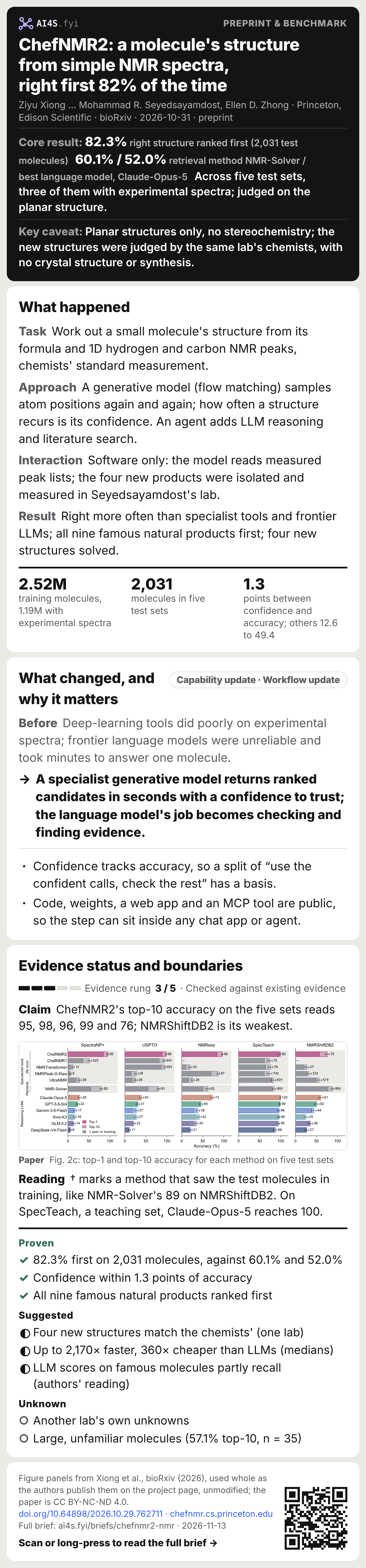
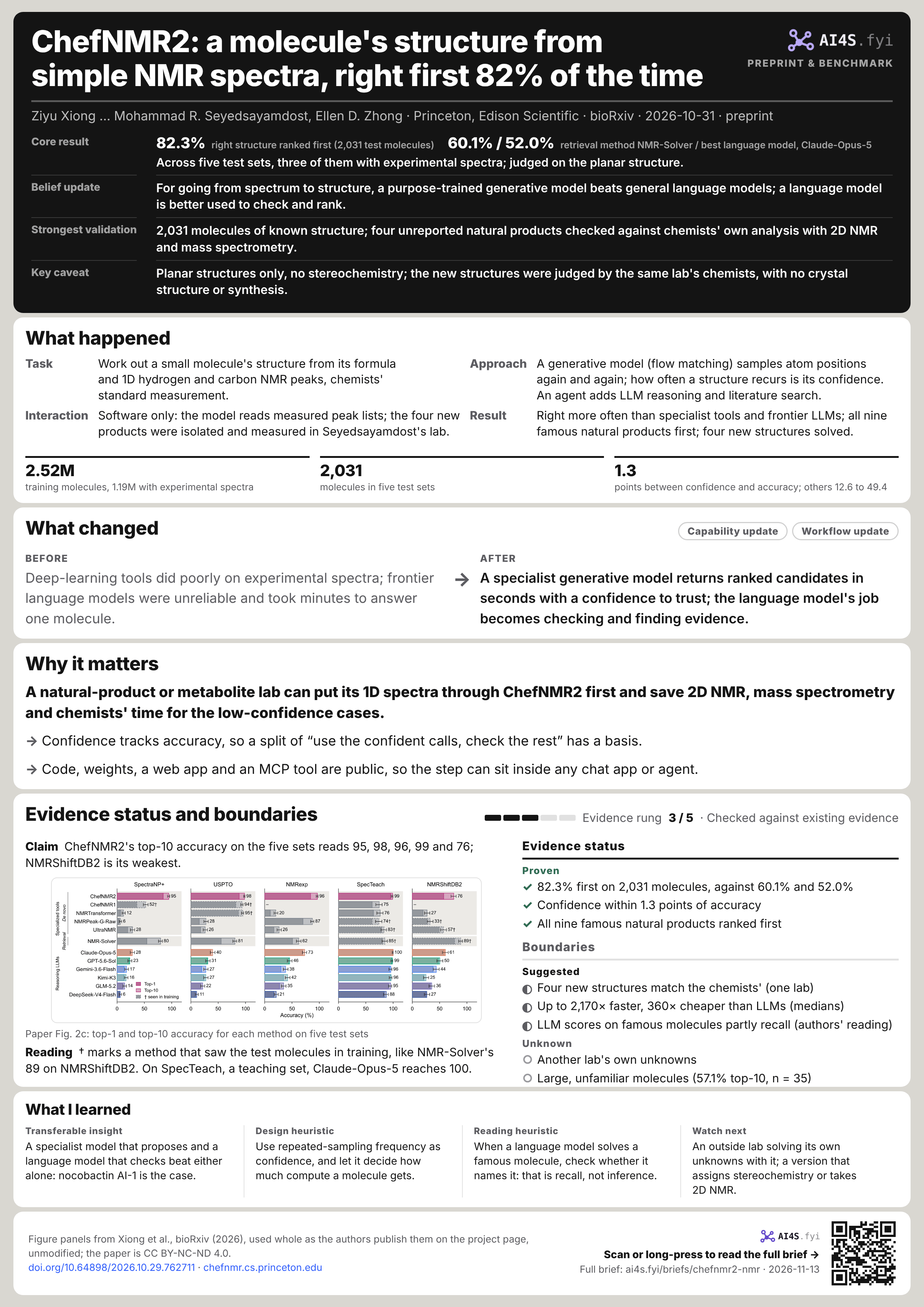
82.3%right structure ranked first (2,031 test molecules)
60.1% / 52.0%retrieval method NMR-Solver / best language model, Claude-Opus-5
Across five test sets, three of them with experimental spectra; judged on the planar structure.
- Belief update
- For going from spectrum to structure, a purpose-trained generative model beats general language models; a language model is better used to check and rank.
- Strongest validation
- 2,031 molecules of known structure; four unreported natural products checked against chemists' own analysis with 2D NMR and mass spectrometry.
- Key caveat
- Planar structures only, no stereochemistry; the new structures were judged by the same lab's chemists, with no crystal structure or synthesis.
01What happened
- Task
- Work out a small molecule's structure from its formula and 1D hydrogen and carbon NMR peaks, chemists' standard measurement.
- Approach
- A generative model (flow matching) samples atom positions again and again; how often a structure recurs is its confidence. An agent adds LLM reasoning and literature search.
- Interaction
- Software only: the model reads measured peak lists; the four new products were isolated and measured in Seyedsayamdost's lab.
- Result
- Right more often than specialist tools and frontier LLMs; all nine famous natural products first; four new structures solved.
2.52Mtraining molecules, 1.19M with experimental spectra
2,031molecules in five test sets
1.3points between confidence and accuracy; others 12.6 to 49.4
The paper went up on bioRxiv on 31 October 2026 under CC BY-NC-ND 4.0, with 12 authors. The corresponding authors are Ellen D. Zhong of Princeton's computer science department and Mohammad R. Seyedsayamdost of its chemistry department; Ziyu Xiong is first author. Zane Koch, Samuel G. Rodriques and Andrew D. White are employees of Edison Scientific, the paper's only competing-interest statement. Code is on GitHub (ml-struct-bio/chefnmr2), weights on Hugging Face, and the project page offers a web app and an MCP tool that plugs into chat apps.[S1][S2][S3][S4]
The model pairs a peak encoder with a multimodal diffusion transformer in which peak and atom tokens attend to each other. At inference it turns random noise into atom coordinates and assigns bonds to get candidate structures. It draws 100 samples first, then uses its confidence to decide whether to draw more: confident molecules return fast, uncertain ones get more time. The agent, ChefNMR2-Agent, adds parsing and checking the peak list, language-model proposals, database search, enumeration of structural variants, chemical-shift prediction and literature search, then ranks the candidates on all the evidence and writes out its reasoning. In the paper the agent runs on Edison's Kosmos platform, with Claude-Opus-5.5 and GPT-6-Astra as the base models.[S1]
The training set holds 2,524,941 molecules: 1,187,838 from NMRexp, with experimental peak lists taken from published papers' supporting information; 674,761 natural products in SpectraNP+ (from COCONUT, NPAtlas and NP-MRD) and 662,342 patent molecules from USPTO, both with simulated spectra. Training molecules are limited to 200 atoms including hydrogens and a fixed set of elements.[S1]
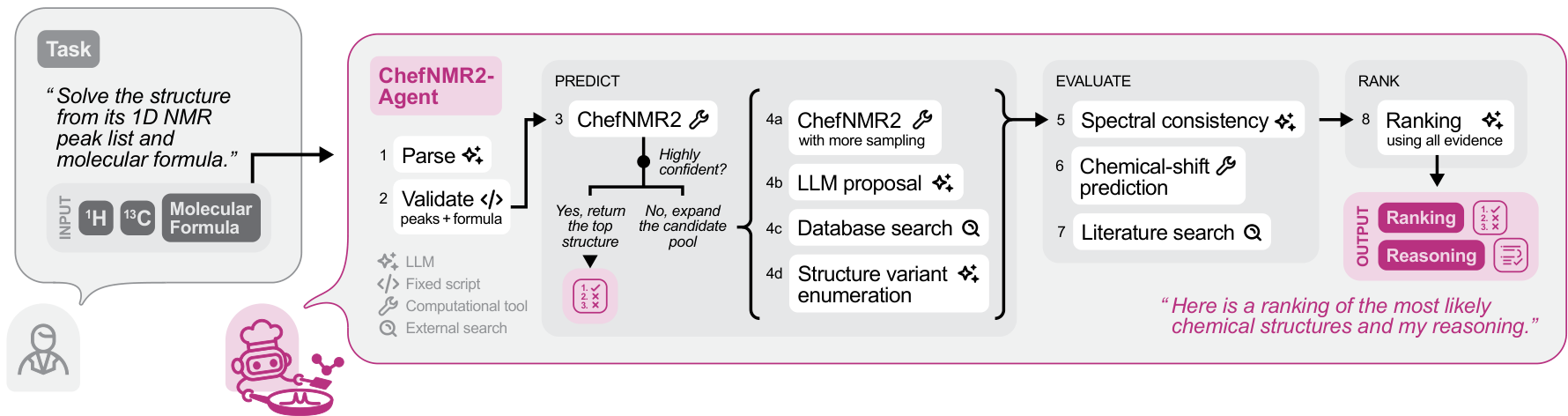
Fig. 1f: the agent parses and checks the peak list and calls ChefNMR2; if confident it returns the top structure, otherwise it widens the pool (more sampling, language-model proposals, database search, variant enumeration), evaluates by spectral consistency, shift prediction and literature search, and ranks on all the evidence with its reasoning. [S1]
02What changed
Capability updateWorkflow updateDeep-learning tools did poorly on experimental spectra; frontier language models were unreliable and took minutes to answer one molecule.
A specialist generative model returns ranked candidates in seconds with a confidence to trust; the language model's job becomes checking and finding evidence.
Speed and cost: two to three orders of magnitude
The paper reports up to 2,170-fold lower median runtime and 360-fold lower median cost per molecule than the language models tested. ChefNMR2 and the other specialist tools ran on H100 GPUs, priced at Modal's US$3.95 per GPU-hour; language models were timed by request duration and priced by list token rates. The paper does not say which model the “up to” refers to.[S1]
A language model that solves a famous molecule may be recalling it
On nine famous natural products (artemisinin, ginkgolide C, ingenol, lysergic acid, morphine, penicillin G, rapamycin, taxol and vancomycin aglycone) ChefNMR2 ranked every one first, NMRTransformer three and NMRPeak-G-Raw none; GPT-5.6-Sol got eight and Claude-Opus-5 seven. The authors note that each correct language-model answer names the compound. On seven closely related taxanes ChefNMR2 had the right structure in its top ten for five; GPT-5.6-Sol and Claude-Opus-5 found four each, taking 6 to 25 minutes per molecule, while Claude-Opus-5 identified taxol in about a minute. The authors read this as familiarity shaping the language models' scores.[S1]
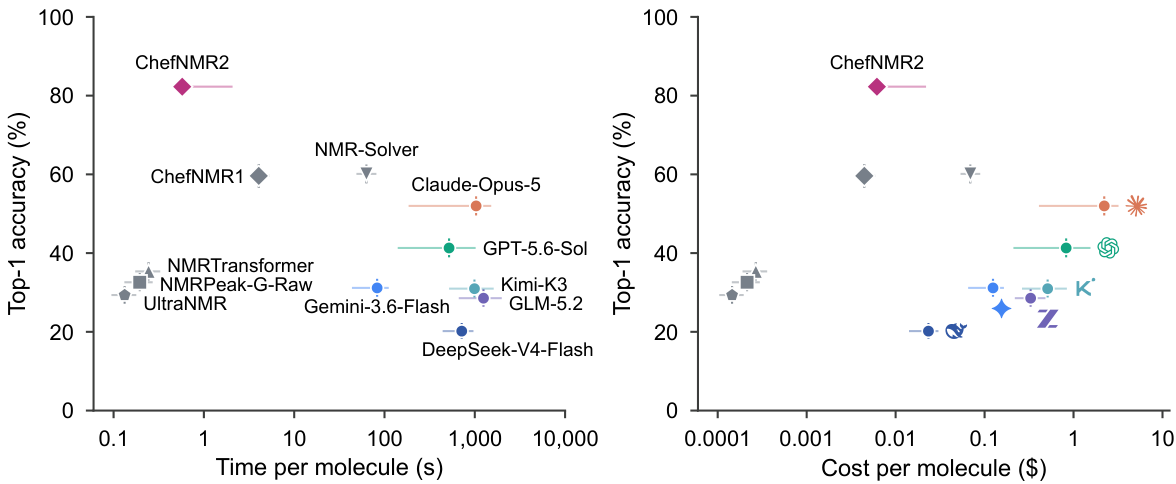
Fig. 2g and 2h: time (seconds) and cost (dollars) per molecule on log axes; ChefNMR2 sits top left, the language models to the right. [S1]
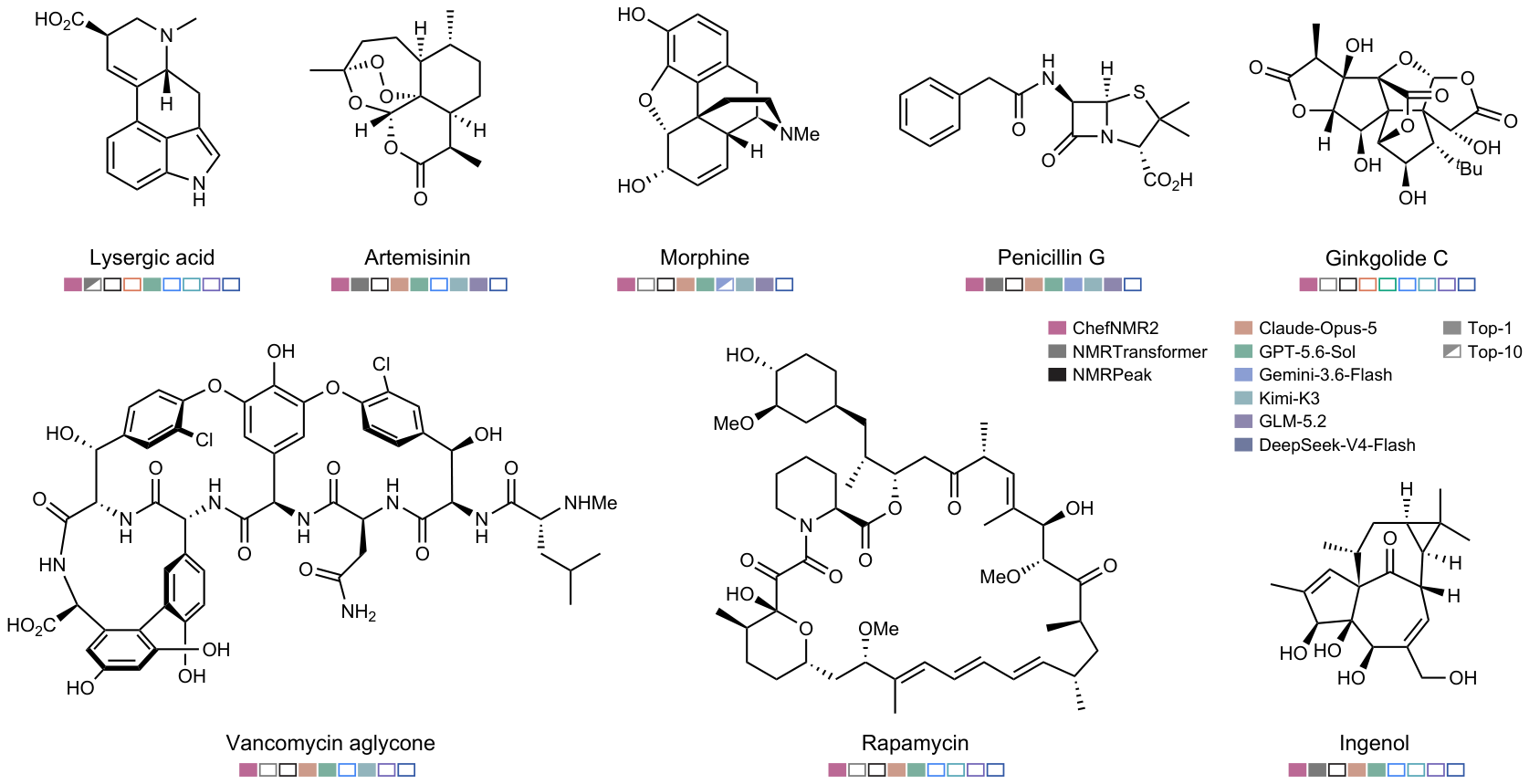
Fig. 3a: nine well-known natural products, with coloured cells marking whether each method ranked the structure first or in its top ten. [S1]
03Why it matters
A natural-product or metabolite lab can put its 1D spectra through ChefNMR2 first and save 2D NMR, mass spectrometry and chemists' time for the low-confidence cases.
- Confidence tracks accuracy, so a split of “use the confident calls, check the rest” has a basis.
- Code, weights, a web app and an MCP tool are public, so the step can sit inside any chat app or agent.
The paper's comparison with chemists: ChefNMR2 was 1,032-fold faster on nocobactin AI-2, and the agent about 86-fold faster on the other three new compounds. The paper gives no absolute times for the chemists and does not say how the human time was measured.[S1]
Three Edison employees are authors and the agent runs on Edison's Kosmos platform; Zhong's work is also funded by Anthropic's AI for Science Program. How Edison offers it in Kosmos, and to whom, the paper does not say.[S1]
04Evidence status and boundaries
Evidence rung 3 / 5 · Checked against existing evidenceEvidence status
Proven
- 82.3% first on 2,031 molecules, against 60.1% and 52.0%
- Confidence within 1.3 points of accuracy
- All nine famous natural products ranked first
Boundaries
Suggested
- Four new structures match the chemists' (one lab)
- Up to 2,170× faster, 360× cheaper than LLMs (medians)
- LLM scores on famous molecules partly recall (authors' reading)
Unknown
- Another lab's own unknowns
- Large, unfamiliar molecules (57.1% top-10, n = 35)
ClaimChefNMR2's top-10 accuracy on the five sets reads 95, 98, 96, 99 and 76; NMRShiftDB2 is its weakest.
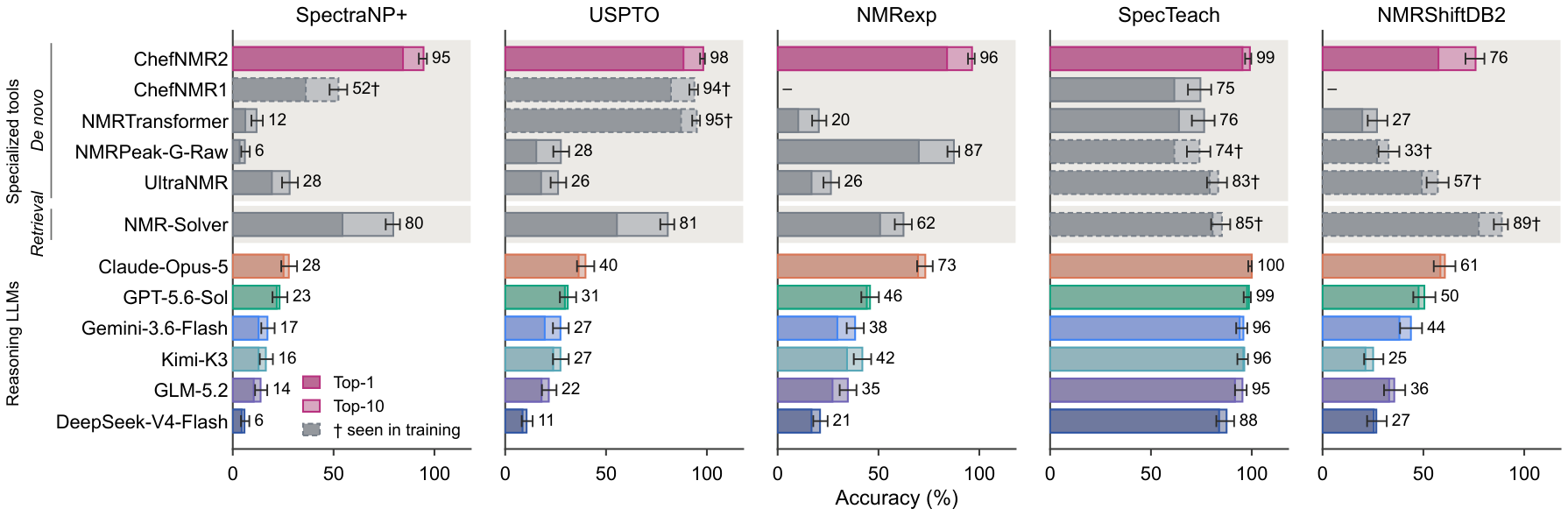
Reading† marks a method that saw the test molecules in training, like NMR-Solver's 89 on NMRShiftDB2. On SpecTeach, a teaching set, Claude-Opus-5 reaches 100.
The five test sets.
Three sets of 500 come from the test splits of the training sources: NMRexp (experimental), SpectraNP+ (simulated) and USPTO (simulated); SpecTeach has 216 molecules with experimental spectra and automatically picked peaks; NMRShiftDB2 has 315 with experimental, assigned peaks. The text does not print top-1 per set, so only the top-10 numbers printed in the figure are quoted here. By size and similarity to training, top-10 is 87.5% for molecules with more than 30 heavy atoms, 84.8% where the nearest training neighbour's similarity is below 0.6, and 57.1% for the 35 molecules that are both.[S1]
How the four new natural products were judged.
The two nocobactins come from Nocardia transvalensis and the two hybridamides from Streptomyces sp. HPH0547. Nocobactin AI-1 was isolated in this study (2.1 mg) and solved by a chemist with 1D and 2D NMR; AI-2 (4.5 mg) was solved by a chemist with 2D NMR and tandem mass spectrometry, and the model used automatically picked peaks with no manual correction; hybridamide A was solved by chemists in a separate study. The paper describes no crystal structure or synthesis. On AI-1, ChefNMR2 alone ranked the right structure fourth or fifth, the agent put it first in three of five runs, and the agent without ChefNMR2 usually failed; on AI-2 the model ranked it first at a 42% sampling frequency and the agent kept it first in all five runs; on hybridamide B the model put a wrong isomer first and the right one fourth to seventh, and the agent reached the right structure, with no run count given.[S1]
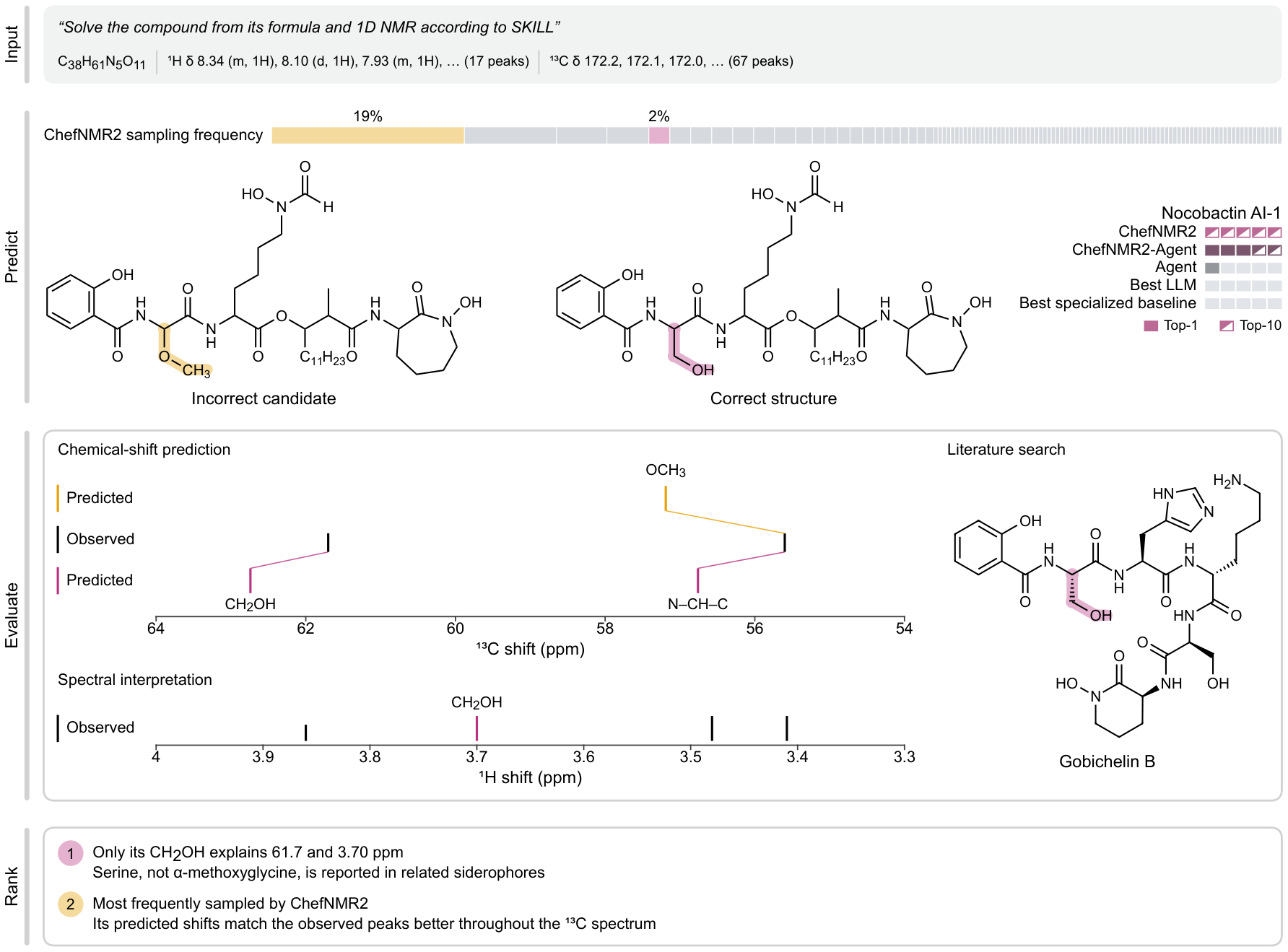
Fig. 4a: nocobactin AI-1. ChefNMR2 most often sampled a wrong candidate (19%), the right structure only 2%; the agent ranked it first using shift prediction, spectral interpretation and related siderophores in the literature. [S1]
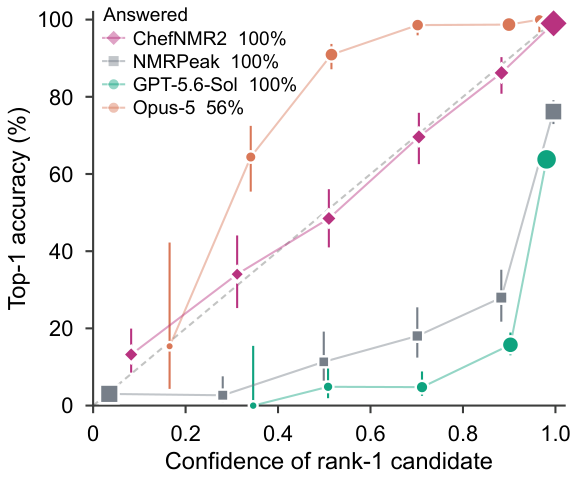
Fig. 2f: confidence of the top candidate against actual accuracy; ChefNMR2's curve follows the diagonal. The legend's percentages are the share of molecules each method answered; Opus-5's is 56%. [S1]
05What I learned
- Transferable insight
- A specialist model that proposes and a language model that checks beat either alone: nocobactin AI-1 is the case.
- Design heuristic
- Use repeated-sampling frequency as confidence, and let it decide how much compute a molecule gets.
- Reading heuristic
- When a language model solves a famous molecule, check whether it names it: that is recall, not inference.
- Watch next
- An outside lab solving its own unknowns with it; a version that assigns stereochemistry or takes 2D NMR.
The limits the authors state
The discussion states that the model needs the molecular formula as an auxiliary input; that it predicts planar structures without stereochemistry, since 1D NMR generally cannot tell stereoisomers apart; that using more information needs richer experimental data for retraining; and that chemists can use tandem mass spectrometry or 2D NMR to choose among the top-ranked structures. The paper also notes that four benchmark molecules (two taxanes, taxol and penicillin G) appear in the training data with simulated spectra, while no benchmark molecule was seen with its test spectrum.[S1]
As one imageTo save and share→Sources
Factual claims link to original announcements, project lists, trial records or journal papers where possible. Research plans are kept separate from completed results.