

Paper Brief
ChronoSyn: Using the Order in Which Materials Were Discovered to Predict Which Can Be Made
Park and Walsh had a composition-only synthesizability model also learn to rank known materials by the year each was first reported. A shuffled-year control ties most of the gain to the order itself; every check runs on existing databases.
◐Preprint + checks against existing experimental records
Current boundary: A composition-level gain on existing databases, backed by controls; whether it speeds real synthesis, or underrates little-studied chemistry, is untested
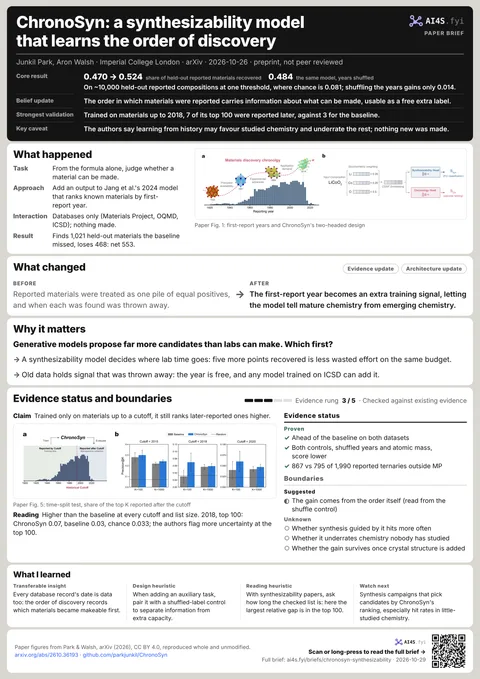
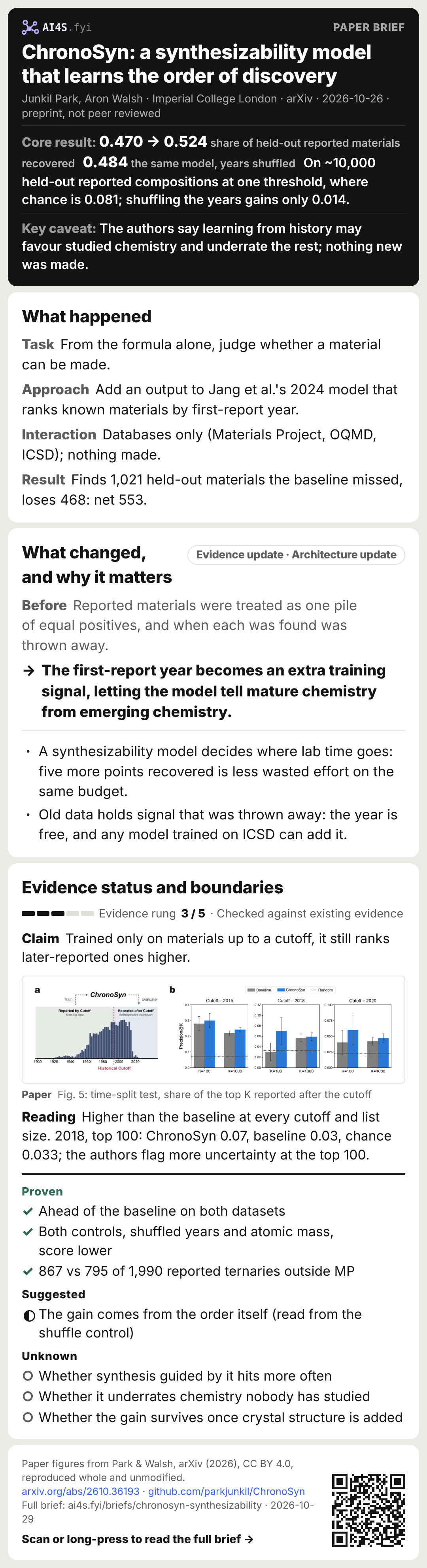
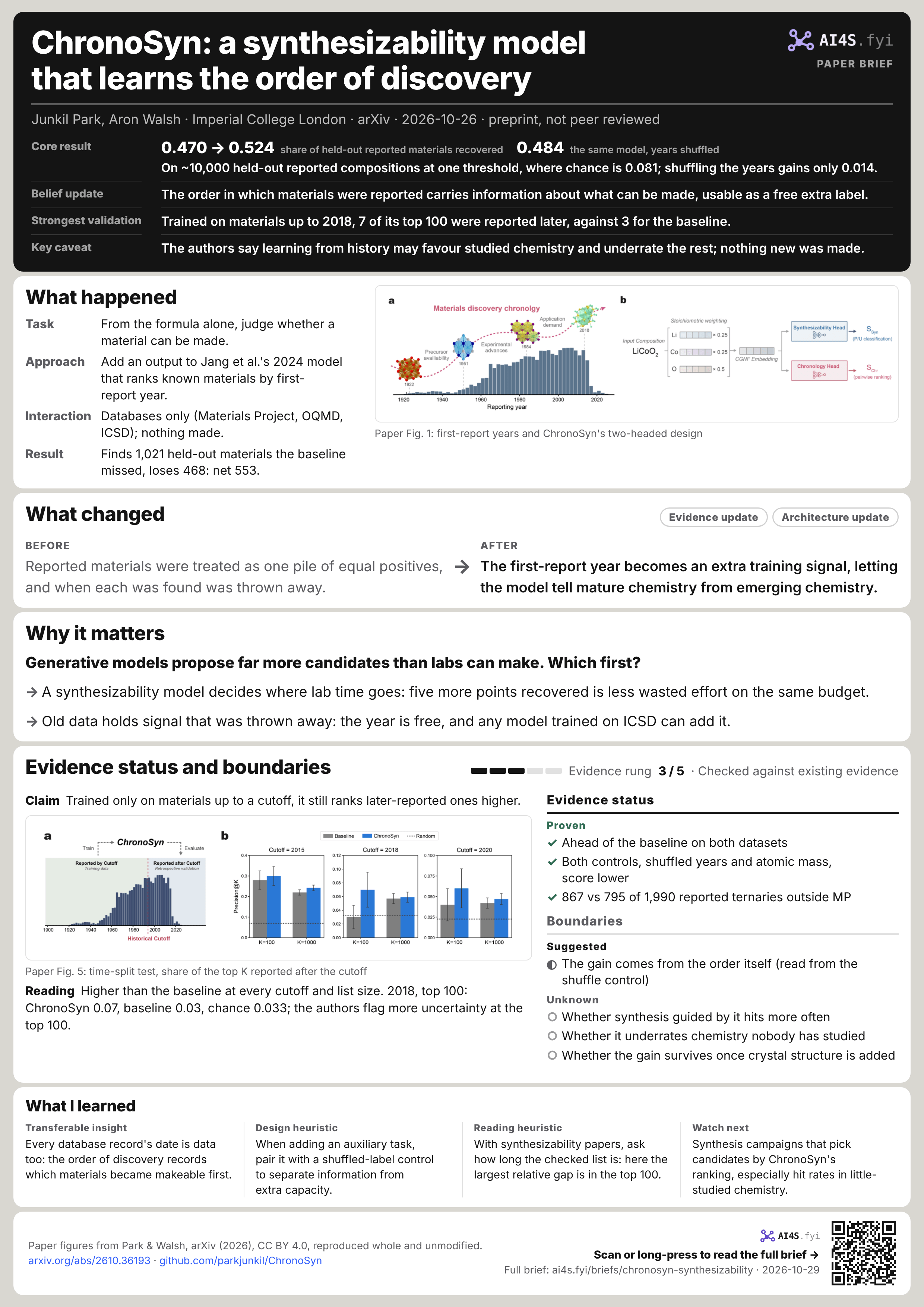
0.470 → 0.524share of held-out reported materials recovered
0.484the same model, years shuffled
On ~10,000 held-out reported compositions at one threshold, where chance is 0.081; shuffling the years gains only 0.014.
- Belief update
- The order in which materials were reported carries information about what can be made, usable as a free extra label.
- Strongest validation
- Trained on materials up to 2018, 7 of its top 100 were reported later, against 3 for the baseline.
- Key caveat
- The authors say learning from history may favour studied chemistry and underrate the rest; nothing new was made.
01What happened
- Task
- From the formula alone, judge whether a material can be made.
- Approach
- Add an output to Jang et al.'s 2024 model that ranks known materials by first-report year.
- Interaction
- Databases only (Materials Project, OQMD, ICSD); nothing made.
- Result
- Finds 1,021 held-out materials the baseline missed, loses 468: net 553.
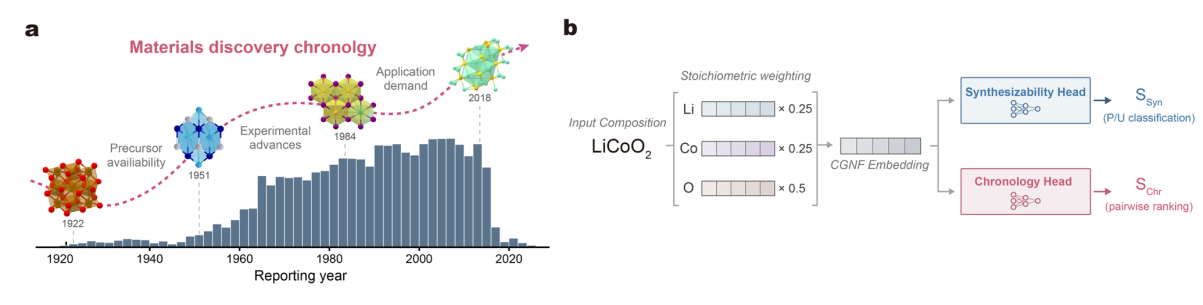
On 26 October 2026, Junkil Park and Aron Walsh of Imperial College London's Department of Materials posted ChronoSyn on arXiv. The paper lists Imperial as its only affiliation. Walsh has also been chief scientific officer of the materials AI company CuspAI since January 2026; the paper does not mention CuspAI.[S1][S4]
Synthesizability is usually framed as positive-unlabelled learning: compositions with an experimental report in ICSD are positives, the rest are unlabelled, since some may be materials nobody has made yet. ChronoSyn keeps the composition model Jang et al. published in Matter in 2024: a 90-number encoding of the formula, five fully connected layers, and one output separating positives from unlabelled. The new second output is trained only among positives, with a pairwise ranking loss, to learn which was reported earlier. The two losses are added, the ranking term weighted 3.[S1][S2]
There are two training sets. The Materials Project one has 104,837 compositions (51,010 positives); with OQMD added it has 408,638 (51,651 positives). Each positive takes the earliest publication year among its ICSD entries, from 1905 to 2024. ICSD is the July 2025 snapshot, and positives drop sharply in the 2020s, which the authors attribute to database coverage lagging rather than fewer discoveries. Each model is a 100-model ensemble on an 80/20 train/test split.[S1]
02What changed
Evidence updateArchitecture updateReported materials were treated as one pile of equal positives, and when each was found was thrown away.
The first-report year becomes an extra training signal, letting the model tell mature chemistry from emerging chemistry.
The controls are what carry the paper
Adding a second output could help a network learn whatever the year, so the authors trained two controls with identical architecture: one with the training positives' years shuffled, one ranking by mean atomic mass instead. On the Materials Project set the share recovered is 0.470 for the baseline, 0.524 for ChronoSyn, 0.484 shuffled and 0.466 for atomic mass; with OQMD, 0.831, 0.873, 0.844 and 0.838. The shuffled control alone gains 0.014 over the baseline, so the part owed to the order is about 0.040. The test set holds about 10,000 positives, standard errors are below 0.005, and McNemar's test on ChronoSyn against the baseline gives p below 10⁻⁴⁶.[S1]
The shares are calibrated for the positive-unlabelled setting: the threshold is set so that 8.1% of unlabelled compositions are called makeable, so every model is compared at the same rate of positive calls, the recovered share is nearly equal to estimated precision, and a random classifier scores 0.081. Redone with that 8.1% replaced by values from 1% to 50%, ChronoSyn is highest across the range.[S1]
ChronoSyn recovers 1,021 test positives the baseline missed and loses 468 it caught, a net 553. Compositions it recovers are 15.5 points more likely to contain an f-block element than those it does not, over twice the next element class. The authors trace this to families such as rare-earth magnets, cuprate superconductors and manganites, whose reports cluster in one period, so the order says more about them.[S1]
03Why it matters
Generative models propose far more candidates than labs can make. Which first?
- A synthesizability model decides where lab time goes: five more points recovered is less wasted effort on the same budget.
- Old data holds signal that was thrown away: the year is free, and any model trained on ICSD can add it.
The paper opens on the claim that high-throughput computation and generative models now propose candidate materials far faster than labs can synthesize them, so telling which hypothetical materials can be made matters more and more. A 2025 study Walsh co-authored with the Fritz Haber Institute estimated that 80-84% of GNoME's 554,054 public compositions are likely to form disordered structures, unlike the ordered crystals the database lists. Both ask the same question: of a flood of predicted materials, which deserve lab time.[S1][S3]
The authors argue the idea is not limited to composition models: the chronology objective could be added to structure-based synthesizability models or to methods built on large language models, and might apply to fields with long discovery records such as drug discovery and catalysis. An appendix makes an approximate comparison with one language-model method, where ChronoSyn has higher precision, though the authors call the two complementary rather than competing.[S1]
04Evidence status and boundaries
Evidence rung 3 / 5 · Checked against existing evidenceEvidence status
Proven
- Ahead of the baseline on both datasets
- Both controls, shuffled years and atomic mass, score lower
- 867 vs 795 of 1,990 reported ternaries outside MP
Boundaries
Suggested
- The gain comes from the order itself (read from the shuffle control)
Unknown
- Whether synthesis guided by it hits more often
- Whether it underrates chemistry nobody has studied
- Whether the gain survives once crystal structure is added
ClaimTrained only on materials up to a cutoff, it still ranks later-reported ones higher.
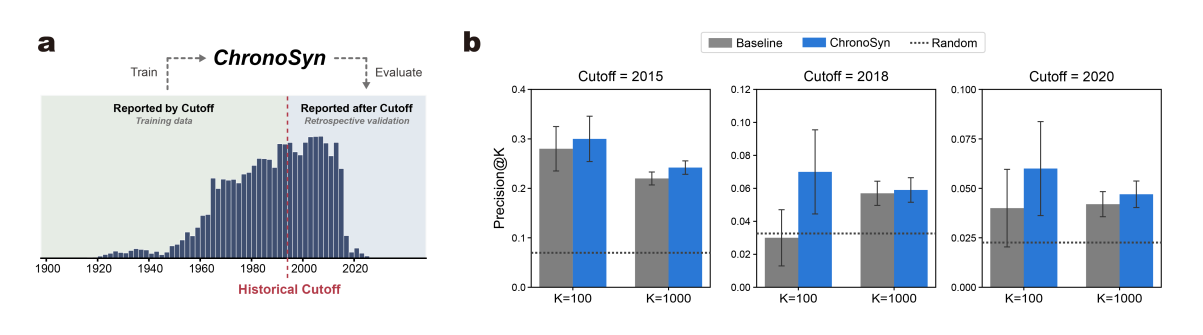
ReadingHigher than the baseline at every cutoff and list size. 2018, top 100: ChronoSyn 0.07, baseline 0.03, chance 0.033; the authors flag more uncertainty at the top 100.
The time-split test is closest to real use, but the gap sits at the very top.
With cutoffs at 2015, 2018 and 2020, both outputs were trained only on materials reported up to the cutoff, then asked to rank compositions reported after it. The pool is the later positives (807, 363 and 249) plus a fixed 10,765 held-out unlabelled compositions. ChronoSyn is above the baseline, and above chance, at all three cutoffs and both list sizes, the top 100 and the top 1,000. The authors say the largest relative differences come at the top 100 for later cutoffs, with greater statistical uncertainty. The 2018 top 100 is the case the paper gives in numbers: the baseline at 0.03, close to chance at 0.033, ChronoSyn at 0.07, which is 7 against 3.[S1]
Scoring outside the databases, there is an independent reference set.
Following Park, Onwuli, Butler and Walsh's 2025 framework, the authors enumerated about 50 million binary and ternary compositions over 89 elements and split them by a charge-balance check and presence in the Materials Project. Charge-balanced ones absent from MP are called Missing (7,485 binary, 8,037,364 ternary). Of these, 101 binary and 1,990 ternary have experimental reports in ICSD and serve as a reference set: ChronoSyn finds 38 and 867, the baseline 32 and 795. The authors note ChronoSyn calls slightly more ternaries makeable overall (22.4% vs 21.1%), which may explain part of the gap; at a matched rate it is still 826 against 795.[S1]
The three limits the authors list.
First, the reporting year is a stand-in for discovery and may not be when a material was first made or recognized. Second, the chronology signal reflects practical factors behind experiments, but may also lead ChronoSyn to favour chemical spaces that have drawn attention and score viable compositions in neglected regions lower, limiting its ability to find entirely new classes of materials. Third, it works on composition only and ignores polymorphism, though structure often decides whether a material can be made.[S1]
05What I learned
- Transferable insight
- Every database record's date is data too: the order of discovery records which materials became makeable first.
- Design heuristic
- When adding an auxiliary task, pair it with a shuffled-label control to separate information from extra capacity.
- Reading heuristic
- With synthesizability papers, ask how long the checked list is: here the largest relative gap is in the top 100.
- Watch next
- Synthesis campaigns that pick candidates by ChronoSyn's ranking, especially hit rates in little-studied chemistry.
Free labels are often already in the metadata
ChronoSyn uses no new measurement, only the publication year already in each ICSD entry. Any model built on a long-accumulated experimental database can ask whether the timing, provenance or correction history of its records holds information that was thrown away.
A model that learns from history inherits its biases
The second limit the authors name is the price of the method: if the order records where researchers' attention went, part of what the model learns is what will be studied, not only what can be made. Separating the two needs prospective synthesis in little-studied chemistry.
As one imageTo save and share→Sources
Factual claims link to original announcements, project lists, trial records or journal papers where possible. Research plans are kept separate from completed results.