

Case Study & Hardware Run· Evidence · Frontier
Codex Joins the Calibration of a Real Quantum Chip: What One Public Run Shows
An MIT EQuS researcher connected GPT-5.6 Sol, through Codex, to the lab's control software, and the model chose parameters, ran measurements, fit the data and decided what to do next. The article says that with clear signals it completed a standard sequence of measurements; weak or noisy signals still needed a researcher. The public evidence is an OpenAI case study and an excerpt of two steps on one qubit from one run.
○Vendor case study + excerpt of a real-hardware run
Current boundary: Rabi and Ramsey measurements chosen, run and fit by the model on a real chip are shown with data; run counts, success and intervention rates, and time or quality against a researcher are not published
This work advances: Has a model, through Codex, choose parameters, run measurements, fit the data and decide the next step on a real superconducting chip
- MODELUnderstand / predict
- DECIDEChoose next
- INTERACTTest against reality
- UPDATEChange next round
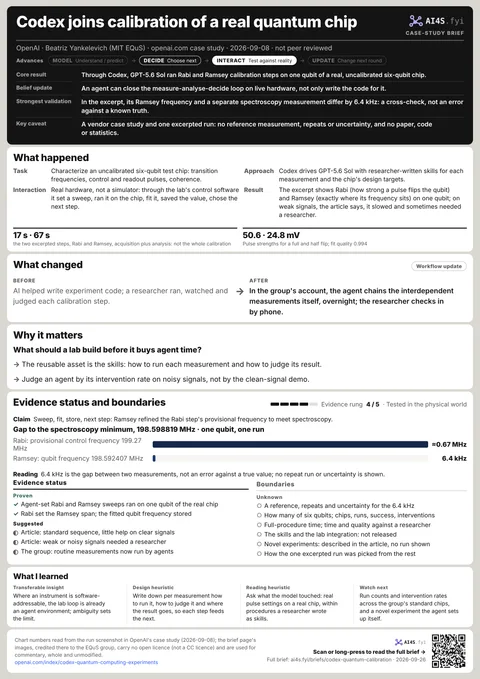
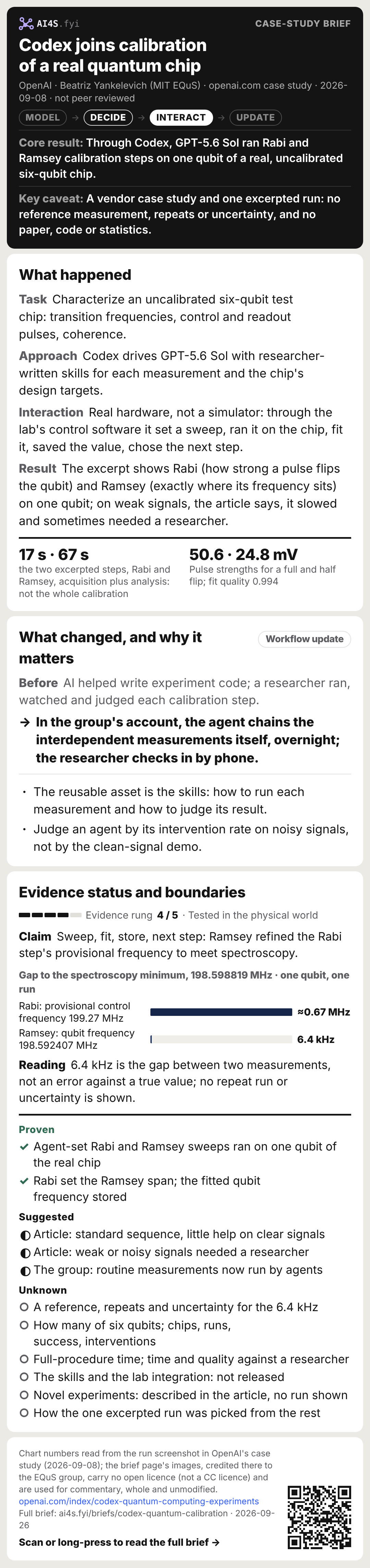
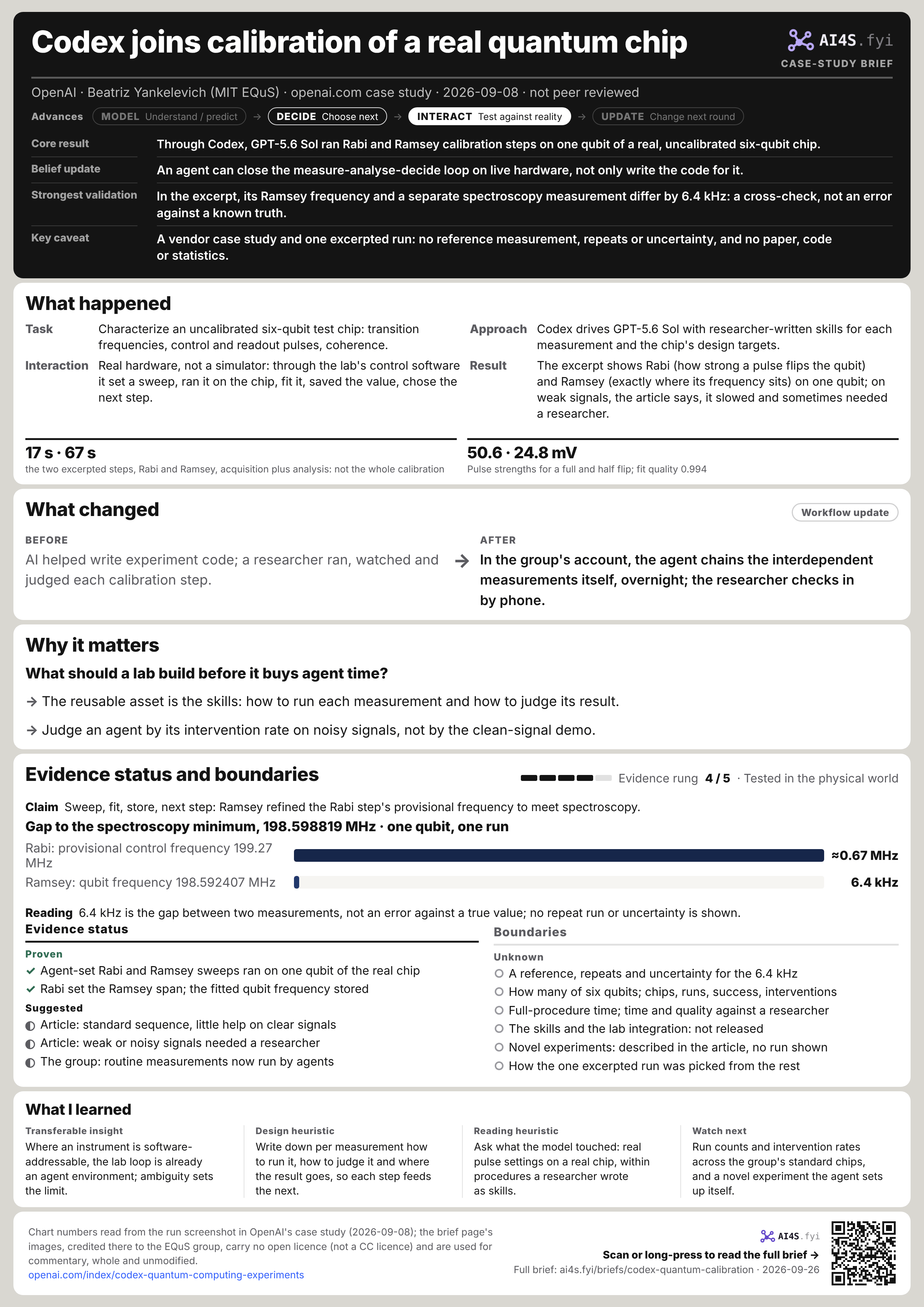
Through Codex, GPT-5.6 Sol ran Rabi and Ramsey calibration steps on one qubit of a real, uncalibrated six-qubit chip.
- Belief update
- An agent can close the measure-analyse-decide loop on live hardware, not only write the code for it.
- Strongest validation
- In the excerpt, its Ramsey frequency and a separate spectroscopy measurement differ by 6.4 kHz: a cross-check, not an error against a known truth.
- Key caveat
- A vendor case study and one excerpted run: no reference measurement, repeats or uncertainty, and no paper, code or statistics.
01What happened
- Task
- Characterize an uncalibrated six-qubit test chip: transition frequencies, control and readout pulses, coherence.
- Approach
- Codex drives GPT-5.6 Sol with researcher-written skills for each measurement and the chip's design targets.
- Interaction
- Real hardware, not a simulator: through the lab's control software it set a sweep, ran it on the chip, fit it, saved the value, chose the next step.
- Result
- The excerpt shows Rabi (how strong a pulse flips the qubit) and Ramsey (exactly where its frequency sits) on one qubit; on weak signals, the article says, it slowed and sometimes needed a researcher.
17 s · 67 sthe two excerpted steps, Rabi and Ramsey, acquisition plus analysis: not the whole calibration
50.6 · 24.8 mVPulse strengths for a full and half flip; fit quality 0.994
On 8 September 2026 OpenAI published a case study: Beatriz Yankelevich, a graduate student in MIT's Engineering Quantum Systems Group (EQuS), used GPT-5.6 Sol, harnessed to Codex, in her own experimental workflow. EQuS studies superconducting qubits, which are cooled to near absolute zero in dilution refrigerators and controlled with microwave signals.[S1]
The premise the article sets out is that once a chip has been fabricated, packaged and cooled, researchers interact with it entirely through software. Connected to the lab software that coordinates experiments, Codex could run measurements, analyse the results and decide what to try next.[S1]
What the model actually touched
The test object was an uncalibrated six-qubit chip, one of a standard type EQuS routinely uses to benchmark its fabrication process. Yankelevich gave Codex measurement-specific skills explaining how to run and evaluate each experiment. Using those skills and the chip's design targets, GPT-5.6 Sol chose measurement parameters, operated the hardware, analysed the data, and then either refined the measurement or saved the result for the next one.[S1]
First, what the two measurements are for. A Rabi measurement steps up the drive pulse's amplitude and answers "how strong a pulse flips the qubit from 0 to 1", which sets the π and π/2 pulse amplitudes; a Ramsey measurement puts a variable wait between two π/2 pulses and answers "exactly where the qubit's frequency sits". The run screenshot attached to the article shows the grain of that interaction. Through a Jupyter integration the model issued a 1D Rabi sweep over 0-0.4 V and fit an Xπ amplitude of 50.6 mV and an Xπ/2 amplitude of 24.8 mV (R² 0.994). The Rabi chevron's driven centre, 199.27 MHz, sat about 0.67 MHz above the half-flux spectroscopy minimum, so it widened the Ramsey detuning span to ±2 MHz, ran it on the 4 ns hardware grid with active reset, and stored a bare transition frequency f01 = 198.592407 MHz. The two steps are marked 17 s and 67 s of acquisition plus analysis and about 1k tokens each, the model's own estimate. The model was setting sweep ranges and pulse amplitudes on a real chip and reading back real measured signals, not simulator output.[S1]
The boundary sits here too. The measurement types themselves (Rabi, Ramsey, spectroscopy, coherence) are standard procedures, and how to run and evaluate them was written into the skills by the researcher. The model chose parameters within those procedures, judged the results and chained the next step; the article does not say it designed new pulse sequences or new experiments.[S1]
The outcome
When the signals were clear, Codex completed a standard sequence of measurements with little researcher intervention: it identified the qubit's transition frequencies, calibrated the pulses used to control and read it, and determined how long it retained quantum information. When signals were weak or noisy, it took longer to find suitable measurement parameters and sometimes needed guidance from an experienced researcher. The article's conclusion is that current agents can handle clearly defined experimental workflows, while interpreting ambiguous physical results remains a challenge.[S1]
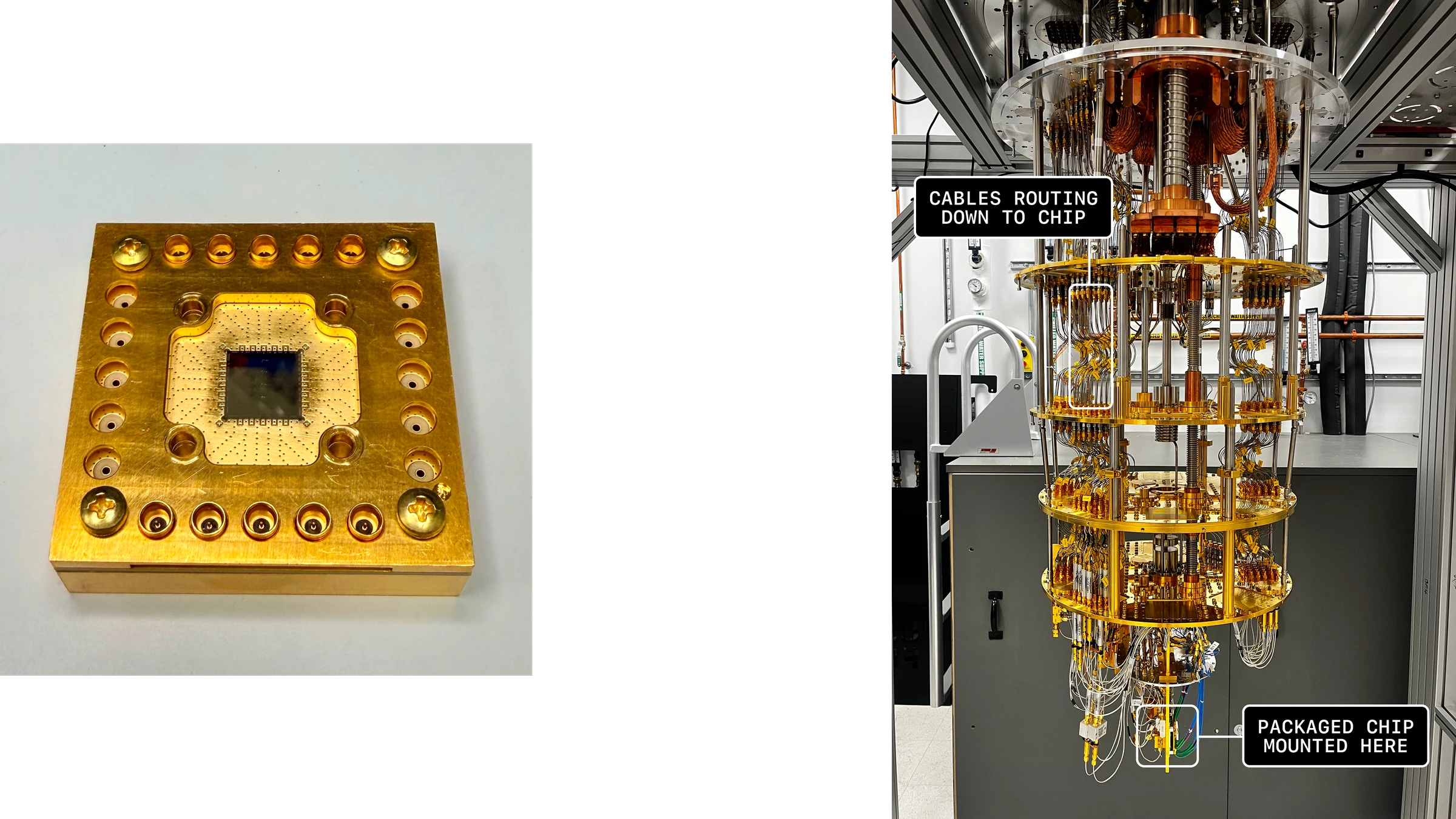
The packaged chip (left) and the open dilution refrigerator (right). The photo shows the setting, not evidence of the run, so the A4 sheet leaves it off and gives the space to the measured numbers in the screenshot. Image from OpenAI's case study, credited to the EQuS group; no open licence stated, used for commentary, reproduced whole and unmodified. [S1]
02What changed
Workflow updateAI helped write experiment code; a researcher ran, watched and judged each calibration step.
In the group's account, the agent chains the interdependent measurements itself, overnight; the researcher checks in by phone.
The article describes qubit calibration as a series of interdependent measurements, each result shaping what happens next; qubit properties can drift and unexpected physical behaviour can produce inconsistent results, which experienced researchers recognise and adapt to. That combination of software control, repeated measurement and adaptive decision-making is what makes it a use case for agents. Preparing and running qubit experiments can take months and hundreds to thousands of preliminary measurements.[S1]
EQuS fabricates many of these standard chips, each of which can take a researcher several days to characterize. The article says the group now regularly uses agents for routine measurements. In Yankelevich's words: "I can have agents running measurements for many hours overnight or while I'm working in the cleanroom. I can check in from my phone, see what they've done, and steer them if something needs fixing or if I want to explore a different direction."[S1]
The article also concedes that experienced researchers may still find the best calibration settings faster than current models; the gain is the time no longer spent monitoring every step, not a better calibration.[S1]
03Why it matters
What should a lab build before it buys agent time?
- The reusable asset is the skills: how to run each measurement and how to judge its result.
- Judge an agent by its intervention rate on noisy signals, not by the clean-signal demo.
Yankelevich says she has "built infrastructure to guide agents through several parts of my work - measurement, theory, and chip design - and now it's really starting to pay off." What does the work in this case is not only the model: measurement-specific skills, the chip's design targets and an interface that stores each result for the next step are what let a chain of interdependent measurements run unattended.[S1]
For novel experiments she gives agents narrower goals and leans more on their ability to write, modify and test code for control, analysis and simulation; connecting agents directly to the lab lets the group revise code, test it against real measurements and complete longer stretches autonomously. The article shows no run for this part, so it is a description, not evidence.[S1]
A standard calibration on clear signals is the easiest part to demonstrate; the hard part the article itself names (weak signals, noise, ambiguous physical results) is what decides how much supervision an agent can actually replace in a lab.
04Evidence status and boundaries
Evidence rung 4 / 5 · Tested in the physical world · Closed-loop experimentationEvidence status
Proven
- Agent-set Rabi and Ramsey sweeps ran on one qubit of the real chip
- Rabi set the Ramsey span; the fitted qubit frequency stored
Boundaries
Suggested
- Article: standard sequence, little help on clear signals
- Article: weak or noisy signals needed a researcher
- The group: routine measurements now run by agents
Unknown
- A reference, repeats and uncertainty for the 6.4 kHz
- How many of six qubits; chips, runs, success, interventions
- Full-procedure time; time and quality against a researcher
- The skills and the lab integration: not released
- Novel experiments: described in the article, no run shown
- How the one excerpted run was picked from the rest
ClaimSweep, fit, store, next step: Ramsey refined the Rabi step's provisional frequency to meet spectroscopy.
Gap to the spectroscopy minimum, 198.598819 MHz · one qubit, one run
Reading6.4 kHz is the gap between two measurements, not an error against a true value; no repeat run or uncertainty is shown.
It did reach real hardware.
The colour maps and fits in the screenshot come from measured signals on one qubit of the chip, labelled q1: a Rabi chevron with a driven centre of 199.27 MHz, a 1D Rabi oscillation, a Ramsey chevron and its linear-branch fit. The bare frequency the model stored, 198.592407 MHz, agrees with the half-flux spectroscopy minimum of 198.598819 MHz to 6.4 kHz: a cross-check between two different kinds of measurement, and the closest this case comes to quantitative validation. But it is the difference between two measurements, not a calibration error against an independent true value. The screenshot gives no reference measurement, no repeat run and no uncertainty, so whether 6.4 kHz is good agreement cannot be judged from the public material. On this site's ladder that reaches rung 4: new measurements were executed on real hardware because the model chose them.[S1]
But the evidence is a vendor case study.
The source is OpenAI's own site, and the screenshot is "an excerpted GPT-5.6 Sol chain-of-thought from a calibration run." What the screenshot measures is two steps on one qubit: a six-qubit chip does not mean six qubits calibrated, and 17 s and 67 s are the times of those two steps, not of the whole procedure. There is no paper, no code, no published skills and no statistics: how many chips, how many runs, how many of the six qubits were calibrated, how often a researcher stepped in, how much faster than a researcher: none of it has a number. "Little intervention on clear signals" and "the group now regularly uses agents for routine measurements" are statements by the article and the researcher, not measurements in the screenshot, which is why they sit under suggested.[S1]
"Better" is not claimed.
The article says outright that experienced researchers may find the best settings faster. What is claimed is supervision time saved, not calibration quality beyond a person's.[S1]
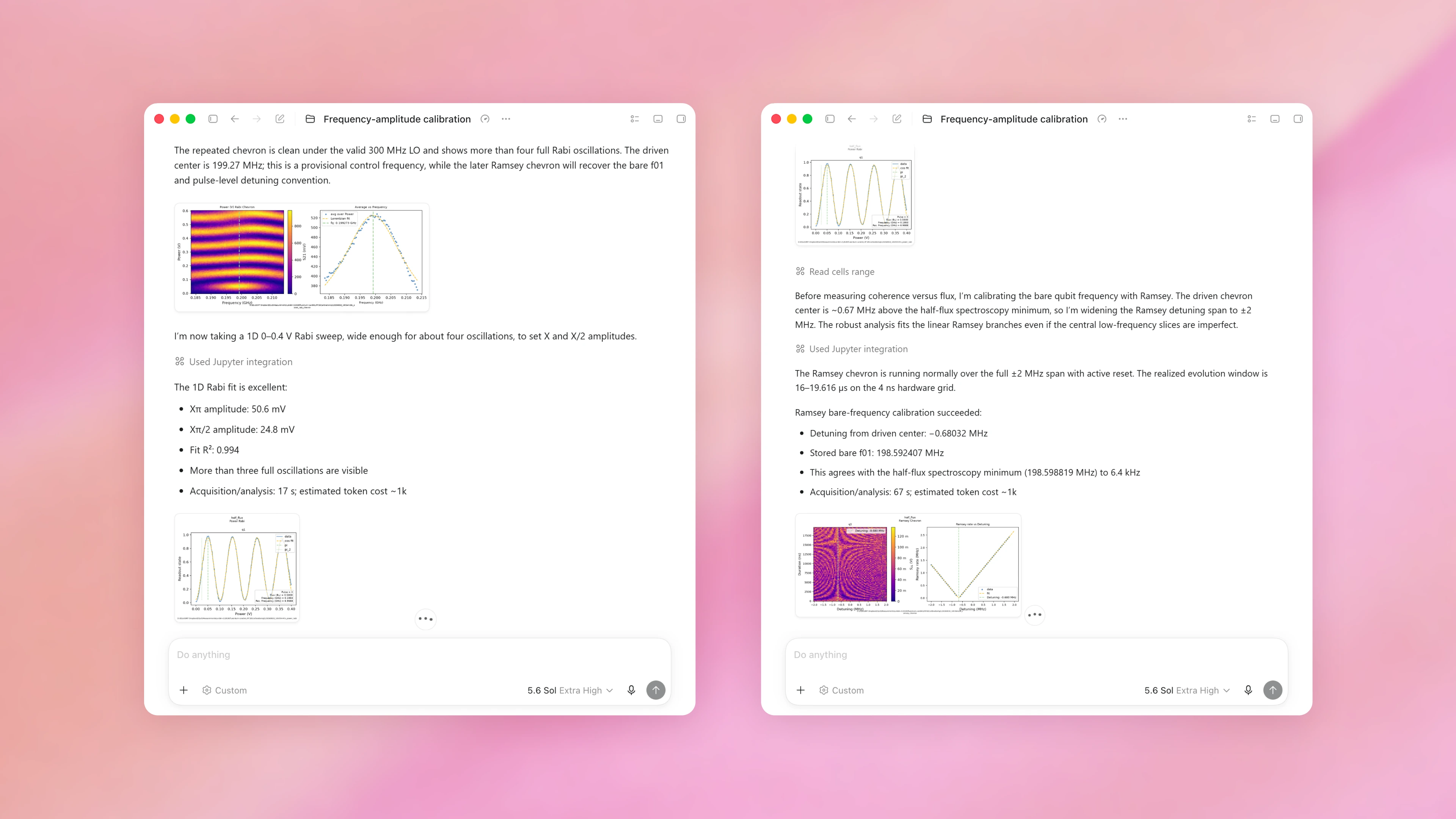
What OpenAI calls "an excerpted GPT-5.6 Sol chain-of-thought from a calibration run." Left: a Rabi chevron and 1D Rabi fit (Xπ 50.6 mV, Xπ/2 24.8 mV, R² 0.994, 17 s acquisition plus analysis). Right: a ±2 MHz Ramsey that stores f01 = 198.592407 MHz, 6.4 kHz from the spectroscopy minimum (67 s). One run, picked by the publisher. Image from OpenAI's case study, credited to the EQuS group; no open licence stated, used for commentary, reproduced whole and unmodified. Its text is illegible at A4, so it appears on this page only. [S1]
05What I learned
- Transferable insight
- Where an instrument is software-addressable, the lab loop is already an agent environment; ambiguity sets the limit.
- Design heuristic
- Write down per measurement how to run it, how to judge it and where the result goes, so each step feeds the next.
- Reading heuristic
- Ask what the model touched: real pulse settings on a real chip, within procedures a researcher wrote as skills.
- Watch next
- Run counts and intervention rates across the group's standard chips, and a novel experiment the agent sets up itself.
Interaction is the whole point of this case
Most AI-for-science claims stop at code and compute: the model writes programs, runs simulations, produces predictions. Here the model issued sweep ranges and pulse amplitudes to a real chip and read back signals from inside a dilution refrigerator. That is the distinction this site exists to make visible, even while the evidence is thin.
Execution is not the hard part; interpretation is
The boundary the article draws itself is weak, noisy, ambiguous signals. Standard calibration of a standard chip has already been written down as procedure, and the model does well inside it; once the physics does not show up as expected, a person is still needed.
The next evidence that would change the judgment
A record with statistics: how many chips, how many runs, how many researcher interventions, and time and outcome against manual characterization, or a novel experiment the agent designs and runs itself. Either would turn this from a case into a result that can be compared.
As one imageTo save and share→Sources
Factual claims link to original announcements, project lists, trial records or journal papers where possible. Research plans are kept separate from completed results.