

Company Map
Out of DeepMind: Where the Senior Researchers Went
Companies founded by people who left DeepMind, Google DeepMind and Google Brain: from reinforcement learning and world models to automated science, how research programs became companies.
○Founders and closed rounds check against primary pages; many valuations are reports, targets or talks; several early research results this brief discusses still lack an outside check
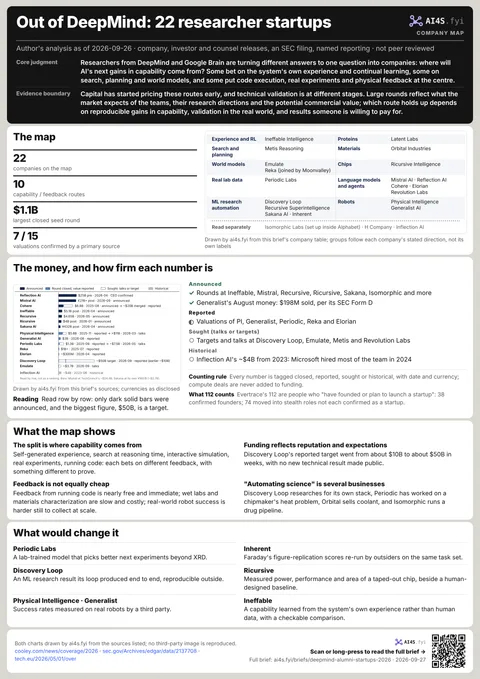

- Core judgment
- Researchers from DeepMind and Google Brain are turning different answers to one question into companies: where will AI's next gains in capability come from? Some bet on the system's own experience and continual learning, some on search, planning and world models, and some put code execution, real experiments and physical feedback at the centre.
- Evidence boundary
- Capital has started pricing these routes early, and technical validation is at different stages. Large rounds reflect what the market expects of the teams, their research directions and the potential commercial value; which route holds up depends on reproducible gains in capability, validation in the real world, and results someone is willing to pay for.
22companies on the map
10capability / feedback routes
$1.1Blargest closed seed round
7 / 15valuations confirmed by a primary source
01The map
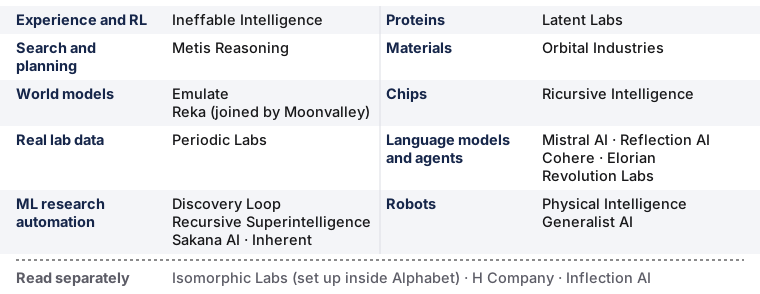
In 2026 the wave of companies founded by DeepMind and Google Brain researchers reached the most senior of them. David Silver's Ineffable Intelligence announced a $1.1B seed round in April; in August Jeff Dean launched Discovery Loop with Quoc Le, Oriol Vinyals and Sanjay Ghemawat, a Google distributed-systems engineer; by September Thore Graepel, Nando de Freitas and Jack Parker-Holder of the Genie team were founding or raising too. Bloomberg's report of 25 September puts all five side by side.[S1][S3][S7]
The teams have each chosen a different road. Some want AI to keep learning from experience, some put search and planning at the centre, some build world models, and some make ML experiments, protein design, materials work or chip design the business itself. Read together, the companies look like a map of research routes and routes to market: researchers are turning different technical judgements into different kinds of company. Each has three things to answer: where the next gains in capability will come from, what experiment will test that judgement, and who ends up paying for the result.
The scope is broad: core founders from DeepMind, Google DeepMind and Google Brain, with mixed teams marked as such. Isomorphic Labs, set up inside Alphabet, and two companies whose story has already turned (H Company and Inflection AI) are read separately and not counted with the independent departures. Amounts stay in the currency disclosed; a valuation carries no pre- or post-money label unless its source gives one; and a fundraising target never counts as a closed round.
David Silver: learning past the human data
Silver's company follows straight on from his research. He was head of reinforcement learning at Google DeepMind and worked on AlphaGo and AlphaZero; Ineffable aims to build learning systems that gain new knowledge and abilities from their own experience. On 27 April 2026 it announced a $1.1B seed round co-led by Sequoia and Lightspeed, with NVIDIA, Google, DST, Index, EQT Ventures, BOND, the UK's Sovereign AI Fund and the British Business Bank among the participants; the $5.1B post-money valuation is stated in the release from its counsel, Cooley.[S4][S3][S2]
Nor is Silver the only founder. Fortune reported in September that the company had confirmed six added cofounders: Chris Apps, Wojciech Czarnecki, Lasse Espeholt and Junhyuk Oh from DeepMind, Alexandre Laterre from InstaDeep and Heather Gorham from Flying Fish.[S6]
The research goal and what has been shown need keeping apart. "Without relying on human data" is the company's own phrase, and it invites the reading that a system has already been shown to grow free of human knowledge, task design and feedback. The accurate statement today is narrower: Ineffable wants to move the main source of new capability from existing data to a steady stream of new experience. That is a research program still to be tested.[S5]
Jeff Dean: first, a colleague for ML researchers
Discovery Loop launched on 5 August 2026 as a Delaware public benefit corporation. Of its four founders, Dean, Le and Vinyals come from Google Brain and DeepMind, while Ghemawat is a Google distributed-systems engineer; the company's own line is "three of the most-cited researchers in artificial intelligence and two of the most-cited researchers in distributed systems." The initial round is co-led by Radical Ventures and Khosla Ventures, with Lightspeed, Kleiner Perkins, Doerr Capital and Alphabet participating, and Alphabet has also set up a long-term cloud and compute partnership with it. Neither counsel's release nor the company's site gives an amount or a valuation.[S7][S8]
Its public roadmap is far narrower than "AI automates all of science": automate machine learning research and engineering first, act as its own first customer, then expand to other domains. Propose an experiment, implement and run it, examine the results, iterate: that is the unit it wants to automate. The long-range goals on its site are the National Academy of Engineering's Grand Challenges; chips and materials are not named, so chips, biology, drugs and materials are possible extensions, not businesses to list beside what it does now.[S8]
The valuations exist only in reporting. Business Insider, citing people familiar with the matter, said the company sought $1B at about $10B and, weeks later, sought funding at about $50B, adding that terms could still change. Those are two fundraising targets, not a valuation that "rose fivefold in weeks", which is how Tech Funding News headlined it, while also attributing the $10B to the co-led round. This brief therefore cites Business Insider as the origin.[S9][S10]
Emulate: the Genie team's world models
Emulate was founded in August by Jack Parker-Holder, Matthew McGill and Philip Ball, all from DeepMind's world-model team, carrying on the Genie line of research toward interactive environments, robotics and simulation. The FT reported advanced talks on up to $700M, jointly led by Index and Lightspeed, with Creandum participating; Bloomberg's headline calls it a seed round. The valuation is reported three ways: Tech Funding News says about $3.7B after the round, while TNW says the FT reported $3.7B pre-money and Bloomberg about $3B before the new money. This brief gives about $3.7B with the basis contested, not post-money. Terms were not agreed, so it is not a closed round.[S11][S12][S13]
Graepel and de Freitas: judgement worth watching, details still to come
Graepel did not go straight from DeepMind to a company. His own site lists DeepMind from 2015 to 2021 (AlphaGo and its successors), Altos Labs from 2021 to 2025, and Google DeepMind's Post-AGI team from 2025 to 2026. The name Metis Reasoning comes from Bloomberg and from the company's site. Bloomberg reported on 24 September that he is seeking tens of millions of dollars from a small group of early backers and could later raise hundreds of millions at a higher valuation; the talks are preliminary, and no investors or valuation are named.[S15][S14][S16]
The two framings need their sources kept straight. "Bringing AlphaGo-style reasoning to frontier AI, so that machines can plan and act under uncertainty" and "search and learned judgement" are from Graepel's personal site. The company's site says something different: today's models turn brittle when they reason beyond their training data, and Metis wants grounded, trusted conclusions and actions in high-stakes fields such as embodied AI, science and engineering. Both are aims; neither is a validated "search plus world model" product architecture.[S15][S16]
De Freitas spent about a decade at DeepMind, left in 2024 and then worked at Microsoft. Revolution Labs' funding is known only from reports; the company has announced nothing. Bloomberg reported on 25 September that it was in discussions to raise at least $100M initially, with Accel among the funds in talks to lead. Sifted reported on 15 October that Accel is set to lead a $60M round, smaller than September's figure, though Bloomberg had said the money would likely come in several tranches. Dealroom's summary of the Sifted report says GV and NEA are also said to have joined. Sifted's text could not be read here, and no valuation is given.[S1][S17][S18]
The phrase "diffusion instead of the transformer" needs care, and it is Bloomberg's own: the report calls diffusion models "an alternative to the transformer technology that underpins large language models." Diffusion describes a way of doing generative modelling; the transformer is a network architecture; the two combine, and the Diffusion Transformer (DiT) is an established line of research. Nothing public yet says whether Revolution Labs is leaving the transformer behind.[S1][S19]
Periodic Labs: experimental data into training
Periodic Labs joins two research lines: Ekin Doğuş Çubuk led the materials and chemistry team at Google Brain and DeepMind, where GNoME was one of his projects, and Liam Fedus was OpenAI's VP of research after working alongside Çubuk at Google Brain. The company wants to connect models, physical simulation and autonomous labs, and to improve scientific AI with the new data experiments produce.[S20][S21][S22]
Two rounds need keeping apart. The $300M seed of September 2025 was announced: TechCrunch later reported that a16z led it and Felicis wrote the first check, and Periodic's own post lists DST, NVentures, Accel and individuals including Jeff Bezos, Elad Gil, Eric Schmidt and Jeff Dean. The $1.3B valuation is not in the announcement; it is Forbes'. In May 2026 Forbes reported advanced talks to raise at least $500M at about $7.5B, led by AMP, the vehicle Anjney Midha founded. The report gives no round name and no pre- or post-money basis, and no closing announcement turned up, so it remains talks.[S20][S22][S23]
Its targets include superconductors and magnets, and it has disclosed work helping a semiconductor manufacturer with heat dissipation, so "only high-temperature superconductors" misses the industrial problems it has already named. The loop it has to build: decide what material to make, predict how to synthesize it, run the experiment, work out what was actually made, update the next round. Periodic itself describes three phases plus a refine-and-repeat step; the five steps here split out running the experiment.[S20][S24]
Inside that loop an experimental result is not a ready-made reward signal. The model has to read the measurement, spot anomalies and judge whether the product matches the plan; a failed experiment becomes useful training data only once it is recorded and explained.
On 15 September 2026, in "Building Labs that Learn," Periodic introduced Periodic Neon, a 1-trillion-parameter model it post-trained to analyze experimental results, with midtraining and reinforcement learning on its own laboratory data, deployed to its physical labs in Menlo Park; X-ray diffraction (XRD) analysis is a focus. It is post-trained from the open-weight Kimi K2.6, not a foundation model pretrained from scratch: this announcement does not name the base, and the research post published the same day, "Nature Is Our Learning Environment," states it. The company says Neon beats Claude Fable 5.1 and GPT-6 Astra at diffraction analysis; that is its own evaluation.Periodic Labs: When Experimental Results Become Training Signal →[S24][S25]
That is a far more concrete thing to watch than "building an AI scientist": whether experimental data improves scientific analysis, and whether better analysis picks better experiments. But analysis ability, loop efficiency, the properties of a new material and industrial scale-up are four separate levels of validation, and progress on one does not complete the next.
Research automation, proteins and chips
Besides Inherent, Latent, Ricursive and Orbital, this group takes in Recursive Superintelligence and Sakana AI, which bear, like Discovery Loop and Inherent, on the core question of how AI takes part in research and improves itself. Sakana is included on its founders' Google Brain and Google research background, not as a DeepMind team.
Recursive Superintelligence launched on 13 May 2026 with $650M in early funding that it says values it at $4.65B, co-led by GV and Greycroft, with NVIDIA and AMD's venture arm joining. No source gives a round name (GV calls it "early" funding) or says whether the valuation is pre- or post-money. Richard Socher is CEO; cofounders include Tim Rocktäschel, who led the open-endedness and self-improvement teams at Google DeepMind, in a mixed team. The company says it will focus first on the science of AI itself: recursive self-improvement and open-ended algorithms.[S26][S27][S28][S29]
Sakana AI was founded by David Ha (who led Google Brain's research team in Tokyo), Llion Jones (a co-author of the Transformer paper) and Ren Ito, who came from Japan's foreign ministry, Mercari and Stability AI. Its Series B was announced on 17 November 2025, when TechCrunch reported ¥20B (about $135M) at $2.65B post-money; a company update of 9 April 2026 enlarged the round to about ¥32B at about ¥432B post-money, with about ¥66B raised in total: about $200M, $2.7B and $412M at the company's own ¥160 to the dollar. Investors include MUFG, Khosla, NEA, Lux, Google, Salesforce Ventures, Citi, Macquarie and IQT; no lead is named. Its work spans model collaboration and evolution, self-improvement and the AI Scientist, alongside Japanese enterprise and defence business.[S30][S31][S32]
Inherent was founded by three former DeepMind researchers, Tantum Collins, Edward Hughes and Louis Kirsch, with Kaloyan Aleksiev from Reka and Microsoft: a mixed team. The company is called Inherent: legally Inherent Laboratories, a public benefit corporation. It came out of stealth in May 2026 with a $50M seed co-led by Index and Radical, with NVentures, Ex/Ante, Metaplanet, Macroscopic and Mythos participating; no valuation was given.[S33][S34]
Nor is it just "a platform that helps scientists think." Faraday was already its platform's name at launch in May; on 14 August the company described the agent behind it: a 27B-parameter model trained with long-horizon reinforcement learning, calling coding agents as tools, and set to replicate one figure from a research paper within a time and compute budget and without seeing the original plot: 310 tasks from 100 papers. The entry point is specific: first test whether a system can recover the "99% perspiration" a paper leaves unwritten, then ask about broader originality.Inherent's Faraday: a 27B judgment model that calls a frontier coding agent →[S35][S33]
Latent Labs was founded by Simon Kohl, former co-lead of DeepMind's protein design team and a senior research scientist on AlphaFold2, and works on generative design of proteins and antibodies. On 13 February 2025 it announced $50M in total, including a $40M Series A co-led by Radical Ventures and Sofinnova Partners, with angels including Jeff Dean, Aidan Gomez and Mati Staniszewski; no valuation was given, and no later round turned up.[S36]
Ricursive Intelligence was founded by AlphaChip's co-creators, Anna Goldie and Azalia Mirhoseini, to do AI-driven semiconductor design: AI and hardware co-evolving, in its words. On 26 January 2026 it closed a $300M Series A at a $4B post-money valuation, led by Lightspeed, with DST, NVentures, Felicis, Sequoia, 49 Palms and Radical.[S38]
Orbital Industries, formerly Orbital Materials, was founded by Jonathan Godwin and others; Godwin spent five years at Google DeepMind on AI for science and advanced materials. Its core model, Orb, simulates atoms, and its products now reach PFAS-free data-centre coolant and modular data centres. On 28 May 2026 it closed a $50M Series B led by Plural, with NVentures and existing investors Radical, Compound and Fly Ventures; no valuation was given.[S37]
Recursive and Ricursive are two companies: the first starts with AI improving AI, the second with chip design. The names differ by one letter; their funding, teams and businesses must not be merged.
Nor is the difference between them just whether they build a wet lab. Their feedback may come from code execution, paper replication, molecular experiments, materials characterization or chip design constraints, and its cost, speed and reliability shape how the whole learning system has to be built.
Foundation models and agents: not everyone is leaving LLMs
Mistral, Reflection and Cohere are the counterweight: founders from Google and DeepMind are also still building language models, multimodal models and enterprise agents. Calling the whole map "a collective bet beyond LLMs" hides what these companies actually chose to build.
Mistral AI's Arthur Mensch came from DeepMind; his cofounders Guillaume Lample and Timothée Lacroix came from Meta. On 8 September 2026 it announced a €3B Series D at a post-money valuation of more than €21B, led by Samsung with co-leads Scaleup Europe Fund, managed by EQT, and existing investor PSG Equity; funds and accounts managed by BlackRock joined as new investors, and existing investors including ASML, NVIDIA and a16z took part. The figures stay in euros; TechCrunch converts the valuation to about $24.4B. Its line is open-weight models, enterprise deployment and sovereign AI.[S39][S40]
Reflection AI was founded in 2024 by two former Google DeepMind researchers, Misha Laskin and Ioannis Antonoglou, to build open frontier models, coding and agentic reasoning. Its news page lists a CNBC interview of 23 April 2026 headlined as the CEO confirming a round closed at a $25B pre-money valuation, and TechCrunch in July described it as "currently valued at $25 billion pre-money" with close to $2.6B raised in total. No equally firm primary source gives this round's size, so this brief gives none, and 2025's investor list is not carried into 2026.[S41][S42]
Reflection's compute contracts are not funding. The SpaceX deal (up to $6.3B) and the Nebius deal ($1B) on its news page are purchases of capacity: the money flows out of Reflection, not in, and TechCrunch describes Nebius giving it access to NVIDIA's latest chips. Neither can be added to equity raised.[S41][S42]
Of Cohere's three founders, Aidan Gomez (a Transformer co-author and Google Brain intern) and Nick Frosst (Google Brain 2016-2020) have a Google research background; none was found for Ivan Zhang. On 14 August 2025 the company announced $500M at a $6.8B valuation; on 24 September BetaKit reported a $100M second close of the same round that lifted the valuation to about $7B, with investors including BDC, Nexxus, AMD Ventures, HOOPP, Inovia, NVIDIA, PSP, Radical and Salesforce Ventures.[S43][S44]
Two later events need writing separately. In April 2026 Cohere announced a planned combination with Aleph Alpha while raising a Series E to be led by Schwarz Group, Aleph Alpha's main backer, which committed about €500M (about $600M) in structured financing; TechCrunch, citing Handelsblatt, said the term sheet puts the combined company at around $20B. On 16 September the two signed a definitive business combination agreement, still subject to final regulatory approvals and expected to close later in the year. A merger is not a closed round: neither the Series E nor the $20B figure has a record of closing.[S45][S46]
Reka was founded by Dani Yogatama and others with DeepMind and Google Brain backgrounds; cofounder Yi Tay went back to Google DeepMind in November 2024, before the round below. On 22 July 2025 Reka announced $110M, with NVIDIA and Snowflake among new and existing investors; the release gives no valuation, and "over $1B" comes from Tech Funding News and Bloomberg's reporting. Then the picture changed: on 11 June 2026 Reka announced it had joined forces with Moonvalley, bringing former DeepMind researchers Mateusz Malinowski and Mikołaj Bińkowski into its research leadership. Reka now calls itself a research lab building foundational intelligence for the physical world, and the combined team is focused on a World Language Action Model, which is why this brief files it under world models.[S47][S48][S49]
Moonvalley's own last round was on 14 July 2025: $84M more, led by existing investor General Catalyst, with CAA, CoreWeave and Comcast Ventures new and Khosla and Y Combinator returning, for $154M in total and no valuation disclosed. Its video model, Marey, is trained exclusively on licensed content, and its CEO, Naeem Talukdar, is not from DeepMind. The Information reported the merger as an all-share acquisition; the release itself gives no terms.[S50][S49]
Elorian was founded by Andrew Dai, who spent about 14 years at Google Brain and DeepMind; cofounder Yinfei Yang was a machine learning researcher at Apple, so it is not an all-Google team. It works on visual understanding and visual reasoning. On 9 April 2026 it announced a $55M seed led by Striker Ventures, Menlo Ventures and Altimeter, with 49 Palms participating; its site also names NVIDIA and Jeff Dean. TechCrunch reported a $300M valuation in July; the "pre-seed valuation" in its headline is loose wording, not pre-money, and the basis remains unverified.[S51][S52]
Robots: from model capability to success in the real world
Physical Intelligence was founded by former Google DeepMind robotics researchers including Karol Hausman and Brian Ichter, with Sergey Levine, Chelsea Finn and others, to build general robot foundation models that join vision, language and action. Its November 2025 round was $600M at $5.6B, led by CapitalG with Lux, Thrive and Jeff Bezos returning, but SiliconANGLE states that the company has not officially disclosed it and that the figures come from sources quoted by The Information and Bloomberg, so they are reported, with no post-money label. SiliconANGLE calls Index Ventures and T. Rowe Price new investors; The Robot Report lists T. Rowe Price among returning ones.[S53][S54]
In March 2026 TechCrunch, citing Bloomberg, reported talks to raise about $1B more at a valuation above $11B, at an early stage, with Founders Fund set to take part. In August TechCrunch was still writing that it is "reportedly valued at $11 billion." Claims that the round closed rest on no primary source, and no closing announcement turned up, so it stays as talks.[S55][S59]
Generalist AI was founded by former Google DeepMind researchers Pete Florence and Andy Zeng with Andrew Barry, formerly a Boston Dynamics engineer, to build general robot models trained on large-scale physical-interaction data. On 4 June 2026 it announced $400M in new funding led by Radical Ventures, bringing its total past half a billion dollars; the post gives no valuation, while SiliconANGLE and TechCrunch report $2B and TechCrunch calls it a Series B. The August money has a primary record: an SEC Form D filed on 24 August shows an offering of about $208.2M with about $198.2M sold, first sale on 7 August, 32 investors. The 8VC lead and the $3B valuation come from a source quoted by Axios and two people cited by TechCrunch, which describes the money as an extension of the Series B that takes the round to $600M.[S56][S57][S58][S60][S59]
Three cases read separately
Isomorphic Labs was set up within Alphabet in 2021, founded and run by Demis Hassabis, so it is not an independent departure. On 12 May 2026 it announced a $2.1B Series B led by Thrive Capital, with Alphabet and GV continuing and MGX, Temasek, CapitalG and the UK Sovereign AI Fund joining; neither the release nor the press gives a valuation.[S61]
H Company announced a $220M seed in May 2024, with Accel, Amazon, Samsung and UiPath among the backers, along with Eric Schmidt. Bloomberg reported, as relayed by SiliconANGLE, that investors discussed putting in about 40% as equity and the rest as convertible debt, so "equity plus convertibles" can be stated only as reported. The founders were Charles Kantor and four former DeepMind researchers: Laurent Sifre, Karl Tuyls, Daan Wierstra and Julien Perolat. Wierstra, Tuyls and Perolat left in August 2024 over "operational differences"; in June 2025 Gautier Cloix replaced Kantor as CEO.[S62][S63][S64]
Inflection AI raised $1.3B in June 2023, led by Microsoft, Reid Hoffman, Bill Gates, Eric Schmidt and new investor NVIDIA. The roughly $4B valuation is not in the press release; it comes from a source quoted by TechCrunch, and Reuters later described the money as a mix of cash and cloud credit. In March 2024, according to a person familiar with the matter quoted by Reuters, Microsoft agreed to pay about $650M to use Inflection's models, and hired Mustafa Suleyman, Karén Simonyan and most of the 70-person team.[S65][S66]
Company by company: feedback, founders, latest round and next evidence
02The money, and how firm each number is
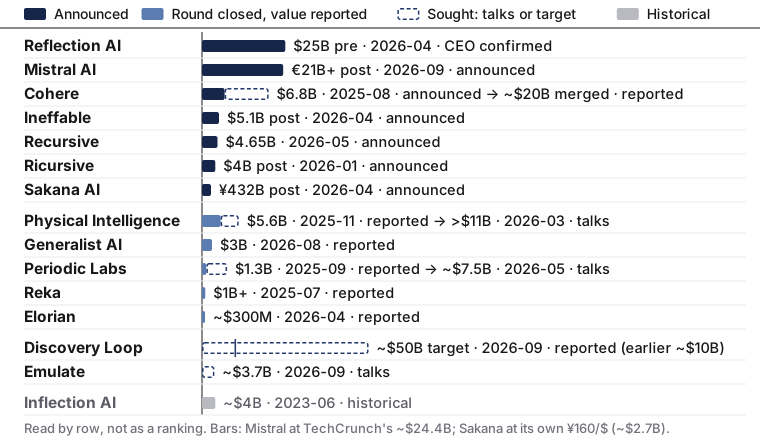
ReadingRead row by row: only dark solid bars were announced, and the biggest figure, $50B, is a target.
Announced
- Rounds at Ineffable, Mistral, Recursive, Ricursive, Sakana, Isomorphic and more
- Generalist's August money: $198M sold, per its SEC Form D
Reported
- Valuations of PI, Generalist, Periodic, Reka and Elorian
Sought (talks or targets)
- Targets and talks at Discovery Loop, Emulate, Metis and Revolution Labs
Historical
- Inflection AI's ~$4B from 2023: Microsoft hired most of the team in 2024
Counting ruleEvery number is tagged closed, reported, sought or historical, with date and currency; compute deals are never added to funding.
What 112 countsEvertrace's 112 are people who "have founded or plan to launch a startup": 38 confirmed founders; 74 moved into stealth roles not each confirmed as a startup.
What the record confirms.
What this record confirms is who founded what, which rounds closed according to company, investor or counsel announcements, and, from an SEC filing, Generalist's August money. What it suggests without proving are the reported valuations, targets and talks. What it leaves unknown is whether the early research results it discusses hold up: Periodic Neon's diffraction scores and Faraday's replication scores are published and evaluated by the companies themselves, with no outside check yet. That a company exists and has money is never evidence that its technology works.[S2][S58][S24][S35]
Funding reflects reputation and market expectations
Very large early rounds reflect research reputation and market expectations; they cannot on their own show technology that has delivered. And this is a heavily selected sample of star teams: the brief picks the most senior and best-known founders on purpose, so it says nothing about how researcher-founded companies fare in general.
Reading the valuation chart
The valuation chart keeps four kinds of number apart: announced by the company, an investor or counsel (dark solid); a closed round whose valuation comes from reporting (light solid); a figure only sought, a target or talks (dashed outline); and a historical deal (grey). They differ in date and basis and keep their disclosed currency, so each row is read on its own, never as a ranking at one moment. The longest bar is Discovery Loop's ~$50B fundraising target, not a completed valuation; Reflection's $25B is pre-money and Mistral's €21B post-money, so even those two do not compare directly.
The statistic: what 112 counts
The often-quoted "112 DeepMind alumni founded startups" needs relabelling. Tech.eu, on 1 May 2026, relayed Evertrace's count over the previous 18 months: 112 people who "have founded or plan to launch a startup," of whom 38 had started a company and 74 had moved into a "stealth" role, and Tech.eu says it has not established that each stealth role is a new startup. The sample is looser than research staff, taking in interns, a consultant and a scholarship recipient, and 70 of the 112 are in the US although the headline speaks of European startups. The accurate line: 112 alumni have founded or may be preparing startups, 38 of them confirmed.[S67]
03What the map shows
- The split is where capability comes from
- Self-generated experience, search at reasoning time, interactive simulation, real experiments, running code: each bets on different feedback, with something different to prove.
- Funding reflects reputation and expectations
- Discovery Loop's reported target went from about $10B to about $50B in weeks, with no new technical result made public.
- Feedback is not equally cheap
- Feedback from running code is nearly free and immediate; wet labs and materials characterization are slow and costly; real-world robot success is harder still to collect at scale.
- "Automating science" is several businesses
- Discovery Loop researches for its own stack, Periodic has worked on a chipmaker's heat problem, Orbital sells coolant, and Isomorphic runs a drug pipeline.
Where the next gains in capability come from
The split among these companies has been moving from model scale to a more basic question: where will the next gains in capability come from? For each company it breaks into three: what feedback does the system learn from, is it reliable enough, and can it keep coming at a reasonable cost? Roughly, experience and reinforcement learning bet on data the system generates itself, search and planning on search at reasoning time, world models on interactive simulation, Periodic on real experiments, research automation on code execution and paper replication, proteins, materials and chips on molecular experiments, materials characterization and design constraints, and robots on success in the real world. That grouping is this brief's reading of the stated directions, not the companies' own labels.
"Automating science" is several businesses
What does the customer actually buy: model access, research software, R&D services, intellectual property, or materials and devices it can deploy? Under the same label, Discovery Loop does research for its own stack first, Periodic has already worked on a chipmaker's heat problem, Orbital sells coolant and modular data centres, and Isomorphic runs a drug pipeline. Different payers need different proof.[S8][S20][S37][S61]
The founders left Google; the capital network came with them
Alphabet joined Discovery Loop's initial round and provides long-term cloud and compute; Google joined Ineffable's seed, and Ineffable announced a Google Cloud compute partnership in July, Fortune reports; GV co-led Recursive with Greycroft; CapitalG led Physical Intelligence's reported round; and Isomorphic never left Alphabet. When these companies are judged, it is worth remembering that the investor is sometimes also the compute supplier.[S7][S3][S6][S27][S53][S61]
Valuations move with reputation and expectations
Discovery Loop's reported target went from about $10B to about $50B in weeks with no new technical result made public. Valuations move with reputation and the supply of capital; they cannot be read as a verdict on whether a technology works.[S9]
Feedback first, model second
Under the same label of AI doing research, feedback from running code is nearly free and immediate, feedback from wet labs and materials characterization is slow and costly, and real-world robot success is harder still to collect at scale. Stating a system's feedback (source, reliability, cost) says more about how far it can go than its parameter count.
04What would change it
- Periodic LabsA lab-trained model that picks better next experiments beyond XRD.
- InherentFaraday's figure-replication scores re-run by outsiders on the same task set.
- Discovery LoopAn ML research result its loop produced end to end, reproducible outside.
- RicursiveMeasured power, performance and area of a taped-out chip, beside a human-designed baseline.
- Physical Intelligence · GeneralistSuccess rates measured on real robots by a third party.
- IneffableA capability learned from the system's own experience rather than human data, with a checkable comparison.
Closing: from research records to a new record of validation
The update most worth tracking next is which of these companies first publishes a result that can be checked, can be reproduced, and changes how research is actually done. A higher valuation cannot change this record's judgement of any route.
Concretely, the things to wait for: whether Periodic's lab-trained model picks better experiments beyond XRD; whether Faraday's replication scores can be re-run by outsiders on the same task set; Discovery Loop's first ML research result produced end to end by its loop; measured power, performance and area from a Ricursive tape-out; and robot success rates measured by a third party in real settings. Each of these could change this record's judgement of a route; a rising valuation cannot.
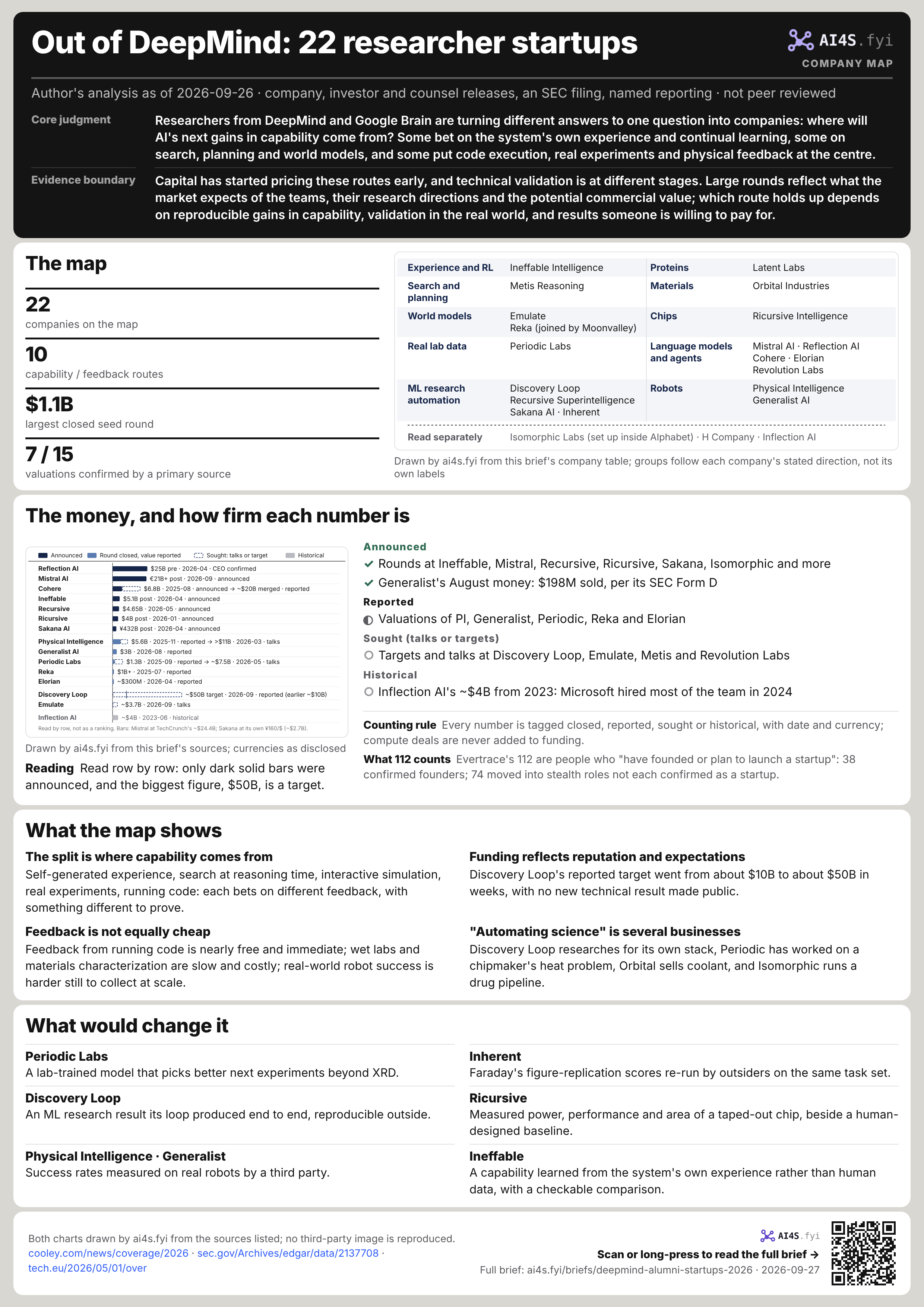
As one imageTo save and share→Sources
Factual claims link to original announcements, project lists, trial records or journal papers where possible. Research plans are kept separate from completed results.
- S1Google DeepMind exodus sparks VC interest (Bloomberg, syndicated by Yahoo Finance)Bloomberg via Yahoo Finance · 2026.09.25 · News report
- S2Ineffable Intelligence announces $1.1 billion seed financingCooley · 2026.04.27 · Company counsel announcement
- S3Ineffable Intelligence launches with record-breaking $1.1B seed roundTech.eu · 2026.04.27 · News report
- S4UK backs company building breakthrough AI that can discover new knowledgeGOV.UK · 2026.04.27 · Government announcement
- S5Ineffable Intelligence websiteIneffable Intelligence · 2026.09.26 · Company website (date read)
- S6Ineffable Intelligence hires cofounders from Google DeepMind, InstaDeep and Flying FishFortune · 2026.09.07 · News report
- S7Wilson Sonsini advises Discovery Loop on launch and initial fundingWilson Sonsini · 2026.08.05 · Company counsel announcement
- S8Discovery Loop websiteDiscovery Loop · 2026.09.26 · Company website (date read)
- S9AI startup Discovery Loop seeks funding at $50bn valuation (Business Insider, via Investing.com)Investing.com (Business Insider) · 2026.09.11 · News report (relayed)
- S10Ex-Google chief scientist Jeff Dean targets $50B valuation for Discovery Loop (secondary; headline framing flagged)Tech Funding News · 2026.09.14 · News report
- S11DeepMind's Genie creators launch Emulate, seeking $700MTech Funding News · 2026.09.17 · News report (relaying the FT)
- S12Former DeepMind world-model researchers' startup Emulate in talks to raise $700MTNW · 2026.09.17 · News report
- S13DeepMind offshoot Emulate closes in on $700 million seed round (headline only)Bloomberg · 2026.09.17 · News report
- S14DeepMind alumni draw investors beyond large language models (relaying Bloomberg)PYMNTS · 2026.09.24 · News report (relayed)
- S15Thore Graepel, personal siteThore Graepel · 2026.09.26 · Personal site (date read)
- S16Metis Reasoning websiteMetis Reasoning · 2026.09.26 · Company website (date read)
- S17Exclusive: Accel set to lead DeepMind alum's $60m round (headline and date only)Sifted · 2026.10.15 · News report (text not read)
- S18Accel to lead $60M round for DeepMind alum's post-LLM startupDealroom · 2026.10.16 · Database news summary (relaying Sifted)
- S19Scalable Diffusion Models with TransformersPeebles & Xie, ICCV 2023 · 2023.10.02 · Conference paper
- S20Introducing Periodic LabsPeriodic Labs · 2025.09.30 · Company announcement
- S21Former OpenAI and DeepMind researchers raise whopping $300M seed to automate scienceTechCrunch · 2025.09.30 · News report
- S22Top OpenAI, Google Brain researchers set off a $300M VC frenzy for their startup Periodic LabsTechCrunch · 2025.10.20 · News report
- S23Former OpenAI researcher to raise $500 million for AI science startupForbes · 2026.05.07 · News report
- S24Building Labs that LearnPeriodic Labs · 2026.09.15 · Company technical post
- S25Nature Is Our Learning EnvironmentPeriodic Labs · 2026.09.15 · Company research post
- S26Recursive Superintelligence raises $650M to build self-improving AI modelsSiliconANGLE · 2026.05.13 · News report
- S27Recursive Superintelligence: self-improving AIGV · 2026.05.13 · Investor announcement
- S28What happens when AI starts building itselfTechCrunch · 2026.05.14 · News report
- S29Recursive Superintelligence websiteRecursive Superintelligence · 2026.09.26 · Company website (date read)
- S30Sakana AI Series B announcement (updated 2026-04-09)Sakana AI · 2025.11.17 · Company announcement
- S31Sakana AI raises $135M Series B (TechCrunch, syndicated by Yahoo)TechCrunch via Yahoo Finance · 2025.11.17 · News report
- S32Sakana AI company informationSakana AI · 2026.09.26 · Company website (date read)
- S33Inherent raises $50 million seed for FaradayTNW · 2026.05.30 · News report
- S34London-based AI lab Inherent emerges from stealth with $50M raiseTech.eu · 2026.05.29 · News report
- S35Training to ReplicateInherent · 2026.08.14 · Company technical post
- S36Latent Labs secures $50M in fundingLatent Labs · 2025.02.13 · Company announcement
- S37Exclusive: Orbital Industries raises $50 million Series BFortune · 2026.05.28 · News report
- S38Ricursive Intelligence raises $300 million Series A at $4 billion valuationPR Newswire · 2026.01.26 · Company announcement
- S39Mistral makes sovereign open-weight AI to frontier (Series D)Mistral AI · 2026.09.08 · Company announcement
- S40Mistral raises €3B as sovereign AI becomes big businessTechCrunch · 2026.09.08 · News report
- S41Reflection AI news pageReflection AI · 2026.09.26 · Company news page (date read)
- S42Reflection inks $1B compute deal with NebiusTechCrunch · 2026.07.14 · News report
- S43Cohere raises $500M at $6.8B valuationCohere · 2025.08.14 · Company announcement
- S44Cohere's valuation hits $7 billion USD following $100 million round extensionBetaKit · 2025.09.24 · News report
- S45Why Cohere is merging with Aleph AlphaTechCrunch · 2026.04.25 · News report
- S46Cohere and Aleph Alpha sign agreement to become the first transatlantic sovereign AI solutionPR Newswire · 2026.09.16 · Company announcement
- S47Reka secures $110 million to accelerate adoption of its multimodal AI platformsReka · 2025.07.22 · Company announcement
- S48Reka raises $110 million for multimodal AITech Funding News · 2025.07.25 · News report
- S49Reka and Moonvalley join forces to advance models and infrastructure for physical AIPR Newswire · 2026.06.11 · Company announcement
- S50Moonvalley raises additional $84 million to scale its licensed AI video modelMoonvalley via Business Wire · 2025.07.14 · Company announcement
- S51Wilson Sonsini advises Elorian on $55 million seed financingWilson Sonsini · 2026.04.13 · Company counsel announcement
- S52How a former DeepMind researcher raised at a $300M pre-seed valuation before launching a productTechCrunch · 2026.07.16 · News report
- S53Jeff Bezos-backed Physical Intelligence raises $600M to improve AI robot brainsSiliconANGLE · 2025.11.20 · News report
- S54Physical Intelligence raises $600M to advance robot foundation modelsThe Robot Report · 2025.11.25 · News report
- S55Physical Intelligence is reportedly in talks to raise $1 billion againTechCrunch · 2026.03.27 · News report
- S56Accelerating the next phase of physical AIGeneralist AI · 2026.06.04 · Company announcement
- S57Generalist AI raises $400M at $2B valuationSiliconANGLE · 2026.06.04 · News report
- S58Generalist AI, Inc. Form D (filed 2026-08-24)U.S. SEC (EDGAR) · 2026.08.24 · Regulatory filing
- S59Robotics startup Generalist reaches $3B valuation, sources sayTechCrunch · 2026.08.25 · News report
- S60Scoop: Generalist raises another $200M (Axios, syndicated by Yahoo)Axios via Yahoo Finance · 2026.08.24 · News report
- S61Isomorphic Labs secures $2.1 billion funding to scale its AI drug design engineIsomorphic Labs · 2026.05.12 · Company announcement
- S62H, a new Paris-based AI startup, raises $220M from prominent investorsSiliconANGLE · 2024.05.21 · News report (relaying Bloomberg)
- S633 co-founders leave French AI startup H amid operational differencesPYMNTS · 2024.08.23 · News report
- S64After founders flee, H's new CEO wants to steady the shipSemafor · 2025.07.09 · News report
- S65Inflection AI lands $1.3B investment to build more personal AITechCrunch · 2023.06.29 · News report
- S66Microsoft agreed to pay Inflection $650 million (Reuters, syndicated by Yahoo)Reuters via Yahoo Finance · 2024.03.21 · News report
- S67Over 100 DeepMind alumni have founded or plan to launch startups (Evertrace data)Tech.eu · 2026.05.01 · News report (relaying third-party data)