

Lab & Model Brief· Evidence · Frontier
Periodic Labs: When Experimental Results Become Training Signal
Across three posts Periodic Labs published on one day, the fullest stretch is characterization: the model learns to read what a synthesis actually produced, and that reading feeds the next round of training.
◆Company technical blog + internal benchmark + expert annotation
Current boundary: What is established is one stretch of characterization capability, and that lab data can train it
This work advances: Turns a lab's own diffraction data into post-training signal so a model reads what was actually made
- MODELUnderstand / predict
- DECIDEChoose next
- INTERACTTest against reality
- UPDATEChange next round
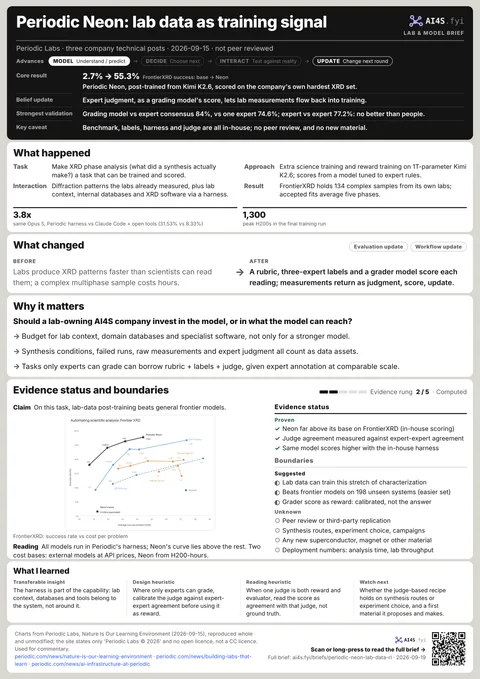
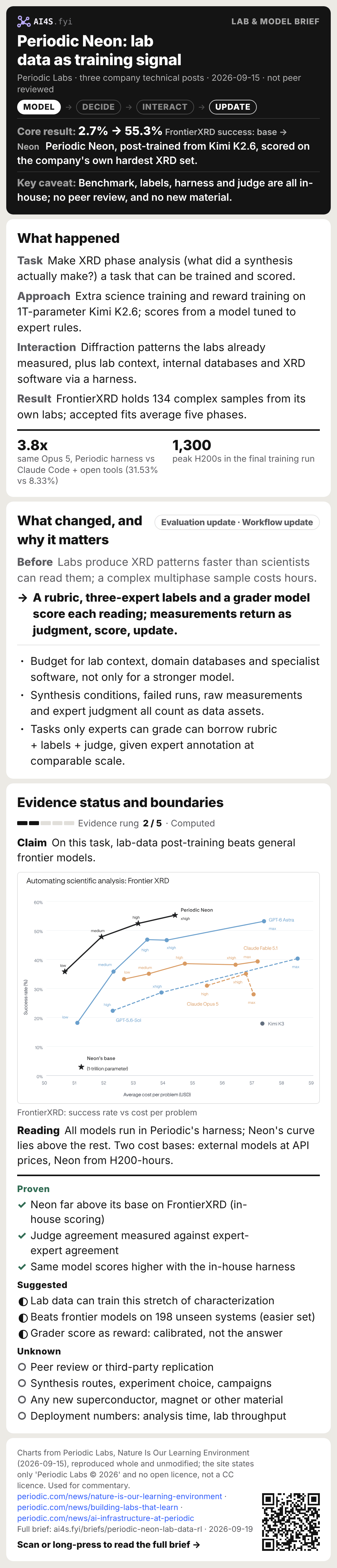
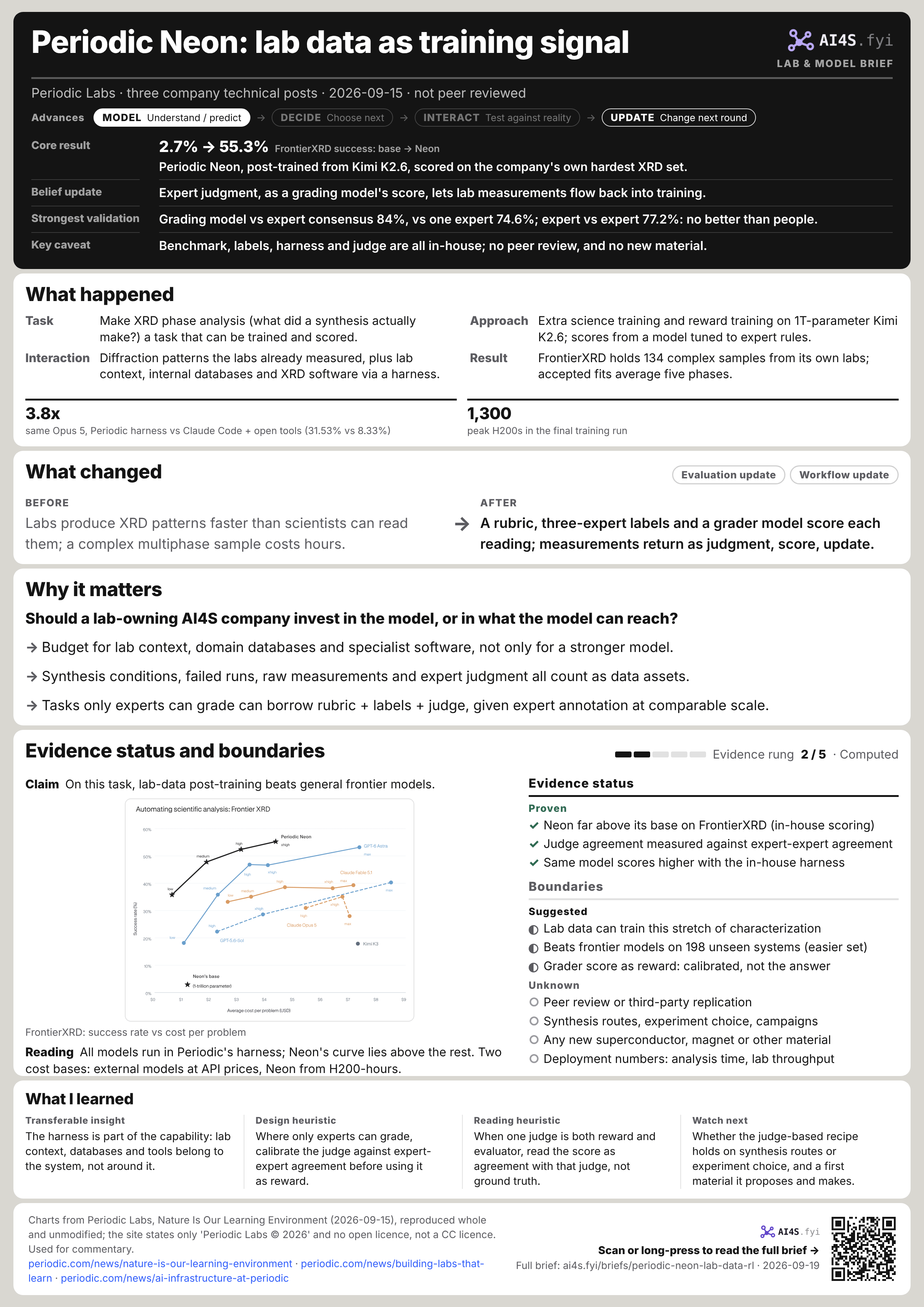
2.7% → 55.3%FrontierXRD success: base → Neon
Periodic Neon, post-trained from Kimi K2.6, scored on the company's own hardest XRD set.
- Belief update
- Expert judgment, as a grading model's score, lets lab measurements flow back into training.
- Strongest validation
- Grading model vs expert consensus 84%, vs one expert 74.6%; expert vs expert 77.2%: no better than people.
- Key caveat
- Benchmark, labels, harness and judge are all in-house; no peer review, and no new material.
01What happened
- Task
- Make XRD phase analysis (what did a synthesis actually make?) a task that can be trained and scored.
- Approach
- Extra science training and reward training on 1T-parameter Kimi K2.6; scores from a model tuned to expert rules.
- Interaction
- Diffraction patterns the labs already measured, plus lab context, internal databases and XRD software via a harness.
- Result
- FrontierXRD holds 134 complex samples from its own labs; accepted fits average five phases.
3.8xsame Opus 5, Periodic harness vs Claude Code + open tools (31.53% vs 8.33%)
1,300peak H200s in the final training run
On September 15, 2026, Periodic Labs published three posts at once: one on the labs, one on the Neon model and one on the AI infrastructure behind it. Read together, the strategy is plain: keep the labs producing data, then send that data back into model training. The company launched in September 2025, founded by Liam Fedus, a former OpenAI VP of Research, and Ekin Dogus Cubuk, who led materials science work at Google Brain and DeepMind, with better superconductors and magnets as the goal.[S1][S4]
Neon starts from Kimi K2.6, a one-trillion-parameter open-weight model, and goes through scientific midtraining and reinforcement learning. On FrontierXRD, the company's own evaluation set, its success rate rises from the base model's 2.7% to 55.3%. That set holds 134 complex XRD samples from their labs.[S2]
The capability published in the most detail is one question in the materials-discovery loop (what was made?) answered after the experiment is done.[S1]
198
held-out chemical-system patterns in the generalization set, which the post notes is easier than FrontierXRD[S2]
1,300
peak H200s in the final training run, across both the midtraining and RL phases[S2][S3]
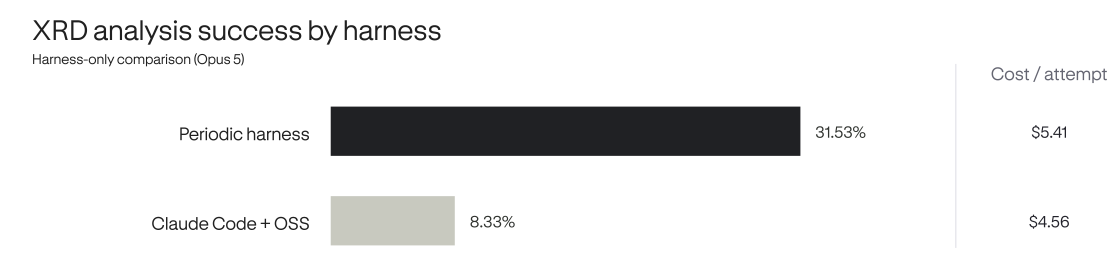
The harness comparison from Periodic Labs' research post, unmodified. Both rows run the same Claude Opus 5; only what it can reach differs. [S2]
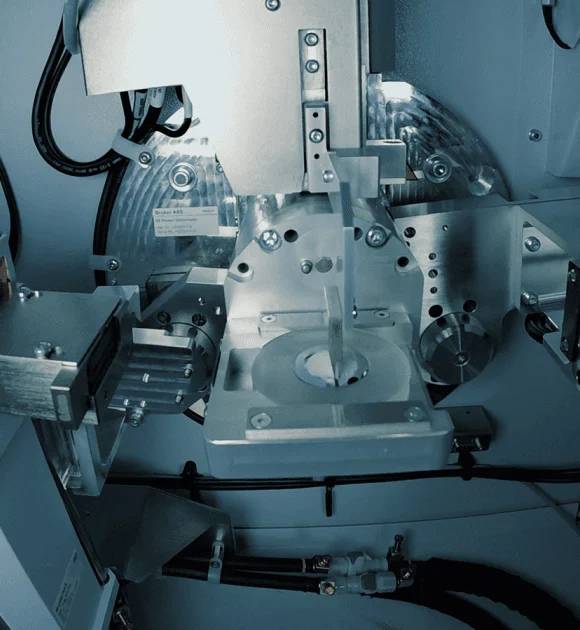
The header photograph from Periodic Labs' research post, cropped to the image. The badge reads Bruker AXS: the sample sits at the centre and the arm sweeps through an arc, recording intensity against angle. The curve this brief is about comes off a machine like this one. [S2]
02What changed
Evaluation updateWorkflow updateLabs produce XRD patterns faster than scientists can read them; a complex multiphase sample costs hours.
A rubric, three-expert labels and a grader model score each reading; measurements return as judgment, score, update.
From measurement to training signal
XRD phase analysis takes much more than pattern matching. One synthesis can yield the target phase, unreacted precursors and byproducts at once, and in multiphase samples those peaks overlap. A scientist also weighs temperature, atmosphere, handling history, structure databases and related experiments to judge whether an interpretation makes chemical sense. Among FrontierXRD samples with an accepted solution, fits contain five phases on average, and a complex pattern can take hours by hand.[S2]
Periodic turned that judgment into training signal. Experts with PhDs in materials-related fields wrote a rubric and labelled thousands of XRD analyses, three experts per pattern, and an LLM judge was built from those labels. Human experts agree with each other 77.2% of the time; the judge agrees with an individual expert 74.6% of the time, and with expert consensus 84%.[S2]
Lab data can then re-enter the model along one path: experiment, measurement, scientific judgment, reward, model update. This is where "nature is our learning environment" acquires a concrete engineering meaning: nature supplies the measurement, and getting from a measurement to a trainable reward still takes experimental context, specialist tooling and expert judgment.[S1][S2]
Why XRD came first
There is also a practical reason: the lab and the GPUs run on different clocks. A real materials experiment can take hours or days, and running more of them in parallel takes equipment, power and engineering; GPUs, meanwhile, can keep working through experimental data that already exists. So characterization became the first problem shaped for training and evaluation at scale: it comes from the physical world, it is already digital, and criteria for judging it are comparatively tractable.[S1]
In this site's framework, the clearest progress here sits at Interact → Update: the labs produce physical measurements, the model becomes able to interpret them, and the results are fed back into learning.
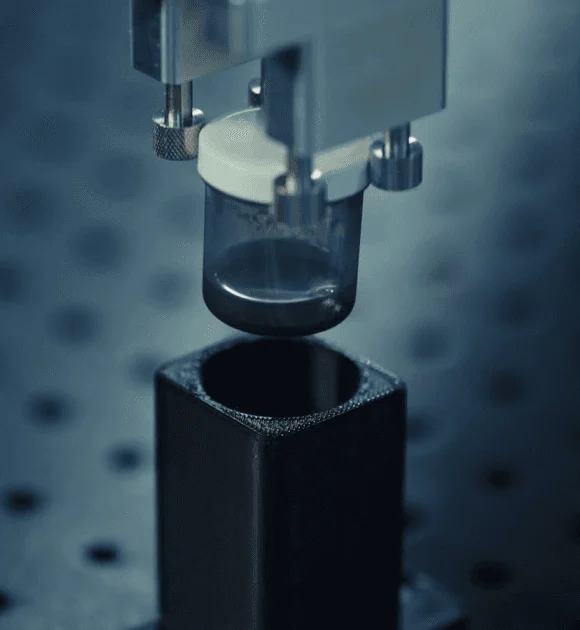
The header photograph from Periodic Labs' announcement post, cropped to the image. A vessel is being lowered into a holder: the kind of physical step that sets the lab's clock, and the reason the furnaces and the GPUs do not run at the same rate. [S1]
03Why it matters
Should a lab-owning AI4S company invest in the model, or in what the model can reach?
- Budget for lab context, domain databases and specialist software, not only for a stronger model.
- Synthesis conditions, failed runs, raw measurements and expert judgment all count as data assets.
- Tasks only experts can grade can borrow rubric + labels + judge, given expert annotation at comparable scale.
The lab environment is worth 3.8x
The other number worth remembering is 3.8x. Periodic ran the comparison on the same Claude Opus 5: one side with Claude Code and open tools (COD, Materials Project, BGMN) and the other with Periodic's own scientific harness, carrying laboratory context, internal structure and simulation databases and XRD analysis software. Success rates were 8.33% and 31.53%, at a similar cost per analysis ($4.56 and $5.41). The model did not change. What differs is the whole system configuration, the experimental context, databases and tools, not the harness framework code itself.[S2]
A lot of AI4S discussion stops at whether the model is strong enough. This comparison introduces another variable: capability on scientific tasks depends heavily on what the model can reach. For a company that builds its own labs, that widens what counts as a data asset: not only the final composition-to-property record, but synthesis conditions, failed runs, raw instrument measurements, sample history and expert judgment, all of which can enter the same scientific environment for the model to call on.[S2]
The second layer is methodological. Many scientific tasks are falsifiable but not cheaply verifiable: correctness needs expert judgment rather than a metric you can compute. Periodic's answer combines a rubric, multi-annotator labels and an LLM judge, using human-human agreement as the reference for whether the judge is good enough. Other fields can borrow the recipe, provided they can organize expert annotation at a comparable scale.[S2]
04Evidence status and boundaries
Evidence rung 2 / 5 · Computed · Retrospective or simulatedEvidence status
Proven
- Neon far above its base on FrontierXRD (in-house scoring)
- Judge agreement measured against expert-expert agreement
- Same model scores higher with the in-house harness
Boundaries
Suggested
- Lab data can train this stretch of characterization
- Beats frontier models on 198 unseen systems (easier set)
- Grader score as reward: calibrated, not the answer
Unknown
- Peer review or third-party replication
- Synthesis routes, experiment choice, campaigns
- Any new superconductor, magnet or other material
- Deployment numbers: analysis time, lab throughput
ClaimOn this task, lab-data post-training beats general frontier models.
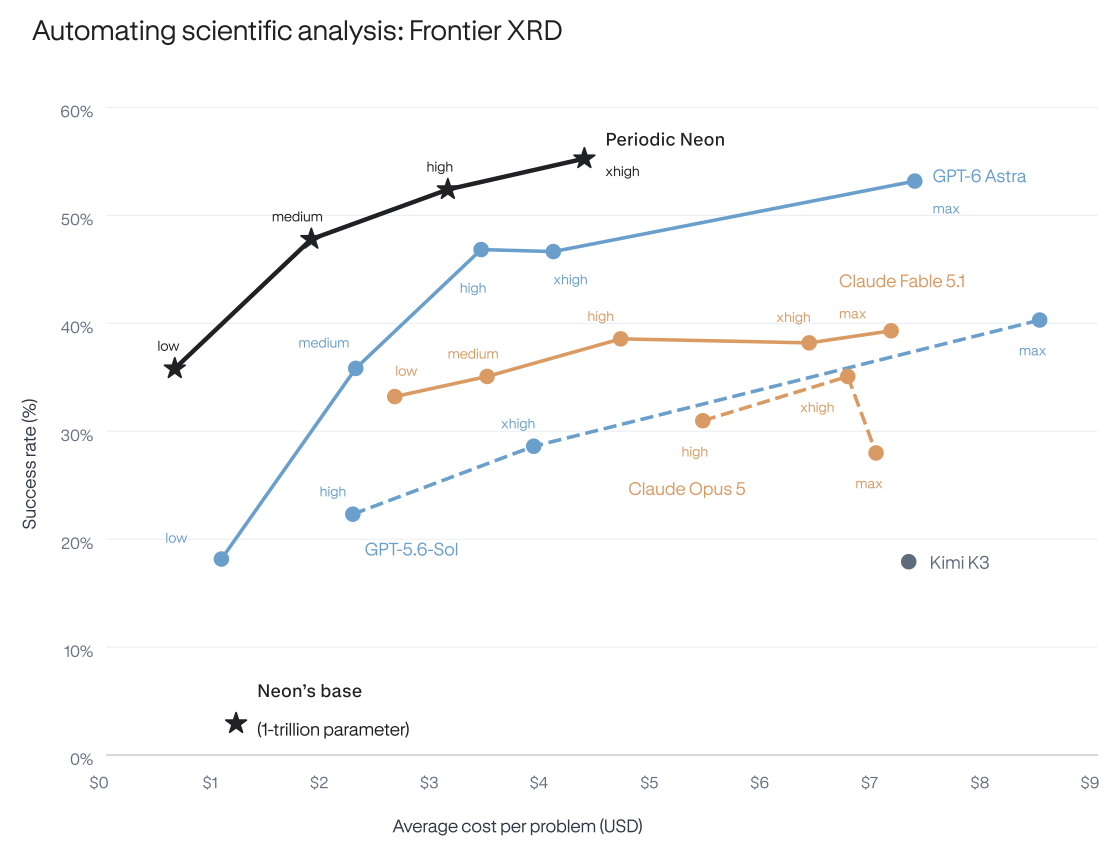
ReadingAll models run in Periodic's harness; Neon's curve lies above the rest. Two cost bases: external models at API prices, Neon from H200-hours.
The evaluation and the data come from the same company.
FrontierXRD is a 134-sample internal benchmark built by Periodic, and the experimental data, the expert labels, the scientific harness and the scoring all come from there. The LLM judge serves both as RL reward and as final evaluator, which makes it an expert-calibrated evaluation tool rather than independent ground truth. All three pieces are technical blog posts, without peer review or third-party replication so far.[S2][S3]
The cost axis is computed two ways.
The research post notes that external models are costed at standard API prices assuming perfect caching across agent turns, while Neon is costed from system throughput per H200-hour at $2.50 an hour. Success is scored by an LLM-judge ensemble of Opus 5 and GPT-5.6-Sol, and every model in the chart runs in the Periodic harness.[S2]
What is shown is the XRD analysis stretch.
The 55.3% comes from the hardest set, and the 198 held-out patterns used for generalization are, as the post says, easier, so the two numbers are not interchangeable. The release also reports no new superconductor, magnet or other material: what it establishes is a stretch of analysis capability, and that lab data can train it.[S2]
The rest of the loop has no results at this level yet.
Periodic states the next stage plainly: direct scientific campaigns, develop synthesis procedures, decide which experiments to run. Those three are harder than characterization largely on the evaluation side: synthesis and experiment selection have no equally clear criteria, and held-out sets are harder to construct for them.[S1]
05What I learned
- Transferable insight
- The harness is part of the capability: lab context, databases and tools belong to the system, not around it.
- Design heuristic
- Where only experts can grade, calibrate the judge against expert-expert agreement before using it as reward.
- Reading heuristic
- When one judge is both reward and evaluator, read the score as agreement with that judge, not ground truth.
- Watch next
- Whether the judge-based recipe holds on synthesis routes or experiment choice, and a first material it proposes and makes.
Whether Neon moves from explaining the last experiment to choosing the next one.
These are two different kinds of step in the same loop. Interpreting an existing measurement has a relatively clear right answer; choosing the next experiment means judging when candidates far exceed the budget, and whether the choice was good often only shows up rounds later. If the same judge-based recipe reproduces on synthesis routes or experiment selection, the loop genuinely closes.
Whether a tighter feedback loop reduces the experiments and the time a discovery takes.
This is the question the strategy ultimately has to answer, and the slowest one to observe. Intermediate signals will show up first: how much analysis time is compressed, how much effective lab throughput rises, and the first material this system proposes and actually makes.
As one imageTo save and share→Sources
This article draws on the three Periodic Labs posts of September 15, 2026, each read in full at source. Company background and funding are cited from the launch announcement and outside reporting. The upstream open-source pull requests mentioned in the posts were not opened during this check.
- S1Building Labs that LearnPeriodic Labs · 2026.09.15 · Company announcement
- S2Nature Is Our Learning EnvironmentPeriodic Labs · 2026.09.15 · Company research blog, not peer reviewed
- S3AI Infrastructure at PeriodicPeriodic Labs · 2026.09.15 · Company technical blog
- S4Introducing Periodic LabsPeriodic Labs · 2025.09.30 · Company launch announcement
- S5Top OpenAI, Google Brain researchers set off a $300M VC frenzy for their startup Periodic LabsTechCrunch · 2025.10.20 · Outside reporting, source for the funding figure