

Paper Brief
Eight AI Peptide Sequencers Share One Weak Spot: Spectra Missing Fragments, Whichever Model Reads Them
A VIB-UGent team compared eight deep-learning models that read peptide sequences straight from mass spectra, with no database, on three public proteomics datasets. The best single model gets half right and all eight together under two thirds; most failures trace to spectra with fragments missing.
●Peer reviewed + benchmark on public data
Current boundary: That errors come mainly from spectra missing fragments shows a clear dose-response on one Orbitrap dataset; the answer key covers only peptides a database holds, so new peptides outside it were not tested
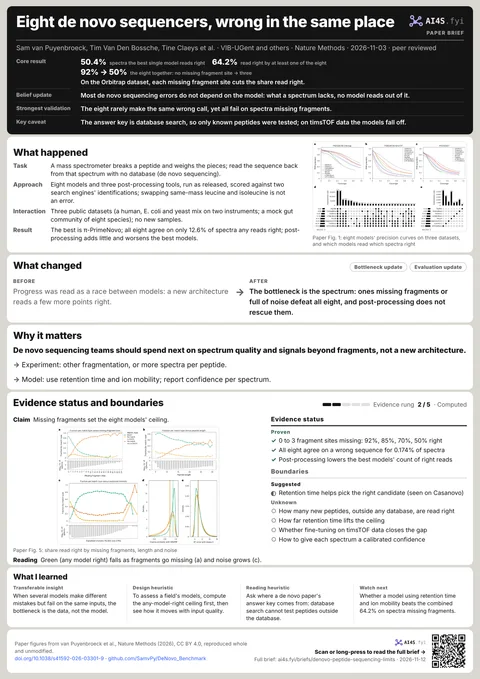
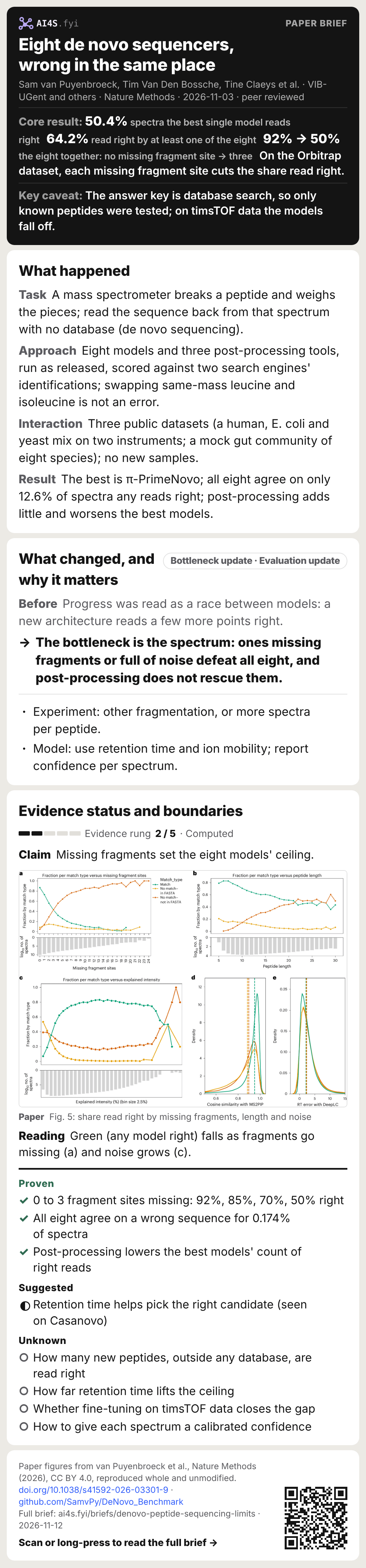
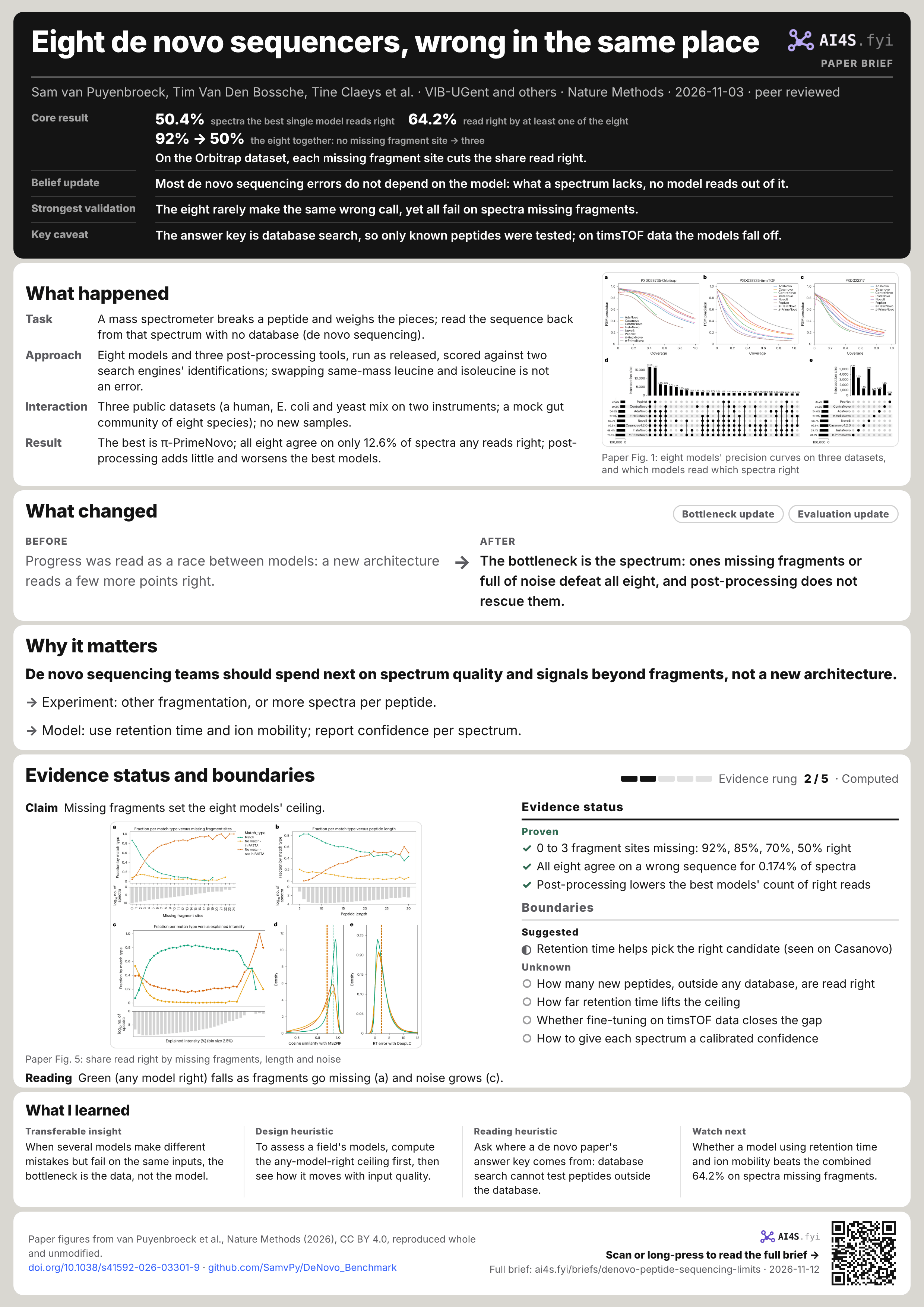
50.4%spectra the best single model reads right
64.2%read right by at least one of the eight
92% → 50%the eight together: no missing fragment site → three
On the Orbitrap dataset, each missing fragment site cuts the share read right.
- Belief update
- Most de novo sequencing errors do not depend on the model: what a spectrum lacks, no model reads out of it.
- Strongest validation
- The eight rarely make the same wrong call, yet all fail on spectra missing fragments.
- Key caveat
- The answer key is database search, so only known peptides were tested; on timsTOF data the models fall off.
01What happened
- Task
- A mass spectrometer breaks a peptide and weighs the pieces; read the sequence back from that spectrum with no database (de novo sequencing).
- Approach
- Eight models and three post-processing tools, run as released, scored against two search engines' identifications; swapping same-mass leucine and isoleucine is not an error.
- Interaction
- Three public datasets (a human, E. coli and yeast mix on two instruments; a mock gut community of eight species); no new samples.
- Result
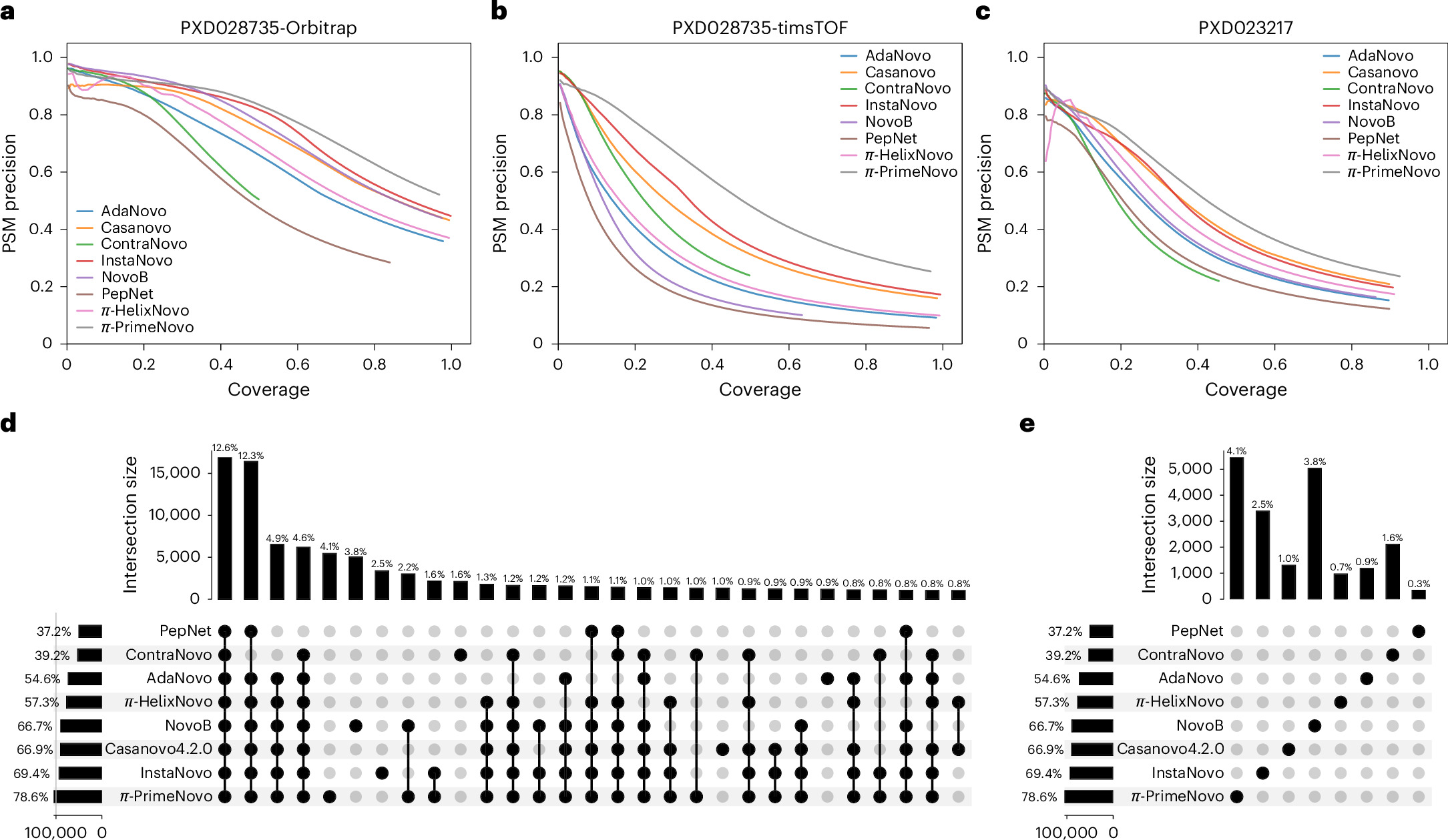
- The best is π-PrimeNovo; all eight agree on only 12.6% of spectra any reads right; post-processing adds little and worsens the best models.
The paper appeared open access (CC BY 4.0) in Nature Methods on 3 November 2026. The first author is Sam van Puyenbroeck of the VIB-UGent Center for Medical Biotechnology, jointly supervised by Tim Van Den Bossche and Tine Claeys, with overall supervision by Lennart Martens; co-authors are at the Robert Koch Institute in Berlin, the University of Turku and the University of Strasbourg. Code, pipeline and every model output are public, and most of the benchmark now runs on the community platform ProteoBench.[S1]
Proteomics usually identifies peptides by database search, matching each spectrum only against sequences expected in the sample. That keeps the search small and reliable but cannot find proteins or variants the database lacks. De novo sequencing drops that limit and can in principle read any peptide, at the price of an unconstrained search where ambiguity returns in full. The ambiguity has three sources: amino acids of equal mass (leucine and isoleucine), cleavage sites with no fragment on either side (a missing complementary ion pair), and spurious fragments from co-fragmentation and noise.[S1]
The eight models are AdaNovo, Casanovo, ContraNovo, InstaNovo, NovoB, PepNet, π-HelixNovo and π-PrimeNovo; the post-processing tools are InstaNovo+, MS²Rescore and Spectralis. The answer key is the identifications from two search engines, Sage in chimeric mode and MSGF+, at a q-value below 0.01, keeping several peptides per spectrum; a prediction matching any of them counts, and swapping leucine for isoleucine is not an error. Comparisons centre on the Orbitrap dataset, where every model does best.[S1]
02What changed
Bottleneck updateEvaluation updateProgress was read as a race between models: a new architecture reads a few more points right.
The bottleneck is the spectrum: ones missing fragments or full of noise defeat all eight, and post-processing does not rescue them.
Why post-processing does not help
Spectralis changed 27.6% to 33.3% of predictions and InstaNovo+ 8.19% to 35.3%, yet the number read right barely moved. For more accurate models such as π-PrimeNovo and Casanovo, refinement lowered it: some wrong answers were fixed, more right ones were broken, and the broken ones were almost always sequences absent from the database. Real fixes changed fewer than two amino acids. As a scorer, MS²Rescore did no better than each model's own score on any model; the authors' explanation is that wrong de novo answers often match the spectrum far better than the decoy sequences a database search uses, so a method trained to separate decoys cannot separate them.[S1]
The authors had Casanovo propose ten candidates per spectrum. For 41.6% of spectra none of the ten was correct; when the right answer was in the list, Casanovo ranked it first 79.7% of the time. Its ranking is sound, then: the failure is mostly that the right sequence is never generated, and those spectra are systematically poorer, with less of their signal explained and more fragment sites missing.[S1]
03Why it matters
De novo sequencing teams should spend next on spectrum quality and signals beyond fragments, not a new architecture.
- Experiment: other fragmentation, or more spectra per peptide.
- Model: use retention time and ion mobility; report confidence per spectrum.
In the discussion the authors say current models do well on good Orbitrap data, some above 90% peptide-level accuracy on spectra with complete fragment ladders; but only about half the spectra a database search identifies are read right de novo, the rest lacking signal or holding several indistinguishable candidates. They argue for a more realistic goal: reliable sequence tags where they can be pinned down, with uncertainty marked explicitly, rather than a full high-confidence sequence for every spectrum.[S1]
Confidence is another gap. Database search controls its error rate with the established target-decoy method; de novo sequencing has no accepted equivalent and falls back on one global score threshold, and the paper shows π-PrimeNovo and π-HelixNovo giving some wrong answers high scores, which makes such thresholds misleading. The authors propose looking at the gap between the best and second-best candidates: a wide gap supports confidence, a narrow one signals ambiguity. As models start predicting post-translational modifications, candidates multiply and the problem grows.[S1]
04Evidence status and boundaries
Evidence rung 2 / 5 · ComputedEvidence status
Proven
- 0 to 3 fragment sites missing: 92%, 85%, 70%, 50% right
- All eight agree on a wrong sequence for 0.174% of spectra
- Post-processing lowers the best models' count of right reads
Boundaries
Suggested
- Retention time helps pick the right candidate (seen on Casanovo)
Unknown
- How many new peptides, outside any database, are read right
- How far retention time lifts the ceiling
- Whether fine-tuning on timsTOF data closes the gap
- How to give each spectrum a calibrated confidence
ClaimMissing fragments set the eight models' ceiling.
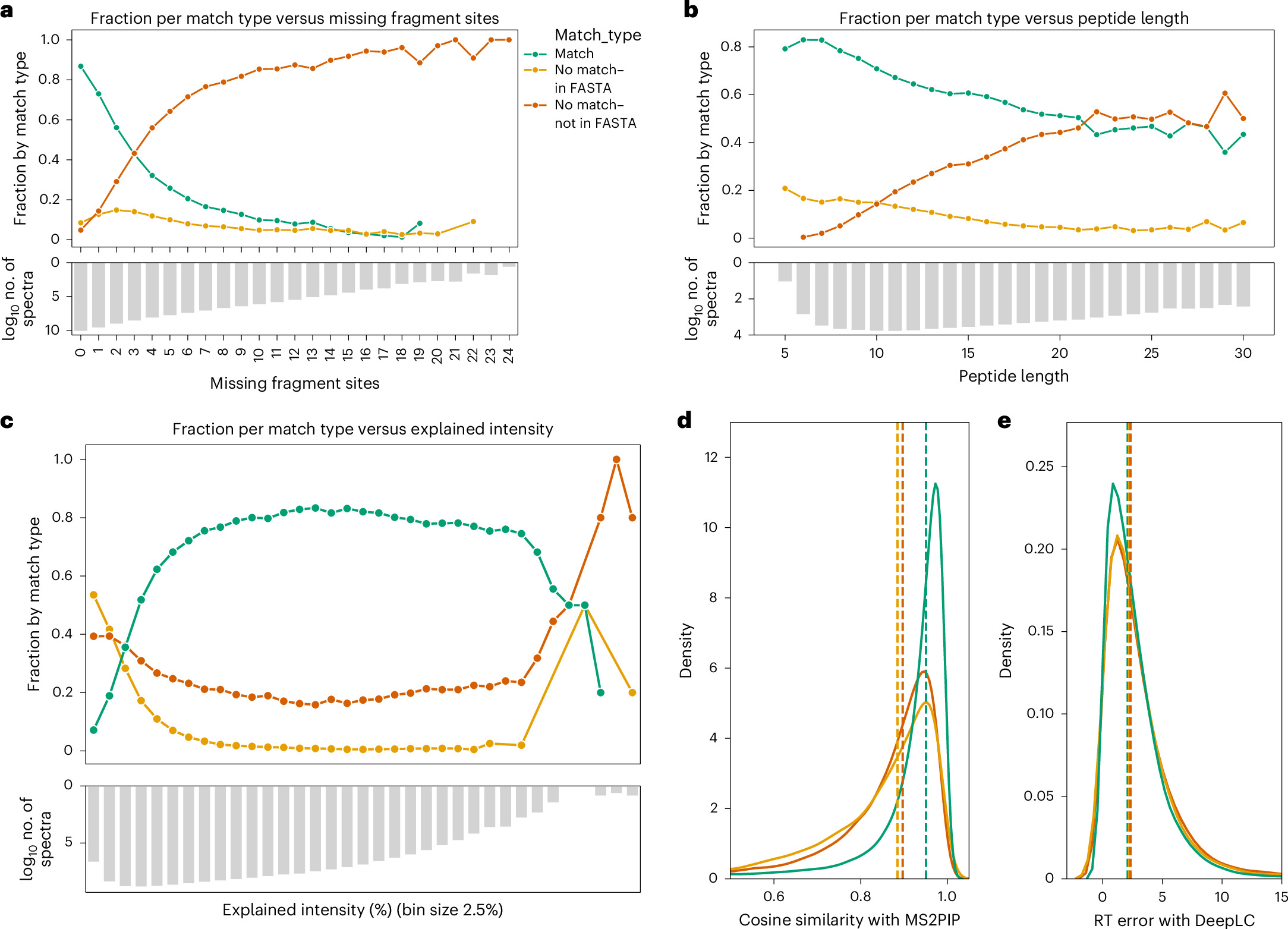
ReadingGreen (any model right) falls as fragments go missing (a) and noise grows (c).
Missing fragments matter more than peptide length.
The authors combine the eight into an idealised ensemble that counts a spectrum as right if any model reads it right. That ceiling is 92% when every cleavage site has a fragment, falling to 85%, 70% and 50% with one, two and three complementary ion pairs missing. Longer peptides fail more, but the authors say length is tangled with missing fragments: longer peptides are more likely to miss some, so the two are hard to separate. Spectrum noise is the other strong predictor: of spectra with under 5% of their signal explained, only 17.1% are read right by any model; above 25%, over 80% are.[S1]
Small, local errors are mostly spectra that cannot tell the answers apart.
About a fifth of errors sit at one site. Where two amino acids swap places, 68.5% of cases have no fragment that could tell the two candidates apart; for swapped stretches of equal mass, about half are likewise indistinguishable. These errors cluster at the peptide's C-terminus, where most models start building the sequence. On average 20.0% of wrong answers are entirely different from the right sequence.[S1]
The limit of the answer key itself.
Using database search as the key means only peptides a database already holds are tested, while de novo sequencing exists to find what lies outside one. The authors reduce bias in the key by using two engines and allowing several answers per spectrum, and checked that most wrong predictions are sequences absent from the database, which no search could ever propose; but 10.7% of wrong predictions are peptides that are in the database, possibly a better alternative candidate.[S1]
05What I learned
- Transferable insight
- When several models make different mistakes but fail on the same inputs, the bottleneck is the data, not the model.
- Design heuristic
- To assess a field's models, compute the any-model-right ceiling first, then see how it moves with input quality.
- Reading heuristic
- Ask where a de novo paper's answer key comes from: database search cannot test peptides outside the database.
- Watch next
- Whether a model using retention time and ion mobility beats the combined 64.2% on spectra missing fragments.
An ensemble ceiling is a cheap test of where the bottleneck is
The paper proposes no new model; it pools existing models' outputs to see how far the best case reaches, then which inputs pull that ceiling down. Any field with several competing models can take this step first: if the ceiling itself drops steeply with input quality, the next model has limited room to gain.
Confidence is harder than accuracy
A model scoring wrong answers high is more dangerous than the errors themselves, because downstream users see only the score. Where results are interpreted directly, as in metaproteomics and antibody sequencing, a method that reports ambiguity spectrum by spectrum may be worth more than a few more points of accuracy.
As one imageTo save and share→Sources
Factual claims link to original announcements, project lists, trial records or journal papers where possible. Research plans are kept separate from completed results.