

Paper Brief· Evidence · Frontier
Designed zinc proteases: 135 designs in one shot, 36% cut at the bond they were told to
The Institute for Protein Design and ETH Zurich hand RFdiffusion a five-residue zinc catalytic motif and design the protease together with the peptide it is meant to cut. Of 135 designs, 36% were active and mass spectrometry put every cut at the intended bond; the best beats the uncatalysed reaction by more than 10^8-fold, and four substitutions take that to 1.4x10^10. The designs cleave full-length TDP-43 and unmask an IL-2 mimic that the human protease MMP2 leaves alone. The paper says itself that straight out of the computer, turnover is still 10^3 to 10^4 below the best natural proteases.
◆Peer-reviewed paper + wet-lab assays + active-site knockouts + crystal structures
Current boundary: The designs were expressed, purified and measured, knocking out the catalytic residues cost them their activity, and two crystal structures match the design models: that much is tested. But the rates stay two to four orders of magnitude below natural proteases, the disease proteins were cut as purified protein in vitro, nothing reaches a cell interior or an animal, and no outside lab has repeated any of it
This work advances: Moves a natural zinc protease's active site into a wholly new backbone, designed together with the peptide it is to cut
- MODELUnderstand / predict
- DECIDEChoose next
- INTERACTTest against reality
- UPDATEChange next round
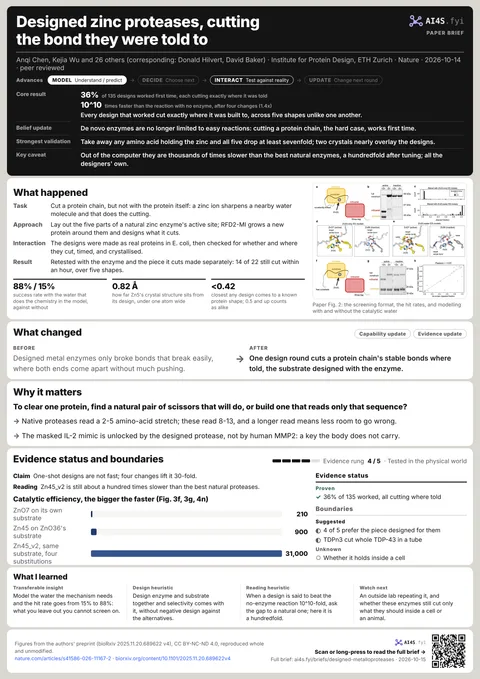
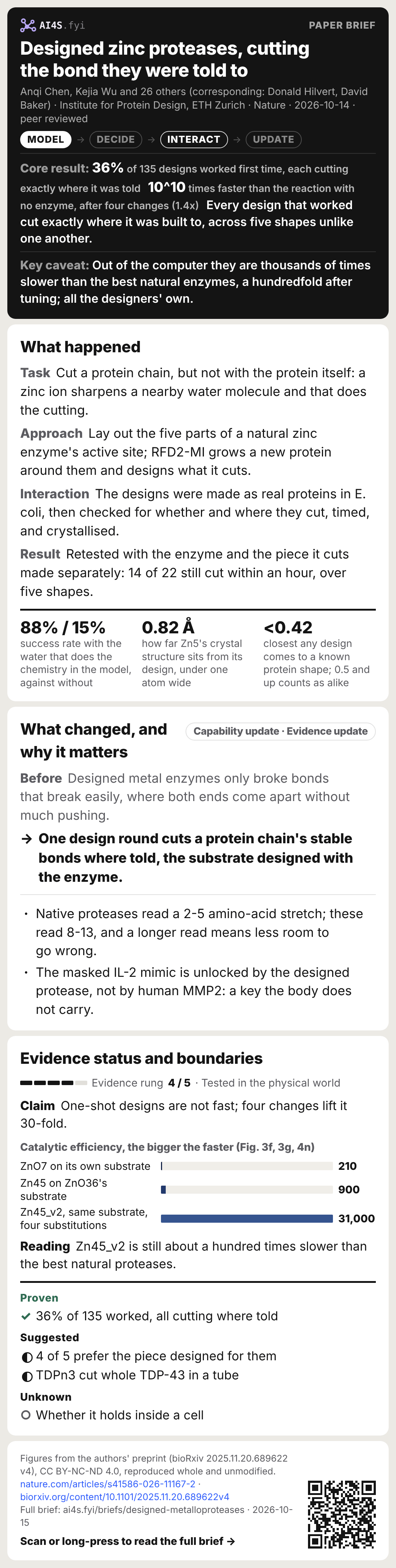
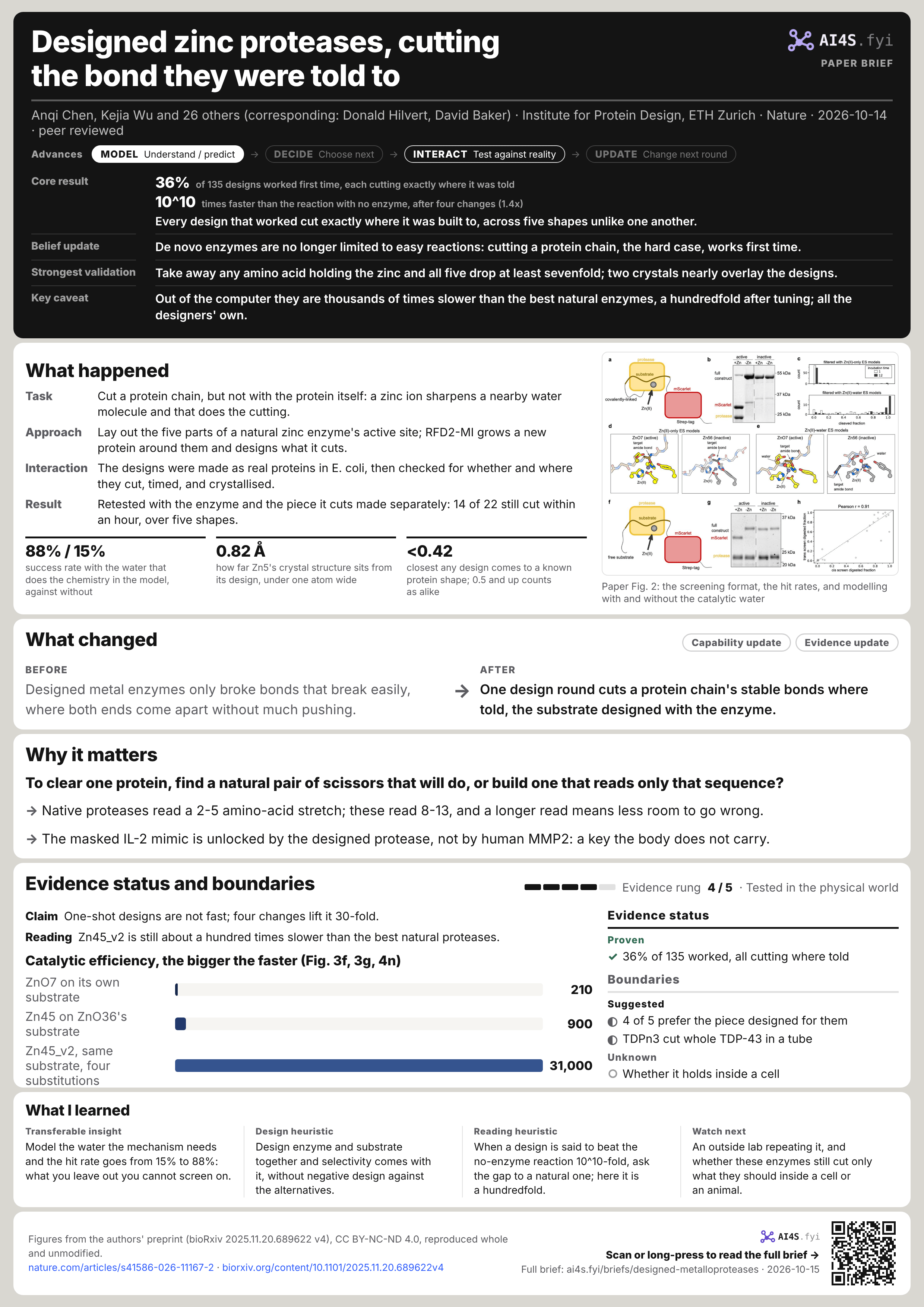
36%of 135 designs worked first time, each cutting exactly where it was told
10^10times faster than the reaction with no enzyme, after four changes (1.4x)
Every design that worked cut exactly where it was built to, across five shapes unlike one another.
- Belief update
- De novo enzymes are no longer limited to easy reactions: cutting a protein chain, the hard case, works first time.
- Strongest validation
- Take away any amino acid holding the zinc and all five drop at least sevenfold; two crystals nearly overlay the designs.
- Key caveat
- Out of the computer they are thousands of times slower than the best natural enzymes, a hundredfold after tuning; all the designers' own.
01What happened
- Task
- Cut a protein chain, but not with the protein itself: a zinc ion sharpens a nearby water molecule and that does the cutting.
- Approach
- Lay out the five parts of a natural zinc enzyme's active site; RFD2-MI grows a new protein around them and designs what it cuts.
- Interaction
- The designs were made as real proteins in E. coli, then checked for whether and where they cut, timed, and crystallised.
- Result
- Retested with the enzyme and the piece it cuts made separately: 14 of 22 still cut within an hour, over five shapes.
88% / 15%success rate with the water that does the chemistry in the model, against without
0.82 Åhow far Zn5's crystal structure sits from its design, under one atom wide
<0.42closest any design comes to a known protein shape; 0.5 and up counts as alike
On 14 October 2026 Nature published two enzyme-design papers from the Institute for Protein Design on the same day; this is the metalloprotease one (s41586-026-11167-2, received 14 October 2025, accepted 15 September 2026). The first authors are Anqi Chen and Kejia Wu, the corresponding authors Donald Hilvert at ETH Zurich and David Baker at the University of Washington, with 28 authors in all. Every number on this page was read in the paper's own text and figure captions, from the PDF the author supplied. The two figures reproduced here are taken from the authors' own preprint version (bioRxiv 10.1101/2025.11.20.689622 v4), since the published version cannot be reproduced; the figure numbers, panels and values in the two were checked against each other one by one. Two US provisional patent applications have been filed on the methods and designs.[S1][S2]
The pipeline: move a natural active site into a new backbone, and design the substrate with it
The catalytic motif comes from a co-crystal of natural aminopeptidase N with a transition-state analogue (PDB 4QHP): two histidines and a glutamate hold the zinc, a second glutamate activates the zinc-bound water that attacks the carbonyl carbon, and a tyrosine stabilises the oxyanion intermediate that forms. For how the substrate should sit, the authors took an AlphaFold 3 prediction of natural astacin with a substrate peptide, where the substrate pairs with the enzyme as an antiparallel beta strand, and superimposed the P1-P2' coordinates onto the catalytic residues to make the full target site. RFD2-MI, a molecular-interface fine-tune of RoseTTAFold Diffusion 2, generates a 160-190 residue backbone around that site together with an 8-13 residue substrate; sequences come from EnhancedMPNN, a fine-tuned LigandMPNN, in a two-sided design where enzyme and substrate are optimised together, so every protease carries a substrate sequence of its own.[S2]
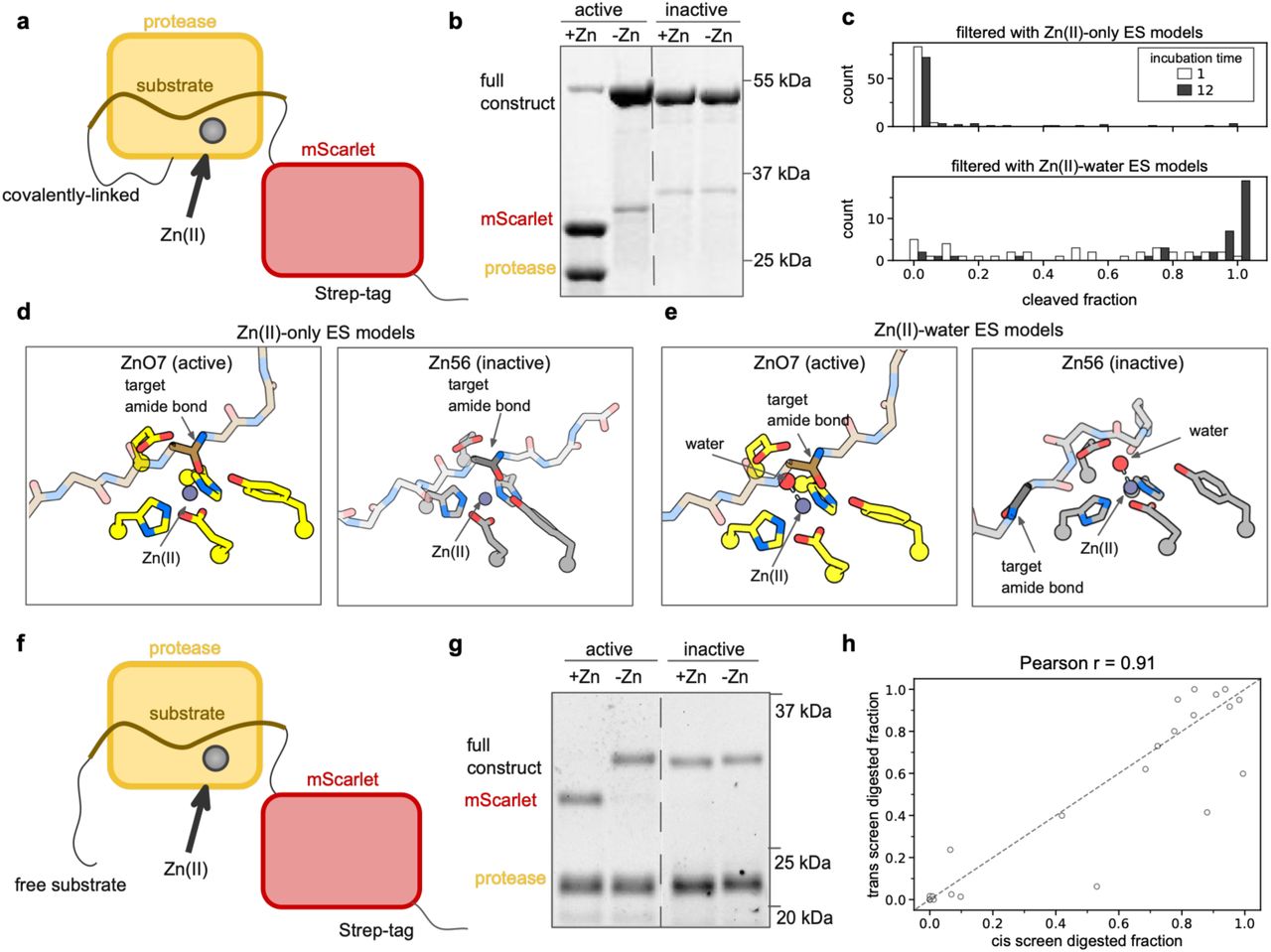
The filtering step is this paper's real variable. Each design was modelled by AlphaFold 3 in three states: the apo protease, to check the fold; the enzyme-substrate complex, to check where the substrate sits; and a transition-state-analogue complex, to check transition-state stabilisation. For the enzyme-substrate complex the first approach put in the zinc alone (SMILES `[Zn+2]`), the usual way to predict zinc sites; the second added the mechanistically essential water (`[Zn+2].O`). The two strategies sent 95 and 40 designs to gene synthesis. The outcomes differ sharply: of 89 tested zinc-only designs, 14 cut more than 10% of their substrate after 12 hours (15%); of 38 zinc-water designs, 35 did (88%). Across all 135, the success rate is 36%. Looking back at Zn56 (inactive) and ZnO7 (active), the zinc-only models put both substrates neatly in their clefts and gave no way to tell them apart; with the water in, Zn56's catalytic water pushes the substrate several angstroms out of place, while ZnO7's scissile bond points the right way for attack.[S2]
Activity was first screened in a cis format: the protease and its substrate on one chain, with mScarlet behind them as a molecular-weight marker, and cleavage read off an SDS-PAGE gel. Of the 135 fusions, 131 were soluble and 127 ran at the expected weight. Twenty-two hits were then tested in trans, protease and substrate expressed separately, where 14 of them, from five different scaffolds, cut more than 10% in an hour at 37 C; cleaved fractions in the two formats correlate at a Pearson r of 0.91.[S2]
02What changed
Capability updateEvidence updateDesigned metal enzymes only broke bonds that break easily, where both ends come apart without much pushing.
One design round cuts a protein chain's stable bonds where told, the substrate designed with the enzyme.
What changed is the line of which reactions are reachable, not the ceiling on speed. The paper opens by listing why the peptide bond was the hard case: resonance makes an amide far more stable than an ester; the amine leaving group in a protein is poor, with a pKa above 35 against under 8 for a typical activated ester; and peptide substrates are flexible and hard to bind precisely. Earlier de novo metallohydrolases avoided the first two by using activated esters. This work takes all three head-on, and pays for it in rate: straight out of the computer, turnover is 10^3 to 10^4 below the best natural proteases. The quality of the evidence changed with it: all five scaffolds had their catalytic residues knocked out, two were crystallised, Foldseek finds no fold-level match in the PDB with any TM-score above 0.42, and BLASTP E-values run from 0.34 to 33, so these are not natural proteins with a few residues swapped.[S2]
03Why it matters
To clear one protein, find a natural pair of scissors that will do, or build one that reads only that sequence?
- Native proteases read a 2-5 amino-acid stretch; these read 8-13, and a longer read means less room to go wrong.
- The masked IL-2 mimic is unlocked by the designed protease, not by human MMP2: a key the body does not carry.
Binding and cutting are different kinds of intervention. Nearly all designed proteins so far have been binders: block an interface, occupy a pocket, and the effect lasts as long as the occupancy does. Cutting is not like that: one protease molecule processes many substrate molecules (Zn45_v2 turns over more than 3,500 times per active site) and what has been cut does not come back. The three targets chosen are proteins whose aggregation causes disease: TDP-43 (ALS and frontotemporal dementia), serum amyloid A, and amyloid-beta. For TDP-43 the authors deliberately target only the C-terminal segment, residues 320-350, to break up pathological assemblies while leaving the protein's own function intact. That is what the long recognition face buys therapeutically: not clearing a protein, but touching only the part of it that goes wrong.[S2]
The second use is closer to engineering. The authors take Neo2, a previously designed IL-2 mimic, mask its receptor-binding face with a small binder, and bury Zn45's substrate sequence in the linker between them. Without protease the masked cytokine has an EC50 of about 0.5 nM; with Zn45 or Zn45_v2 that falls to about 0.01 nM, matching unmasked Neo2, a roughly 50-fold activation window, while human MMP2, the protease usually used as a trigger in tumour-activated prodrugs, does not open it at all. The same construction works for a masked EGFR antagonist and stops working when the catalytic residues are knocked out. The point is orthogonality: the switch runs on a protease the body does not have, so when it opens is decided by whether the enzyme is given, not by how much MMP2 a lesion happens to contain.[S2]
04Evidence status and boundaries
Evidence rung 4 / 5 · Tested in the physical world · Physical validationEvidence status
Proven
- 36% of 135 worked, all cutting where told
Boundaries
Suggested
- 4 of 5 prefer the piece designed for them
- TDPn3 cut whole TDP-43 in a tube
Unknown
- Whether it holds inside a cell
ClaimOne-shot designs are not fast; four changes lift it 30-fold.
Catalytic efficiency, the bigger the faster (Fig. 3f, 3g, 4n)
ReadingZn45_v2 is still about a hundred times slower than the best natural proteases.
The rate, and what it is measured against.
Steady-state kinetics were measured for two protease-substrate pairs. ZnO7 on its own substrate: kcat 0.0010+/-0.0001 s-1, KM 4.9+/-1.2 uM, kcat/KM 210+/-60 M-1s-1. Zn45 on ZnO36's substrate is faster: kcat 0.025+/-0.002 s-1, KM 26+/-5 uM, kcat/KM 900+/-200 M-1s-1, a kcat worth more than 10^8-fold over uncatalysed peptide hydrolysis. The authors then mutated all 21 positions within 4 A of Zn45's active site to every amino acid except cysteine: at 11 positions the designed residue was already best, and at the other 10 a substitution raised activity by at least 30%. Combining four of them (F48W, Y152I, A79Q, Y83Q) gives Zn45_v2: kcat 0.75+/-0.04 s-1, kcat/KM 31,000+/-5,000 M-1s-1, both 30-fold above Zn45, which is a 1.4x10^10-fold acceleration and more than 3,500 turnovers per active site. The distinction worth keeping: 10^8 and 10^10 are measured against a peptide bond hydrolysing on its own in water, not against a natural protease. The comparison with natural enzymes is given separately: out of the computer the designs are 10^3 to 10^4 below the best natural proteases, and Zn45_v2 narrows that to two orders of magnitude.[S2]
Why those two orders of magnitude remain.
This is the paper's most interesting piece of self-examination: getting the structure right does not mean getting the catalysis right. Machine-learning force fields put Zn45's and ZnO7's activation barriers 3.6 and 15.1 kcal/mol above natural astacin's, and ZnO7, whose crystal structure matches its design model more closely than Zn45's does, has the lower kcat. Molecular dynamics gives the reason: in Zn45 the catalytic glutamate E77 samples several rotamers, so the distance from its proton-taking oxygen to the water's hydrogen swings widely; in Zn45_v2 and in astacin the base is far better held, at mean distances of 1.75 A and 1.88 A. The scissile bond's orientation tells the same story: the angle between the water oxygen, the carbonyl carbon and the carbonyl oxygen averages 37.4 degrees in Zn45 against 99.4 in Zn45_v2 and 87.1 in astacin, and only the latter two are near the preferred trajectory for nucleophilic attack. The gap is therefore pinned on incomplete preorganisation: neither the catalytic groups nor the substrate are held where they should be. The authors also say plainly that neither AF3 nor MPNN predicted any of the four beneficial mutations.[S2]
Selectivity, and where it comes from.
Because enzyme and substrate were designed together, every protease has a substrate sequence of its own, which makes cross-testing direct: seven proteases against six substrates, and four of the five scaffolds prefer their own. What is notable is that no negative design against the other substrates was done, and designs predicted to cut the wrong substrate were not removed: the selectivity fell out of the two-sided design itself. The fifth, Zn45, is the exception and is active against every substrate tested, which the AF3 metrics had already flagged at design time. Zinc dissociation constants run from 10^-10 to 10^-8 M, with ZnO39 subnanomolar, above previously reported designed zinc enzymes and approaching some natural ones: a practical advantage wherever adding zinc is impractical, as in a therapeutic setting.[S2]
The disease proteins: how far it actually goes.
TDP-43 was attacked two ways. Reworking the existing ZnO36 by partial diffusion and redesign gave TDPr3, which cuts the target sequence but still prefers its original substrate, which the authors put down to an imperfect interface. Designing a new scaffold for the TDP-43 peptide directly, with atom-level RFdiffusion, worked: TDPn3 is clearly more active on the target sequence than on the others, at kcat 0.033+/-0.003 s-1, KM 52+/-9 uM and kcat/KM 640+/-130 M-1s-1. Full-length TDP-43, both monomeric and oligomeric, gave cleavage products of the expected sizes, confirmed by mass spectrometry, with no cleavage in buffer-only or base-knockout controls; cutting the full-length protein was slower than cutting the synthetic substrate, which the authors suggest may reflect TDP-43's liquid-liquid phase separation or precipitation. Peptides from serum amyloid A (SSRSFFSFLG) and amyloid-beta (KGAIIGLMVG) were each targeted successfully too. What should be said plainly is that everything in this section was done on purified protein and peptides in vitro; no step of it enters a cell interior or an animal.[S2]
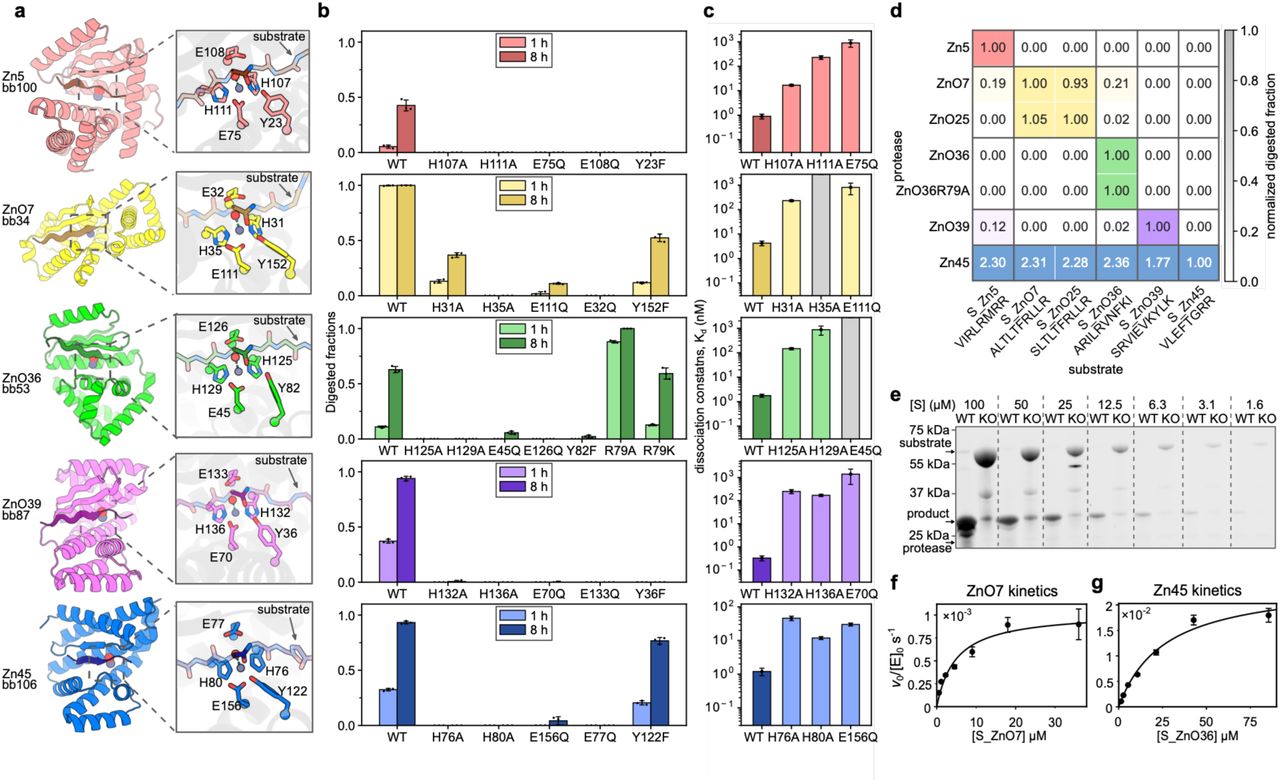
Paper Fig. 3: (a) the active sites of five independent scaffolds, with TM-scores below 0.23 between any pair; (b) activity after each of the five catalytic residues is knocked out; (c) zinc dissociation constants; (d) seven proteases against six substrates; (f, g) steady-state kinetics for ZnO7 and Zn45. Chen, Wu et al., bioRxiv 10.1101/2025.11.20.689622v4, CC BY-NC-ND 4.0; image unmodified. [S2]
05What I learned
- Transferable insight
- Model the water the mechanism needs and the hit rate goes from 15% to 88%: what you leave out you cannot screen on.
- Design heuristic
- Design enzyme and substrate together and selectivity comes with it, without negative design against the alternatives.
- Reading heuristic
- When a design is said to beat the no-enzyme reaction 10^10-fold, ask the gap to a natural one; here it is a hundredfold.
- Watch next
- An outside lab repeating it, and whether these enzymes still cut only what they should inside a cell or an animal.
The filter is the hypothesis; the hit rate is the test
The most transferable thing here is the same as in the AlphaProtein Novo paper of the same month: the geometric filter used to pick candidates is itself a falsifiable mechanistic hypothesis. The hypothesis here is that the water waiting on the zinc takes up room, so without modelling it you cannot see whether the substrate fits. The test was to send a batch from each modelling strategy to synthesis: 15% against 88%. That is a better controlled comparison than most ablations, because it is not a recomputation on one dataset but two batches of real wet-lab work. Read the other way, it raises a question: how many earlier findings that de novo enzyme design hits at a few percent were really about leaving a mechanistically essential component out of the model, rather than a ceiling on the design method, is now hard to say.
Two papers, one institute, one day
Nature published a second de novo protease paper from the same institute on the same day, running entirely different chemistry: an activated cysteine rather than a zinc, with 13 of 69 designs working. The pair says more together than either does alone: one hard reaction, two chemistries that do not depend on each other, both delivered in the same month, which looks less like one method working and more like the capability itself arriving. What to keep in mind is that both come from the same lab system, so they corroborate each other rather than replicate each other.
As one imageTo save and share→Sources
Factual claims link to original announcements, project lists, trial records or journal papers where possible. Research plans are kept separate from completed results.
- S1Computational design of metalloproteasesNature · Chen, Wu, Hilvert, Baker et al. · Institute for Protein Design, ETH Zurich · 2026.10.14 · Peer-reviewed paper · full text and figures read from the PDF the author supplied, 2026-10-15
- S2Computational design of metalloproteases (preprint, version 4)bioRxiv 10.1101/2025.11.20.689622 · Chen, Wu et al. · 2026.09.27 · The authors' own version, which is where the two figures shown here come from; checked line by line against the published paper · CC BY-NC-ND 4.0