

Model Release· Evidence · Frontier
LiteMol-1: A Cross-Class Molecular Foundation Model Built for AI Agents
LiteFold's LiteMol-1 matters for more than generating several molecular classes with one model. It tries to turn molecular generation into a cheap, editable proposal layer that an AI agent can call repeatedly.
◐Technical report + computational evaluation
Current boundary: this is closer to a computational proof of concept than a validated drug-discovery system
This work advances: Generates, edits and searches molecular candidates at low cost
- MODELUnderstand / predict
- DECIDEChoose next
- INTERACTTest against reality
- UPDATEChange next round
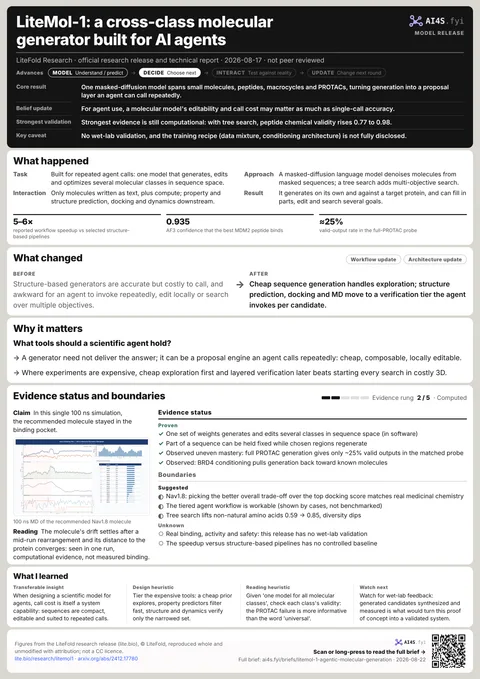
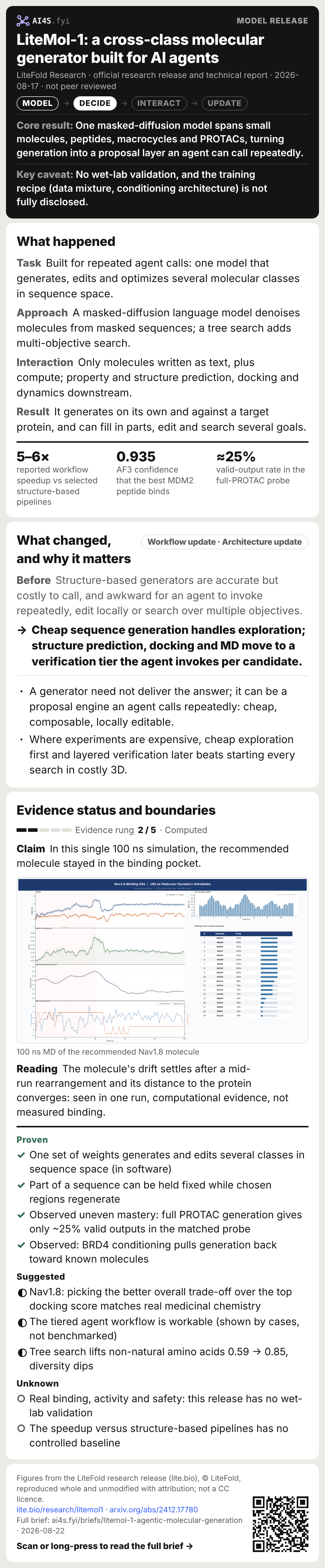
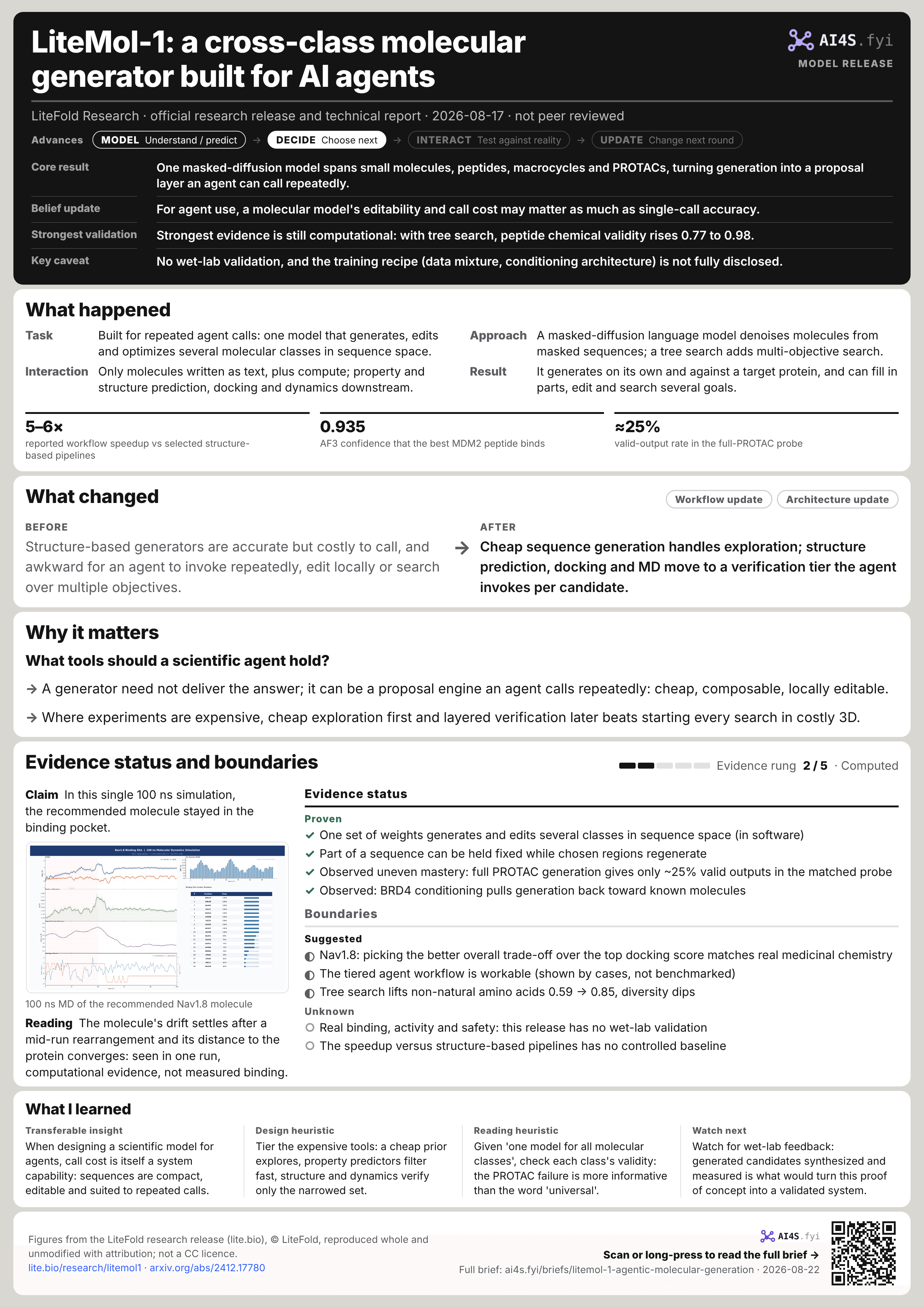
One masked-diffusion model spans small molecules, peptides, macrocycles and PROTACs, turning generation into a proposal layer an agent can call repeatedly.
- Belief update
- For agent use, a molecular model's editability and call cost may matter as much as single-call accuracy.
- Strongest validation
- Strongest evidence is still computational: with tree search, peptide chemical validity rises 0.77 to 0.98.
- Key caveat
- No wet-lab validation, and the training recipe (data mixture, conditioning architecture) is not fully disclosed.
01What happened
- Task
- Built for repeated agent calls: one model that generates, edits and optimizes several molecular classes in sequence space.
- Approach
- A masked-diffusion language model denoises molecules from masked sequences; a tree search adds multi-objective search.
- Interaction
- Only molecules written as text, plus compute; property and structure prediction, docking and dynamics downstream.
- Result
- It generates on its own and against a target protein, and can fill in parts, edit and search several goals.
5–6×reported workflow speedup vs selected structure-based pipelines
0.935AF3 confidence that the best MDM2 peptide binds
≈25%valid-output rate in the full-PROTAC probe
On August 17, 2026, AI4Science company LiteFold released its first foundation model, LiteMol-1. It is a masked diffusion language model pretrained over molecular sequence tokens rather than a model that directly generates 3D coordinates.[S1]
A single set of weights covers small molecules, linear and cyclic peptides, peptides with non-canonical amino acids, macrocycles and PROTAC-related molecules. It supports unconditional and protein-conditioned generation, local in-painting, editing and multi-objective search.[S1]
The deeper question is which molecular model works best inside an agent loop of generate, evaluate, edit and generate again.
Masked diffusion makes local editing natural
LiteMol-1 does not write molecules left to right. Sampling begins with a sequence hidden behind masks; repeated denoising reveals each position. Parts of the sequence can remain fixed while selected regions are regenerated.[S1]
Different positions do not follow the same masking schedule. Building on PepTune, sites that determine scaffold and connectivity are recovered earlier. The scaffold emerges before local details are revised.[S1][S2]
Multi-objective optimization does not need one total score
Drug design is rarely a single-objective problem. Strong binding says little about cardiac risk, permeability or synthesizability. One weighted score hides human preferences inside the result.
LiteMol-1 applies Monte Carlo Tree Search at inference. The model supplies a prior over plausible continuations; MCTS decides which branches deserve more compute and retains candidates representing different trade-offs.[S1]
With MCTS, peptide chemical validity rises from 0.77 to 0.98 and non-canonical amino-acid proportion from 0.59 to 0.85, while diversity declines slightly. The gain changes the generative distribution and is not free.[S1]
02What changed
Workflow updateArchitecture updateStructure-based generators are accurate but costly to call, and awkward for an agent to invoke repeatedly, edit locally or search over multiple objectives.
Cheap sequence generation handles exploration; structure prediction, docking and MD move to a verification tier the agent invokes per candidate.
Explore sequence space before paying for structural tools
Structure-based generators have an intuitive advantage because molecules ultimately exist in 3D. Yet early discovery may begin with thousands of candidates before structure prediction, docking and simulation are applied. Starting every exploration in 3D quickly becomes expensive.[S1]
Molecular sequences contain less physical information than 3D structures, but they are compact, comparable and easy to edit. LiteMol-1 acts as a fast generator, proposing and revising many candidates before structural tools are called on a smaller set.[S1]
This tiers the tools rather than rejecting structural reasoning. The generator handles cheap exploration, property predictors filter quickly, and structural tools perform deeper verification. The agent decides which candidate deserves more compute.
03Why it matters
What tools should a scientific agent hold?
- A generator need not deliver the answer; it can be a proposal engine an agent calls repeatedly: cheap, composable, locally editable.
- Where experiments are expensive, cheap exploration first and layered verification later beats starting every search in costly 3D.
LiteMol-1 is not evidence for the strongest molecular generator. Its more important proposal is an agent-native workflow: use a cheap, editable sequence prior to generate many candidates, then progressively invoke expensive tools before sending only a small set to experiments.
The generator becomes a proposal engine rather than a final-answer machine. A scientific agent depends not only on reasoning, but on tools that are cheap, composable, locally editable and able to continue once new evidence returns.
04Evidence status and boundaries
Evidence rung 2 / 5 · Computed · Prospective in silicoEvidence status
Proven
- One set of weights generates and edits several classes in sequence space (in software)
- Part of a sequence can be held fixed while chosen regions regenerate
- Observed uneven mastery: full PROTAC generation gives only ~25% valid outputs in the matched probe
- Observed: BRD4 conditioning pulls generation back toward known molecules
Boundaries
Suggested
- Nav1.8: picking the better overall trade-off over the top docking score matches real medicinal chemistry
- The tiered agent workflow is workable (shown by cases, not benchmarked)
- Tree search lifts non-natural amino acids 0.59 → 0.85, diversity dips
Unknown
- Real binding, activity and safety: this release has no wet-lab validation
- The speedup versus structure-based pipelines has no controlled baseline
ClaimIn this single 100 ns simulation, the recommended molecule stayed in the binding pocket.
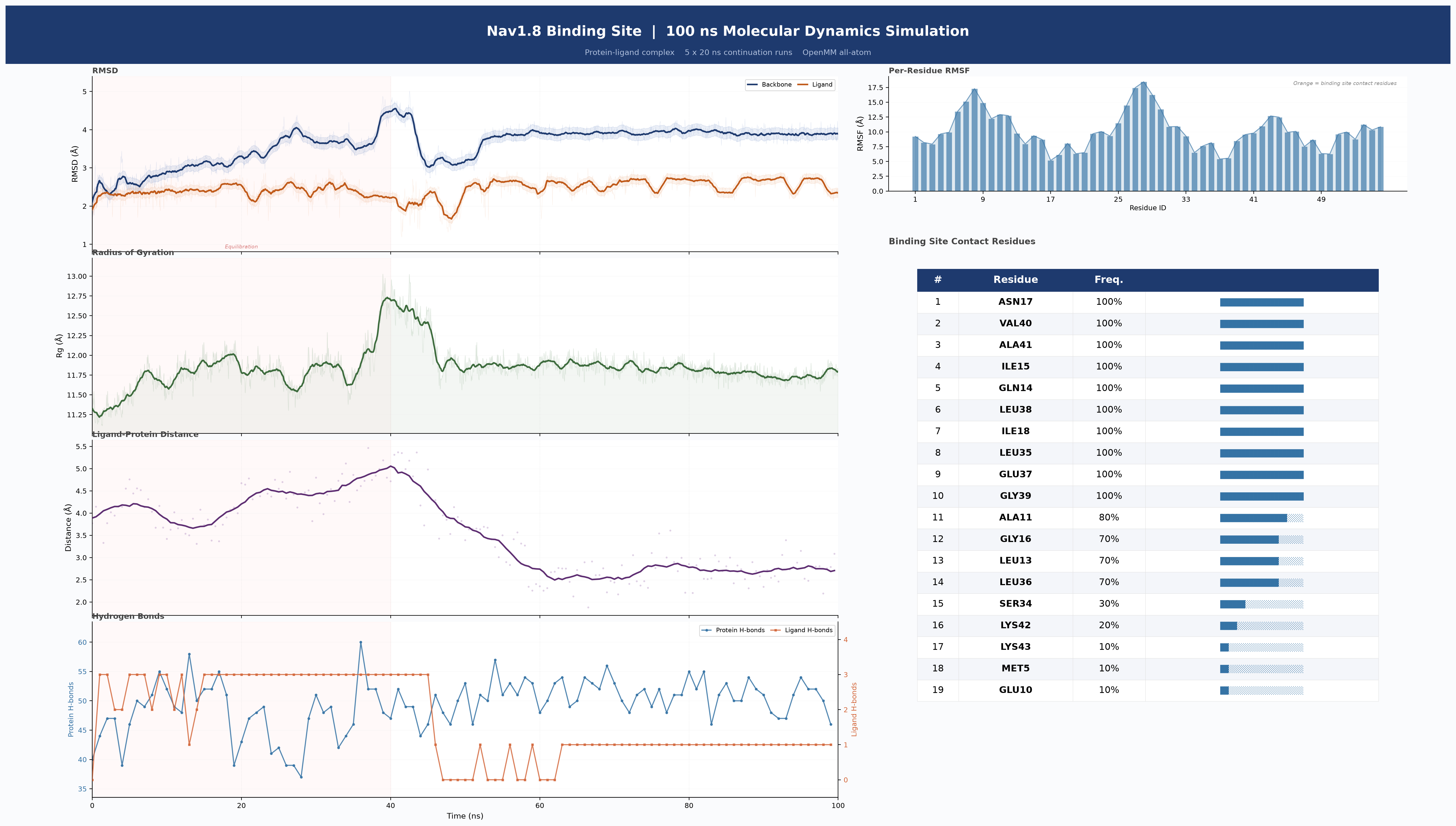
ReadingThe molecule's drift settles after a mid-run rearrangement and its distance to the protein converges: seen in one run, computational evidence, not measured binding.
Nav1.8 and PROTACs: one shows trade-offs, the other a limit
Nav1.8 illustrates multi-objective choice. The team rejects the strongest docked candidate because predicted cardiac risk and blood-brain-barrier behavior are worse, choosing a slightly weaker docking score with a better overall trade-off and then running a 100 ns simulation.[S1]
These scores can rank candidates, but docking, structural confidence and simulation stability are not experimental affinity, pharmacology or clinical efficacy. The candidates may be worth taking into the next experiment.
One set of weights does not imply equal mastery of every class
PROTAC generation is an informative failure. Only about 25% of outputs are valid in the matched probe, and BRD4 conditioning pulls generation toward known molecules. LiteFold instead uses component-wise editing.[S1]
That is more informative than claiming the model already solves PROTACs. Today LiteMol-1 looks more like a molecular editor an agent can call on selected components than a universal end-to-end generator.
A computational proof of concept, not yet a validated drug-discovery system
This release contains no wet-lab validation. ipTM, docking scores, predicted ADMET probabilities and MD trajectories are computational proxies, not experimental affinity, activity, toxicity or degradation efficiency.[S1]
The second boundary is reproducibility. LiteFold publishes the overall method but not the full training mixture, loss weights, masking configuration or conditioning architecture. That is not the same degree of openness as the full training transparency OpenBind-0 emphasises.[S1]
The third boundary is modality coverage. One set of weights does not imply equal mastery of every class. Low PROTAC validity shows a clear gap to a universal end-to-end generator.[S1]
05What I learned
- Transferable insight
- When designing a scientific model for agents, call cost is itself a system capability: sequences are compact, editable and suited to repeated calls.
- Design heuristic
- Tier the expensive tools: a cheap prior explores, property predictors filter fast, structure and dynamics verify only the narrowed set.
- Reading heuristic
- Given 'one model for all molecular classes', check each class's validity: the PROTAC failure is more informative than the word 'universal'.
- Watch next
- Watch for wet-lab feedback: generated candidates synthesized and measured is what would turn this proof of concept into a validated system.
Editability may matter as much as single-call accuracy
For scientific agents, call cost is a system capability. Sequences are compact, editable and suitable for repeated use.
A generator does not need to deliver the final answer
A cheaper prior that can run 100,000 times, paired with fewer expensive verifications, may suit the whole discovery system better.
Molecular design is a trade-off, not one-score maximization
The strongest docked Nav1.8 candidate was not recommended because other predicted liabilities were worse. Maintaining Pareto-optimal hypotheses is closer to medicinal chemistry.
Cross-class generality must be checked class by class
Supporting small molecules, peptides, macrocycles and PROTACs does not imply equal validity, controllability or downstream usefulness. The PROTAC failure case says more than the phrase 'general model' does.
The next step is wet-lab feedback
SAPP/DMX accelerates experimental feedback, OpenBind asks which data are worth producing, and LiteMol-1 explores how an agent can generate the next batch of candidates cheaply. Only by connecting these steps does the work approach Generate → Evaluate → Experiment → Learn → Generate again.
As one imageTo save and share→Sources
Factual claims link to original announcements, project lists, trial records or journal papers where possible. Research plans are kept separate from completed results.