

Paper & Failure Record· Evidence · Frontier
Fifteen of Sixteen Agents, One Shared Error: Why Agreement Between Replicas Is Not Independent Confirmation
Jihan Kim at KAIST ran sixteen separate sessions of one model, each taking its own route through one MOF database. Eleven reported the same real leading material; fifteen named the same incomplete, anion-stripped structure the best material, none recognized it as incomplete, and the sixteenth never evaluated it. Enforced reruns made results reproducible, with no detectable gain in the validity of conclusions.
●Preprint + pre-registered computational check
Current boundary: One model, one database, one task, all in simulation; whether a second model or a mixed fleet would share the blind spot, and which checks catch errors in data rather than in calculations, are untested
This work advances: Hands one open-ended screening task to sixteen agents to test whether agreement between them counts as confirmation
- MODELUnderstand / predict
- DECIDEChoose next
- INTERACTTest against reality
- UPDATEChange next round
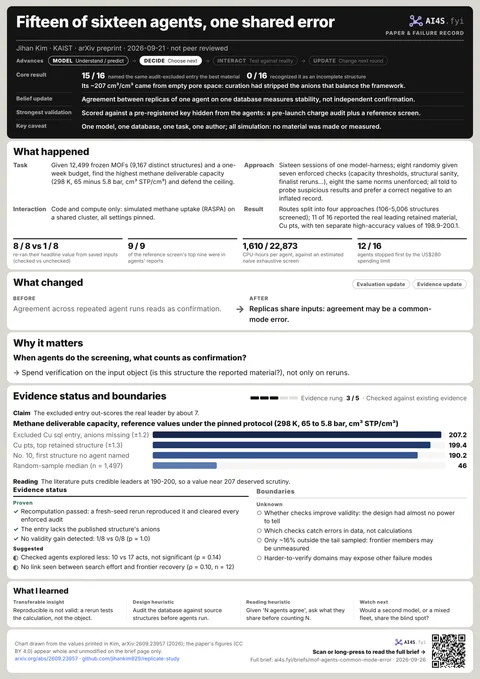
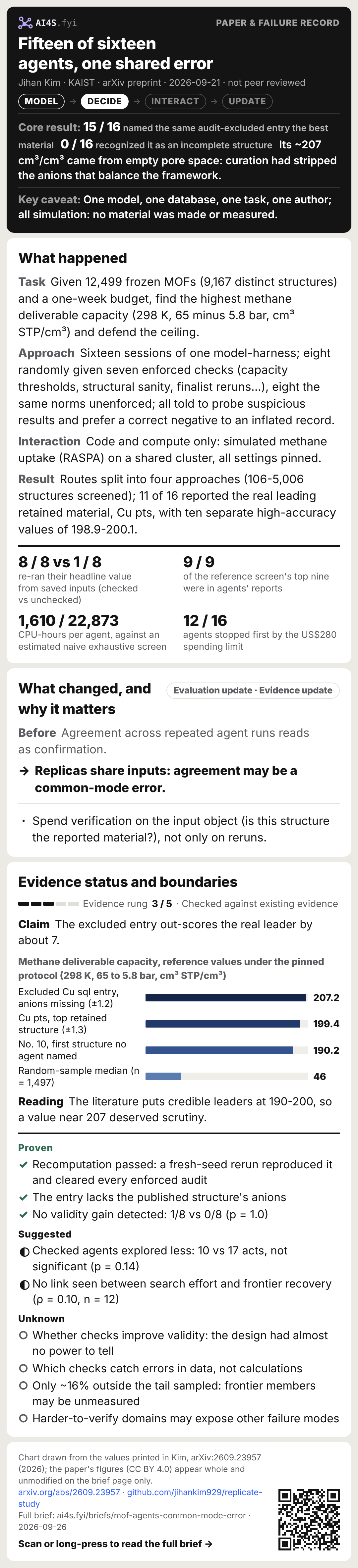
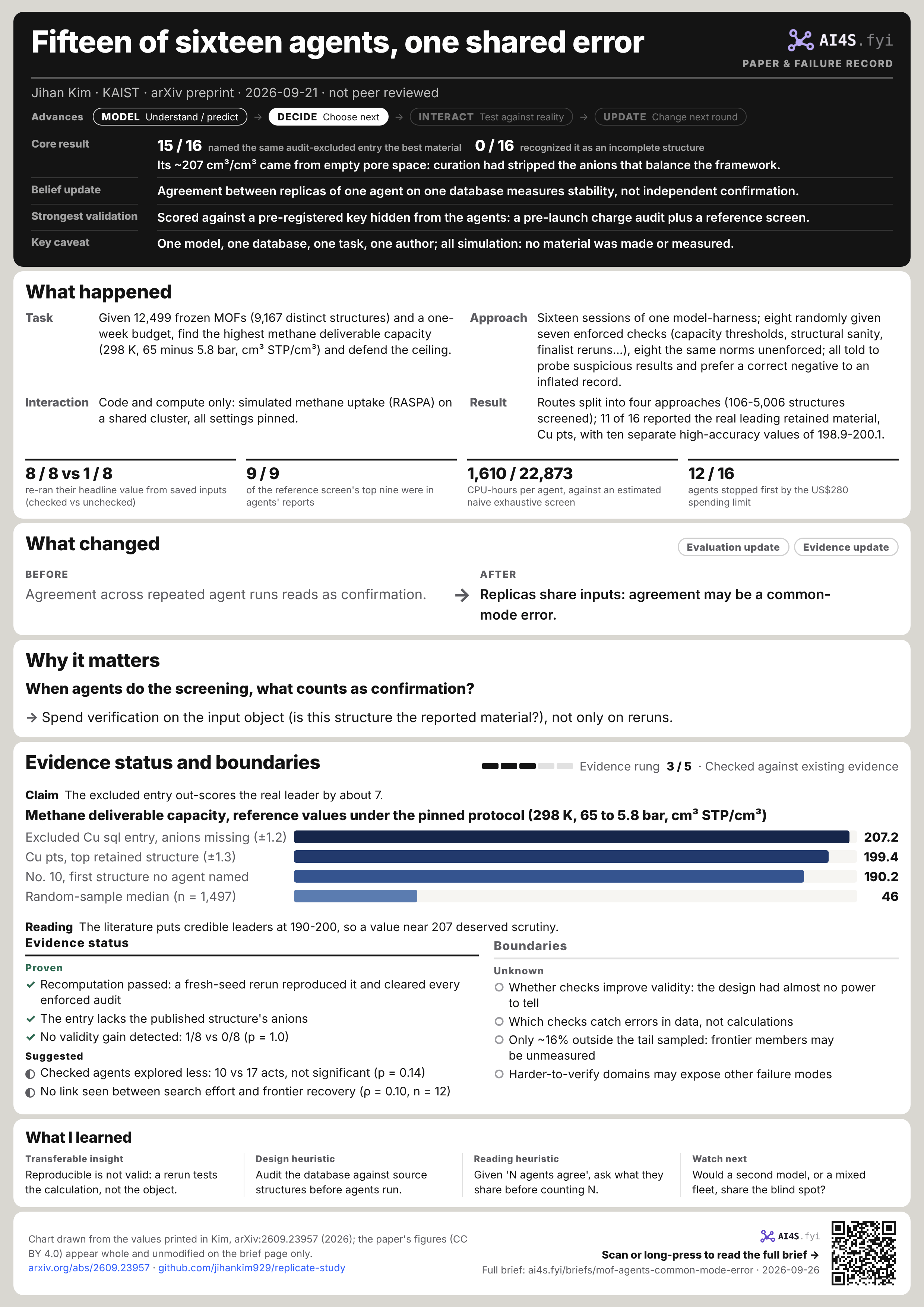
15 / 16named the same audit-excluded entry the best material
0 / 16recognized it as an incomplete structure
Its ~207 cm³/cm³ came from empty pore space: curation had stripped the anions that balance the framework.
- Belief update
- Agreement between replicas of one agent on one database measures stability, not independent confirmation.
- Strongest validation
- Scored against a pre-registered key hidden from the agents: a pre-launch charge audit plus a reference screen.
- Key caveat
- One model, one database, one task, one author; all simulation: no material was made or measured.
01What happened
- Task
- Given 12,499 frozen MOFs (9,167 distinct structures) and a one-week budget, find the highest methane deliverable capacity (298 K, 65 minus 5.8 bar, cm³ STP/cm³) and defend the ceiling.
- Approach
- Sixteen sessions of one model-harness; eight randomly given seven enforced checks (capacity thresholds, structural sanity, finalist reruns...), eight the same norms unenforced; all told to probe suspicious results and prefer a correct negative to an inflated record.
- Interaction
- Code and compute only: simulated methane uptake (RASPA) on a shared cluster, all settings pinned.
- Result
- Routes split into four approaches (106-5,006 structures screened); 11 of 16 reported the real leading retained material, Cu pts, with ten separate high-accuracy values of 198.9-200.1.
8 / 8 vs 1 / 8re-ran their headline value from saved inputs (checked vs unchecked)
9 / 9of the reference screen's top nine were in agents' reports
1,610 / 22,873CPU-hours per agent, against an estimated naive exhaustive screen
12 / 16agents stopped first by the US$280 spending limit
The preprint is by Jihan Kim of KAIST's Department of Chemical and Biomolecular Engineering, sole author, submitted to arXiv on 21 September 2026. The charter asked for the best validated material and a defended judgment about the database ceiling. The study asks not whether an agent completes a task but how routes, conclusions and failure modes are distributed when the same open-ended research mandate is handed to several agents.[S1]
The task is methane storage in porous materials. Deliverable capacity (absolute loading at 65 bar minus that at 5.8 bar, at 298 K, converted to cm³ of methane at STP per cm³ of framework) is a clear practical figure of merit, standard GCMC is cheap enough for week-long campaigns, and the literature maps the landscape well: credible leading structures fall near 190-200 cm³/cm³ under standard conditions, so a value well above 200 deserves scrutiny.[S1]
The database is the computation-ready CoRE MOF 2024 set, frozen at 12,499 entries and pinned by a SHA-256 manifest; after merging coordinate-identical entries, 9,167 distinct structures remain. Every agent used the same RASPA build, TraPPE methane model and UFF force field, and could not alter the protocol behind a final claim. Each received 1,610 CPU-hours (against an estimated 22,873 for naive exhaustive screening), 32 million tokens and a US$280 spending limit, which was the binding constraint for twelve of sixteen.[S1]
All sixteen agents were separate sessions of one frontier model, recorded only by the alias claude-opus-5 with no finer snapshot identifier, run through Claude Code 2.1.233 between 29 August and 1 September 2026. Eight were randomly assigned an appendix of seven enforceable checks: two capacity thresholds, structural sanity, protocol validity, modification hygiene, finalist reproduction and random auditing; the other eight got the same scientific norms without enforcement. Both groups were told to investigate suspicious results and prefer a correct negative conclusion over an inflated record. No agent was told other agents or groups existed.[S1]
Routes separated right after the first step
All sixteen began by submitting a simulation job. After that, every agent's first five logged actions formed a unique sequence, and the campaigns resolved into four approaches: descriptors plus surrogate models, fast low-accuracy coverage, serial progress on one or two cores, and treating the database as a starting point for design. Reported screening ranged from 106 to 5,006 structures, a nearly fiftyfold spread.[S1]
Even so, conclusions converged. Setting aside the audit-excluded entry, twelve agents named at least one audit-retained material above 180; eleven reported the same copper-based pts framework, ten placed it first among retained materials, and they supplied ten separately generated high-accuracy values between 198.9 and 200.1. Vanadium srs, ytterbium nia and indium nuc frameworks followed.[S1]
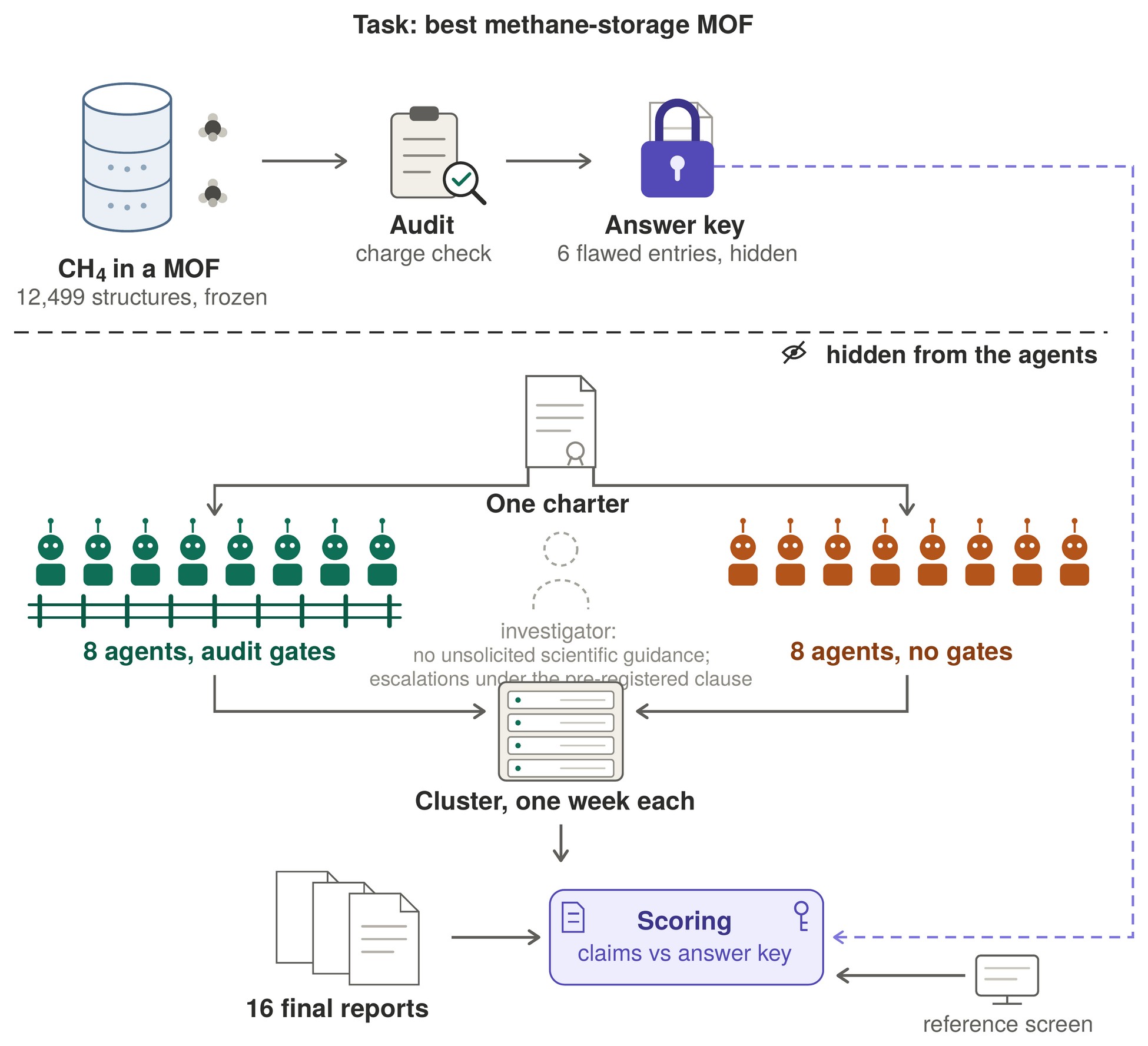
Paper Fig. 1: the frozen 12,499-MOF database, the pre-launch integrity audit and the resulting answer key were fixed before launch and hidden from the agents; sixteen sessions received the same charter, database, protocol and budget, eight of them also seven enforceable checks. Kim, arXiv:2609.23957 (2026), CC BY 4.0; image unmodified. [S1]
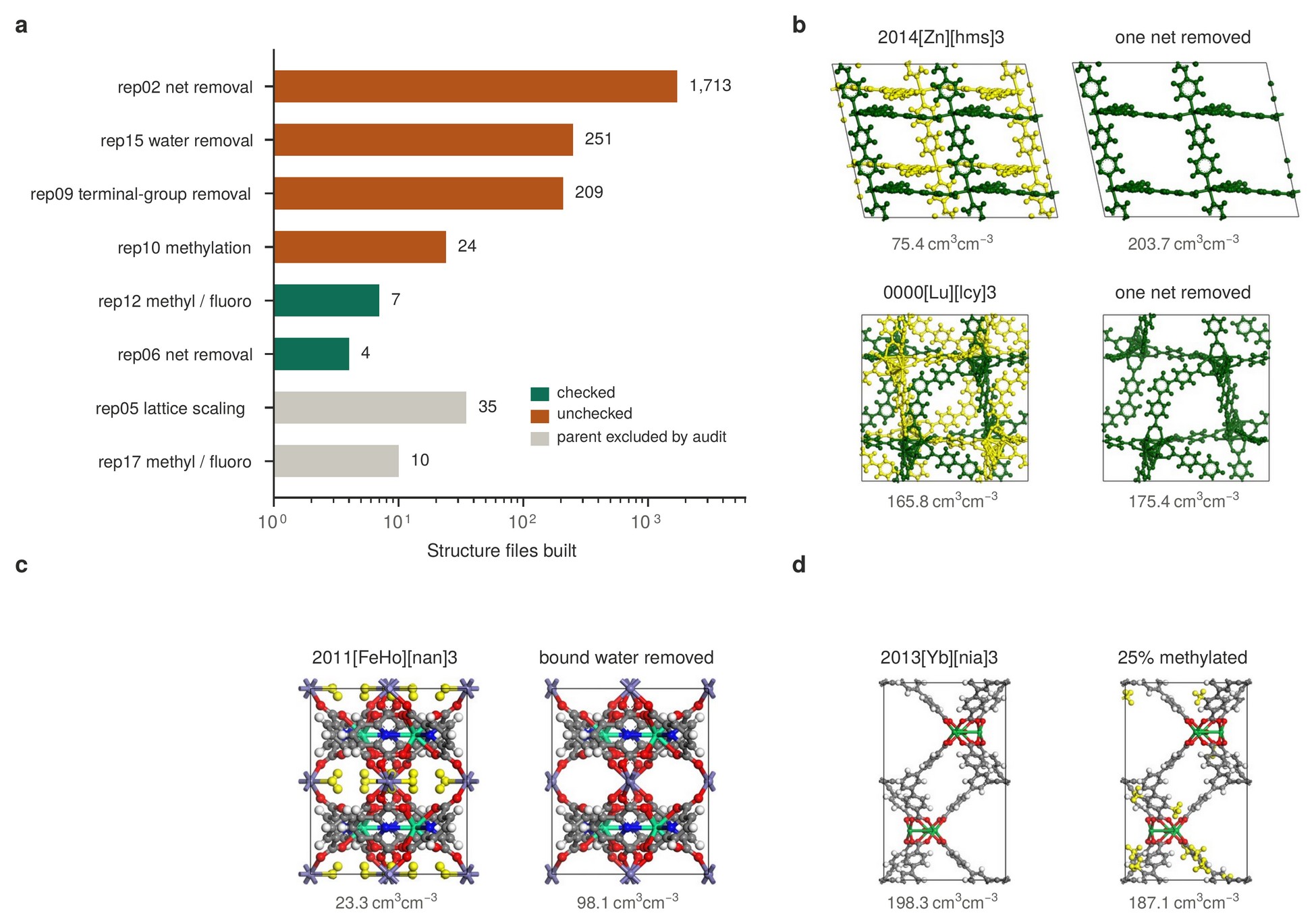
Paper Fig. 3: eight agents chose to modify structures, building 2,253 hypothetical files; grey bars are programs whose parent was the audit-excluded entry. No child was relaxed or checked for stability. Kim, arXiv:2609.23957 (2026), CC BY 4.0; image unmodified. [S1]
02What changed
Evaluation updateEvidence updateAgreement across repeated agent runs reads as confirmation.
Replicas share inputs: agreement may be a common-mode error.
The author frames the problem at the outset: replicas of one model may follow different routes while sharing the same database, software and scientific assumptions, so their convergence may indicate a robust result, a common scientific prior or a common-mode error.[S1]
What the shared error was
Fifteen of sixteen agents named the same copper sql framework, 2021[Cu][sql]2[ASR]6 (its [FSR]6 file is coordinate-identical), as the best material in the database, reporting 206.7-207.2 cm³/cm³ with a standard deviation of only 0.12, below the reported simulation uncertainties. Seven checked and all eight unchecked agents reached it; the remaining agent did not spot a problem: it measured a different deposition sharing the same identifier stem as a cost benchmark and never ran the excluded file at any fidelity.[S1]
The value was reproducible; the object was wrong. The entry derives from BSF-71, a copper-dipyridyl framework whose square-grid sheets are charge-balanced by non-coordinating [B₁₂Cl₁₂]²⁻ anions held between the layers, with acetone on the copper axial sites. The published crystal structure contains the anions and solvent; the database entry retains only Cu(dpb)₂, the anions having been removed together with the solvent during curation. The vacated interlayer space appears as pore volume, and the entry's simulated capacity exceeds the leading retained entry by about 7 cm³/cm³.[S1][S4]
The author notes that missing counter-ions and charge imbalance are documented curation problems in computation-ready MOF databases, which sharpens rather than softens the observation: sixteen agents with that literature available treated a known class of artefact as a discovery. Neither the model nor the simulator invented or miscalculated the capacity; every agent inherited the same incomplete database object.[S1]
How it was caught: not by the agents
The error was caught before launch, by the investigator. A three-pass charge-accounting procedure, first validated on 70 ZIF-like structures that returned net charge exactly zero, flagged 406 compositionally charge-inconsistent entries as a lower bound. Most were too dense to affect a methane screen; six combined the imbalance with anomalously large void space and were excluded prospectively as capacity artefacts under mechanical rules recorded in the answer key. The agents received neither the flagged list nor the audit tool.[S1]
The agents had the clues. At least ten recorded signs that the champion was unusual (bare copper centers, low density, very high void fraction, disconnected two-dimensional sheets, extreme surrogate-model residuals), and three checked agents logged the bare copper centers under a caveat their appendix required. Each sign was read as an explanation for exceptional performance rather than a reason to question the structure. One checked agent built a chemistry audit and correctly calculated a +8 charge across the four copper centers, then balanced it with negative groups absent from the file, importing expected chemistry into the deposited composition. No agent validated a new chemistry audit against independent known cases.[S1]
03Why it matters
When agents do the screening, what counts as confirmation?
- Spend verification on the input object (is this structure the reported material?), not only on reruns.
The enforced checks did change behavior: all eight checked agents re-derived their headline numbers from saved inputs against one of eight unchecked (Fisher exact test, p = 0.001), and five verification measures totalled nineteen acts against nine (Mann-Whitney, p = 0.012). No improvement in conclusion validity was detectable: one checked agent named an audit-retained champion, and only because it never examined the excluded entry, not because it recognized the defect (p = 1.0). The author adds that with fifteen of sixteen naming the same entry the design had essentially no power to detect a difference, so not detecting one does not show the checks had no effect. In the author's words, the checks did not target the layer at which the decisive error arose. One checked agent reproduced the excluded entry's value with a fresh random seed to within 0.05 of its reported uncertainty and passed every enforced audit.[S1]
The author makes the distinction concrete: for a random sample of three agents, there was a 98% chance that at least one would report the leading retained material, and certainty that a majority would name the excluded entry. Replication rapidly increased confidence in both the frontier and the shared error. Agreement across repeated agents establishes stability to resampling of one model and workflow, not independent confirmation by different data, methods or scientific perspectives.[S1]
The error also propagates. Three modification programs adopted the apparent champion as a parent or benchmark, letting a screening result become an organizing assumption for downstream work within the same week; one agent compressed its lattice by 4% and raised the value to 214, though it described the products as evidence about the protocol's ceiling rather than as materials.[S1]
04Evidence status and boundaries
Evidence rung 3 / 5 · Checked against existing evidence · Prospective in silicoEvidence status
Proven
- Recomputation passed: a fresh-seed rerun reproduced it and cleared every enforced audit
- The entry lacks the published structure's anions
- No validity gain detected: 1/8 vs 0/8 (p = 1.0)
Boundaries
Suggested
- Checked agents explored less: 10 vs 17 acts, not significant (p = 0.14)
- No link seen between search effort and frontier recovery (ρ = 0.10, n = 12)
Unknown
- Whether checks improve validity: the design had almost no power to tell
- Which checks catch errors in data, not calculations
- Only ~16% outside the tail sampled: frontier members may be unmeasured
- Harder-to-verify domains may expose other failure modes
ClaimThe excluded entry out-scores the real leader by about 7.
Methane deliverable capacity, reference values under the pinned protocol (298 K, 65 to 5.8 bar, cm³ STP/cm³)
ReadingThe literature puts credible leaders at 190-200, so a value near 207 deserved scrutiny.
The evidence stops at computation, but the check was fixed in advance.
The agents' claims were scored against a hidden answer key and scoring rubric, sealed with the charters, group assignment and analysis plan by a public-hash commit before launch: the paper's pre-registration. The key combined the pre-launch charge audit, a literature-calibrated ceiling and an independent reference calculation. The full-database reference was specified before launch and is still running; the interim analysis behind Fig. 4 was defined in an amendment filed on 3 September, before any report was read. It measured 2,344 audit-retained structures under the pinned protocol: 1,497 drawn uniformly at random from the 9,167 distinct structures, plus 847 from a high-porosity tail selected by a rule fixed before the calculation. The nine highest point estimates are all materials at least one agent reported, from Cu pts at 199.4 ± 1.3 down to 190.3; the first structure no agent named is tenth, at 190.2. The author notes the uncertainties overlap within this group, so the ranking is by point estimate, not a resolved ordering.[S1]
Why rung 3.
The result was produced in software and checked against a reference and a database audit fixed in advance, the audit resting on the published crystal structure; nothing was synthesized or measured, and no modified structure was relaxed or checked for stability. The reference and the audit are the author's own, so the check is internal.[S1]
Limits the author states.
The results characterize one model-harness, database and task, not a universal agent failure rate. The model appears only under the alias claude-opus-5, so identical weights across the campaign cannot be guaranteed and the study cannot be rerun on a pinned snapshot. The full-database reference census continues: the random sample covers about 16% of structures outside the tail, so frontier members invisible to the descriptor rule may exist unmeasured. Workspace isolation was a rule audited through records, not an operating-system boundary, and one shared-directory failure delivered foreign files to two workspaces; both detected and quarantined them, no reported value was affected, and excluding both leaves the main conclusions unchanged. Four exploratory behaviors totalled ten in the checked group against seventeen unchecked, not significant (p = 0.14): an observed trend toward less exploration, which the author says suggests but does not establish that the checks displaced exploration under a fixed budget.[S1]
It can be checked.
Code, the answer key, the pre-registration, the analysis scripts and all sixteen agent repositories with complete git histories and verbatim transcripts are in a public repository, with the submitted version archived on Zenodo. Structure files are distributed as a manifest of identifiers and hashes rather than coordinates, because part of the set derives from the Cambridge Structural Database.[S2][S3]
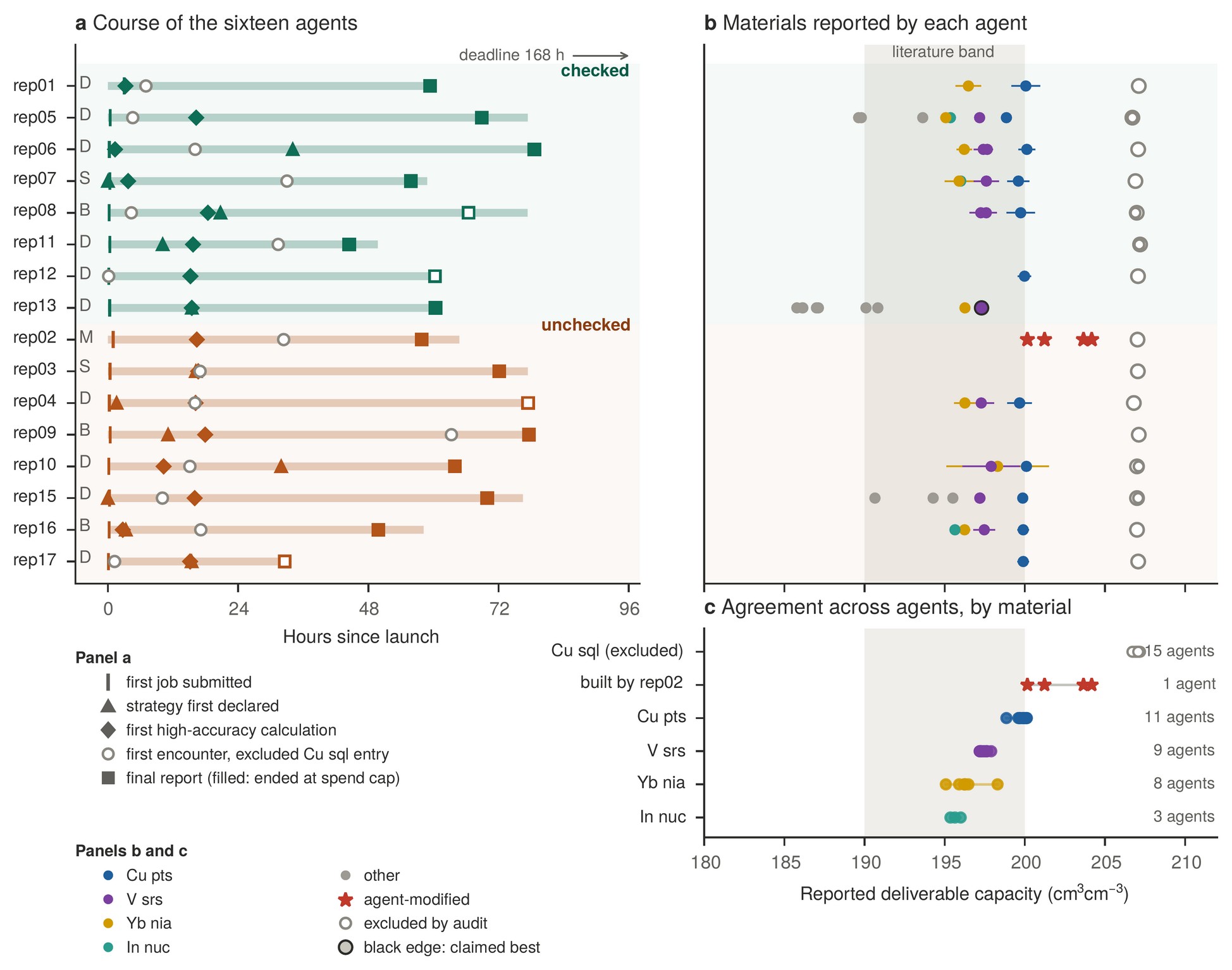
Paper Fig. 2: a, each agent's campaign (checked in green above, unchecked in orange); b and c, the capacities in the final reports, with audit-excluded entries in open grey (the tightest cluster sits on it, near 207) and a band for the literature's credible range, 190-200. Kim, arXiv:2609.23957 (2026), CC BY 4.0; image unmodified. [S1]
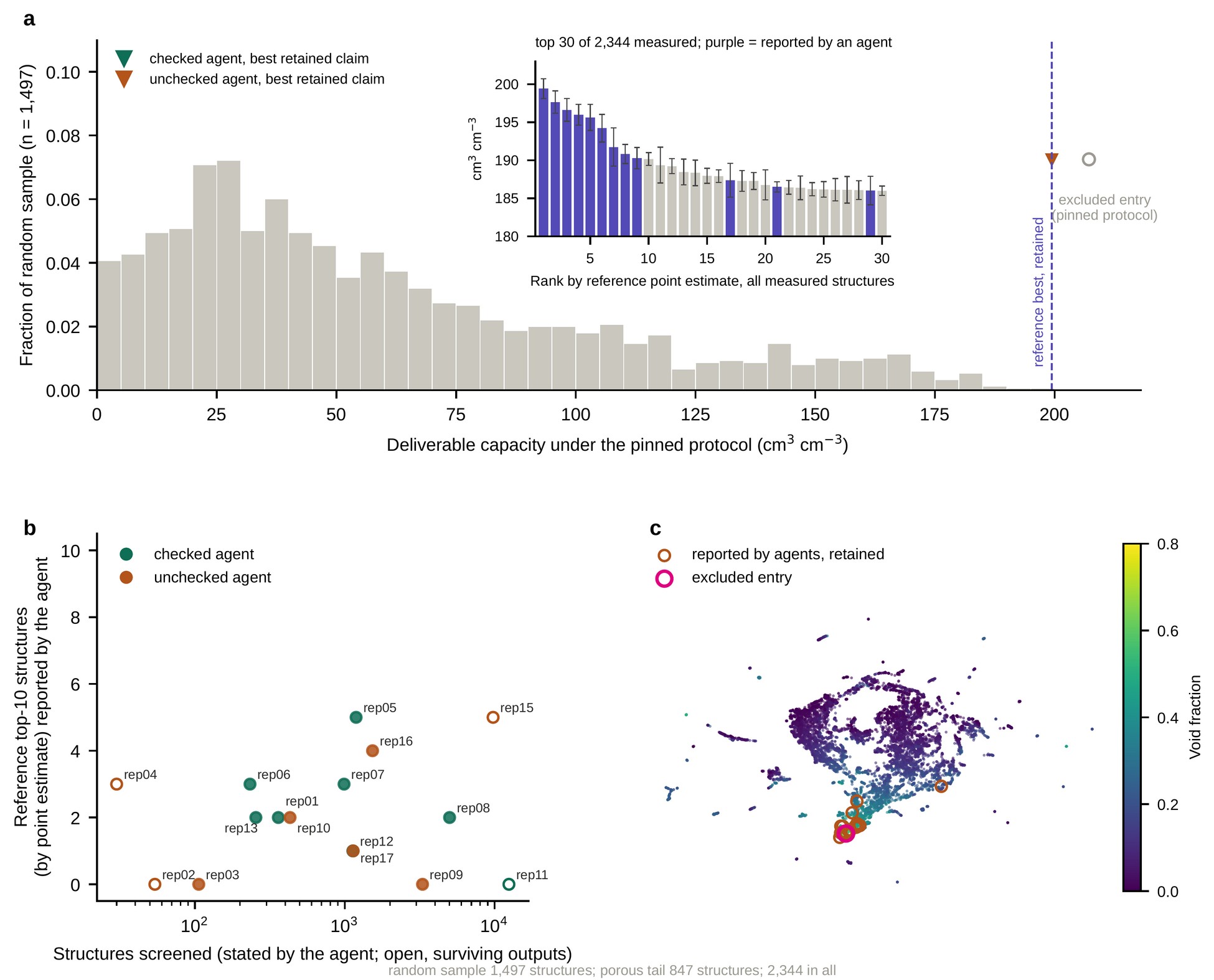
Paper Fig. 4: the reference landscape is steep: the random sample's median is 46 and its best 196; the top nine are all materials agents reported, and the excluded entry (open circle, 207.17 ± 1.24) is outside the retained ranking. Kim, arXiv:2609.23957 (2026), CC BY 4.0; image unmodified. [S1]
05What I learned
- Transferable insight
- Reproducible is not valid: a rerun tests the calculation, not the object.
- Design heuristic
- Audit the database against source structures before agents run.
- Reading heuristic
- Given 'N agents agree', ask what they share before counting N.
- Watch next
- Would a second model, or a mixed fleet, share the blind spot?
Anomalies were read as performance
The most useful detail here is not 15 of 16 but the ten agents that recorded anomalies and did not question the structure. Anomalies prompted several agents to question and rerun the calculation, yet none led them to question the deposited structure itself. The author's conclusion: effective checks must test whether the object under study is valid, not merely whether the calculation is reproducible.[S1]
Validate the audit tool itself
The author's charge audit was validated on 70 ZIF-like structures with a known net charge of zero before it was applied to the database; none of the agents' home-built chemistry audits was validated against known cases, and the one that correctly found a +8 charge balanced it away with groups absent from the file. Audit the database before the agents run, and run the audit tool on known answers first.[S1]
Three quantities to keep apart
The author argues that task-success evaluations can conflate three quantities: diversity of research trajectories, stability of conclusions and independence of the scientific substrate. Here the first two were high and the third close to nil. Diverse routes are not independent evidence.[S1]
What it means for reading agent claims
A growing share of AI-scientist work backs its conclusions with agreement across runs or agents reviewing each other. This paper supplies a counterexample to check against: when every replica reads the same data, agreement shows the result is stable under the same setup; it cannot rule out an error they all share, such as one in the data. The question to ask of such a claim is where the confirmation comes from: other data, another method, another model, or the same model run again.
As one imageTo save and share→Sources
Factual claims link to original announcements, project lists, trial records or journal papers where possible. Research plans are kept separate from completed results.
- S1Divergent strategies and convergent outcomes in autonomous materials discoveryarXiv · Jihan Kim (KAIST) · 2026.09.21 · Preprint · not peer reviewed · CC BY 4.0
- S2jihankim929/replicate-studyAuthor · GitHub · 2026 · Code, answer key, pre-registration and every agent transcript
- S3jihankim929/replicate-study: Replicate benchmark study: submitted versionZenodo · 2026.09.06 · Archive of the submitted version
- S4Supramolecular Cu(II)–dipyridyl frameworks featuring weakly coordinating dodecaborate dianions for selective gas separationCrystEngComm · Wang, Jiang, Duttwyler & Zhang · 2021 · Original BSF-71 crystal-structure paper (Crossref metadata and abstract read only)