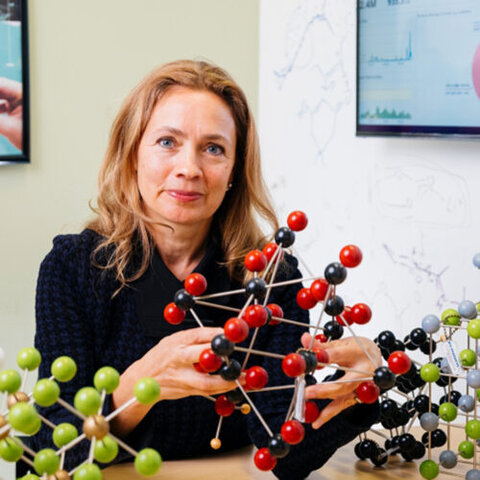
Théo Jaffrelot Inizan, Sherry Yang, Kristin Persson, Omar Yaghi and colleagues at UC Berkeley, Lawrence Berkeley National Laboratory and Google DeepMind, with Ekin Dogus Cubuk among the Google DeepMind authors, published MOFGen in Nature Computational Science on 20 November; a preprint had appeared on arXiv in April 2025. Metal-organic frameworks are porous crystals of metal nodes joined by organic linker molecules, studied for capturing carbon dioxide and pulling water from air. The authors argue that generative models have produced large databases of computed-stable materials while synthesizability stays the bottleneck, and cite a single inorganic material from such a model verified in the lab so far.
The system is a chain of agents. LinkerGen, a language model prompted with every reported linker, proposes chemical formulae; CrystalGen, an all-atom diffusion model trained on experimental and computed frameworks, turns each formula into ten candidate crystals of up to 256 atoms; QForge relaxes them with the MACE-MP-0 force field and filters out non-porous ones; SynthABLE breaks each framework into building blocks and scores whether its linker can be made, using the Allchemy software and other scores; QHarden refines the survivors with density functional theory. For zinc frameworks this gave 259,559 structures, 251,118 relaxed, about 180,000 distinct linkers, of which 73 had been reported, and about 3,000 structures optimised at the r2SCAN-D4 level.
Allchemy rated 92.7% of 26,561 sampled linkers synthesizable at least with moderate difficulty. A blind survey of experimentalists agreed with the model on linkers it called unmakeable (67 to 100%) but accepted only about 40% of those it called makeable, so the authors treat the model as over-optimistic. For the lab, they kept frameworks with one kind of linker, already reported as a molecule, with at least two carboxylate groups and a known zinc node, ranked 349 linkers, and let experimentalists pick. A robotic platform screened synthesis conditions.
Four zinc frameworks followed. AI-MOF-1 reuses a linker known from an aluminium framework; AI-MOF-2 uses perylene, which a chemist substituted for a hard-to-make linker the model proposed; AI-MOF-3 and AI-MOF-4 use 2,3-dimethylfumaric acid, which the model generated often, and AI-MOF-4's single-crystal structure shows solvent molecules bound to zinc in a way the authors say had not been reported. All four share the topology of MOF-5. Three further products, one with aluminium and two with a second linker, are reported, one of them solved by single-crystal diffraction. The paper measures no adsorption, and its discussion lists the 256-atom limit, the focus on zinc and the human in the loop as limits.