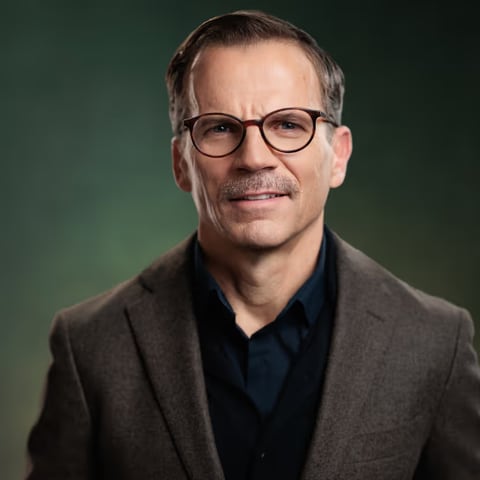
The real world is the final verifier
Fussell says the live split is between those who think more compute and power will let everything be done in silicon, the model eventually just understanding chemistry, and Lila, which holds that new data must eventually be verified in the real world. So it builds large labs, expensive and labour-heavy and space-hungry, which he says they believe necessary; the system moves between compute and physical experiment, doing as much on compute as is fast enough.
“We believe that the world, the universe, is the ultimate verifier.”Chris Fussell
Output could one day be measured by floor area
He compares it with factories after the industrial revolution, when people began asking how much a factory produced per square foot and what energy it needed. He says science will get there: this lab, in this configuration, with this model, can produce this much new scientific knowledge, measurable eventually 'down to the square foot'. He puts Lila's thesis as a 'time machine for science', pulling knowledge from years or decades ahead into today.
Organise as a network, with no blinks at the handoffs
His first career was special operations. The counterterrorism cycle (find, fix, finish, exploit, analyse) ran across separate agencies, and he says they lost in the 'blinks' at each handoff, so rebuilt it as a network that never stops. He sees the scientific method as the same loop, with people now sitting in many of its steps, and Lila's answer as autonomous labs, humans who plug in when they want, and an AI that learns across all of it.
The public will see materials first; and a message for policymakers
He says the public will hear that a material used to weigh this much and now weighs that, or that an offshore drill's lubricant lasts ten times longer, and that materials are where people will first feel science speeding up, then the life sciences. To policymakers he says the pace will be fast and the effects global: watch how allies keep pace and whether the balance with adversaries tips, look at the industrial base, agriculture and supply chains, and expect systems like drug release and approval to be forced to change by the backlog.
Prior public recordThe timeline records Lila's emergence in March 2025 with $200 million to build 'AI science factories', the iridium-free green-hydrogen catalyst of 24 September, and the roughly $2 billion raise in talks reported by Bloomberg in June.
→This interview addsFussell adds an idea for measurement (output estimated from a lab's floor area, configuration and model) and says the labs run to 'many tens of thousands of square feet', with no area, site or output figure.
Prior public recordThe timeline has no Lila entry on government, allies or approval systems.
→This interview addsHis message to policymakers: this is a fast shift with global effects, so plan ahead for allies, supply chains and approval systems; he says it needs more legislators' understanding and more government focus and money, and names no programme.
Measuring output by area needs a definition of output first
New scientific knowledge has no ready unit. If Lila wants to estimate output from area and configuration, it has to say what counts as a unit and who verifies it. Until it does, this is a direction and not a metric. That is our reading.
The same thesis, in the language of organisation and policy
Lila's CTO makes the case elsewhere that reality is the verifier; its operations president makes the same case here in terms of organisation and policy. It brings no new figures, so it is better read as how the company presents itself to policymakers than as new evidence.
ClaimWhose voiceWhere it stands
Lila is building many tens of thousands of square feet of labs controlled by AI models, with autonomous systems and robotics and humans very much involved.
Target
No site, size or date; it is 'being built'.
One day one will be able to estimate from a lab's configuration and the model's power how much new scientific knowledge it produces, down to the square foot.
Target
He says 'eventually'; no method or unit is given.
Compute in silicon is not enough; new data must eventually be verified in the real world.
Guest's judgment
Lila's position; he grants that a lot can be done in silicon.
The US leads in AI for science, in 'pole position', but it needs sustained attention from government and industry, and 'there are not a lot of companies' in the field.
Guest's judgment
His own assessment with no metrics; he says he is confident.
Materials will be where the public first sees the change, for example lighter materials or an offshore-drill lubricant that lasts ten times longer.
Guest's judgment
Both examples are hypothetical, not Lila results.
Systems such as drug approval will be forced to speed up by a backlog of new drugs; today's way will look archaic in fifty years.
Guest's judgment
He says himself he is 'making up' the details of the backlog.
Lila will do amazing things in the autonomous-lab space before many are aware.
Target
He does not say what or when.
Whether Lila gives a way to measure lab output.
Would show up as A throughput or output figure published by Lila, with its unit, definition and floor area, and checked by someone outside.Whether the hypothetical materials become a named Lila result.
Would show up as A specific material published by Lila or a partner, with the change in property against a baseline and how often it was repeated.
Source and how it was readRead 2026.10.14 The full timestamped captions pasted by the author (YouTube's machine captions, no speaker labels; only the host and Fussell speak), read in full; the video was not watched. The captions garble the host's name beyond recognition, so this page does not give it. The host's questions run to scientific competitiveness and policy, and the guest is one of Lila's own executives speaking for the company. Open the interview ↗