

Tech Report Brief· Evidence · Frontier
AnewDDE: One Conversation Steering Two Rounds of Antibody Design and Experiment
Anew Labs, just spun out of ByteDance, wires structure prediction, generative design, affinity prediction and scientific reasoning into one loop. In its first public campaign, 16 of 150 nanobody clones reached single-digit nanomolar affinity.
◐Technical report + in-house benchmarks + measured SPR data
Current boundary: What was made and measured is binding; function and developability come later
This work advances: Wires structure prediction, generative design, affinity prediction and experimental feedback into an agent-dispatched antibody design loop
- MODELUnderstand / predict
- DECIDEChoose next
- INTERACTTest against reality
- UPDATEChange next round
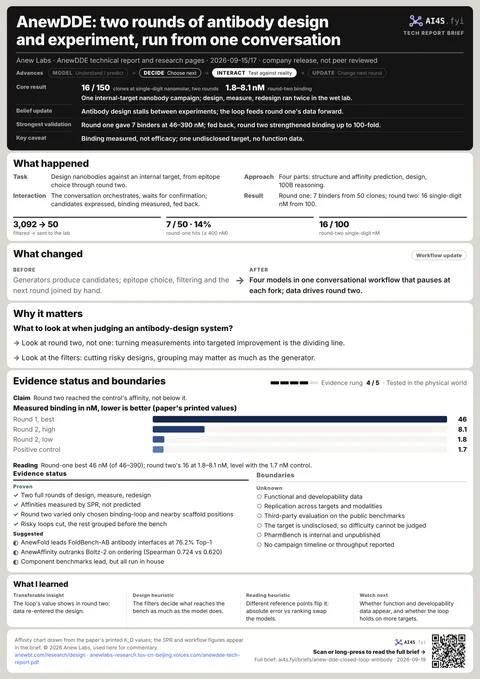
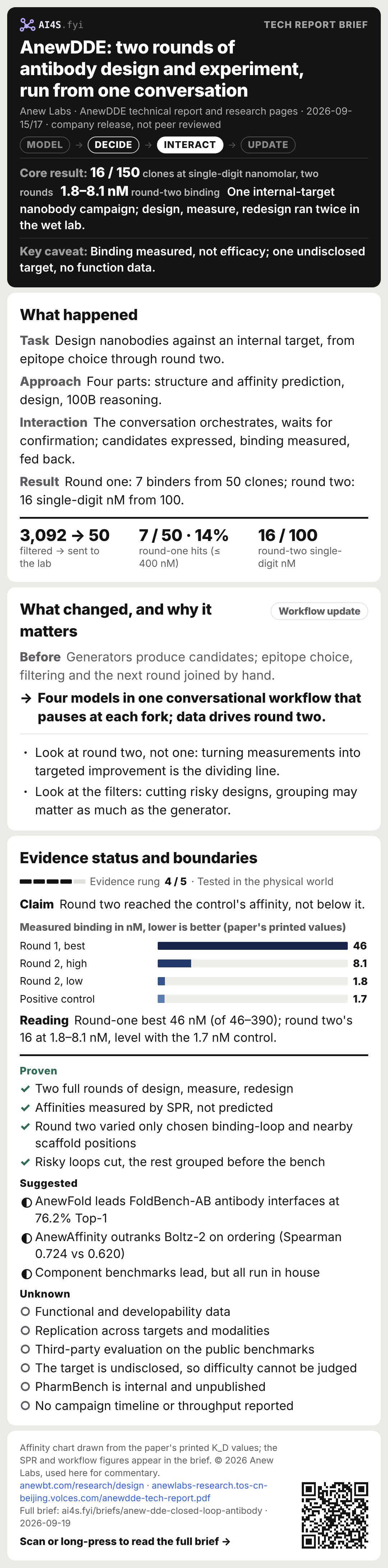
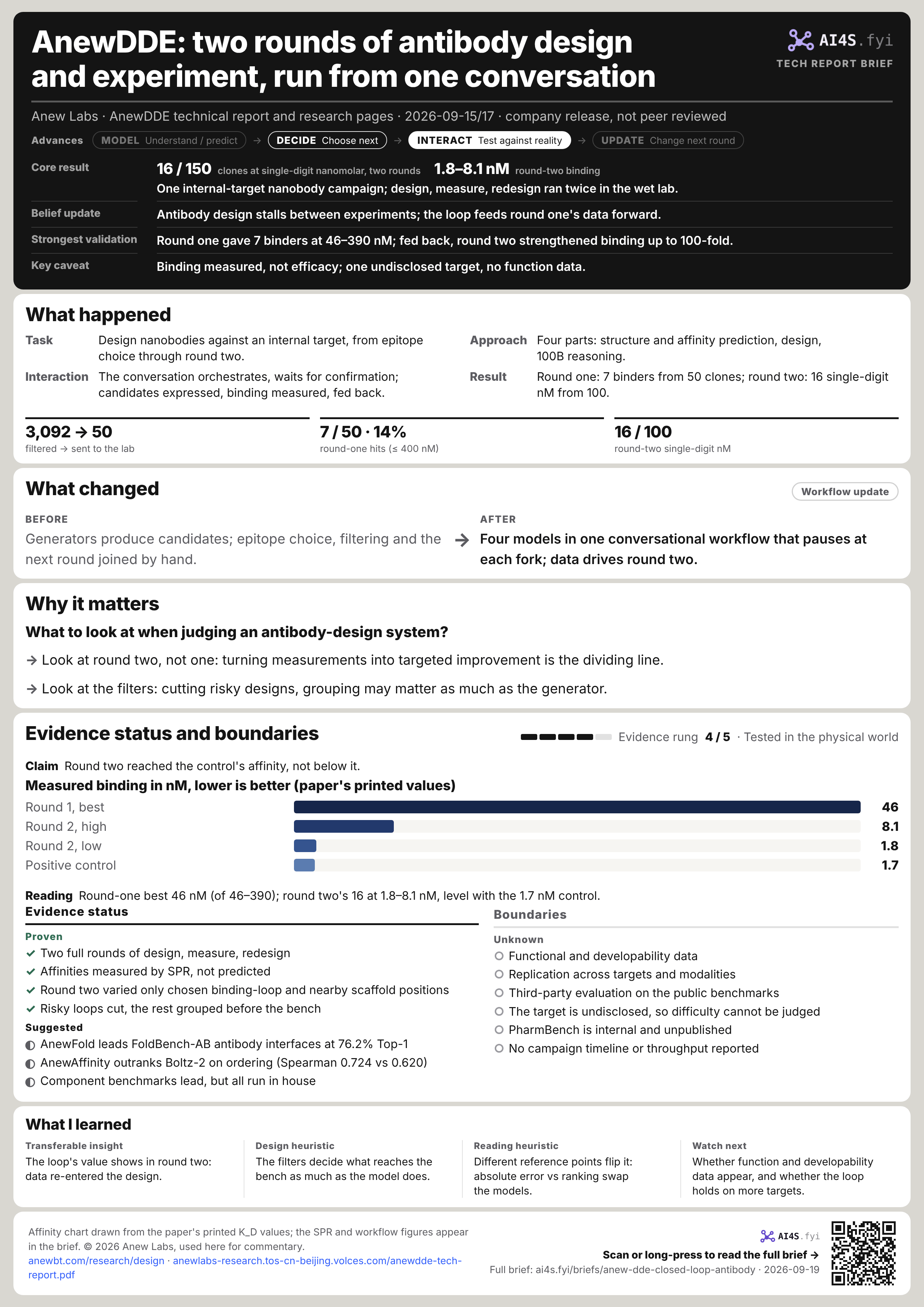
16 / 150clones at single-digit nanomolar, two rounds
1.8–8.1 nMround-two binding
One internal-target nanobody campaign; design, measure, redesign ran twice in the wet lab.
- Belief update
- Antibody design stalls between experiments; the loop feeds round one's data forward.
- Strongest validation
- Round one gave 7 binders at 46–390 nM; fed back, round two strengthened binding up to 100-fold.
- Key caveat
- Binding measured, not efficacy; one undisclosed target, no function data.
01What happened
- Task
- Design nanobodies against an internal target, from epitope choice through round two.
- Approach
- Four parts: structure and affinity prediction, design, 100B reasoning.
- Interaction
- The conversation orchestrates, waits for confirmation; candidates expressed, binding measured, fed back.
- Result
- Round one: 7 binders from 50 clones; round two: 16 single-digit nM from 100.
3,092 → 50filtered → sent to the lab
7 / 50 · 14%round-one hits (≤ 400 nM)
16 / 100round-two single-digit nM
On September 15 and 17, 2026, Anew Labs published three pieces: research pages for AnewMind and AnewDesign, and the AnewDDE technical report that connects them. DDE stands for Drug Discovery Engine, and the word in front of it in the title is agentic: the claim is not another better model, but several models wired into a workflow that can run continuously.[S1][S2][S3]
A word on the company first. Anew Labs is ByteDance's AI pharmaceutical team, whose earlier models (Protenix, PXDesign) already have users in the structure-prediction community. Reuters reported that the business line has just completed a spin-off round: $290M at a $1.5B valuation, with ByteDance retaining 56%, led by HSG, IDG Capital and Hillhouse, roughly 50 core staff moving to the new company, and compute still supplied by ByteDance's Volcano Engine. This release is the team's first substantial showing after that split.[S5][S4]
The workflow has four components, each covering one stretch. AnewFold predicts structures, covering antibody-antigen complexes, protein-ligand interactions, blind pocket identification and molecular-glue ternary complexes. AnewAffinity predicts binding affinity, aiming for accuracy approaching free-energy perturbation (FEP) at a speed that suits large-scale screening. AnewDesign handles generative design and affinity maturation. AnewMind is a hundred-billion-parameter language model, post-trained on all parameters, that does ADMET and developability analysis, candidate ranking and R&D decision reasoning.[S1]
What connects them is an interface. In the AnewScience web app, a scientist states the objective in natural language; the agent gathers literature and structures, proposes epitopes, launches and manages the compute jobs, assembles the candidate list, and stops at each fork to ask whether to proceed. The figure below is the company's own screenshot of that flow: biological context and epitope selection on the left, generation, filtering and experimental feedback on the right.[S2]
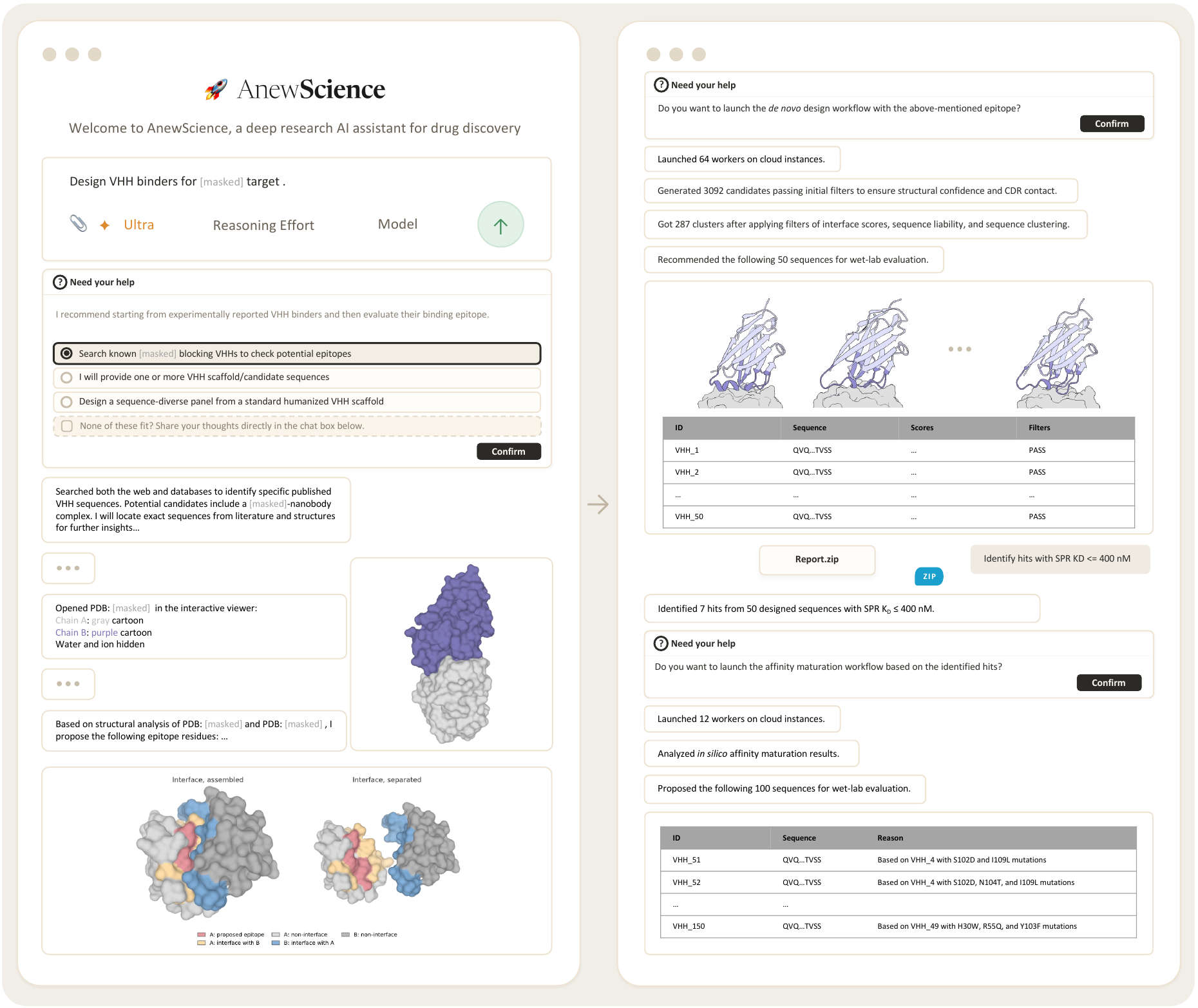
The AnewScience workflow: epitope selection on the left, the campaign's actual funnel on the right. Anew Labs research pages. [S2]
02What changed
Workflow updateGenerators produce candidates; epitope choice, filtering and the next round joined by hand.
Four models in one conversational workflow that pauses at each fork; data drives round two.
Two rounds of one campaign
The first round starts from what has already been reported. The agent looks up published VHH binders and where they bind, searches literature, patents and structure databases, and uses a published crystal structure to locate candidate epitopes; a second structure, of the target bound to its interaction partner, is used to check whether that epitope sits on the mechanism they want to block. With the epitope fixed, a diffusion model generates candidates and a structure-prediction model scores them.[S2]
The filtering step is fairly careful: beyond structural consistency and interface plausibility, the workflow flags and removes CDR motifs carrying high-risk liabilities (deamidation, fragmentation, isomerization, N-linked glycosylation), then clusters the rest so that what goes to the bench is structurally and sequentially diverse. Fifty sequences went to the lab; SPR found 7 binders between 46 and 390 nM, a 14% hit rate in the first round.[S2][S1]
The second round is where the system makes its case. The measured affinities and developability labels flow back as reference data; a partial-diffusion algorithm keeps the validated regions fixed and explores only selected CDR and nearby framework residues, with the agent assisting in the pick. A hundred more sequences went out for measurement and returned 16 candidates at 1.8-8.1 nM. Across both rounds: 150 clones, 16 at single-digit nanomolar, a 10.7% success rate.[S2][S1]
What the other three components report
AnewFold reports three Top-1 success rates on antibody-antigen interfaces: 62.3% on AF3-AB, 60.8% on PXMeter-AB and 76.2% on FoldBench-AB, the highest among the methods compared on all three. On protein-ligand complexes it reports 77.4% on FoldBench Protein-Ligand, against 76.0% for IsoDDE, 64.9% for AF3 and 64.0% for Protenix-v2. A more practical point sits in the report: with a single seed, AnewFold already beats Protenix-v1 sampled with 500 seeds: quality per sample, not just more sampling.[S1]
AnewAffinity's comparison runs on 199 ligands: a pairwise ΔΔG RMSE of 1.057 kcal/mol, a weighted Pearson R² of 0.553 and a Spearman of 0.724, against 1.016, 0.486 and 0.620 for Boltz-2. The split is worth noticing: Boltz-2 has the slightly smaller absolute error, while AnewAffinity reports the higher rank correlation (Spearman 0.724 vs 0.620), and in a real project, ordering is what decides which compound gets made first.[S1]
AnewMind is the judgment layer. It places in the top five across all four aggregate ADMET and developability evaluations, first on cyclic-peptide permeability and near the lead on antibody developability, while the company stresses that it holds up on general benchmarks such as MMLU-Pro and GPQA Diamond: domain post-training did not trade away general ability. To evaluate longer-horizon decisions, pharmaceutical R&D experts built an internal benchmark, PharmBench, around real cases: project context and experimental evidence are revealed progressively to see whether a model can integrate them into an R&D judgment. It holds 200 subquestions across seven capability dimensions and compares 17 models.[S1][S3]
03Why it matters
What to look at when judging an antibody-design system?
- Look at round two, not one: turning measurements into targeted improvement is the dividing line.
- Look at the filters: cutting risky designs, grouping may matter as much as the generator.
Most antibody-design demonstrations show one capability at a time: structures predicted more accurately, or a generator producing more plausible interfaces. What usually stalls a project sits between two experiments: who picks the epitope, who cuts thousands of candidates down to what a bench can absorb, which residues to change once the measurements come back. What makes AnewDDE worth reading is that it writes those handoffs into one workflow and publishes measured numbers from two full turns of it.[S1][S2]
The natural-language interface is not just packaging. Because the workflow pauses at each fork to ask whether to continue, expert judgment stays inside the loop: whether the epitope is right, whether this batch deserves the bench budget, is still the scientist's call, and the agent turns that call into runnable compute. For a company that has both an AI team and a medicinal-chemistry team, that division is more realistic than full autonomy.[S2]
There is an industry reading too. The team's earlier Protenix is a publicly available reproduction of AlphaFold3, widely used in the community. After the spin-off, models from the same people are serving an in-house pipeline: the company lists IL-17, IL-4R and two undisclosed targets. Reputation built through open models is being converted into a company with drug candidates of its own.[S4][S5]
04Evidence status and boundaries
Evidence rung 4 / 5 · Tested in the physical world · Closed-loop experimentationEvidence status
Proven
- Two full rounds of design, measure, redesign
- Affinities measured by SPR, not predicted
- Round two varied only chosen binding-loop and nearby scaffold positions
- Risky loops cut, the rest grouped before the bench
Boundaries
Suggested
- AnewFold leads FoldBench-AB antibody interfaces at 76.2% Top-1
- AnewAffinity outranks Boltz-2 on ordering (Spearman 0.724 vs 0.620)
- Component benchmarks lead, but all run in house
Unknown
- Functional and developability data
- Replication across targets and modalities
- Third-party evaluation on the public benchmarks
- The target is undisclosed, so difficulty cannot be judged
- PharmBench is internal and unpublished
- No campaign timeline or throughput reported
ClaimRound two reached the control's affinity, not below it.
Measured binding in nM, lower is better (paper's printed values)
ReadingRound-one best 46 nM (of 46–390); round two's 16 at 1.8–8.1 nM, level with the 1.7 nM control.
What was measured is binding, not efficacy.
SPR reports affinity. Whether these nanobodies block the intended mechanism, whether they are active in cells or animals, and how they behave on developability are described in the report as the next evaluation steps, with no data yet. Between a binder and a drug candidate, those are usually the steps with the highest attrition.[S2]
One target, one modality.
What is published is one nanobody campaign against one undisclosed internal protein target. With the target undisclosed, an outside reader cannot gauge its difficulty: a target with a solved crystal structure and published VHH binders to start from is not the same as a genuinely hard one. The report itself lists further studies across additional targets as the work ahead.[S2]
The benchmarks were run by the team.
The AnewFold and AnewAffinity comparisons were run in house, and PharmBench is internal and not yet public. Self-evaluation is normal in a model release; it simply reads as results the team reports rather than an independent assessment. The collections AnewFold uses (AF3-AB, FoldBench and others) are public, so third-party replication is possible.[S1]
Different reference points, different conclusions.
Affinity is the clean example: by absolute ΔΔG error Boltz-2 is slightly better, by rank correlation AnewAffinity reports the higher values. The antibody result has its own natural reference: the 16 optimized candidates land at 1.8-8.1 nM while the positive control in the same figure is 1.7 nM, the same order as an existing molecule rather than surpassing it.[S1][S2]
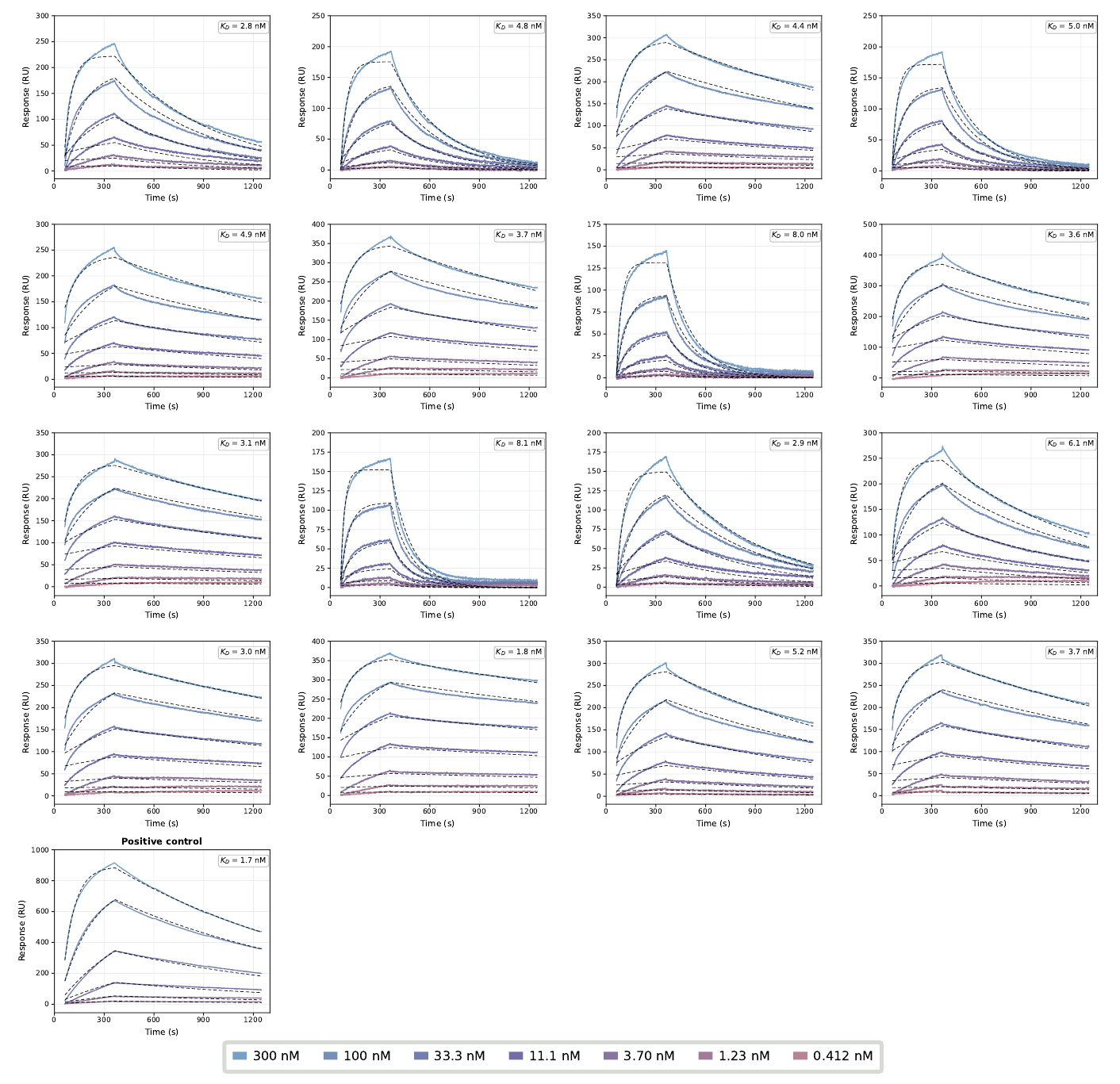
Round-two SPR response curves after experimental-feedback optimization: 16 candidates at 1.8–8.1 nM, the last plot the positive control. Anew Labs research pages, reproduced whole. [S2]
05What I learned
- Transferable insight
- The loop's value shows in round two: data re-entered the design.
- Design heuristic
- The filters decide what reaches the bench as much as the model does.
- Reading heuristic
- Different reference points flip it: absolute error vs ranking swap the models.
- Watch next
- Whether function and developability data appear, and whether the loop holds on more targets.
Closing the loop pays off in the second round.
A 14% first-round hit rate is not unusual in antibody discovery; the dividing line is whether the SPR data can be turned into targeted improvement. Affinity here improved by up to two orders of magnitude between rounds, which means the measurements actually re-entered the design rather than just being recorded. When judging systems like this, the second round carries more information than the first.
Writing the filters into the workflow matters as much as the model.
The easy-to-skip passage in the report is candidate selection: removing CDR motifs that carry deamidation, fragmentation, isomerization or glycosylation liabilities, then clustering for diversity. Those rules decide what the 50 sequences going to the bench look like, and their effect on the hit rate is not obviously smaller than the generator's.
Open models and in-house pipelines are starting to part ways.
Protenix was released publicly; AnewFold and AnewMind are, for now, parts of an internal system. After the same team spun out, raised money and acquired a pipeline of its own, what gets published shifts from model weights to a technical report. That is not unique to this company, and it is worth recording as a pattern.
As one imageTo save and share→Sources
This article draws on the Anew Labs AnewDDE technical report and the AnewDesign and AnewMind research pages, all read during this check. The spin-off round, valuation and investors come from Reuters reporting, relayed by The Next Web. Pipeline information comes from the company's own site.
- S1AnewDDE: An Agentic Drug Discovery Engine for Biomolecular Interaction Modelling and Closed-Loop DesignAnew Labs · 2026.09.17 · Company technical report, not peer reviewed
- S2AnewDesign: An Integrated Workflow for Antibody Design and OptimizationAnew Labs · 2026.09.15 · Company research page and image source
- S3AnewMind: A Scientific Reasoning LLM for Drug Discovery DecisionsAnew Labs · 2026.09.15 · Company research page
- S4Anew Labs: platform, pipelines and teamsAnew Labs · 2026.09 · Company website
- S5ByteDance's AI drug unit Anew Labs raises $290M at $1.5B valuation, Reuters reportsThe Next Web, reporting Reuters · 2026.09.16 · Outside reporting