

Lab & Tooling Brief· Evidence · Frontier
Claude Makes Biomolecular Models Faster and More Memory-Efficient: Optimizing Scientific Tools, Not Only Using Them
At Anthropic, an internal research model rewrote the inference paths of more than 30 open-source biology models in under four weeks, roughly 4x faster on average, with all 36 kits open-sourced. What changed is not one model's capability but the unit cost of this computation for everyone.
◐Company technical report + open code + public baselines
Current boundary: What is shown is engineering and access; the wet-lab half waits on the Adaptyv competition
This work advances: Has an agent rewrite the implementation of scientific software, cutting the unit cost of structure prediction and protein design
- MODELUnderstand / predict
- DECIDEChoose next
- INTERACTTest against reality
- UPDATEChange next round
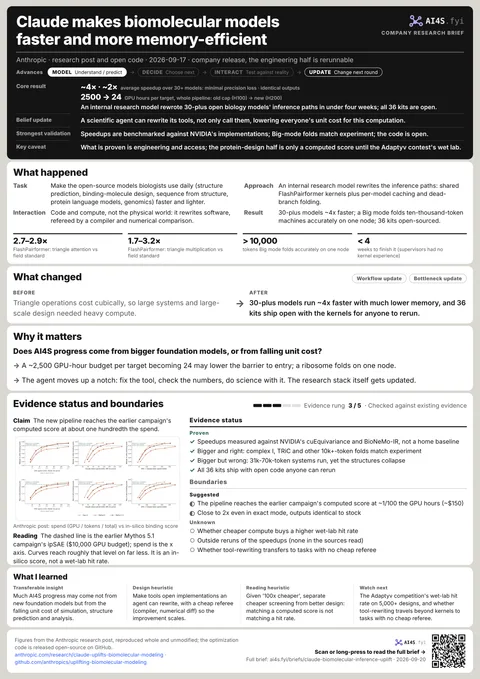
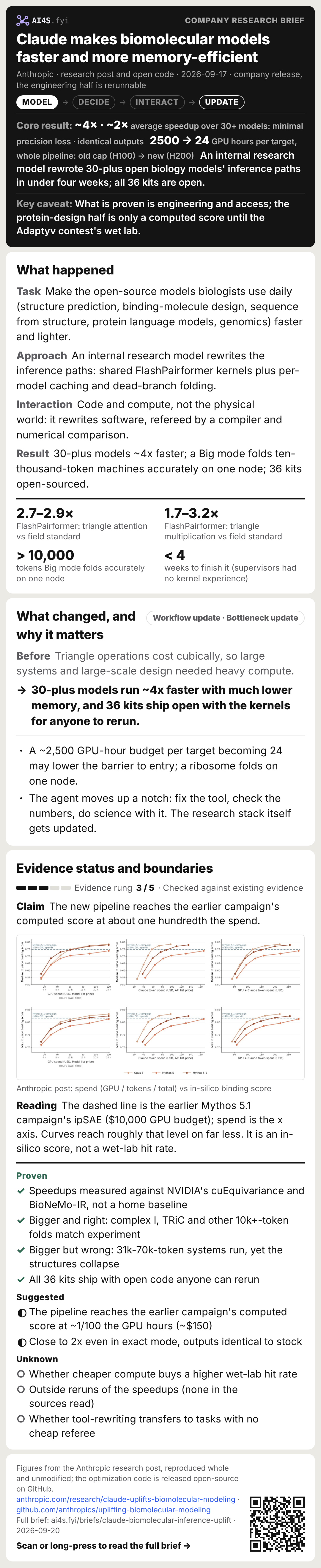
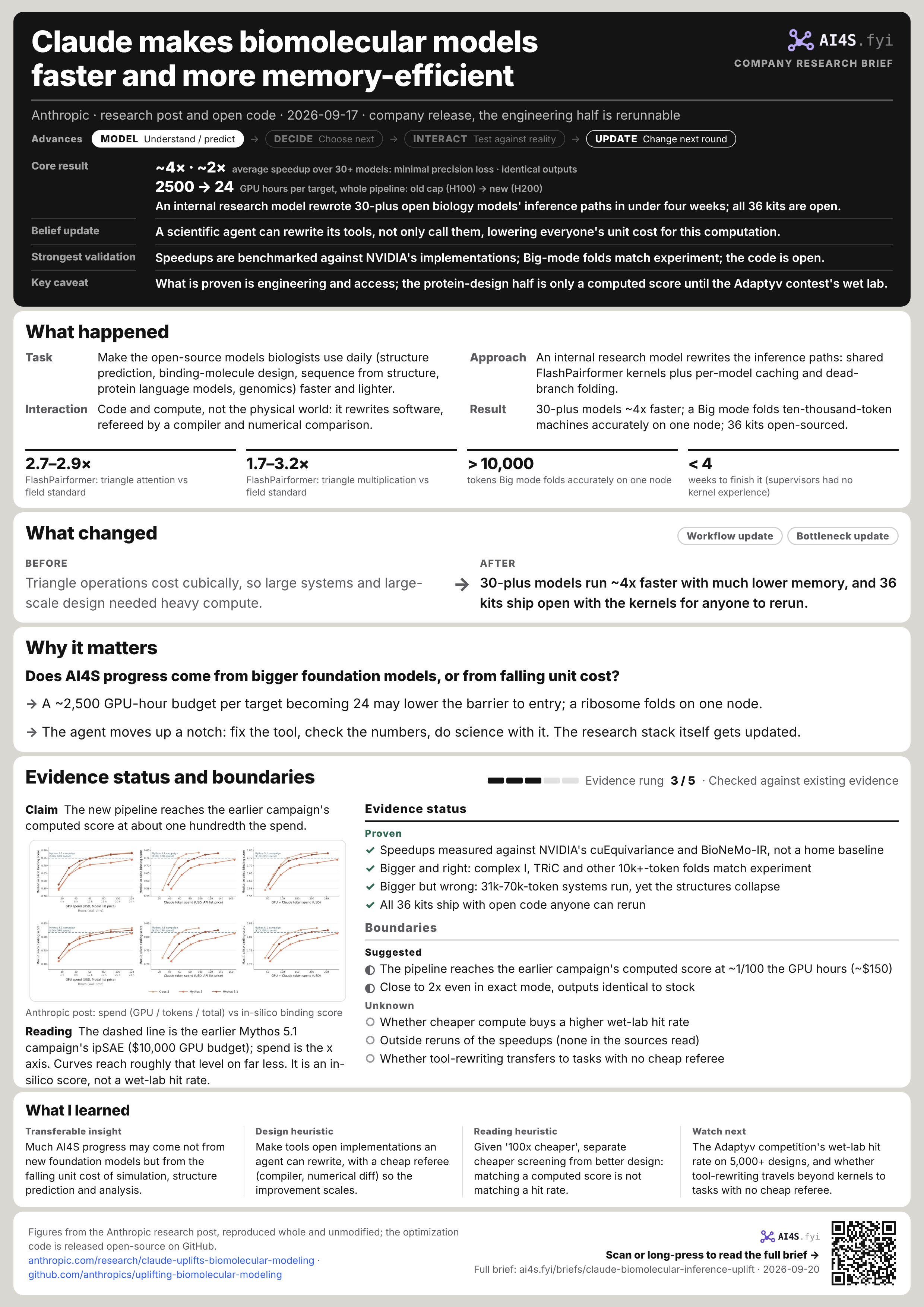
~4× · ~2×average speedup over 30+ models: minimal precision loss · identical outputs
2500 → 24GPU hours per target, whole pipeline: old cap (H100) → new (H200)
An internal research model rewrote 30-plus open biology models' inference paths in under four weeks; all 36 kits are open.
- Belief update
- A scientific agent can rewrite its tools, not only call them, lowering everyone's unit cost for this computation.
- Strongest validation
- Speedups are benchmarked against NVIDIA's implementations; Big-mode folds match experiment; the code is open.
- Key caveat
- What is proven is engineering and access; the protein-design half is only a computed score until the Adaptyv contest's wet lab.
01What happened
- Task
- Make the open-source models biologists use daily (structure prediction, binding-molecule design, sequence from structure, protein language models, genomics) faster and lighter.
- Approach
- An internal research model rewrites the inference paths: shared FlashPairformer kernels plus per-model caching and dead-branch folding.
- Interaction
- Code and compute, not the physical world: it rewrites software, refereed by a compiler and numerical comparison.
- Result
- 30-plus models ~4x faster; a Big mode folds ten-thousand-token machines accurately on one node; 36 kits open-sourced.
2.7–2.9×FlashPairformer: triangle attention vs field standard
1.7–3.2×FlashPairformer: triangle multiplication vs field standard
> 10,000tokens Big mode folds accurately on one node
< 4weeks to finish it (supervisors had no kernel experience)
On September 17, 2026, Anthropic published "How Claude is uplifting biomolecular modeling". The content is an engineering job: an internal general-purpose research model, working inside Claude Science, was pointed at the inference paths of the open-source models biologists use daily: structure prediction and cofolding, binder design, inverse folding, protein language models, genomics. More than 30 models, under four weeks, roughly 4x faster on average, and close to 2x when outputs must match the original implementation exactly.[S1]
Two details are worth holding onto. The first is who supervised it: two members of Anthropic's technical staff experienced in biomolecular modeling but with no prior background in inference optimization or kernel engineering. The second is the shape of the delivery: not a paper plus a demo, but 36 drop-in optimization kits, one per upstream tool, published on GitHub, each offering three modes: exact (outputs identical to stock), fast (small numeric differences, usually the default) and big (lowest peak memory for large inputs).[S1][S2]
Anthropic also announced a protein design competition co-sponsored with Adaptyv Bio: five frontier problems (species cross-reactivity, pH sensitivity, peptide-MHC specificity, and hard targets such as GPCRs), with wet-lab validation promised for more than 5,000 community-submitted designs, up to $1M in Claude credits, $250,000 in Modal compute and DNA from Twist Bioscience.[S1]
02What changed
Workflow updateBottleneck updateTriangle operations cost cubically, so large systems and large-scale design needed heavy compute.
30-plus models run ~4x faster with much lower memory, and 36 kits ship open with the kernels for anyone to rerun.
The bottleneck is in the triangle operations
In structure models of the AlphaFold3, OpenFold3 and Boltz-2 family, most of the runtime and memory goes into two operations: triangle attention and triangle multiplication. They act on triplets of tokens, which is how the model expresses geometry, and they cost cubically in both time and memory: double the system and you pay eight times; triple it and you pay twenty-seven.[S1]
Writing kernels is the standard way to cut that cost, and NVIDIA's cuEquivariance and later BioNeMo Inference Runtime exist for exactly this. FlashPairformer, built with Claude, is a set of custom kernels for those two operations: against that field standard it is 2.7-2.9x faster on triangle attention and 1.7-3.2x on triangle multiplication, depending on configuration. On top of that shared layer, Claude was pointed at each model for specific work: caching redundant recomputation, folding dead branches into their constant outputs. Together these make the structure-prediction models about 4x faster.[S1]
The second piece is memory. The low-memory Big mode Claude created lets systems above 10,000 tokens be predicted accurately on a single GPU node. Machines folded this way include human mitochondrial complex I, the TRiC chaperone complex, a proteasome and a bacterial ribosome, each closely matching its experimentally determined structure. For scale, the 40S ribosome AlphaFold3 predicted accurately was 7,663 tokens.[S1]
The same score, a hundredth of the compute
The clearest consequence of the optimizations shows up against Anthropic's own earlier binder-design work. That run gave Claude an approximately 16,000-word prompt, permission to spawn sub-agents, and up to $10,000 per target on Modal (roughly 2,500 H100 GPU hours) within 24 hours. The 2,500 hours is a spending cap, not measured use.[S1]
This time the conditions were much tighter: a single Claude model, one H200, 24 hours of wall time, a prompt of about 1,100 words plus a reference sheet for pre-installed tools, no sub-agents and no human steering the designs. Three models (Mythos 5.1, Mythos 5 and Opus 5) ran against 16 targets, scored by ipSAE, an in-silico measure shown to be predictive of wet-lab binding. Averaged over the 16 targets, the median and top-scoring designs reach roughly the same ipSAE as the earlier campaign, using about two orders of magnitude fewer GPU hours: around $150 for GPUs and tokens combined. This compares two whole pipelines: the hardware (H100 to H200), the prompt, the agent setup (no sub-agents) and the design workflow all changed, and Anthropic itself attributes the result to the accelerated models combined with simplifications to its earlier design approach. It is not a roughly 100x kernel speedup under one configuration; the speedup from the kernels and per-model work is the ~4x average (near 2x with identical outputs) above.[S1]
The scope of that sentence matters: what matches is the in-silico score, not a wet-lab hit rate. ipSAE correlates with experimental binding, but correlation is not equivalence, and no new experimental data accompanies this result.[S1]
03Why it matters
Does AI4S progress come from bigger foundation models, or from falling unit cost?
- A ~2,500 GPU-hour budget per target becoming 24 may lower the barrier to entry; a ribosome folds on one node.
- The agent moves up a notch: fix the tool, check the numbers, do science with it. The research stack itself gets updated.
The role of a scientific agent moves one notch here. Most demonstrations so far have the model read the literature, pick candidates, call the tools and interpret results, with the tools taken as given. This one runs in a different order: find the bottleneck in the tool, change the implementation, check that the numbers still hold, then do science with the faster tool. In this site's framework that is also an Update, except what gets updated is the research stack rather than a hypothesis or a world model.[S1]
Unit cost is an under-discussed variable in AI for Science. A binder-design pipeline going from a cap of about 2,500 GPU hours per target to 24 (a whole-pipeline comparison, not the kernels alone) may lower the barrier to this kind of computation; how many more labs can now afford it has not been surveyed. Folding a ribosome on one node takes a class of structural-biology problems off multi-node clusters. If this kind of optimization keeps going, a lot of progress may come not from new foundation models but from the falling unit cost of simulation, structure prediction, analysis and experiment planning.[S1]
One more thing sets this apart from most lab claims: it is open. The 36 kits ship with their code, the baselines are NVIDIA's own implementations, and anyone can rerun the speedups on their own machine. The claim and the means to check it arrived together, which is not common in recent company releases.[S1][S2]
04Evidence status and boundaries
Evidence rung 3 / 5 · Checked against existing evidence · Retrospective or simulatedEvidence status
Proven
- Speedups measured against NVIDIA's cuEquivariance and BioNeMo-IR, not a home baseline
- Bigger and right: complex I, TRiC and other 10k+-token folds match experiment
- Bigger but wrong: 31k-70k-token systems run, yet the structures collapse
- All 36 kits ship with open code anyone can rerun
Boundaries
Suggested
- The pipeline reaches the earlier campaign's computed score at ~1/100 the GPU hours (~$150)
- Close to 2x even in exact mode, outputs identical to stock
Unknown
- Whether cheaper compute buys a higher wet-lab hit rate
- Outside reruns of the speedups (none in the sources read)
- Whether tool-rewriting transfers to tasks with no cheap referee
ClaimThe new pipeline reaches the earlier campaign's computed score at about one hundredth the spend.
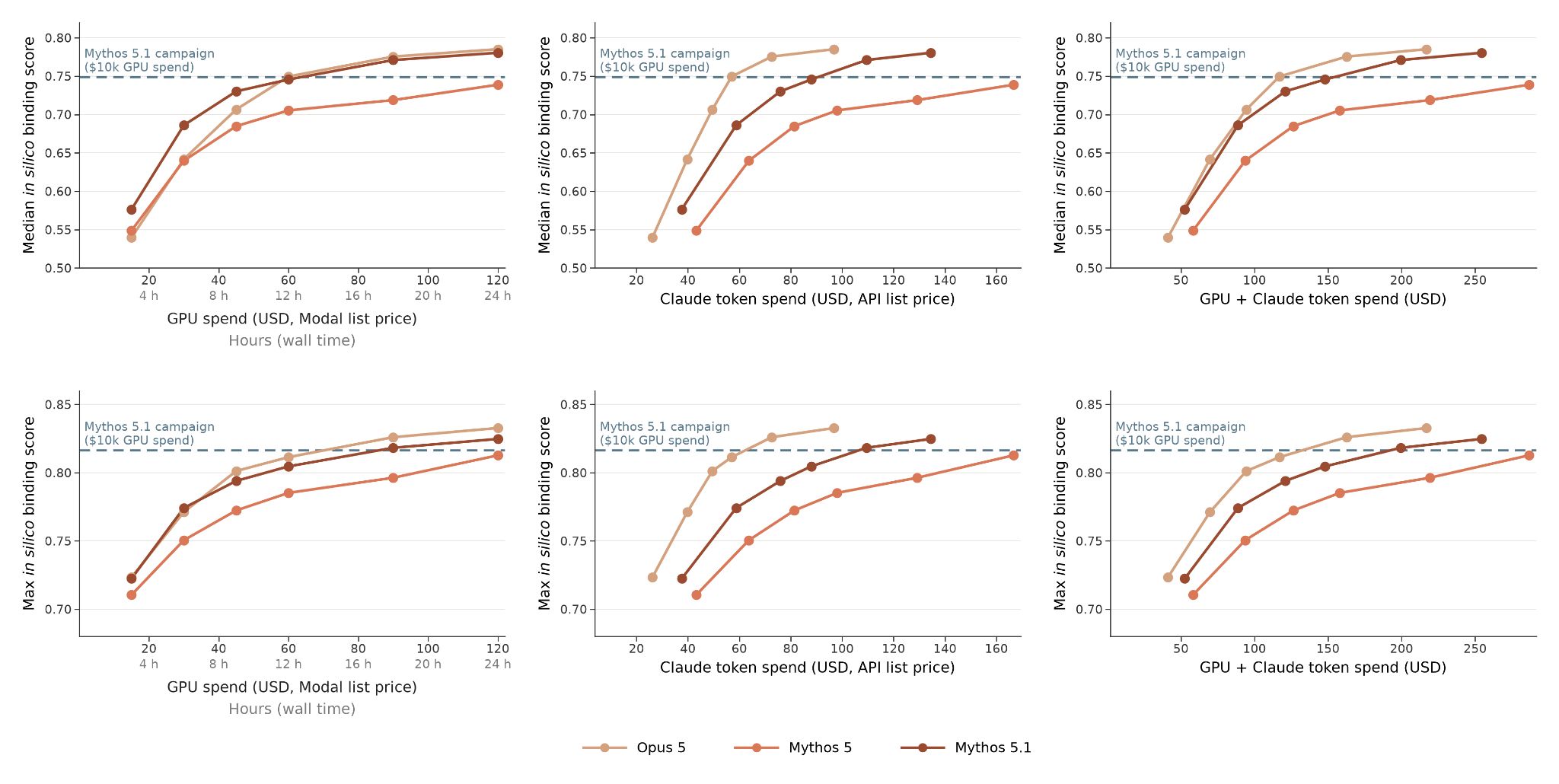
ReadingThe dashed line is the earlier Mythos 5.1 campaign's ipSAE ($10,000 GPU budget); spend is the x axis. Curves reach roughly that level on far less. It is an in-silico score, not a wet-lab hit rate.
The engineering half is checkable.
The speedups are measured against NVIDIA's cuEquivariance and BioNeMo-IR rather than a home-made baseline; the complex I, TRiC, proteasome and ribosome folded in Big mode are compared with experimentally determined structures; the code is open. This part outsiders can verify themselves, which is rare in a company release.[S1][S2]
The larger systems run, but they do not come out right.
On viral capsids and protein compartments of 31,000 to 70,000 tokens, inference completes on a single 8-GPU B300 node but the predicted structures collapse. Anthropic states this plainly: those systems are nearly two orders of magnitude beyond the models' training context, and what moved is the memory wall, not the models' generalization.[S1]
The protein-design conclusion is currently an in-silico score.
Reaching the earlier ipSAE level at about a hundredth of the GPU hours is a conclusion about whole-pipeline cost, not about hit rate. The Adaptyv competition promises wet-lab validation for more than 5,000 designs; only when that data lands does the cost chain connect to physical feedback.[S1]
Kernel optimization is a task with a cheap referee.
Part of why this finished in four weeks is that the task is well posed: whether the output is right has a compiler and a numerical comparison as referee, and whether it is faster has a benchmark. Most scientific problems have no such referee, so an agent that can rewrite tools does not immediately imply an agent that can rewrite science.
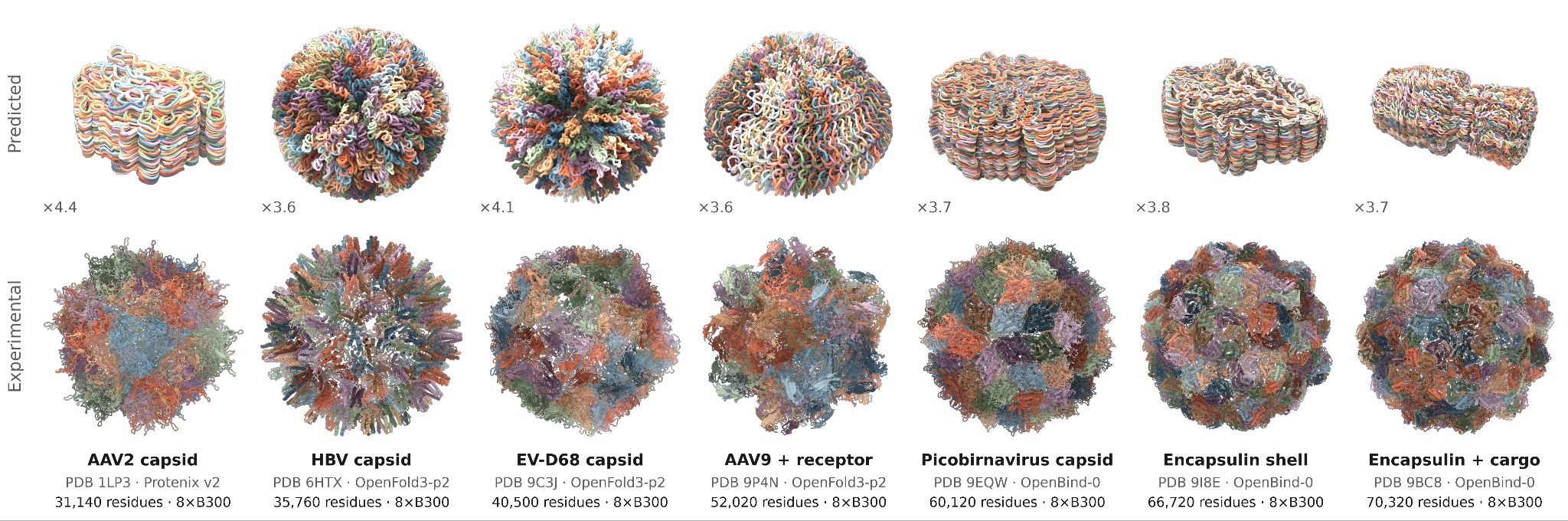
A figure from the Anthropic post, unmodified. It shows the boundary: on a single 8-GPU B300 node, viral capsids and protein compartments from 31,140 to 70,320 residues complete inference (predictions on top, experimental structures below), but the predictions clearly collapse. The memory wall moved; the models did not generalize to that scale. [S1]
05What I learned
- Transferable insight
- Much AI4S progress may come not from new foundation models but from the falling unit cost of simulation, structure prediction and analysis.
- Design heuristic
- Make tools open implementations an agent can rewrite, with a cheap referee (compiler, numerical diff) so the improvement scales.
- Reading heuristic
- Given '100x cheaper', separate cheaper screening from better design: matching a computed score is not matching a hit rate.
- Watch next
- The Adaptyv competition's wet-lab hit rate on 5,000+ designs, and whether tool-rewriting travels beyond kernels to tasks with no cheap referee.
Hit rates from the Adaptyv competition.
Wet-lab results for more than 5,000 community designs are the first real data connecting cheaper compute to more discovery. If hit rates hold as entrants' compute budgets shrink, the chain closes; if they do not, what got cheaper was screening rather than design quality.
Whether this travels beyond kernels.
The next thing worth watching is the same approach applied where verification is not cheap: experiment planning, data pipelines, choosing simulation parameters. There is no compiler to referee those, which is exactly what would test whether tool-rewriting is a general capability or a good fit for one well-posed class of task.
As one imageTo save and share→Sources
This article draws on Anthropic's research post of September 17, 2026, read in full at source, with the count of 36 kits and the three modes taken from the README of its GitHub repository. The figures are the post's own, unmodified. The technical report itself was not read page by page during this check.