

Program Portfolio Brief · 02· Context · Frontier
Genesis Mission Portfolio II: From Autonomous Labs to Scientific Infrastructure
Twenty-two projects led by Berkeley Lab and Oak Ridge show how AI is entering materials experiments, Earth systems, digital twins, scientific software and research operations.
○Selected for award negotiations. Public materials mainly describe workflows to be developed and demonstrated, not completed technical results
Context · Frontier
It records the institutional and resource context for autonomous experimentation entering national laboratories.
Series Context
Genesis Mission series | DOE's first selections, read in three laboratory portfolios
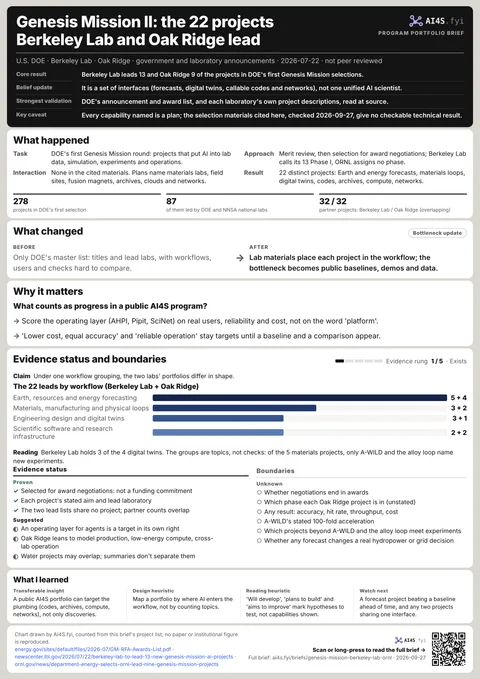
Berkeley Lab leads 13 and Oak Ridge 9 of the projects in DOE's first Genesis Mission selections.
- Belief update
- It is a set of interfaces (forecasts, digital twins, callable codes and networks), not one unified AI scientist.
- Strongest validation
- DOE's announcement and award list, and each laboratory's own project descriptions, read at source.
- Key caveat
- Every capability named is a plan; the selection materials cited here, checked 2026-09-27, give no checkable technical result.
01What happened
- Task
- DOE's first Genesis Mission round: projects that put AI into lab data, simulation, experiments and operations.
- Approach
- Merit review, then selection for award negotiations; Berkeley Lab calls its 13 Phase I, ORNL assigns no phase.
- Interaction
- None in the cited materials. Plans name materials labs, field sites, fusion magnets, archives, clouds and networks.
- Result
- 22 distinct projects: Earth and energy forecasts, materials loops, digital twins, codes, archives, compute, networks.
278projects in DOE's first selection
87of them led by DOE and NNSA national labs
32 / 32partner projects: Berkeley Lab / Oak Ridge (overlapping)
First separate selection, plans and results
On July 22, 2026, the U.S. Department of Energy announced 278 projects selected for Genesis Mission award negotiations. Berkeley Lab says it will lead 13 and participate in more than 30 others (its projects page says 32); Oak Ridge National Laboratory will lead nine and contribute to another 32. The two lead lists contain 22 distinct projects. Participation counts should not be added, however, because collaborations overlap. Oak Ridge, for example, participates in Berkeley Lab's AHPI project.[S1][S4][S6][S7]
Selection for award negotiations is not a commitment to fund, and negotiations may still be cancelled; part I of this series covers that and the Phase I and Phase II framework, so it is not repeated here. What is particular to this pair: Berkeley Lab identifies its 13 projects as Phase I, while the Oak Ridge release assigns no phase and neither does DOE's list, so the 22 should not be treated as one uniform phase. Phrases such as will develop, plans to build and aims to improve describe hypotheses to test, not demonstrated capabilities.[S1][S3][S4][S6]
The DOE announcement says 87 of the 278 are led by DOE and NNSA national laboratories; part I of this series gives the rest of the breakdown.[S1]
The two laboratories reveal different capability structures
Berkeley Lab's portfolio concentrates on materials experiments, subsurface systems, water, nuclear waste and domain-specific digital twins. The A-WILD autonomous materials laboratory and the complex-alloy loop sit closest to physical experimentation. Three distinct water and water-energy projects, two nuclear-waste projects and several subsurface projects draw on long-running data, domain simulation codes and national user facilities.[S4][S5][S2]
Oak Ridge combines fusion, materials and Earth systems with a stronger emphasis on model production, low-energy computing and cross-institution operation. Pipit is conceived as a foundation-model factory for materials and manufacturing. SciNet focuses on network coordination for agents and scientific workflows across institutions. The neuromorphic project puts energy, speed and accuracy into one evaluation problem. The American Science Cloud and the Lux supercomputer under installation provide context and infrastructure, but they are not completed results from the nine lead projects.[S6][S2]
Placing 22 projects back into the scientific workflow
Reading the institutional lists project by project emphasizes topic counts. Reordering them by workflow reveals four clearer routes: producing actionable forecasts for Earth and resource systems; connecting models to materials experiments and manufacturing; using digital twins for costly, high-consequence engineering; and building an operating layer through which scientific agents can call codes, archives, models, compute and networks. The next-evidence column is not a promised deliverable. It identifies what would be most useful for evaluating each claim.[S5][S6][S2]
02What changed
Bottleneck updateOnly DOE's master list: titles and lead labs, with workflows, users and checks hard to compare.
Lab materials place each project in the workflow; the bottleneck becomes public baselines, demos and data.
The most revealing aspect of these 22 Berkeley Lab and Oak Ridge projects is not the count but where AI is being inserted into scientific work. Some projects connect models to materials experiments, some build digital twins or Earth-system forecasts, and others aim to make scientific codes, archives, compute and cross-institution networks callable infrastructure for agents. This is not one unified AI scientist. It is a set of interfaces distributed across data, simulation, experiment and research operations. The public record still consists mainly of project plans and institutional announcements, so it is too early to know whether those interfaces work in practice.
Before
Only titles and lead institutions were visible in the master list.
Bottleneck
Workflows, users and verification paths were difficult to compare.
What changed
Institutional materials for thirteen Berkeley Lab and nine Oak Ridge projects clarified twenty-two technical paths.
New bottleneck
Turning planned targets into public baselines, real demonstrations and operating data.
What remains unsolved
Whether vertical projects interoperate and move from model accuracy to experimental and manufacturing outcomes.
03Why it matters
What counts as progress in a public AI4S program?
- Score the operating layer (AHPI, Pipit, SciNet) on real users, reliability and cost, not on the word 'platform'.
- 'Lower cost, equal accuracy' and 'reliable operation' stay targets until a baseline and a comparison appear.
Three signals from the portfolio
First, part of the Genesis Mission portfolio is not directly searching for a material or predicting a phenomenon. It is building the operating layer through which future scientific agents might safely call data, models, codes, compute, networks and facilities. AHPI, Pipit, SciNet and neuromorphic computing look more like scientific AI infrastructure. They may determine whether closed loops can scale across institutions and facilities, but their value still needs evidence from real users, reliability and cost.
Second, the concentration of water, subsurface, materials and fusion projects shows where investment is focused, not that these approaches already work. Public summaries do not yet clearly distinguish data, spatial scale, time horizon and users across Berkeley Lab's three water-related projects, HydroORBIT and the TVA forecasting project. Shared benchmarks, interfaces and data will matter more than whether project titles sound similar.[S5][S6][S2]
Third, the integrated science discovery platform currently looks more like a set of proposed interfaces connecting data, models, instruments and supercomputing facilities than a finished unified system. The real test is whether these vertical projects interoperate, create experimental or operational feedback, and move success metrics beyond model accuracy toward throughput, facility stability, manufacturing outcomes or scientific discovery.
04Evidence status and boundaries
Evidence rung 1 / 5 · ExistsEvidence status
Proven
- Selected for award negotiations: not a funding commitment
- Each project's stated aim and lead laboratory
- The two lead lists share no project; partner counts overlap
Boundaries
Suggested
- An operating layer for agents is a target in its own right
- Oak Ridge leans to model production, low-energy compute, cross-lab operation
- Water projects may overlap; summaries don't separate them
Unknown
- Whether negotiations end in awards
- Which phase each Oak Ridge project is in (unstated)
- Any result: accuracy, hit rate, throughput, cost
- A-WILD's stated 100-fold acceleration
- Which projects beyond A-WILD and the alloy loop meet experiments
- Whether any forecast changes a real hydropower or grid decision
ClaimUnder one workflow grouping, the two labs' portfolios differ in shape.
The 22 leads by workflow (Berkeley Lab + Oak Ridge)
ReadingBerkeley Lab holds 3 of the 4 digital twins. The groups are topics, not checks: of the 5 materials projects, only A-WILD and the alloy loop name new experiments.
Why the rung is 1, Exists.
What exists is a selection and a set of project descriptions: DOE's announcement and award list, and the two laboratories' releases and project pages. Checked on 2026-09-27, those materials give no checkable technical result from these projects: no system run in public, no forecast, experiment or measurement to check. That says nothing against the teams' earlier published research. On this site's ladder it shows only that something was announced; the projects existing is not evidence that any of the technologies works.[S1][S2][S4][S5][S6]
How the chart was counted.
Counted by category from this brief's project list, each category split by lead lab: Earth, resources and energy forecasting nine (Berkeley Lab 5, Oak Ridge 4); materials, manufacturing and physical loops five (3, 2); engineering design and digital twins four (3, 1); scientific software and research infrastructure four (2, 2). The categories are this site's topic grouping, not DOE's or either lab's, and they are not a count of how each project will be checked. Within materials, Pipit is a model factory, the excited-state project is mainly many-body simulation plus AI, and SMART-AI describes combining experimental data, computational thermodynamics and structural descriptors; only A-WILD (robotic experiments in the A-Lab) and the alloy loop (rapid synthesis and 4D-STEM) name new experiments on their pages. Conversely, the fusion-magnet project, grouped with digital twins, says it will combine models and measurements. Which projects meet physical feedback has to be read project by project, not inferred from a category count.[S5][S6][S2]
05What I learned
- Transferable insight
- A public AI4S portfolio can target the plumbing (codes, archives, compute, networks), not only discoveries.
- Design heuristic
- Map a portfolio by where AI enters the workflow, not by counting topics.
- Reading heuristic
- 'Will develop', 'plans to build' and 'aims to improve' mark hypotheses to test, not capabilities shown.
- Watch next
- A forecast project beating a baseline ahead of time, and any two projects sharing one interface.
The AI4S platform layer is becoming concrete
Projects such as AHPI, Pipit and SciNet do not directly discover a material. They build interfaces through which models call codes, compute, networks and facilities. That infrastructure may matter, but real users, reliability and cost (not the word platform) must demonstrate it.
Similar themes do not necessarily mean duplicate approaches
Water, materials and fusion projects may look similar while using different data, time horizons and decision targets. The useful next step is not recounting projects but comparing shared benchmarks, interfaces and physical validation.
What evidence would change the view
Physical-loop projects need end-to-end demonstrations, clear autonomy boundaries, experimental throughput, hit rates and measured material properties. Forecasts and digital twins need prospective validation, calibrated uncertainty, transfer across sites and evidence from real operating decisions. Infrastructure projects need public software or interfaces, cross-institution tasks, reliability, security, energy measurements and real users. Claims of hundred-fold acceleration, lower cost with equivalent accuracy or reliable operation should remain targets until those baselines and comparisons appear.
Until those results appear, the 22 projects are best read as a map of research hypotheses. They show which data, facilities and engineering capabilities national laboratories plan to connect to AI, while creating specific points at which later evidence can be checked.
As one imageTo save and share→Sources
Factual claims link to original announcements, project lists, trial records or journal papers where possible. Research plans are kept separate from completed results.
- S1First 278 Genesis Mission projects selectedU.S. Department of Energy · 2026.07.22 · Government program announcement
- S2Official list of the first Genesis Mission RFA selectionsU.S. Department of Energy · 2026.07.22 · Official project list
- S3Genesis Mission Phase I and Phase II funding frameworkU.S. Department of Energy · 2026.03.17 · Government RFA announcement
- S4Berkeley Lab to lead 13 Genesis Mission projectsLawrence Berkeley National Laboratory · 2026.07.22 · Institutional announcement
- S5Berkeley Lab's detailed pages for 13 projectsLawrence Berkeley National Laboratory · 2026.07 · Institutional project descriptions
- S6Oak Ridge selected to lead nine Genesis Mission projectsOak Ridge National Laboratory · 2026.07.23 · Institutional announcement
- S7Oak Ridge lead and participating project listOak Ridge National Laboratory · 2026.07 · Institutional project relationship list