

Program Portfolio Brief · 03· Context · Frontier
Genesis Mission Portfolio III: Sixteen AI for Science Workflows at PNNL
PNNL's projects selected for the DOE Genesis Mission: from tuning quantum instruments and modeling subsurface energy and water to manufacturing twins, nuclear-waste knowledge systems and distributed scientific workflows.
○PNNL lists sixteen Phase I lead projects and participation in twenty-six others. DOE's program notice retains its award-negotiation condition, and the public record is mainly plans, targets and metrics still to be tested
Context · Frontier
It records how energy and materials AI workflows are organized as a program portfolio.
Series Context
Genesis Mission series | DOE's first selections, read in three laboratory portfolios
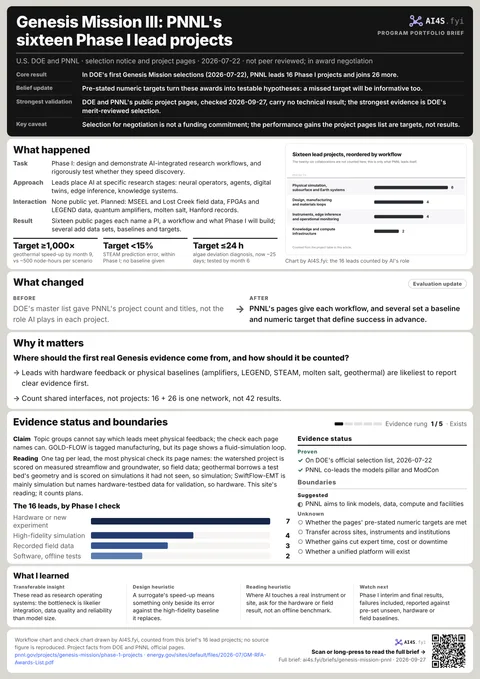
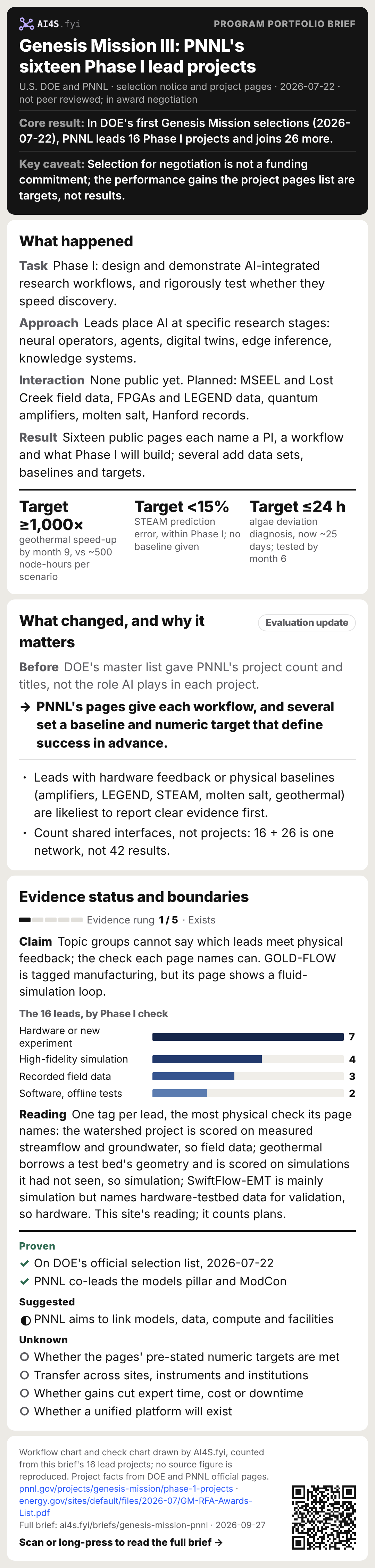
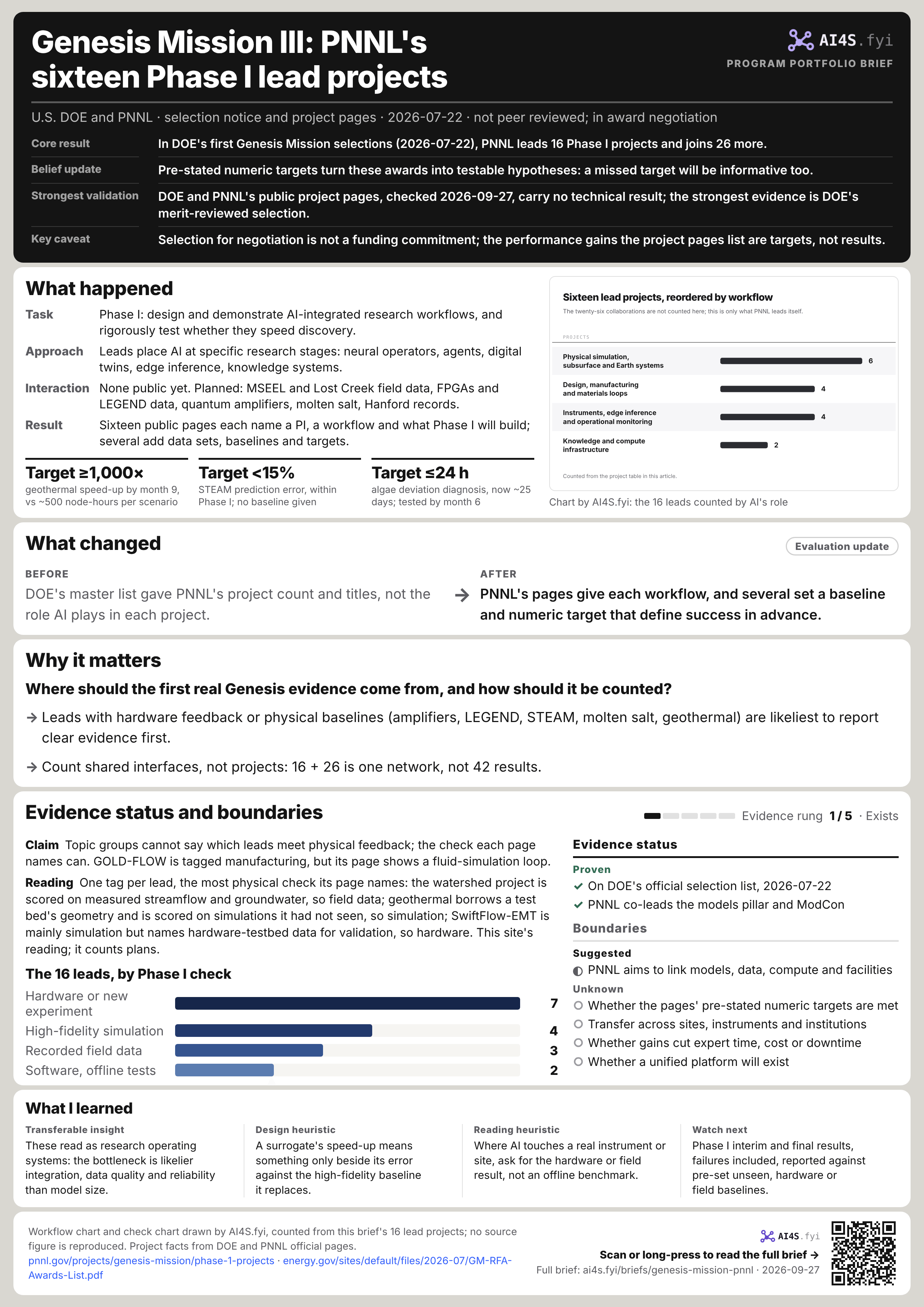
In DOE's first Genesis Mission selections (2026-07-22), PNNL leads 16 Phase I projects and joins 26 more.
- Belief update
- Pre-stated numeric targets turn these awards into testable hypotheses: a missed target will be informative too.
- Strongest validation
- DOE and PNNL's public project pages, checked 2026-09-27, carry no technical result; the strongest evidence is DOE's merit-reviewed selection.
- Key caveat
- Selection for negotiation is not a funding commitment; the performance gains the project pages list are targets, not results.
01What happened
- Task
- Phase I: design and demonstrate AI-integrated research workflows, and rigorously test whether they speed discovery.
- Approach
- Leads place AI at specific research stages: neural operators, agents, digital twins, edge inference, knowledge systems.
- Interaction
- None public yet. Planned: MSEEL and Lost Creek field data, FPGAs and LEGEND data, quantum amplifiers, molten salt, Hanford records.
- Result
- Sixteen public pages each name a PI, a workflow and what Phase I will build; several add data sets, baselines and targets.
Target ≥1,000×geothermal speed-up by month 9, vs ~500 node-hours per scenario
Target <15%STEAM prediction error, within Phase I; no baseline given
Target ≤24 halgae deviation diagnosis, now ~25 days; tested by month 6
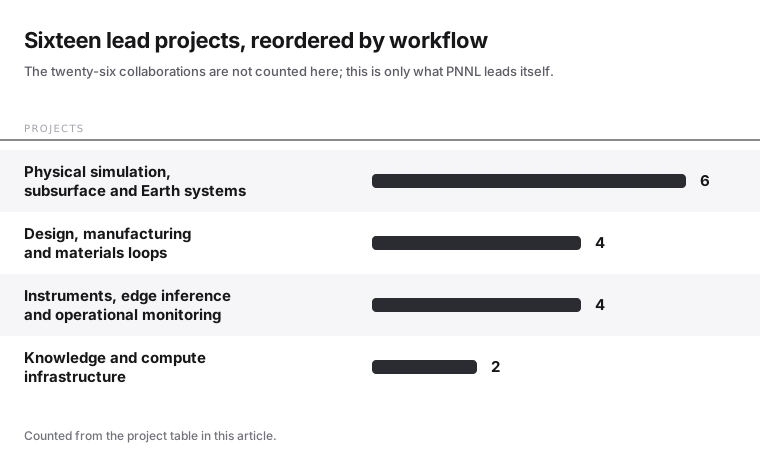
First separate sixteen lead projects from twenty-six collaborations
PNNL says it leads sixteen Phase I projects in the first Genesis Mission selections and contributes to another twenty-six led by universities, companies or other national laboratories, for forty-two relationships in total. This brief maps only the sixteen PNNL-led projects. The other twenty-six help describe the collaboration network, but they are not additional PNNL-led projects and should not be counted as such.[S3][S4][S2]
PNNL's role is broader than its project count
PNNL also co-leads the Genesis Mission's Models pillar and names staff responsible for model capabilities, baseline capabilities and commercial-cloud integration across the Transformational AI Models Consortium and American Science Cloud. These institutional roles help explain why its portfolio includes both domain science and operating-layer projects such as PORTUS and WASTECHAT. They show an intention to connect models, data, compute and facilities, not that a unified platform already exists.[S5]
Placing sixteen projects back into the scientific workflow
An application-by-application list quickly becomes unwieldy. Reordering the projects by the role AI plays produces four groups: surrogates and agents for subsurface and Earth systems; design, manufacturing and materials loops; instruments, edge inference and operational monitoring; and knowledge and compute infrastructure. Each row also carries what the project is checked against (see section 04). The next-evidence column identifies what would help evaluate its target. It is not a completed or promised public deliverable.[S4][S2]
02What changed
Evaluation updateDOE's master list gave PNNL's project count and titles, not the role AI plays in each project.
PNNL's pages give each workflow, and several set a baseline and numeric target that define success in advance.
Not one general AI scientist
PNNL's sixteen lead projects do not revolve around one general AI scientist. They insert different forms of AI into specific stages of research: neural operators stand in for costly simulations, agents orchestrate models and experiments, digital twins connect sensors to engineering decisions, edge models enter physical instruments, and knowledge systems organize decades of nuclear-waste records. PNNL's project descriptions are unusually specific about Phase I data sets, baselines and performance targets, which should make later verification easier. Those numbers are still targets, not completed results.[S4]
A visible common thread is the use of physical constraints, established scientific codes, real sensors and expert review. In most proposals AI does not replace high-fidelity simulation or scientists. It screens scenarios, approximates expensive computation, proposes the next action, coordinates tools or escalates uncertain cases to more costly models and human judgment.[S4]
Bottleneck
The roles of models, instruments, digital twins and research infrastructure were unclear.
New bottleneck
Reporting results against predefined hardware, field and held-out-data baselines.
What remains unsolved
Transfer across sites, cross-institution interfaces and real operating value.
03Why it matters
Where should the first real Genesis evidence come from, and how should it be counted?
- Leads with hardware feedback or physical baselines (amplifiers, LEGEND, STEAM, molten salt, geothermal) are likeliest to report clear evidence first.
- Count shared interfaces, not projects: 16 + 26 is one network, not 42 results.
Three provisional views
First, PNNL's portfolio looks more like a collection of research operating systems than a program focused only on larger models. Most proposals retain established scientific codes, experimental data and sensors, while AI compresses computation, connects tools or recommends the next action. That makes verifiers easier to define, but system integration, data quality and engineering reliability may become the main bottlenecks.
Second, the clearest near-term evidence may come from projects with hardware feedback or explicit physical baselines: quantum-amplifier tuning, LEGEND edge inference, fuel-cell manufacturing, molten-salt sensing and geothermal simulation. They can compare time, error, throughput, energy or anomaly detection directly. Cross-site transfer, scientific knowledge systems and distributed workflows will depend more heavily on longer-term use.
Third, the sixteen lead projects and twenty-six collaborations form an interface network, not forty-two independent accomplishments. The consequential question is whether workflows share data standards, model interfaces, compute and verification methods. If each remains a one-off vertical system, project count alone will not become platform capability.[S3][S5]
04Evidence status and boundaries
Evidence rung 1 / 5 · ExistsEvidence status
Proven
- On DOE's official selection list, 2026-07-22
- PNNL co-leads the models pillar and ModCon
Boundaries
Suggested
- PNNL aims to link models, data, compute and facilities
Unknown
- Whether the pages' pre-stated numeric targets are met
- Transfer across sites, instruments and institutions
- Whether gains cut expert time, cost or downtime
- Whether a unified platform will exist
ClaimTopic groups cannot say which leads meet physical feedback; the check each page names can. GOLD-FLOW is tagged manufacturing, but its page shows a fluid-simulation loop.
The 16 leads, by Phase I check
ReadingOne tag per lead, the most physical check its page names: the watershed project is scored on measured streamflow and groundwater, so field data; geothermal borrows a test bed's geometry and is scored on simulations it had not seen, so simulation; SwiftFlow-EMT is mainly simulation but names hardware-testbed data for validation, so hardware. This site's reading; it counts plans.
Why rung 1
Rung 1, Exists: what is established is the selection itself (which teams, doing what, against which targets). On DOE and PNNL's public project pages, checked 2026-09-27, none of the sixteen projects shows a computed result, instrument data or field validation from this Phase I work, so none reaches rung 2. That says nothing against the teams' earlier published research; it is simply not a result of these projects. The baselines and numeric targets on the project pages make later checking easier, but a target is not evidence.[S4][S1]
Selected for negotiation, not yet funded
PNNL calls these Phase I funding awards, while DOE's national notice also states that selection for award negotiations is not a commitment to issue funding and that negotiations may still be cancelled. The careful interpretation is that the teams have passed selection and entered the Phase I award process, while the public pages describe workflows to be developed, demonstrated and evaluated rather than completed scientific or engineering capabilities.[S1][S3]
What the portfolio's composition signals
The workflow chart counts only the sixteen PNNL leads; the twenty-six collaborations are not in it. By topic, physical simulation and Earth systems has six, design, manufacturing and materials loops four, instruments, edge inference and monitoring four, and knowledge and compute infrastructure two. Topics show the spread, not which projects meet physical feedback: the watershed project is checked against measured streamflow and groundwater heads yet sits with simulation, while GOLD-FLOW sits with manufacturing although its page describes a CFD-driven loop with CFD or experimental checks on selected designs only.[S2][S4]
So this brief gives each project a second tag for what it is checked against, one per project: the most physical check its page names. Hardware or a new experiment, seven: STEAM's new sensor-equipped tape-casting runs, synthesis and characterization of protein-vdW devices, the algae project's LEAPS pond simulator at month nine, LEAP-FWD's FPGAs, AQUA-WOLF's amplifiers at several institutions, SwiftFlow-EMT's hardware-testbed data and the molten-salt electrochemical measurements. High-fidelity simulation, four: geothermal, uranium recovery, EARL and GOLD-FLOW. Recorded field data, three: the E3SM hindcasts, the MSEEL fracture data and the measured watersheds. Software or offline tests, two: WASTECHAT and PORTUS.[S4]
The edge cases, as the pages put them. The geothermal project borrows only the geometry of the Sanford Underground Research Laboratory test bed; its Phase I check is held-out simulated scenarios, with real-time field inversion left to Phase II. Uranium recovery builds its models from Lost Creek well logs, pump tests and historical pumping records, but its performance reference is PFLOTRAN simulation. SwiftFlow-EMT is mainly electromagnetic-transient simulation, supplemented by hardware-testbed data. The E3SM project is checked on the forecast skill of multi-year hindcasts against independent test data. The tags count plans, not results, and they are this site's reading, not PNNL's.[S4]
Numeric targets improve testability, but they remain targets
PNNL's detailed pages provide several trackable metrics. The geothermal neural-operator project targets at least a 100-fold wall-clock speedup by month six and 1,000-fold by month nine. STEAM targets prediction error below 15 percent. The algae project aims to reduce productivity-deviation diagnosis from about twenty-five days to under twenty-four hours and lower seven-day forecast error by at least 30 percent. These numbers are valuable because they define success in advance. They must not yet be reported as achieved results.[S4]
Later verification must look beyond a single accuracy number. Surrogate speedups need errors against high-fidelity baselines. Agentic workflows need explicit tool-calling and human-escalation rules. Instrument control must remain stable on real hardware. Digital twins need evidence that their recommendations improve field or manufacturing decisions. Speed without physical consistency, or an offline benchmark without an operating loop, is not enough.
05What I learned
- Transferable insight
- These read as research operating systems: the bottleneck is likelier integration, data quality and reliability than model size.
- Design heuristic
- A surrogate's speed-up means something only beside its error against the high-fidelity baseline it replaces.
- Reading heuristic
- Where AI touches a real instrument or site, ask for the hardware or field result, not an offline benchmark.
- Watch next
- Phase I interim and final results, failures included, reported against pre-set unseen, hardware or field baselines.
PNNL's portfolio resembles research operating systems
Many projects retain established scientific codes, experimental data and sensors while AI compresses computation, connects tools or recommends the next action. The easy-to-miss risks are system integration, data quality and engineering reliability, not model size alone.
Specific targets make failure informative
Targets such as 100-fold speedup, 15% error or diagnosis within 24 hours are not yet results, but they define success in advance. If later results use the same baselines, missed targets will also reveal the real boundary of each approach.
What evidence would change the view
The first evidence layer is Phase I interim and final results: success and failure reported against predefined held-out data, hardware or field baselines, not only demonstration videos. The second is reuse: whether another team can run the software, data, interfaces and models on another instrument, site or resource configuration. The third is operating value: whether gains in speed and accuracy reduce expert time, experimental cost, facility downtime, manufacturing defects or decision risk.
Until those results appear, PNNL's sixteen projects are best treated as a relatively well-specified set of research hypotheses. They tell us where to look for the next evidence and make failure or missed targets informative too.
As one imageTo save and share→Sources
Factual claims link to original announcements, project lists, trial records or journal papers where possible. Research plans are kept separate from completed results.
- S1First 278 Genesis Mission projects selectedU.S. Department of Energy · 2026.07.22 · Government program announcement
- S2Official list of the first Genesis Mission RFA selectionsU.S. Department of Energy · 2026.07.22 · Official project list
- S3PNNL leads sixteen and participates in twenty-six Genesis Mission projectsPacific Northwest National Laboratory · 2026.07.22 · Institutional announcement
- S4PNNL Genesis Mission projects and Phase I targetsPacific Northwest National Laboratory · 2026.07 · Institutional project descriptions
- S5PNNL roles in the Models pillar, ModCon and the American Science CloudPacific Northwest National Laboratory · 2026 · Institutional program overview