

Program Portfolio Brief · 01· Context · Frontier
Where Is AI Entering the Scientific Workflow?
Twelve distinct projects involving Brookhaven and Stony Brook show how models are being connected to hypotheses, instruments, experiments, computing infrastructure and engineering design.
○Selected for award negotiations. Public evidence currently consists mainly of project plans and institutional announcements, not completed technical demonstrations
Context · Frontier
It records how a federal AI-for-science program allocates institutions, missions and infrastructure.
Series Context
Genesis Mission series | DOE's first selections, read in three laboratory portfolios
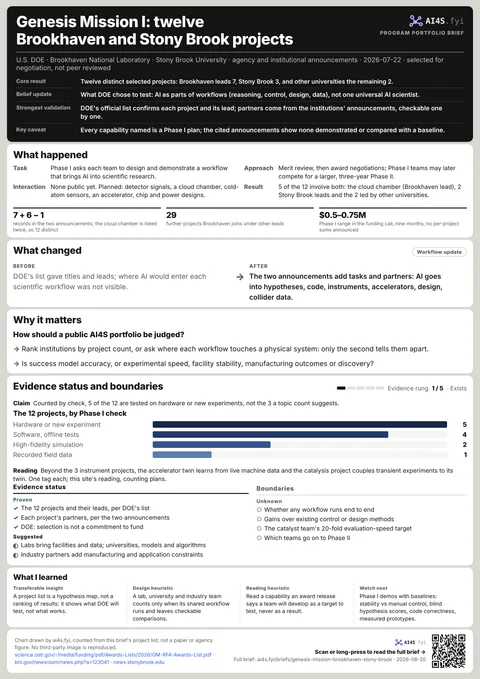
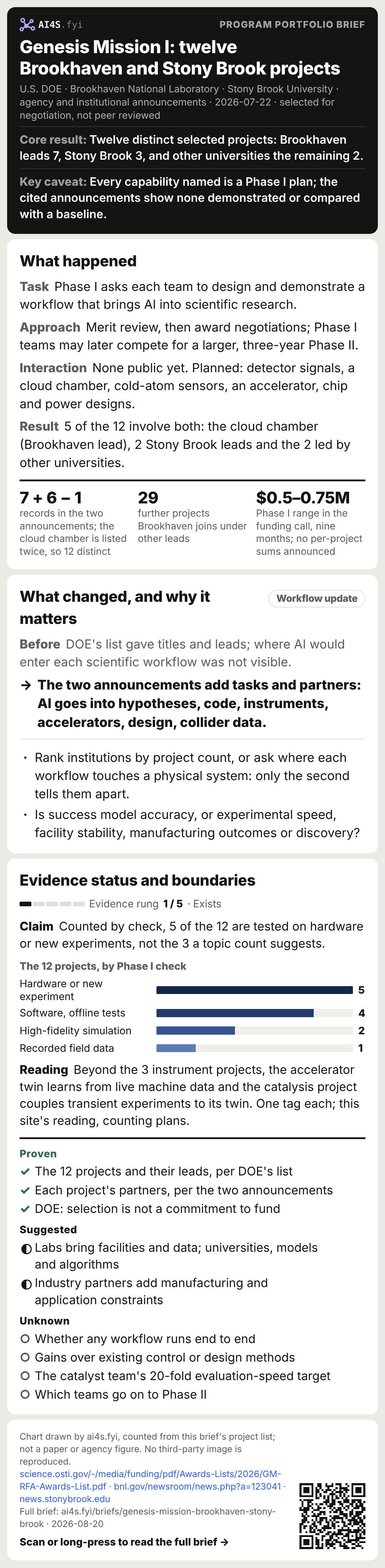
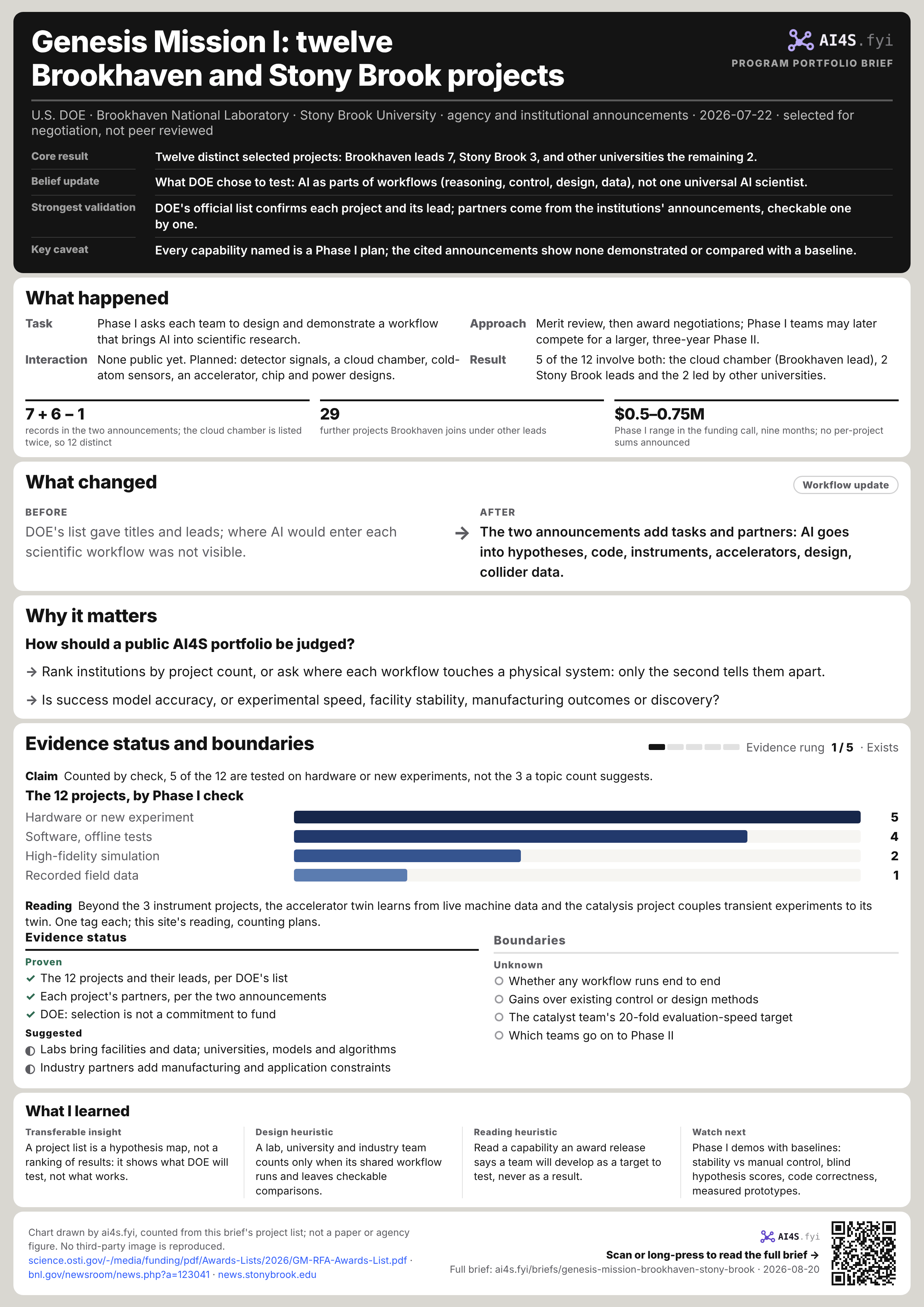
Twelve distinct selected projects: Brookhaven leads 7, Stony Brook 3, and other universities the remaining 2.
- Belief update
- What DOE chose to test: AI as parts of workflows (reasoning, control, design, data), not one universal AI scientist.
- Strongest validation
- DOE's official list confirms each project and its lead; partners come from the institutions' announcements, checkable one by one.
- Key caveat
- Every capability named is a Phase I plan; the cited announcements show none demonstrated or compared with a baseline.
01What happened
- Task
- Phase I asks each team to design and demonstrate a workflow that brings AI into scientific research.
- Approach
- Merit review, then award negotiations; Phase I teams may later compete for a larger, three-year Phase II.
- Interaction
- None public yet. Planned: detector signals, a cloud chamber, cold-atom sensors, an accelerator, chip and power designs.
- Result
- 5 of the 12 involve both: the cloud chamber (Brookhaven lead), 2 Stony Brook leads and the 2 led by other universities.
7 + 6 − 1records in the two announcements; the cloud chamber is listed twice, so 12 distinct
29further projects Brookhaven joins under other leads
$0.5–0.75MPhase I range in the funding call, nine months; no per-project sums announced
The most informative part of this portfolio is not the project count but where AI is being inserted into scientific work. The selections span hypothesis generation, scientific code and foundation models, then extend into sensor control, cloud chamber experiments, particle accelerators, chip design, catalyst research and collider computing infrastructure. The early Genesis Mission portfolio is therefore not only about training larger scientific models; it is also about connecting models to data, instruments and facilities. Yet selection for award negotiations means only that these directions passed this round of review. The public record mainly describes workflows that teams plan to design and demonstrate during Phase I, not systems already shown to work.
The 278 selections are first a map of research plans
On July 22, 2026, the U.S. Department of Energy announced 278 projects selected for Genesis Mission award negotiations. DOE or NNSA laboratories lead 87, universities lead 168, companies lead 19 and nonprofit organizations lead four, with 342 institutions participating. DOE explicitly states that selection is not a commitment to issue an award and that negotiations may still be cancelled.[S1]
Per the RFA, Phase I awards range from $500,000 to $750,000 over nine months, to design and demonstrate workflows that integrate AI into scientific research; Phase II awards range from $6 million to $15 million over three years. In FY 2026 teams could apply directly to either phase, and successful Phase I teams may compete for Phase II in later cycles. These sums are the range the RFA proposed, not amounts negotiated for these projects. The accurate status today is therefore selected for award negotiations, not funded and completed. Capabilities in the announcements are research targets to be tested, not established results.[S3]
Brookhaven is placing AI inside scientific facilities
Brookhaven National Laboratory leads seven Phase I projects and participates in another 29 led by other laboratories, universities and companies. Its lead portfolio spans an automated cloud chamber, multi-agent hypothesis generation, cold-atom quantum sensing, microelectronics co-design, collider computing infrastructure, a particle accelerator digital twin and composable foundation models.[S4][S5]
Stony Brook shows a different collaboration structure
Stony Brook University is associated with six selected projects. Three are led by its researchers: a transferable particle-tracking foundation model for nuclear physics, autonomous monitoring and recovery for radiation-tolerant readout electronics, and geometry-informed multiphysics co-design for wide-bandgap power modules; Brookhaven also takes part in the first two. In three other projects, Stony Brook participates under external leads in verifiable computational physics code generation, a catalyst digital twin and Brookhaven's automated cloud chamber; Brookhaven is also on the first two of those.[S7][S5][S2]
Reordering twelve distinct projects by workflow
The two institutional announcements contain thirteen participation records (seven Brookhaven leads, six Stony Brook projects), with the automated cloud chamber appearing once under each institution. They therefore represent twelve distinct projects. That is the count of distinct associated projects; counted by lead, it is Brookhaven 7, Stony Brook 3 and other universities 2, so the two do not lead all twelve. Grouping them by institution emphasizes counts; grouping them by workflow shows where AI is approaching the scientific system and what the next public result needs to establish.[S4][S7]
02What changed
Workflow updateDOE's list gave titles and leads; where AI would enter each scientific workflow was not visible.
The two announcements add tasks and partners: AI goes into hypotheses, code, instruments, accelerators, design, collider data.
Before
The DOE list mainly provided project titles and lead institutions
Bottleneck
It was unclear where AI entered each scientific workflow
What changed
Brookhaven and Stony Brook disclosures added roles and collaborations for twelve distinct projects
New bottleneck
Phase I workflow demonstrations and comparable metrics
What remains unsolved
Whether cross-institution interfaces work and improve experiments, facilities or scientific outcomes
What this portfolio changes in our understanding
The portfolio suggests that DOE's view of AI for Science extends beyond scientific question answering or candidate generation. Many selections target interfaces between models and real research systems: raw detector signals, real-time instrument control, experimental feedback, engineering constraints, and the data and computing layers beneath major facilities. AI appears here as a set of reasoning, control and feedback components inside workflows, not one universal AI Scientist that performs all research.
03Why it matters
How should a public AI4S portfolio be judged?
- Rank institutions by project count, or ask where each workflow touches a physical system: only the second tells them apart.
- Is success model accuracy, or experimental speed, facility stability, manufacturing outcomes or discovery?
That is why project counts are not yet a useful ranking of institutions. The differentiating questions are where each workflow touches a physical system, whether it generates new experimental data, whether feedback returns to the model, and whether success is measured by model accuracy or by experimental speed, facility stability, manufacturing outcomes or scientific discovery.
The portfolio suggests that national laboratories may contribute more than compute to AI for Science. They can offer scarce instruments, long-running operational data, real-time control environments and facilities that generate physical feedback. The cloud chamber, quantum sensor and accelerator digital twin make the connection between model output and physical state especially visible. Whether these interfaces outperform existing control methods in stability and reliability still requires direct comparison.
Five of the twelve involve both institutions. Brookhaven joins two projects led by Stony Brook, Stony Brook participates in Brookhaven's cloud chamber project, and both are on the participant lists of the two led by Johns Hopkins and Penn State. This reveals a division of labor worth tracking: national laboratories contribute facilities, operational environments and domain data; university teams contribute models, algorithms and engineering; some projects add companies such as GE Vernova and ExxonMobil to bring manufacturing or application constraints. The collaboration structure alone does not prove that research cycles will shorten. That requires evidence from the shared workflows themselves.[S7][S5]
04Evidence status and boundaries
Evidence rung 1 / 5 · ExistsEvidence status
Proven
- The 12 projects and their leads, per DOE's list
- Each project's partners, per the two announcements
- DOE: selection is not a commitment to fund
Boundaries
Suggested
- Labs bring facilities and data; universities, models and algorithms
- Industry partners add manufacturing and application constraints
Unknown
- Whether any workflow runs end to end
- Gains over existing control or design methods
- The catalyst team's 20-fold evaluation-speed target
- Which teams go on to Phase II
ClaimCounted by check, 5 of the 12 are tested on hardware or new experiments, not the 3 a topic count suggests.
The 12 projects, by Phase I check
ReadingBeyond the 3 instrument projects, the accelerator twin learns from live machine data and the catalysis project couples transient experiments to its twin. One tag each; this site's reading, counting plans.
Rung 1, Exists.
The public record is a selection list and institutional announcements describing workflows teams plan to build; nothing has yet been computed, measured or run on a facility. What can be confirmed is the selection and its scope, not that any of the technology works.[S1][S2]
By topic, scientific reasoning and software has four, design, simulation and digital twins four, instruments and physical control three, and data and computing infrastructure one. That is only the spread of topics; it does not show that just three projects meet physical feedback. The accelerator digital twin learns from live operating data and the catalyst digital twin is coupled to transient experiments (per Penn State's announcement), and both sit under design and digital twins. So the chart counts on a different axis: each project is tagged with what its Phase I work is checked against, one tag each, the most physical one named. Hardware or new experiments, five (cloud chamber, cold-atom sensing, readout electronics, accelerator, catalysis); software and offline tests, four (MARS, composable foundation models, code synthesis, collider computing); high-fidelity simulation, two (chip EDA, power modules); recorded field data, one (particle tracking). Both counts come from this article's project table and are this site's grouping, not one the institutions published; the tags for projects Stony Brook leads or joins rest on the DOE list's titles and Stony Brook's announcement. The project list itself is the DOE awards list.[S2][S4][S7][S6]
05What I learned
- Transferable insight
- A project list is a hypothesis map, not a ranking of results: it shows what DOE will test, not what works.
- Design heuristic
- A lab, university and industry team counts only when its shared workflow runs and leaves checkable comparisons.
- Reading heuristic
- Read a capability an award release says a team will develop as a target to test, never as a result.
- Watch next
- Phase I demos with baselines: stability vs manual control, blind hypothesis scores, code correctness, measured prototypes.
A project list is a hypothesis map, not a ranking of results
Reordering projects by workflow rather than institutional count makes it easier to see where AI enters raw signals, instrument control, engineering design and data infrastructure. Selection shows what DOE is willing to test, not what has already worked.
Collaboration matters only when the shared workflow runs
National-lab facilities and data, university algorithms and engineering, and industry manufacturing constraints look complementary. The evidence is still whether an end-to-end task runs reliably and produces checkable comparisons.
The next evidence matters more than the project count
During the next nine months, the useful evidence will be workflow demonstrations, comparison baselines, data sets, software, papers and results from operating facilities. Cloud chamber and quantum sensing projects need stability and repeatability. Hypothesis and code projects need blinded evaluation, correctness and transfer. Digital twins and engineering design projects need predictions that survive contact with hardware, manufacturing or live operations.
As those results appear, this portfolio can move from showing what DOE is willing to explore to showing which AI4S workflows actually work. Until then, the selections outline routes toward technical validation; they do not complete it.
As one imageTo save and share→Sources
Factual claims link to original announcements, project lists, trial records or journal papers where possible. Research plans are kept separate from completed results.
- S1First 278 Genesis Mission projects selectedU.S. Department of Energy · 2026.07.22 · Government program announcement
- S2Official list of 278 Genesis Mission RFA selectionsDOE Office of Science · 2026.07.22 · Official project list
- S3Genesis Mission Phase I and Phase II funding frameworkU.S. Department of Energy · 2026.03.17 · Government RFA announcement
- S4Brookhaven selected to lead seven Genesis Mission projectsBrookhaven National Laboratory · 2026.07.22 · Institutional announcement
- S5Thirty-six Genesis Mission projects involving BrookhavenBrookhaven National Laboratory · 2026.07.22 · Institutional project relationship list
- S6Penn State scientists to lead three Genesis Mission projectsPenn State University · 2026.07.23 · Institutional announcement
- S7Six Genesis Mission projects led by or involving Stony BrookStony Brook University · 2026.07.22 · Institutional announcement